Uncategorized

Messages from my Mother

The size of the networks of solidarity expressing and providing support to Ukrainian refugees is another sign of the capacity of human populations to come together to share their feelings and act upon them. When we open our hearts to the other, individual or collective, human or more-than-human, we are apparently able to reverse years of injustice.

Let us take good note, as Gaia teaches us how to come together. Whilst we fight opinion wars around the scary viruses and the dark oils she produces from her bowels, we are coming together through networking. We are developing the capacity to respond en masse to disaster. We are developing resilience as we slowly come to realise that we need to drop what we are doing to run helter-skelter to the bedside of our sick Mother.

Aaah, here you are, she smiles. I Knew you would come! So you took me for granted, did you?, she cries. As Mother squeezes black oil out of her body, she moans, Can you not see me crying!?

Although our planet shows signs of illness daily with unbalanced ecosystems, biodiversity loss and climate change, she is widely ignored. So, she sent a message for all to receive, from the tyrants of the Kremlin to the humblest Amazonian tribesmen, one that at the core of our ego, one that can threaten our life if we ignore it. This hyper-sophisticated virus carries varying ethos-changing messages for all, whether awoken by fear of suffering, or toppled into passionate love for life, no-one has been left unshaken. Have we heard her plea now? Can we decrypt and put to good use the information we received as individuals, who are also part of the human collective and part and parcel of the Earth? As first world refugees are in the spotlight, do we remember the hunger-stuck refugees who have been huddling in tents in the desert for years? As we breathe through plastic ventilators or clad our beautiful faces with plastic masks, do we remember how our bodies deserve to be fed and cared for, the bodies that our Mother gave us?

Our collective Pain for the World is breaking free now so that we can prioritise and get our response armies trained and organised… Yet, can we feel the urgency in the ecological unravelling that we still perceive as intangible? Surely, yes! If we are able to feel pangs of solidarity in response to these recent crises, even at a distance, our fingers brushing our screens, we must be reviving the muscles of our natural response to danger, we must be noting that it is all connected. And when our fingers brush the leaves, our eyes sweep the horizon, our hearts will open to the realisation that we Knew, we always Knew, that this is why we are here. Close to eight billion individuals have a role to play, with two hundred thousand newcomers daily. We have been called to be a part of the Great Turning.

Let us pick up our weapons of compassion now.

©Artwork by Amanda Vela

Uncategorized

The United Nations “Climate Change 2022” report has been published and globally unnoticed

by Joanna Tomkins, sharing a press release from IPCC

Whilst the public eye is riveted on the events Russia, has this important document received the attention it deserves?

Climate change: a threat to human wellbeing and health of the planet.

Taking action now can secure our future“.

BERLIN, Feb 28 – Human-induced climate change is causing dangerous and widespread disruption in nature and affecting the lives of billions of people around the world, despite efforts to reduce the risks. People and ecosystems least able to cope are being hardest hit, said scientists in the latest Intergovernmental Panel on Climate Change (IPCC) report, released today.

“This report is a dire warning about the consequences of inaction,” said Hoesung Lee, Chair of the IPCC. “It shows that climate change is a grave and mounting threat to our wellbeing and a healthy planet. Our actions today will shape how people adapt and nature responds to increasing climate risks.”

The world faces unavoidable multiple climate hazards over the next two decades with global warming of 1.5°C (2.7°F). Even temporarily exceeding this warming level will result in additional severe impacts, some of which will be irreversible. Risks for society will increase, including to infrastructure and low-lying coastal settlements.

The Summary for Policymakers of the IPCC Working Group II report, Climate Change 2022: Impacts, Adaptation and Vulnerability was approved on Sunday, February 27 2022, by 195 member governments of the IPCC, through a virtual approval session that was held over two weeks starting on February 14.

Urgent action required to deal with increasing risks

Increased heatwaves, droughts and floods are already exceeding plants’ and animals’ tolerance thresholds, driving mass mortalities in species such as trees and corals. These weather extremes are occurring simultaneously, causing cascading impacts that are increasingly difficult to manage. They have exposed millions of people to acute food and water insecurity, especially in Africa, Asia, Central and South America, on Small Islands and in the Arctic.

To avoid mounting loss of life, biodiversity and infrastructure, ambitious, accelerated action is required to adapt to climate change, at the same time as making rapid, deep cuts in greenhouse gas emissions. So far, progress on adaptation is uneven and there are increasing gaps between action taken and what is needed to deal with the increasing risks, the new report finds. These gaps are largest among lower-income populations. 

The Working Group II report is the second instalment of the IPCC’s Sixth Assessment Report (AR6), which will be completed this year.

“This report recognizes the interdependence of climate, biodiversity and people and integrates natural, social and economic sciences more strongly than earlier IPCC assessments,” said Hoesung Lee, the Chair of the Intergovernmental Panel on Climate Change (IPCC). “It emphasizes the urgency of immediate and more ambitious action to address climate risks. Half measures are no longer an option.”

To access the report, you may use the following link:

https://www.ipcc.ch/report/ar6/wg2/

Uncategorized

A “Buddha of our time” passed away on 22nd January 2022 at 00:00

A great influencer in my life and that of many of my family members, his books have been at my bedside for over 20 years now.

I wish to honour Thich Nhat Hahn today by sharing the resources hereunder so that you can participate in the knowing and in the commemorating of this wonderful being.

The first article by the buddhist review Tricycle gives a good overview of his influence and the second two links will take you to the Plum Village website, where all memorial services and ceremonies during this week of commemoration, as well as other meditations and practices – throughout the year – are available for his disciples and followers.

Sending prayers for the peaceful passing of this great man.

– by Joanna Tomkins

Uncategorized

The Council of All Beings, by Joanna Macy

The Council of All Beings is a communal ritual in which participants step aside from their human identity and speak on behalf of another life-form. A simple structure for spontaneous expression, it aims to heighten awareness of our interdependence in the living body of Earth, and to strengthen our commitment to defend it. The ritual serves to help us acknowledge and give voice to the suffering of our world. It also serves, in equal measure, to help us experience the beauty and power of our interconnectedness with all life.

HISTORY

The form originated in Australia in early 1985, when I was on a workshop tour bringing group practices to sustain social and environmental activists. One day after a weekend workshop, John Seed, founder of the Rainforest Information Center, took me to one of the last vestiges of his continent’s primordial forests, saved from the timber companies by blockades mounted by John and other local protesters. On that excursion John and I discovered that we shared a passionate interest in deep ecology and the writings of Norwegian philosopher Arne Naess about the “ecological self.” As Buddhists, we both resonated with these concepts, finding them close to the Buddha’s core teaching on the interdependence of all life. John expressed the wish that my workshops include a “deep ecological” group experience to directly challenge the anthropocentrism of industrial society.

So together, that day, we invented the Council of All Beings. It was introduced shortly afterwards, in the course of the weeklong training that culminated my workshop tour. At a camp north of Sydney, on huge flat rocks by a waterfall, some forty people took part. And soon they were taking the ritual back with them to their local communities.

Within a year, by word of mouth–and through John’s and my travels– the Council of All Beings spread to North America, Western Europe, and Japan. From the Grand Canyon to the banks of the Rhine, in redwood groves and classrooms and church basements, people were gathering to shed their personae as humans and give voice to the plight of the Earth. They spoke as whale and wolf and wind, aspen and marsh and any other nonhuman they felt called to represent.

Articles about the ritual soon appeared in a variety of publications, and by 1988 a book by us both, with Arne Naess and Pat Fleming (Thinking Like a Mountain: Towards a Council of All Beings) carried the practice more widely, especially among activists, religious groups, and environmental educators. These publications helped people from different cultures and walks of life to guide the Councils in a recognizably consistent fashion.

DESCRIPTION

As the practice spread, the name “Council of All Beings” came to be used in two ways: to refer to the ritual itself, and also to refer to the workshop or gathering in which it is held, and which includes closely related processes. Since two of these related processes are considered by many to be important, if not essential, to the experience as a whole, they are included in the following description.

The Mourning

The interdependence of all life remains just a mental concept, without power to affect our attitudes and behaviors, unless it takes on some emotional reality. We need to feel it, and our capacity to feel is stunted, if we block out the pain within us over what is happening to our world. Furthermore, if we proceed to take part in the Council per se, speaking on behalf of other life-forms, without first acknowledging our sorrow for what other beings are suffering at human hands, we risk being superficial, even presumptuous.

Here we use “mourning” as a generic term for the expression of moral pain for what humans are inflicting on the natural world. This pain for the world includes not only grief, but fear, anger, and despair as well. Because these emotions are not encouraged in conventional society, and because they reveal the truth of our interconnectedness with all life, we allow them full play.

For the Mourning, a variety of forms have evolved, in which people feel both safe and free in expressing and releasing their pain for the world. The methods I like best are simple ones: a recitation of the names of endangered species, with drum beat and pauses for people to name what is disappearing from their lives today. Or the Cairn of Mourning, where, gathered in a circle, people move to the center, one by one, and place a stone. Each stone represents a loss that has occurred or is occurring. As it is brought forward, the loss is described: a family farm replaced by a shopping mall, a fishing stream polluted or paved over, clean air, safe food…

Reconnecting us with our capacity to care, such ritual namings of the losses brought by our industrial culture serve as an antidote to the pervasive psychic numbing this culture incurs. They also serve to awaken us to the interconnectedness of all life forms, our deep ecology. I have come to see deep ecology as an explanatory principle both for the pain we experience on behalf of the natural world, and for the sense of belonging that arises when we stop repressing that pain.

Remembering

Our connections with other life-forms are based not only on emotional attachments to places and beings we have loved. They are also organic, woven by shared ancestries, embedded in our bodies. Each atom in each molecule of our being goes back to the beginning of life, and has belonged to far more ancient and varied forms of life than our own. The human form we now wear is just the latest and briefest chapter of a long evolutionary journey. In the Remembering, we consciously own this ancient kinship so that, when the time comes to speak for other life-forms, we can do so a greater sense of naturalness and authenticity.

Also known as “evolutionary remembering”, this experiential process guides the imagination while drawing on multiple senses and inner body knowings. It sets our present-day, hurried lives within larger contexts of time. On occasion, the Remembering extends back to the beginning of space and time, drawing on texts such as The Universe Story by Thomas Berry and Brian Swimme, and ritual adaptations by such teacher-practitioners as Sr. Miriam MacGillis. But as a preparatory stage to the Council of All Beings, we usually focus on “our life as Gaia;” it is easier to feel with our bodies, and we have already done it in our mother’s womb. Just as, in utero, we physically recapitulated the evolution of cellular life, so now we attempt to do it consciously, harnessing intellect and imagination.

Instead of relying on words alone, sound and movement help us to “remember.” A heartbeat on a drum, evoking life’s rhythms, as it pumps our blood, breathes through our lungs, can take us back through time, helping us imagine we can recall the adventures of our four and a half billion years. Our evolutionary journey can also be explored through bodily movement, even the barest of motions. Nosing, crawling, wriggling, pushing up, we imaginatively feel our way into the inner body sense of fish and amphibian and reptile, life stages still embedded in our neurological system.

As your memory improves, as the implications of evolution and ecology are internalized and replace outmoded anthropocentric structures in your mind, there is an identification with all life. Then follows the realization that the distinction between ‘life’ and ‘lifeless’ is a human construct. Every atom in this body existed before organic life emerged. Remember our childhood as minerals, as lava, as rocks? John Seed.

The expanses of time evoked by the Remembering remind us that the industrial growth society is a temporary episode–and that in order to move beyond it now, we can draw on a more deeply rooted legacy. Respect and gratitude arise for our forebears’ capacity to weather adversity and to respond collectively and creatively to enormous challenges. The process helps us to believe that these capacities have not forsaken us, and to draw on them now at this crisis point for life on Earth.

In my years of experiencing and guiding this process, I have seen how it strengthens us to act in defense of Earth and Earth’s beings. It helps us act, not from the whim or nobility of our short-lived individual ego, but clothed in the authority of our four and a half billion years. We start learning to act our age.

Speaking for Other Life-Forms

This is the Council of All Beings per se, enhanced, when time permits, by the preparatory practices described above.

The beings that co-exist with us in the web of life are profoundly affected by our actions, yet they have no hearing in our human deliberations and policies, no voice to call us to account. The Council of All Beings gives them a voice–and because it is our own as well, it can change the ways we see and think.

Participants begin by letting themselves be chosen by another life-form, be it animal, plant, or natural feature like swamp or desert. We use the passive verb, be chosen, in order to encourage people to go with what first intuitively occurs to them, rather than selecting an object of previous study. This way our minds are more receptive and humble, more open to surprise. When out-of-doors, we can wander off alone to happen on the identity we will assume. When indoors, some quiet moments suffice, as we relax and wait with an open, non-discursive mind for the imagined presence of another life-form. Then we take time to behold this life-form in our mind’s eye, bestowing upon it fullness of attention, imagining its rhythms and pleasures and needs. Respectfully, silently, we ask its permission to speak for it in the Council of All Beings.

If time allows and supplies are available, we make simple masks, working together in companionable silence with paper and paints, twigs and leaves. Then, briefly clustering in small groups, we practice taking on the identity of our chosen life-form. This helps us let go of our self-consciousness as humans, and become more at ease in imagining a very different perspective on life.

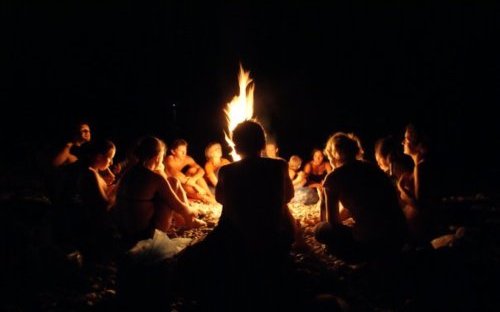
Then, with due formality, the participants assemble in a circle and the Council of All Beings commences. To create a sense of sacred space, prayers and invocations are spoken. Native American practices, such as smudging with sage or cedar, and calling in the blessings of the four directions, are often used here to good effect. When I am the guide, and speaking, of course, as my adopted life-form, I like to begin the proceedings by inviting the beings to identify themselves in turn, a kind of roll call: Wolf is here, I speak for all wolves. I am Wild Goose; I speak for all migratory birds.

Welcoming them all, I thank them for coming, and, with some solemnity, set the theme for our deliberations. “We meet in council because our planet is in trouble; our lives and our ancient ways are endangered. It is fitting that we confer, for there is much now that needs to be said and much that needs to be heard.”

The council unfolds in three consecutive stages. First, the beings address each other, telling of the changes and hardships they are experiencing in these present times.

The shells of my eggs are so thin and brittle now, they break before my young are ready to hatch.”

“I’m tightly crowded in a dark place, far from grass and standing in my own shit. My calves are taken from me, and instead cold machines are clamped to my teats. I call and call for my young. Where did they go? What happened to them”

“As Lichen, I turn rock into soil. I worked as the glaciers retreated, as other life-forms came and went. I thought nothing could stop my work; but now I’m being poisoned by acid rain.”

The second stage of the Council begins after most have spoken, and the guide invites humans into the center. Since it is clear that one young species is at the root of all this trouble, its representatives should be present to hear these testimonies. So, a few at a time, the beings put aside their masks and move to sit for a while, as humans, in the middle of the circle. The other life-forms now speak to them directly.

“For millions of years we’ve raised our young, rich in our ways and wisdom. Now our days are numbered because of what you are doing. Be still for once, and listen to us.”

“See my possum hand, humans? It resembles yours. From its print on the soft soil you can tell where I have passed. What mark on Earth will you leave behind you?”

“Humans! I am Mountain speaking. For millennia your ancestors venerated my holy places. Now you dig and gouge for the ore in my veins. Clearcutting my forests, you take away my capacity to hold water and release it slowly. See the silted rivers? See the floods? In destroyng me, you will destroy yourselves.”

The first time I sat in the center, a human in the presence of other life-forms, I felt stripped. I wanted to protest. ‘I’m different than the logging and mining executives, the multinational CEOs, and the consumers addicted to shopping,’ I wanted to say. ‘I am a caring human; I meditate and recycle and teach deep ecology.’

But because I was not permitted to speak, these words began to evaporate in my mind. I saw them soon as essentially irrelevant. The deep ecology that had so lured me with its affirmation of our interconnectedness with other species now forced me to acknowledge my embeddedness in my own. If I was linked to the wild goose and the lichen, I was far more linked to the investment speculators and compulsive shoppers. Shared accountability sank in, leaching away any sense of moral immunity.

Then, as the others did, I moved back to the periphery, to see and speak from that wider context. From here I could see more clearly than before the isolation in which humans imagine themselves to exist, and the fear and greed than can seize them.

In the third stage of the Council, the other life-forms offer gifts to the humans. Recognizing how dependent they have become on humankind, they would help this young species deal with the crisis it has created. As ritual guide I might cue this stage by saying, “Many humans now realize the destruction they are causing; they feel overwhelmed and powerless in the face of the forces they have unleashed. Yet our fate is in their hands. O fellow-beings, what strengths of ours can we share with them, what powers can we lend them?” With this invitation, the beings in the Council begin spontaneously to offer their own particular qualities and capacities.

“I, Lichen, work slowly, very slowly. Time is my friend. This is what I give you, humans: patience and perseverance.”

“I, Condorgive you my keen, far-seeing eye. Use that power to look ahead beyond your daily distractions, to heed what you see and plan.”

One after another the beings offer their particular powers to the humans in the center. After speaking, each leaves its mask in the outer circle and joins the humans in the middle, receiving the gifts still to be given.

“As Mountain, I offer you humans my solidity and deep peace. Come to me to rest, to dream. Without dreams you lose your vision and hope. Come, too, for my strength and steadfastness, whenever you need them.”

“As Leaf, I would free you humans from your fear of death. My dropping, crumbling, molding allows fresh growth. If you were less afraid of death, you would be readier to live.”

These gifts reside already in the human spirit, as seeds within the psyche; otherwise they could not be spoken. Their naming brings forth a sense of wholeness and glad possibility. When all of them have been offered, the Council of All Beings is formally concluded. Then the assembled often break into singing, drumming, exultant dancing–releasing energy after the long, attentive listening. Sometimes the group just sits in stillness, silently absorbing what has been learned or writing in journals.

Care is taken to thank the life-forms, who have spoken through us, and to dispose of the masks in a deliberate fashion. The masks may be formally burned, or hung on a tree or wall, or taken home with us as symbolic reminders of the ritual. On occasion, at the close of a Council, wanting to stay identified with the other life-forms, we fancy that we are putting on human masks, the better to work for them as we re-enter the world of the two-leggeds.

REFLECTIONS AND APPLICATIONS

The Councils of All Beings, that I have personally experienced, number in the hundreds by now. I can think of nothing I would give in exchange for them–nothing that equals their mixture of laughter, tears, and eloquence, or that can replace the spontaneous insights they engender. Sometimes, as I start to offer the ritual, I fear that people will reject it as beneath their dignity, as childish or a waste of their valuable time. But in each case, when I proceed with quiet confidence, the outcome is similar. Whether in Nebraska or Germany, Russia or Japan, people seem ready and able to step free from their human roles, if only for an hour or two, and give voice to wider, more ancient knowings.

The quality and effectiveness of these rituals vary widely, of course. Because there is no required training for the guide, or “quality control,” they can, on occasion, become diffuse, distracted, even boring. Yet, by and large, there is something irreplaceable that happens in the simple act of taking on–or even attempting to take on–the persona and perspective of another life form. It is basically an act of humility and generosity. It moves the self-important ego from stage center, and sheds a fresh light on even the most ordinary elements of life.

According to theologian Thomas Berry in The Dream of the Earth, the “shamanic personality,” which can understand and speak for other life-forms, is essential to our survival. It helps us to break free from our culture’s anthropocentrism and dispel the trance of industrial civilization. The life-giving powers shaping creation from the beginning of time are still present within us, Berry writes. They exist as “deep spontaneities,” accessible through the imagination.

The Council of All Beings has shown it can evoke these deep spontaneities. Here no fasting or drugs or arduous disciplines are needed to awaken the inner shaman. The Council does not claim to involve channeling or shapeshifting, or to engage any capacities beyond the moral imagination. All that is required is clear intention; it is like opening a door in the mind and walking through. At times people do experience another voice “coming through” that is beyond any conscious editing on their part. This is not surprising, given the close relation of this work to the shamanic experience.

While the processes described above require a measure of uninterrupted time–a few hours for the ritual circle itself, a full day or two with the related practices– briefer applications have evolved. In church services and celebrations of the mass, abridged versions of the Council of All Beings have, on many occasions, functioned as the sermon or liturgy of the word. As enrichment to environmental education, the Council has occurred in countless settings, from elementary and high school classrooms to graduate schools of architecture and urban planning, where students speak for the flora and fauna affected by a building project they are designing. Inspired by their experience of the Council, concerned citizens in several countries have appeared at public hearings on waste disposal and mining, lumber, and other resource extraction projects; and, with or without masks, they have testified on behalf of the non-human dimensions of life these plans will affect. People are also choosing to represent our fellow-species as listening presences in community meetings, and marchers in town parades. All these current practices attest to our readiness and capacity to break through our society’s anthropocentrism, and give expression to the ecological self.

Joanna Macy, Ph.D. is an ecophilosopher grounded in Buddhism and living systems theory, who works worldwide with movements for peace, justice, and ecological sanity. Her books include World as Lover, World as Self and Mutual Causality in Buddhism and General Systems Theory. Her website is http://www.joannamacy.net.
Uncategorized

The Bodhisattva Vows

Joanna Macy refers to ecological activists as “Bodhisattvas”, what does that mean?

It doesn’t matter how much you do, and in which of the dimensions of the Great Turning you are engaged in, but if you are reading this post, you are most probably a Bodhisattva.

Bodhisattva (which can be approximately translated as “Awakened to Truth” or “Enlightened Being”) refers to saviour-like figures found in Mahayana Buddhism, famous for embodying compassion and other noble qualities.

Their motivation seeks to aid all beings, rather than themselves. Their goal is complete enlightenment for all instead of extinguishing merely their own suffering.

In the context of the Great Turning, you are a Bodhisattva even if your acts of activism are small and you don’t even know it or give credit to yourself. If you vow purposes, which are higher than yourself, every act of not doing, doing, or undoing, each step you take, follows the path of the Buddha. You are taking part in an engaged form of Buddhism that does not move away from the suffering of our world, but actively seeks to end it for all beings, human and other-than-human. Your engagements can be as seemingly small as for example sharing your tools, recycling your waste, relearning and restoring the cycles of nature, speaking the truth, advocating for regeneration in all areas of the web of life, not buying GMO… Or they can be as big as green building a house that is self sustainable – and even gives back to the Earth resources that it is built with and upon-, leading holding actions to lobby destructive corporate initiatives before they come into poisonous fruition, or leading spiritual retreats to help people reconnect with themselves and their greater ecological body. Whatever the route of your activism, you are a Bodhisattva.

Bodhisattvas see sunyata, or emptiness, as the deepest truth. The theme of “śūnyatā” emerged from the Buddhist doctrines of Anatta (nonexistence of the self) and Pratitya-samutpada (Interdependent Arising). 

Far from nihilism, śūnyatā inspires us to recognise our interbeing with all species and our planet, and that in separateness we do not exist.

The Mayahana doctrines that Joanna Macy has build the WTR upon are further reinforced and complemented with the knowledge of Systems Thinking and the principles of Deep Ecology too. The whole is bigger than the sum of the parts of course and we are a small part of the huge, bigger-than-life-, web of life.

So whenever you take a step as Bodhisattva, you are acting as Gaia, along with millions of Bodhisattva warriors and through those acts we all play a crucial role in the Great Turning to a life sustainable society.

Uncategorized

The Power of the Regenerative Movement

Focusing on regeneration in all aspects of life is a truly possible solution to the mess that we are in. From an economical perspective, in the Business as Usual set up, there are more companies who realise today that higher long term benefits will be reaped by investing in soils instead of pesticides, investing in community cohesion instead of privileged elites, investing in nutritious food and not in pharma, etc. On an individual scale, we are awakening to the reality that we can regenerate our mind and our gut, by respectively introducing awareness practices in our lives and by buying and growing alive foods.

Triggered by the mediatising of global, polarising medico-political debates, major ideological shifts are planting roots in our society in opposing directions. It seems that all Three Dimensions of the Great Turning are being accelerated. Although pharma is churning out more products and plastic masks are getting tangled in the feet of our already compromised wild birds, individuals are also realising that it is time to reclaim sovereignty over our lives.

For some – as for Vandana Shiva in the video added to this post – increased digitalisation has placed digital barons in a position of dictators, ready to their rules to control. For others, work online and the availability of educational material and live video material has allowed for new forms of expression. Part of the ongoing Shift in Consciousness is happening online through healing modalities, podcasts and blogs, but this does come at the cost of disconnecting us from the Earth and from a much needed, hands-on Regenerative Movement.

After such a long pause, we are all capitalising our hopes on these shifts, in one way or another, awaiting to see a clear picture of our future when the dust settles. But it’s important to act so that these shifts bring us closer to authentic connection to our community and our planet. Are we ready to represent Mother Earth above ourselves and as part of ourselves? Can we focus on deep time, thinking 7 generations back and 7 generations forward, like our indigenous ancestors knew?

We can regenerate dignified lifestyles, where we truly honour ourselves collectively as a society of sovereign beings and as organs of the Earth. Borrowing the terminology that Joanna Macy uses to determine the 3 dimensions of the Great Turning, we need to focus to help birth a radical Shift in Consciousness and like Vandana Shiva, we can also engage and support the Holding Actions that can buy us time to do so – all to varying degrees. And importantly, we can exponentially carve out time from our imposed work schedules to dedicate our lives to Sustainable Practices that are honouring of a self affirming Interconnectedness.

In this recent talk, Dr Vandana Shiva warns us about a Digital Dictatorship that threatens our sovereignty.

Uncategorized

10 Episode Podcast “Coming Back to Life” complete

You can now listen to the full podcast “Coming Back to Life, Readings and Practices” by Joanna Tomkins on Spotify and other platforms such as Apple Podcasts, Google Podcasts, etc…

It is also being released on the meditation app Insight Timer.

Episode 1 to 6 deliver excerpts of the teachings contained in the book Coming Back to Life by Joanna Macy and Molly Young Brown, formatted into sequences that allow for an easy listening. It’s a practical tool for beginners to receive their first introduction to the concepts at the base of the Work that Reconnects.

The intention of this podcast is to encourage listeners to dig deeper into the Work, maybe looking for a physical workshop taking place close to them, or reading the books that are introduced here.

Episodes 7 to 10 include some practices around the 4 stages of the Spiral, writing exercises, poems and meditations.

Uncategorized

Trusting the Spiral of the Work that Reconnects

Extracts from the book Active Hope, by Joanna Macy and Chris Johnstone

THE THREAD OF THE SPIRAL OF THE WORK THAT RECONNECTS

“The spiral of the Work That Reconnects is something we can come back to again and again as a source of strength and fresh insights. It reminds us that we are larger, stronger, deeper, and more creative than we have been brought up to believe. It maps out an empowerment process that journeys through four successive movements, or stations, described as Coming from Gratitude, Honoring Our Pain for the World, Seeing with New Eyes, and Going Forth.

When we come from gratitude, we become more present to the wonder of being alive in this amazing living world, to the many gifts we receive, to the beauty we appreciate. Yet the very act of looking at what we love and value in our world brings with it an awareness of the vast violation under way, the despoliation and unraveling. From gratitude we naturally flow to honoring our pain for the world.

Coming from gratitude helps build a context of trust and psychological buoyancy that supports us to face difficult realities in the second phase. Dedicating time and attention to honoring our pain for the world ensures that there is space to hear our sorrow, grief, outrage, and any other feelings revealing themselves in response to what is happening to our world. Admitting the depths of our anguish, even to ourselves, takes us into culturally forbidden territory. From an early age we’ve been told to pull ourselves together, to cheer up or shut up. By honoring our pain for the world, we break through the taboos that silence our distress. When the activating siren of inner alarm is no longer muffled or shut out, something gets switched on inside us. It is our survival response.

The term honoring implies a respectful welcoming, where we recognize the value of something. Our pain for the world not only alerts us to danger but also reveals our profound caring. And this caring derives from our interconnectedness with all life. We need not fear it.

In the third stage, we step further into the perceptual shift that recognizes our pain for the world as a healthy expression of our belonging to life. Seeing with new eyes reveals the wider web of resources available to us through our rootedness within a deeper, ecological self. This third stage draws on insights from holistic science and ancient spiritual wisdom, as well as from our creative imaginations. It opens us to a new view of what is possible and a new understanding of our power to make a difference.

To experience the benefits of these empowering perspectives, we want to apply them to the task of addressing the challenges we face. The final station, Going Forth, involves clarifying our vision of how we can act for the healing of our world, identifying practical steps that move our vision forward.

The spiral offers a transformational journey that deepens our capacity to act for the sake of life on Earth. We call it a spiral rather than a cycle because every time we move through the four stations we experience them differently. “Each element reconnects us with our world, and each encounter can surprise us with hidden gems. As each station naturally unfolds into the next, a momentum and a flow build up, allowing the four elements to work together to form a whole that is more than the sum of its parts. As we allow ourselves to be guided by this spiral form, it isn’t just us acting; we are letting the world act on us and through us.”

THE WORK THAT RECONNECTS AS A PERSONAL PRACTICE

“The spiral provides a structure we can fall back on, and into, whenever we need to tap into the resilience and resourcefulness arising from the larger web of life. If you’re feeling sickened by a disturbing news report, you can step into gratitude simply by focusing on your breath and taking a moment to give thanks for whatever may be sustaining you in that moment. As you feel the air entering your nostrils, give thanks for oxygen, for your lungs, for all that brings you to life. The question, “To whom am I grateful?” moves your attention beyond yourself to those you receive from, those who support you.

A moment of gratitude strengthens your capacity to look at, rather than turn away from, disturbing information. As you allow yourself to take in whatever you see, allow yourself also to feel whatever you feel. When you experience pain for something beyond your immediate self-interest, this reveals your caring, compassion, and connection — such precious things. By honoring your pain for the world, in whatever form it takes, you take it seriously and allow the signal it brings to rouse you.

When seeing with new eyes, you know that it isn’t just you facing this. You are just one part of a much larger story, a continuing stream of life on Earth that has flowed for more than three and a half billion years and that has survived five mass extinctions. When you sink into this deeper, stronger flow and experience yourself as part of it, a different set of possibilities emerges. Widening your vision increases the resources available to you, since through the same channels of connectedness that pain for the world flows, so also do strength, courage, renewed determination, and the help of allies.

With the shift of perception that seeing with new eyes brings, you can let go of feeling you need to sort everything out. Instead you focus on finding and playing your part, offering your gift of Active Hope, your best contribution to the healing of our world. As you move into going forth, you consider what this might be, and what your next step will be. Then you take that step.

What we’ve described here is a short form of the spiral that might only take a few minutes to move round. Like a fractal that has the same characteristic shape whatever scale it is viewed at, the form of the spiral can be applied to a wide range of time frames, with rotations happening over minutes, hours, days, or weeks. We move through the four stations in a way that supports our intention to act for the sake of life on Earth. The more familiar you become with this strengthening journey, the more you can trust the spiral structure process. Each of these stations contains hidden depths, rich meaning, and treasures to explore. It is to these that we turn in the chapters ahead.”

Uncategorized

Greening the Self

Changing the way we can experience our self is the most important thing we can do to navigate ecological crisis

Something important is happening in our world that you are not going to read about in the newspapers. I consider it the most fascinating and hopeful development of our time, and it is one of the reasons I am so glad to be alive today. It has to do with what is occurring to the notion of the self.

The self is the metaphoric construct of identity and agency, the hypothetical piece of turf on which we construct our strategies for survival, the notion around which we focus our instincts for self-preservation, our needs for self-approval, and the boundaries of our self-interest. Something is shifting here.

Widening our self-interest

The conventional notion of the self with which we have been raised and to which we have been conditioned by mainstream culture is being undermined. What Alan Watts called “the skin-encapsulated ego” and Gregory Bateson referred to as “the epistemological error of Occidental civilization’ is being unhinged, peeled off. It is being replaced by wider constructs of identity and self-interest – by what you might call the ecological self or the eco-self, co-extensive with other beings and the life of our planet. It is what I will call “the greening of the self.”

Greening self touching tree
BEING CO-EXTENSIVE WITH OTHER BEINGS AND THE LIFE OF OUR PLANET

At a recent lecture on a college campus, I gave the students examples of activities which are currently being undertaken in defense of life on Earth-actions in which people risk their comfort and even their lives to protect other species. In the Chipko, or tree-hugging, movement in north India, for example, villagers fight the deforestation of their remaining woodlands. On the open seas, Greenpeace activists are intervening to protect marine mammals from slaughter. After that talk, I received a letter from a student I’ll call Michael. He wrote:

I think of the tree-huggers hugging my trunk, blocking the chainsaws with their bodies. I feel their fingers digging into my bark to stop the steel and let me breathe. I hear the bodhisattvas in their rubber boats as they put themselves between the harpoons and me, so I can escape to the depths of the sea. I give thanks for your life and mine, and for life itself. I give thanks for realizing that I too have the powers of the tree-huggers and the bodhisattvas.

What is striking about Michael’s words is the shift in identification. Michael is able to extend his sense of self to encompass the self of the tree and of the whale. Tree and whale are no longer removed, separate, disposable objects pertaining to a world “out there”; they are intrinsic to his own vitality. Through the power of his caring, his experience of self is expanded far beyond that skin-encapsulated ego. I quote Michael’s words not because they are unusual, but to the contrary, because they express a desire and a capacity that is being released from the prison-cell of old constructs of self This desire and capacity are arising in more and more people today as, out of deep concern for what is happening to our world, they begin to speak and act on its behalf.

Among those who are shedding these old constructs of self, like old skin or a confining shell, is John Seed, director of the Rainforest Information Center in Australia. One day we were walking through the rainforest in New South Wales, where he has his office, and I asked him, “You talk about the struggle against the lumbering interests and politicians to save the remaining rainforest in Australia. How do you deal with the despair?”

John Seed
JOHN SEED

He replied, “I try to remember that it’s not me, John Seed, trying to protect the rainforest. Rather, I am part of the rainforest protecting itself. I am that part of the rainforest recently emerged into human thinking.” This is what I mean by the greening of the sell It involves a combining of the mystical with the practical and the pragmatic, transcending separateness, alienation, and fragmentation.

It is a shift that Seed himself calls “a spiritual change,” generating a sense of profound interconnectedness with all life.

This is hardly new to our species. In the past poets and mystics have been speaking and writing about these ideas, but not people on the barricades agitating for social change. Now the sense of an encompassing self, that deep identity with the wider reaches of life, is a motivation for action. It is a source of courage that helps us stand up to the powers that are still, through force of inertia, working for the destruction of our world. This expanded sense of self serves to empower effective action.

When you look at what is happening to our world-and it is hard to look at what’s happening to our water, our air, our trees, our fellow species – it becomes clear that unless you have some roots in a spiritual practice that holds life sacred and encourages joyful communion with all your fellow beings, facing the enormous challenges ahead becomes nearly impossible.

The ecological self

It is happening in the arising of the ecological self. And it is happening because of three converging developments. First, the conventional small self, or ego-self is being impinged upon by the psychological and spiritual effects we are suffering from facing the dangers of mass annihilation. The second thing working to dismantle the ego-self is a way of seeing that has arisen out of science itself. It is called the systems view, stemming from general systems theory or cybernetics. From this perspective, life is seen as dynamically composed of self-organizing systems, patterns that are sustained in and by their relationships. The third force is the resurgence in our time of nondualistic spiritualities. Here I am speaking from my own experience with Buddhism, but it is also happening in other faith systems and religions, such as “creation spirituality” in Christianity. These developments are impinging on the self in ways that are undermining it, or helping it to break out of its boundaries and old definitions. Instead of egoself, we witness the emergence of an eco-self.

Starlings
LIFE IS DYNAMICALLY COMPOSED OF SELF-ORGANISING SYSTEMS – A MURMURATION OF STARLINGS

The move to a wider ecological sense of self is in large part a function of the dangers that are threatening to overwhelm us. Given nuclear proliferation and the progressive destruction of our biosphere, polls show that people today are aware that the world, as they know it, may come to an end. I am convinced that this loss of certainty that there will be a future is the pivotal psychological reality of our time. The fact that it is not talked about very much makes it all the more pivotal, because nothing is more preoccupying or energy-draining than that which we repress.

Why do I claim that this erodes the old sense of self? Because once we stop denying the crises of our time and let ourselves experience the depth of our own responses to the pain of our world whether it is the burning of the Amazon rainforest, the famines of Africa, or the homeless in our own cities the grief or anger or fear we experience cannot be reduced to concerns for our own individual skin.

We are capable of suffering with our world, and that is the true meaning of compassion. It enables us to recognize our profound interconnectedness with all beings. Don’t ever apologize for crying for the trees burning in the Amazon or over the waters polluted from mines in the Rockies. Don’t apologize for the sorrow, grief, and rage you feel. It is a measure of your humanity and your maturity. It is a measure of your open heart, and as your heart breaks open there will be room for the world to heal. That is what is happening as we see people honestly confronting the sorrows of our time. And it is an adaptive response.

Greening the Self writing in forest
RECOGNIZING OUR PROFOUND INTERCONNECTEDNESS WITH ALL BEINGS

Defining our place in the order of things

The crisis that threatens our planet, whether seen from its military, ecological, or social aspect, derives from a dysfunctional and pathological notion of the self. It derives from a mistake about our place in the order of things. It is a delusion that the self is so separate and fragile that we must delineate and defend its boundaries, that it is so small and so needy that we must endlessly acquire and endlessly consume, and that it is so aloof that as individuals, corporations, nation-states, or species, we can be immune to what we do to other beings.

This view of human nature is not new, of course. Many have felt the imperative to extend self-interest to embrace the whole. What is notable in our situation is that this extension of identity can come not through an effort to be noble or good or altruistic, but simply to be present and own our pain.

The self is a metaphor. We can decide to limit it to our skin, our person, our family, our organization, or our species. We can select its boundaries in objective reality. As the systems theorists see it, our consciousness illuminates a small arc in the wider currents and loops of knowing that interconnect us. It is just as plausible to conceive of mind as coexistent with these larger circuits, the entire “pattern that connects” as Bateson said.

Do not think that to broaden the construct of self this way involves an eclipse of one’s distinctiveness. Do not think that you will lose your identity like a drop in the ocean merging into the oneness of Brahma. From the systems perspective this interaction, creating larger wholes and patterns, allows for and even requires diversity. You become more yourself. Integration and differentiation go hand in hand.Spider web dew drops
OUR CONSCIOUSNESS ILLUMINATES A SMALL ARC IN THE WIDER CURRENTS AND LOOPS OF KNOWING THAT INTERCONNECT US

Dismantling the ego-self, creating the eco-self

The third factor that is aiding in the dismantling of the ego-self and the creation of the eco-self is the resurgence of nondualistic spiritualities. Buddhism is distinctive in the clarity and sophistication with which it deals with the constructs and the dynamics of self. In much the same way as systems theory does, Buddhism undermines categorical distinctions between self and other and belies the concept of a continuous, self-existent entity. It then goes farther than systems theory in showing the pathogenic character of any reifications of the self. It goes farther still in offering methods for transcending these difficulties and healing this suffering. What the Buddha woke up to under the Bodhi tree was the paticca samuppada, the dependent co-arising of phenomena, in which you cannot isolate a separate, continuous self.

We think, “What do we do with the self, this clamorous ‘l’ always wanting attention, always wanting its goodies? Do we crucify it, sacrifice it, mortify it, punish it, or do we make it noble?” Upon awaking we realize, ‘Oh, it just isn’t there.’ It’sa convention, just a convenient convention. When you take it too seriously, when you suppose that it is something enduring which you have to defend and promote, it becomes the foundation of delusion, the motive behind our attachments and our aversions.

For a beautiful illustration of a deviation-amplifying feedback loop, consider Yama holding the wheel of life. There are the domains, the various realms of beings, and at the center of that wheel of suffering are three figures: the snake, the rooster and the pig-delusion, greed and aversion-and they just chase each other around and around. The linchpin is the notion of our self, the notion that we ha veto protect that self or punish it or do something with it.

One of the things I like best about the green self, the ecological self that is arising in our time, is that it is making moral exhortation irrelevant Sermonizing is both boring and ineffective. This is pointed out by Ame Naess, the Norwegian philosopher who coined the phrase deep ecology. This great systems view of the world helps us recognize our imbeddedness in nature, overcomes our alienation from the rest of creation, and changes the way we can experience our self through an ever-widening process of identification.

WORDS BY JOANNA MACY
An excerpt from World as Lover, World as Self (1991)

Copied from the website uplift.love

Uncategorized

How can we as individuals help collectively?

How can we as individuals help our species make the holonic shift to collective self-interest? The following guidelines were composed in 1990 in collaboration with German colleagues in the Work That Reconnects. We offer them here to invite further reflection.

  1. Attune to a common intention. Intention is not a goal or plan you can formulate with precision. It is an open-ended aim: may we meet common needs and collaborate in new ways.


2. Welcome diversity. Self-organization of the whole requires differentiation of the parts. Each one’s role in this unfolding journey is unique.


3. Know that only the whole can repair itself. You cannot fix the world, but you can take part in its self-healing. Healing wounded relationships within you and between you and others is integral to the healing of our world.


4. You are only a small part of a much larger process, like a nerve cell in a neural net. So learn trust. Trust means taking part and taking risks, when you cannot control, or even see, the outcome.


5. Open to flows of information from the larger system. Do not resist painful information about the condition of your world, but understand that the pain you feel for the world springs from interconnectivity, and your willingness to experience it unblocks feedback that is important to the well-being of the whole.


6. Speak the truth of your experience of this world. If you have persistent responses to present conditions, assume that they are shared by others. Willing to drop old answers and old roles, give voice to the questions that arise in you.


7. Believe no one who claims to have the final answer. Such claims are a sign of ignorance and limited self-interest.


8. Work increasingly in teams or joint projects serving common aims. Build community through shared tasks and rituals.


9. Be generous with your strengths and skills — they are not your private property. They grow from being shared. They include both your knowing and your not-knowing, and the gifts you accept from the ancestors and all beings.


10. Draw forth the strengths of others by your own acknowledgment of them. Never prejudge what a person can contribute, but be ready for surprise and fresh forms of synergy.


11. You do not need to see the results of your work. Your actions have unanticipated and far-reaching effects that are not likely to be visible to you in your lifetime.


12. Putting forth great effort, let there also be serenity in all your doing; for you are held within the web of life, within flows of energy and intelligence far exceeding your own.

Extracted from the book “Coming Back to Life” by Joanna Macy and Molly Young Brown