The Work that Reconnects International Network has just announced the Gaian Gathering to be happening in the second half of 2023…
We will be bringing further information to you as this event gets closer.
About the Gaian Gathering
In these challenging and pivotal times, the Work That Reconnects (WTR) is a powerful resource for people who are suffering from anxiety and trauma related to environmental disasters and ongoing social injustice and who are committed to serving the Great Turning. The WTR Network is growing to meet this continuously increasing need by supporting the global community of WTR facilitators, practitioners and lovers with education, inspiration and connection.
In 2023, we’re excited to bring this support to our global community through a comprehensive Gaian Gathering. This global summit experience will be a combination of online events and guided gatherings of local communities around the world. Beyond the typical online summit experience, this gathering will include inspiring and educational content, opportunities to practice WTR together, training for community members to up-level their skills and facilitated conversations for collaborative learning. As we envision this Gaian Gathering we see it moving through the Spiral of the WTR and comprised of four main components:
Learn – Experience – Engage – Celebrate
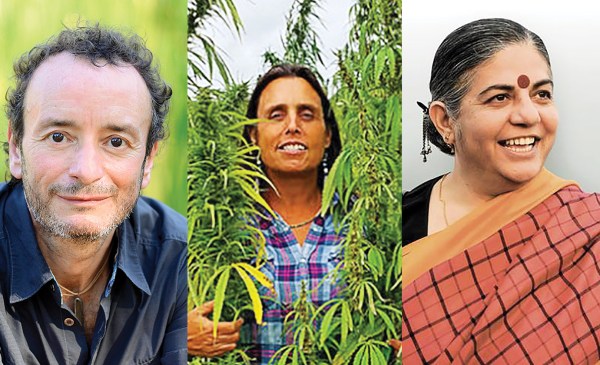
Learn – This component will include educational presentations and panels to explore the foundations of the WTR and its many applications in our changing world. These events will feature world renowned speakers who have been inspired by and love the Work That Reconnects, like Fritjof Capra, Bayo Akomalafe, Jem Bendel, Matthew Fox and Nina Simons as well as several of our own WTR Facilitator Members.
Experience – Events from this component will be woven into the schedule of the gathering to allow participants to experience the WTR and move more deeply into the practices and shared experiences that transmute our anxiety and grief into empowered action. In addition to online WTR experiences, music, movement and ritual engagement, this component will include facilitated guidance for gathering local Communities of Practices to plant seeds of resilience in communities all over the world.
Engage – This component will create opportunities for participants to engage in collaborative learning, up-level their facilitation skills and deepen their practices and gather together around certain topics and affinities. This aspect of the gathering will include Conversation Cafes and training as well as opportunities for participants to initiate ongoing connections with each other through our newly designed Online Community forum space.
Celebrate – Throughout the gathering, we will create opportunities to celebrate and honour Joanna Macy, founder and Root Teacher of the Work That Reconnects, as she moves towards her 94th birthday.
Who would have thought that doughnuts could change the world?
by Joanna Tomkins
They certainly get our attention, don’t they? In the same way we may ourselves once have been addicted to eating doughnuts, our policies are still addicted to promoting growth, even if it harms us each and and every time.
But… now we have got your attention, as you will see hereunder in the graphics, the doughnut in this model is in fact the shape that represents a “safe and just space for humanity”…
The text hereunder, originally published on the DEAL website, offers a comprehensive and convincing introduction to the Doughnut or Donut model. This umbrella is very exciting because its design has enough strength and simplicity to allow policy makers to regroup under it. I personally studied international business at university in France and Spain and I was so put off by some of the contents of the studies, particularly the economical theories, seminars with bankers and practicals in marketing, that I swore to never work for a large corporation. Much later, after I rerouted my career towards arts and also started to work in Africa as a wilderness guide, I went back to university in Barcelona to study Post-developmental African Studies. This was before I moved to Cape Town, wanting to learn about some of the original philosophies on the Continent and the forces at work behind the neocolonialism that still stifle them today. I rallied around the ideas of Serge Latouche (Farewell to Growth, 2007) and his peers. Since the 1980s, voices such as his have been loudly coining terms such as “economical footprint”, “eco-feminism, “overshoot”, etc, and claiming urgency. Yet, those voices have been drowned by the constantly renewed pressure from the Industrial Growth Society.
Finally, in the last few years, at the same time as a larger part of humanity starts to call for socio-economical justice – the one with the privilege to do so and be heard- , some strong, credible and conscious voices have created new alternative economical models that can be understood by many. They are now becoming mainstream and can offer politicians solid solutions to build resilience in the communities whose welfare they are responsible for. Gratitude.
If you are interested in learning more, please read some of the Stories on DEAL. This one for example about how the model has been adopted by 5 major cities around the world:
If you know how this model could be introduced to the University of Cape Town, or the City of Cape Town, please get in touch with me, I’d love to get involved.
Introduction
The Doughnut offers a vision of what it means for humanity to thrive in the 21st century – and Doughnut Economics explores the mindset and ways of thinking needed to get us there.
First published in 2012 in an Oxfam report by Kate Raworth, the concept of the Doughnut rapidly gained traction internationally, from the Pope and the UN General Assembly to Extinction Rebellion.
Kate’s 2017 book, Doughnut Economics: seven ways to think like a 21st century economist, further explored the economic thinking needed to bring humanity into the Doughnut, drawing together insights from diverse economic perspectives in a way that everyone can understand. The book has now been published in over 20 languages.
This 2018 TED talk gives a summary of the book’s core messages, and you can read Chapter One here..
The Doughnut’s holistic scope and visual simplicity, coupled with its scientific grounding, has turned it into a convening space for big conversations about reimagining and remaking the future. It is now being discussed, debated and put into practice in education and in communities, in business and in government, in towns, cities and nations worldwide.
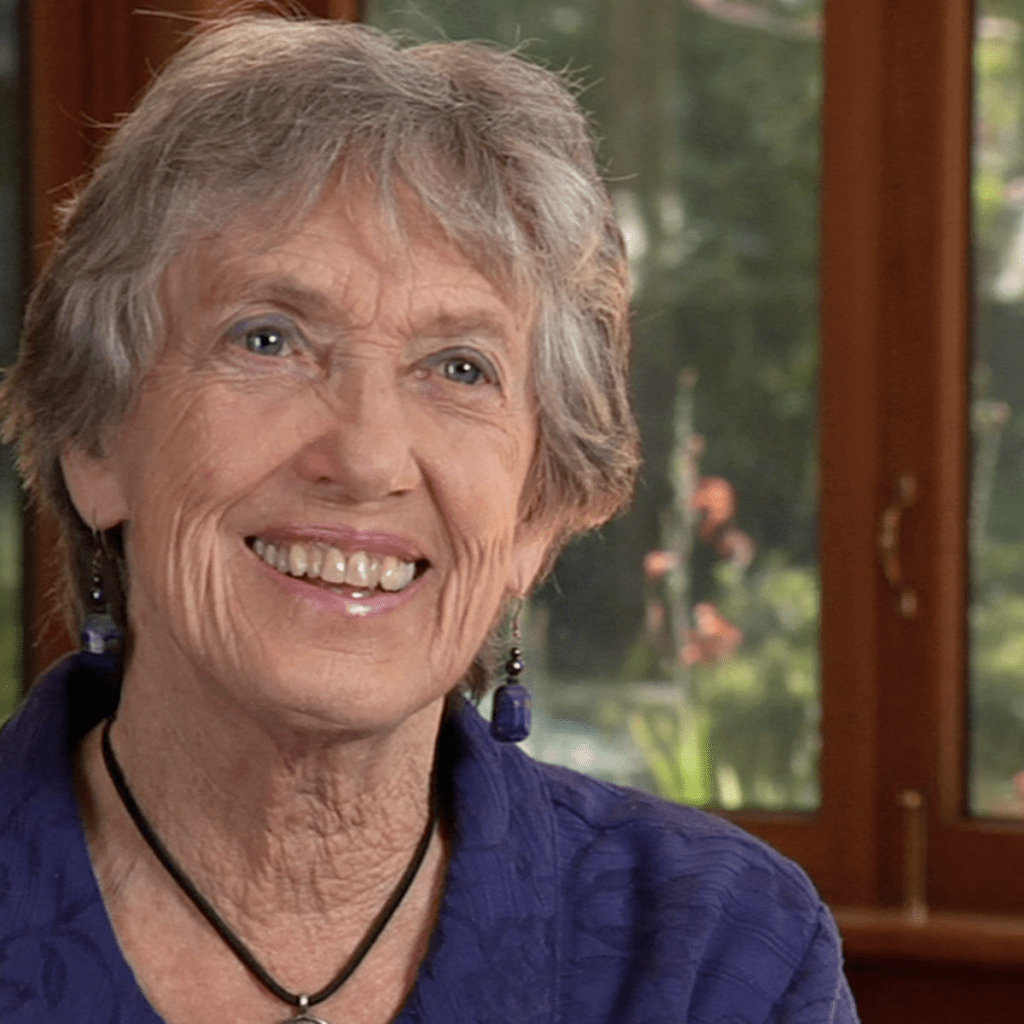
Kate Raworth
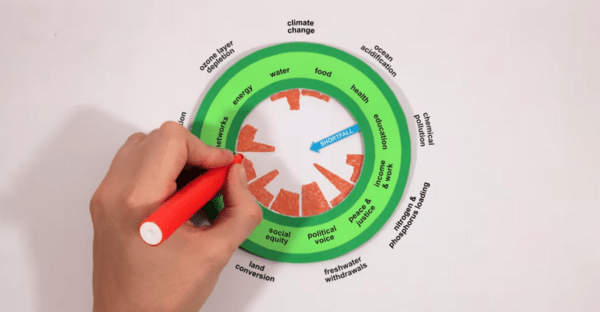
The Doughnut of social and planetary boundaries.
What is the Doughnut?
Think of it as a compass for human prosperity in the 21st century, with the aim of meeting the needs of all people within the means of the living planet.
The Doughnut consists of two concentric rings: a social foundation, to ensure that no one is left falling short on life’s essentials, and an ecological ceiling, to ensure that humanity does not collectively overshoot the planetary boundaries that protect Earth’s life-supporting systems. Between these two sets of boundaries lies a doughnut-shaped space that is both ecologically safe and socially just: a space in which humanity can thrive.
What is Doughnut Economics?
If the 21st century goal is to meet the needs of all people within the means of the living planet – in other words, get into the Doughnut – then how can humanity get there? Not with last century’s economic thinking.
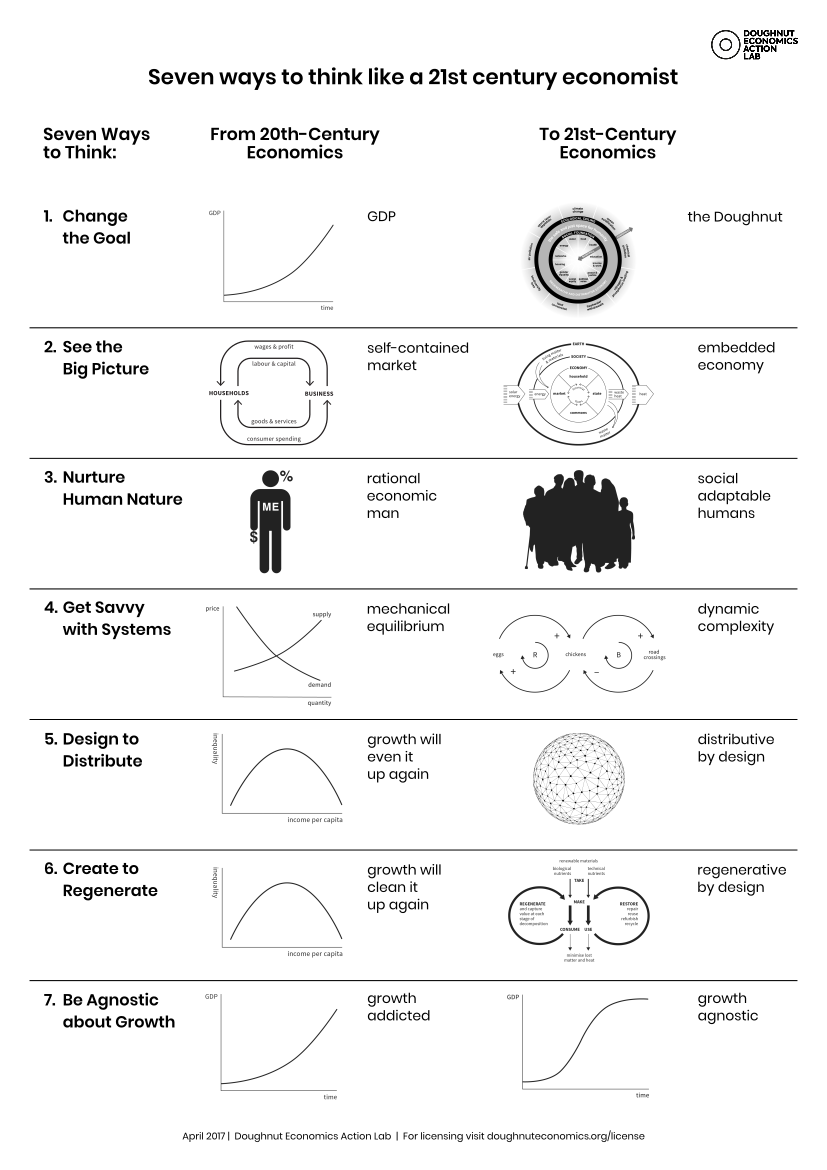
Doughnut Economics proposes an economic mindset that’s fit for our times. It’s not a set of policies and institutions, but rather a way of thinking to bring about the regenerative and distributive dynamics that this century calls for. Drawing on insights from diverse schools of economic thought – including ecological, feminist, institutional, behavioural and complexity economics – it sets out seven ways to think like a 21st century economist in order to transform economies, local to global.
The starting point of Doughnut Economics is to change the goal from endless GDP growth to thriving in the Doughnut. At the same time, see the big picture by recognising that the economy is embedded within, and dependent upon, society and the living world. Doughnut Economics recognises that human behaviour can be nurtured to be cooperative and caring, just as it can be competitive and individualistic.
It also recognises that economies, societies, and the rest of the living world, are complex, interdependent systems that are best understood through the lens of systems thinking. And it calls for turning today’s degenerative economies into regenerative ones, and divisive economies into far more distributive ones. Lastly, Doughnut Economics recognises that growth may be a healthy phase of life, but nothing grows forever: things that succeed do so by growing until it is time to grow up and thrive instead.
Dive deeper into the seven ways to think like a 21st century economist with our series of 90-second animations.
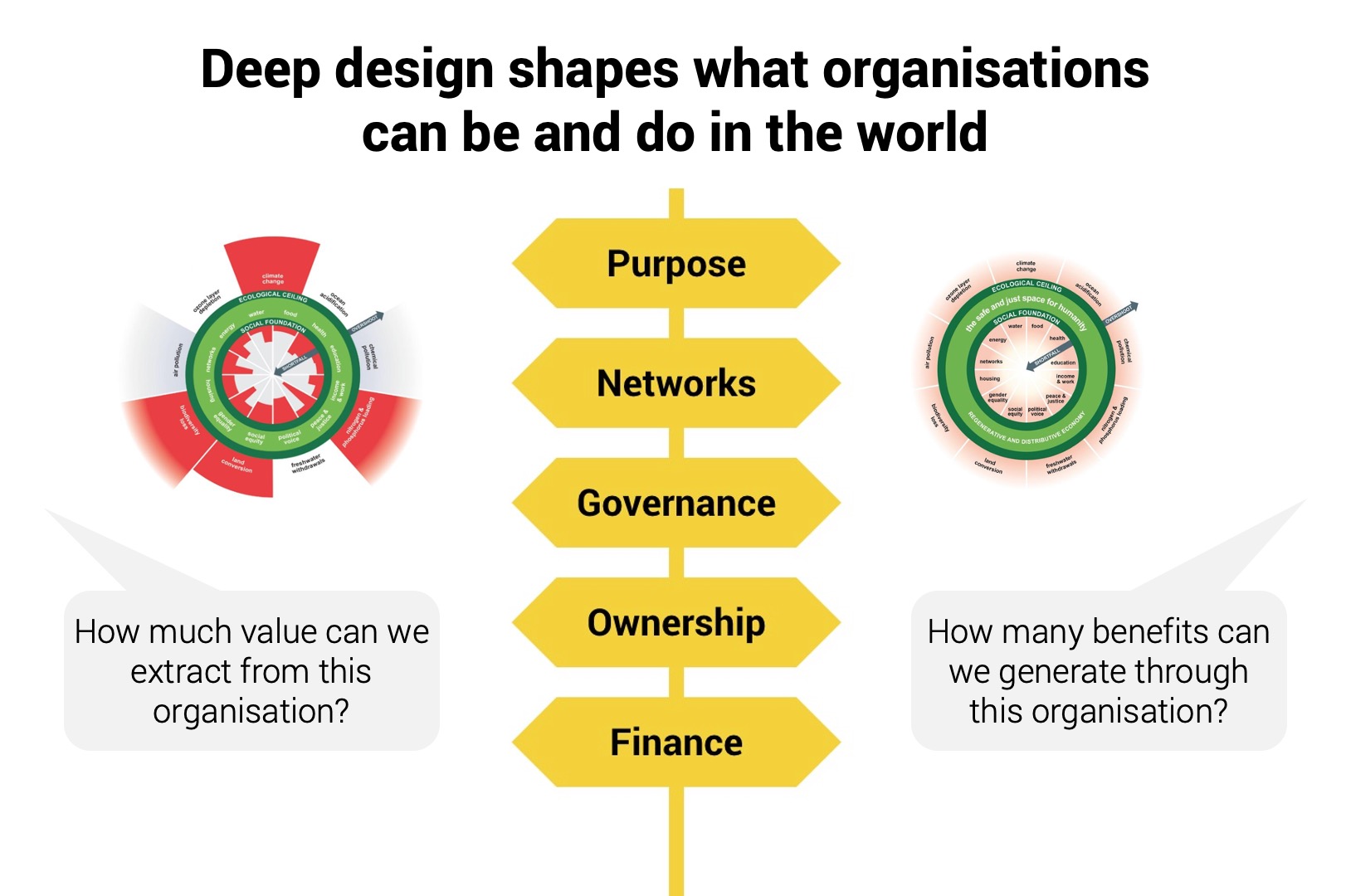
The five layers of organisational design.
Why design matters
What would make it possible for an organisation to become regenerative and distributive so that it helps bring humanity into the Doughnut? DEAL has run workshops with enterprises, city departments, foundations, and other kinds of organisations that want to explore this question, and the implications are transformational.
At the heart of these workshops is a focus on design: not the design of their products and services, or even of their office buildings, but the design of the organisation itself. As described by Marjorie Kelly, a leading theorist in next-generation enterprise design, there are five key layers of design that powerfully shape what an organisation can do and be in the world:
Together these five aspects of organisational design profoundly shape any organisation’s ability to become regenerative and distributive by design, and so help bring humanity into the Doughnut.
Doughnut Principles of Practice
To ensure the integrity of the ideas of Doughnut Economics, we ask that the following principles are followed by any initiative that is working to put the ideas of Doughnut Economics into practice.
Embrace the 21st Century Goal
Aim to meet the needs of all people within the means of the planet. Seek to align your organisation’s purpose, networks, governance, owner-ship and finance with this goal.
See the big picture
Recognise the potential roles of the household, the commons, the market and the state – and their many synergies – in transforming economies. Ensure that finance serves the work rather than drives it.
Nurture human nature
Promote diversity, participation, collaboration and reciprocity. Strengthen community networks and work with a spirit of high trust. Care for the wellbeing of the team.
Think in systems
Experiment, learn, adapt, evolve and aim for continuous improvement. Be alert to dynamic effects, feedback loops and tipping points.
Be distributive
Work in the spirit of open design and share the value created with all who co-created it. Be aware of power and seek to redistribute it to improve equity amongst stakeholders.
Be regenerative
Aim to work with and within the cycles of the living world. Be a sharer, repairer, regenerator, steward. Reduce travel, minimize flights, be climate and energy smart.
Aim to thrive rather than to grow
Don’t let growth become a goal in itself. Know when to let the work spread out via others rather than scale up in size.
Be strategic in practice
Go where the energy is – but always ask whose voice is left out. Balance openness with integrity, so that the work spreads without capture. Share back learning and innovation to unleash the power of peer-to-peer inspiration.
Farmers in Niger are nurturing gao trees to drive Africa’s biggest environmental change
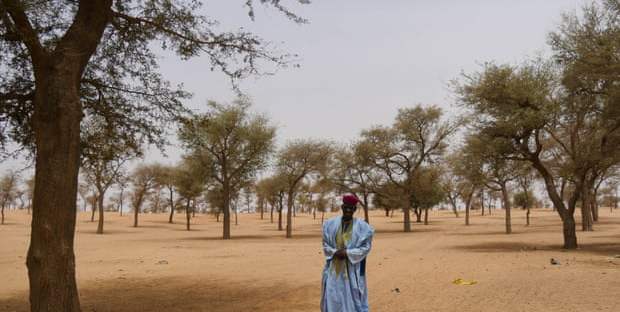
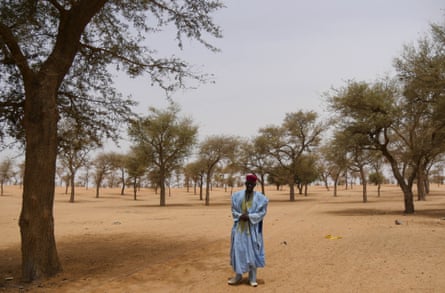
Rain had come to nearby villages, but not yet to Droum in south-east Niger. The sand under its stately trees looked completely barren, but Souley Cheibou, a farmer in his 60s, was not worried. He crooked a finger, fished in the sand, and brought out a millet seed. In a week or two, this seed would germinate and sprout, and soon the whole field would be green.
Cheibou’s peace of mind stemmed from the trees encircling him, which had been standing long before he was born. Despite appearances, these were not any old acacias. They were gao trees – known as winterthorns in English – with unique, seemingly magical powers.
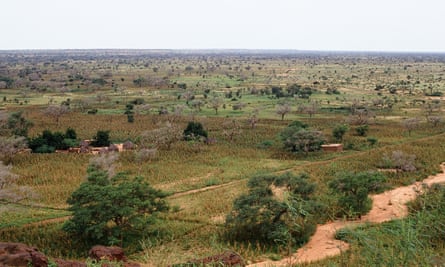
From the peanut basin of Senegal to the Seno plains of Mali, to Yatenga, formerly the most degraded region of Burkina Faso, and as far south as Malawi: gaos are thriving in Africa. And over the past three decades, the landscape of southern Niger has been transformed by more than 200m new trees, many of them gaos. They have not been planted but have grown naturally on over 5m hectares of farmland, nurtured by thousands of farmers.
A valley near the town of Dogondoutchi in the east of Niger. The valley is completely devoted to rainfed cropland. Photograph: Gray Tappan
According to scientists, what has happened in Niger – one of the world’s poorest countries – is the largest-scale positive transformation of the environment in the whole of Africa. This is not a grand UN-funded project aiming to offset climate change. Small-scale farmers have achieved it because of what the trees can do for crop yields and other aspects of farming life.
“It’s a magic tree, a very wonderful tree,” said Abasse Tougiani of Niger’s National Institute of Agricultural Research, who has travelled all over Niger studying Faidherbia albida – the gao’s Latin name.
Shielded from the sun, crops planted under the canopy of a tree usually do not do well in the short term, although there can be longer-term benefits. That’s one reason why many west African rainforests have been decimated. But with gaos, it’s the other way round. The root system of the gao is nearly as big as its branches, and unusually it draws nitrogen from the air, fertilising the soil. And unlike other trees in the area, gao tree leaves fall in the rainy season, allowing more sunlight through to the crops at a key moment.
Used along with mineral fertilisers, crop yields double under gaos, and the gao-nourished soil holds water better, ensuring a better crop in drought years.
A seed-pod of the gao tree. Photograph: Ruth Maclean/Ruth Maclean for the Guardian
Counterintuitively, the great gao regreening is only happening in areas of Niger with high-density populations. With less space to expand into as more people are born, hard-up farmers are increasingly realising that the trees can regenerate degraded land.
“It’s literally a story of more people, more trees,” said Chris Reij, a sustainable land management specialist. “The whole point is that the trees are not protected and managed by farmers for their environmental beauty, but because they are part of the agricultural production system.”
Inadvertently, the farmers are also doing their bit to offset climate change. Trees are crucial for storing carbon, absorbing it out of the atmosphere. “In mature, fairly dense areas, you get 30 tons of wood per hectare. Half of that is carbon,” said Gray Tappan, a geographer.
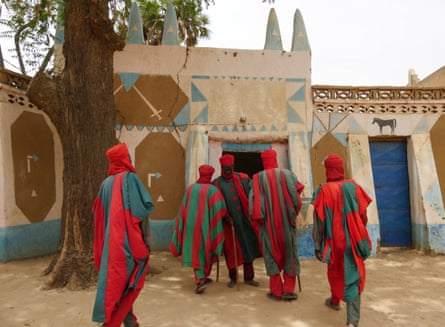
The guards of Droum gather outside the district chief’s palace. Photograph: Ruth Maclean/Ruth Maclean for the Guardian
But none of these grand political projects explains why gaos have caught on. The trees’ pods make very nutritious animal fodder, and fallen branches make good firewood, meaning Droum’s women and children – whose job it is to collect fuel for cooking fires – rarely have to venture further than a few kilometres to find it.
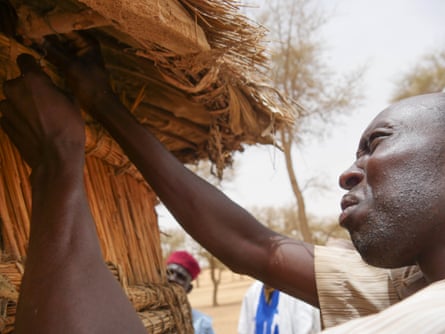
A Droum resident with the village’s mature gao trees. Photograph: Ruth Maclean/Ruth Maclean for the Guardian
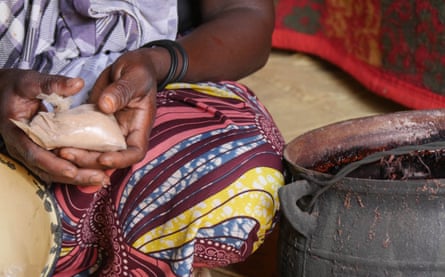
Women in Droum have also made medicine from their gaos for generations. “People come all the way from Zinder [Niger’s second largest city] to buy it,” said Husseina Ibrahim, a busy mother, next to a pot of boiling gao bark. “I’m the only one who makes this here. It’s great for me, it earns me a bit of money which I pay into the women’s cooperative.”
Tales about how the gao came to be so revered abound. Legend has it that crimes against gaos have been taken very seriously since the mid-19th century. “If you touched a branch, you would go to jail,” Tougiani said. In splendid brocade robes and curly-toed velvet slippers, surrounded by self-portraits and stick-wielding guards dressed in red and green, today’s district chief in Droum takes a slightly softer approach.
Gao bark powder and infusion, which locals say cures haemmerhoids. Photograph: Ruth Maclean/Ruth Maclean for the Guardian
“It’s shameful to have to come before the chief and explain yourself. Often that’s punishment enough,” Maman Ali Kaoura said. Droum’s reoffenders face fines of between 5,000 to 10,000 West African CFA francs (€8 to 15), a huge amount for hard-up farmers.
A sense of ownership has been key in the regreening of Niger. Until the mid-1980s, every tree was considered to belong to the state. When this changed, regreening began, as people were happier to look after trees that belonged to them. In areas with the best cover, they organised patrols to protect their trees from passing farmers and neighbouring villagers seeking firewood.
Once people discovered that “one gao was equal to 10 cows” for fertilising, as Tougiani put it, the tree’s popularity took off. Several schemes, including one where farmers with more than 50 gaos were paid 50 CFA for each one, helped it along.
A Droum farmer opens his millet store. Photograph: Ruth Maclean/Ruth Maclean for the Guardian
But their loyalty to their gaos could make areas around Zinder the most vulnerable to a disease that Reij and Tougiani have recently spotted killing trees near Niamey, the capital. If it spreads, the losses could be enormous, particularly in places where there is a near-monoculture of gaos.
“I’m worried, because it’s green oil for farmers – it’s their wealth,” said Tougiani. “If they lose Faidherbia albida, they’ll lose their way of life. They’ll have to leave the village.”
For Cheibou, losing his trees is unthinkable – they were his birthright. “I have nearly 100 gao trees in my fields, which I inherited from my father,” he said. On his way back to the village, he paused by a particularly large one, and cracked open its round seedpod. “This one was here when I was a boy. Just like it is now.”
A note from the Guardian:
Ever wondered why you feel so gloomy about the world – even at a time when humanity has never been this healthy and prosperous? Could it be because news is almost always grim, focusing on confrontation, disaster, antagonism and blame?
This series is an antidote, an attempt to show that there is plenty of hope, as our journalists scour the planet looking for pioneers, trailblazers, best practice, unsung heroes, ideas that work, ideas that might and innovations whose time might have come.
Readers can recommend other projects, people and progress that we should report on by contacting us at theupside@theguardian.com
A note from Gaia Speaking to the Guardian:
We thank you for your independent journalism, which is such an important aspect of the Great Turning, your holding actions create awareness around the negative and the positive actions of thousands of individuals and corporations worldwide. Your writing in turn sparks initiatives in people’s hearts, by informing them about issues that would otherwise go unnoticed, but also by giving them hope through a sense of possibility and togetherness with stories like this one. Gratitude.
True Nature Soul Quest with Rachael Millson – starts January 2024
More and more of us are sensing that, collectively, we are in the process of huge transition – a critical time in our planetary and species’ history and evolution. The crises we find ourselves in connect to both culture and nature and how we each choose to live our lives in this moment is significant for many reasons. Not least with respect to what type of future we want to leave for the coming generations of beings, both human and non-human.
What is needed now is for each of us to stand in our full power, together, to invent new regenerative human cultures and ways of living, that will allow us to live in harmony with the Earth, and with love, compassion and justice for our fellow humans.
At the deepest level, the crises we are facing stem from a type of forgetfulness. We have forgotten who we are, forgotten our true selves as sacred beings. We have bought into the current world mythos of separation, not seeing the truth of our interbeing, and we have forgotten that we are nature, it’s not something apart from us, to be used as a resource alone. It’s from this worldview, of separation, and of mechanistic linearity, that cultures have been formed and systems have been invented, and continue to grow. If we want to see widespread systems-change, we need to question the very basis on which our cultures have been formed. And this begins with a radical personal journey of transformation.
Yet how do we respond to the call that so many of us are hearing, for more depth and meaning, and for a different way, a more beautiful way for all, for life on earth to unfold? There are many actions that can be taken, but perhaps the most important and the bravest, is the willingness to radically come back to the truth at the core of our beings, and to awaken the unique spark and inner resiliency of genius that sits there. Once we find that inner genius (that has been alive all along, but often hidden under the confines of what society and culture has taught us about ourselves), we can begin to live our lives in full alignment with it, weaving it into life in the here and now, despite and because of all the troubles we are facing.
And by developing a sacred reciprocal relationship with nature, collectively we will shift towards decisions that can truly regenerate our home planet.
If you would like to explore your deepest nature, live in alignment with wild nature, embody your inner genius and Soul’s purpose, and contribute your unique gifts towards a more beautiful world, join the True Nature Soul Quest, a 6-month intensive journey into the mysteries of nature and soul.
We’d like to share the recording of a deeply anchoring and supportive conversation between Jonathan Gustin and Adyashanti around the important following questions:
How can Non-Duality inform our way of meeting this Climate Crisis?
How can we root ourselves in the peace of our true nature without avoiding the heartache of the world?
How can we welcome grief and anger without becoming overwhelmed or lost in separation?
In the Zoom conversation that we witnessed he mentioned interesting concepts around “optional and non optional suffering”, or absolute and relative suffering to address how we feel about the world at present.
He said that “Compassion is the link between the absolute and the relative” and that makes it a tool to navigate these times and make sense of where our “stuckness” can end, when despair or grief overwhelms us… So, in a sense “It’s ok not to feel ok”…
Rachael and I invite you to listen to the recording here to enjoy this online gathering, which includes Zen buddhism references and some meditation and deep reflection practices too.
This conversation was preceded by a conversation With Joanna Macy on June 14th 2022, under the same theme “Climate Change as a Spiritual Practice”. The recording is here (watch from minute 05:35 only!) and an article by Rachael hereunder…
Adyashanti is an American spiritual teacher and author from the San Francisco Bay Area who offers talks, online study courses, and retreats in the United States and abroad. He is the author of numerous books, CDs and DVDs and, together with his wife Mukti, is the founder of Open Gate Sangha, which supports and makes available his teachings.
Jonathan Gustin is a purpose guide, psychotherapist, meditation teacher, and integral mentor in private practice in the San Francisco Bay Area for over 25 years. Jonathan is the founder and lead teacher of the Purpose Guides Institute and Green Sangha. He also serves as adjunct faculty at John F. Kennedy University in the Consciousness and Transformation Studies program.Jonathan has co-taught with human potential pioneer George Leonard, Buddhist activist Joanna Macy and depth psychologist Bill Plotkin. For more information on Jonathan Gustin check out the following: Purpose Guides Institute website
The Work that Reconnects integrates, among other teachings, the values present in Buddhism. There are many schools of Buddhism and religious and political interpretations of Buddhism, therefore it is overwhelmingly complex to study all its variants and also some of its practices may not be indicated for certain individual circumstances. Yet, there are great resources available, in which I personally have found refuge and wisdom again and again when confronted with the tyranny of contradictions that riddle my time of Earth.
I’d like to recommend the introduction to Buddhism offered by Tricyle to those of you who are interested in a clear summary of some of its spiritual principles. Hereunder is the link to the page and an extract of the first chapter which will introduce the Four Noble Truths the Eightfold Path. I hope this will serve as some guidance for you today or in future times, when facing difficult transitions and transformations.
A gold sculpture of the Wheel of the Buddhist Law from thirteenth-century Japan. In this ritual object, each of the eight spokes and corners represents one aspect of the Noble Eightfold Path. | Source: Metropolitan Museum of Art.
The Buddha began and ended his teaching career with a discussion of the eightfold path, guidelines for living ethically, training the mind, and cultivating wisdom that brings an end to the causes of suffering. He spoke of the path in his first sermon immediately after his awakening and in the last teaching he gave on his deathbed 45 years later. The eightfold path is the fourth noble truth, the way to awakening.
The Buddha is often described as a great physician or healer, and the eightfold path (also called the noble eightfold path, “noble” because following it can make us better people, like the Buddha) can be viewed as his prescription for relief. Suffering is the disease, and the eight steps are a course of treatment that can lead us to health and well-being; we avoid the extremes of self-indulgence on the one hand and total self-denial on the other. For this reason the Buddha called the path “the middle way.” The eight steps are:
Right view
Right intention
Right speech
Right action
Right livelihood
Right effort
Right mindfulness
Right concentration
The path begins with right view, also called right understanding. We need to see clearly where we are headed before we begin. Right intention means the resolve to follow this path. Right speech and right action refer to what we say and do—to not harming other people or ourselves with our words and behavior. Right livelihood means how we live day to day, making sure our habits and our work don’t cause harm to ourselves and others.
Right effort refers to focusing our energy on the task at hand. Right mindfulness means awareness of the mind and body with discernment. With mindfulness, we might pause and consider whether what we are doing is harmful to ourselves or others. Finally, right concentration refers to dedicated practice, whether it is meditation or chanting. In other words, once we have directed our minds and lives toward awakening, we can proceed. Though the eightfold path is always listed in this order, it is not strictly sequential, and does not need to be followed in only this order.
The eight steps can be divided into three areas for training: ethical conduct (sila), concentration (samadhi), and wisdom (prajna.) Right speech, right action, and right livelihood concern ethical conduct. Right effort, right mindfulness, and right concentration relate to the practice of concentration. Right view and right intention are related to the development of wisdom.
The eightfold path may not always be easy to follow, but we make the effort because we believe it will lead us out of suffering.
Published on tricycle.org: TRICYLE – Buddhism for Beginners
Even if the climate crisis were somehow brought under control, our current growth-oriented economic juggernaut will bring us face-to-face with a slew of further existential threats in future decades. As long as government policies emphasize growth in gross domestic product and transnational corporations relentlessly pursue shareholder returns, we will continue accelerating toward global catastrophe.
We’re rapidly decimating the Earth’s forests, animals, insects, fish, fresh water—even the topsoil we need to grow our crops. We’ve already transgressed four of the nine planetary boundaries that define humanity’s safe operating space, and yet global GDP is expected to triple by 2060, with potentially calamitous consequences. In 2017, more than 15,000 scientists from 184 countries issued an ominous warning to humanity that time is running out: “Soon it will be too late,” they wrote, “to shift course away from our failing trajectory.”
We need to forge a new era for humanity—one that is defined, at its deepest level, by a transformation in the way we make sense of the world, and a concomitant revolution in our values, goals, and collective behavior. In short, we need to change the basis of our global civilization. We must move from a civilization based on wealth accumulation to one that is life-affirming: an ecological civilization.
Jeremy Lent
A Life-Affirming Civilization
Without human disruption, ecosystems can thrive in rich abundance for millions of years, remaining resilient in the face of adversity. Clearly, there is much to learn from nature’s wisdom about how to organize ourselves. Can we do so before it’s too late?
This is the fundamental idea underlying an ecological civilization: using nature’s own design principles to reimagine the basis of our civilization. Changing our civilization’s operating system to one that naturally leads to life-affirming policies and practices rather than rampant extraction and devastation.
An ecological civilization is both a new and ancient idea. While the notion of structuring human society on an ecological basis might seem radical, Indigenous peoples around the world have organized themselves from time immemorial on life-affirming principles. When Lakota communities, on the land that is now the U.S., invoke Mitakuye Oyasin (“We are all related”) in ceremony, they are referring not just to themselves but to all sentient beings. Buddhist, Taoist, and other philosophical and religious traditions have based much of their spiritual wisdom on the recognition of the deep interconnectedness of all things. And in modern times, a common thread linking progressive movements around the world is the commitment to a society that works for the flourishing of life, rather than against it.
6 Rules for Humans Rejoining the Natural World
1. Diversity
A system’s health depends on differentiation and integration. When this principle of natural ecology is applied to human society, we see it as affirmation of different groups—self-defined by ethnicity, gender, or any other delineation. Such as: • Community self-determination • Indigenous rights • Restorative justice • Social equity for LGBTQ communities
Deciphering Nature’s Design Principles
There is a secret formula hidden deep in nature’s intelligence, which catalyzed each of life’s great evolutionary leaps over billions of years and forms the basis of all ecosystems. It’s captured in the simple but profound concept of mutually beneficial symbiosis: a relationship between two parties to which each contributes something the other lacks, and both gain as a result. With such symbiosis, there is no zero-sum game: The contributions of each party create a whole that is greater than the sum of its parts.
Whenever you go for a walk in the woods, eat a meal, or take a dip in the ocean, you’re experiencing the miracle of nature’s symbiosis. Plants transform sunlight into chemical energy that provides food for other creatures, whose waste then fertilizes the soil the plants rely on. Underground fungal networks contribute essential chemicals to trees in return for nutrients they can’t make for themselves. Pollinators fertilize plants, which produce fruit and seeds that nourish animals as they carry them to new locations. In your own gut, trillions of bacteria receive nutrition from the food you enjoy, while reciprocating by producing enzymes you need for digestion.
In human society, symbiosis translates into foundational principles of fairness and justice, ensuring that the efforts and skills people contribute to society are rewarded equitably. In an ecological civilization, relationships between workers and employers, producers and consumers, humans and animals, would thus be based on each party gaining in value rather than one group exploiting the other.
Because of symbiosis, ecosystems can sustain themselves almost indefinitely. Energy from the sun flows seamlessly to all the constituent parts. The waste of one organism becomes the sustenance of another. Nature produces a continuous flow where nothing is squandered. Likewise, an ecological civilization, in contrast to our current society built on extracting resources and accumulating waste, would comprise a circular economy with efficient reuse of waste products embedded into processes from the outset.
Nature uses a fractal design with similar patterns repeating themselves at different scales. Fractals are everywhere in nature—you see them in the patterns of tree branches, coastlines, cloud formations, and the bronchial system in our lungs. Ecologies are themselves fractal, with the deep principles of self-organized behavior that perpetuate life shared by microscopic cells, organisms, species, ecosystems, and the entire living Earth. This form of organization is known as a holarchy, where each element—from cells on up—is a coherent entity in its own right, while also an integral component of something larger. In a holarchy, the health of the system as a whole requires the flourishing of each part. Each living system is interdependent on the vitality of all the other systems.
2. Balance
Every part of a system is in a harmonious relationship with the entire system. When this principle of natural ecology is applied to human society, we see it as competition and cooperation in balance and an equitable distribution of wealth and power. Such as: • Global wealth tax • Multibillionaires proscribed • Abolition of offshore tax havens • Legal support for co-ops and the commons
Based on this crucial precept, an ecological civilization would be designed on the core principle of fractal flourishing: the well-being of each person is fractally related to the health of the larger world. Individual health relies on societal health, which relies in turn on the health of the ecosystem in which it’s embedded. Accordingly, from the ground up, it would foster individual dignity, providing the conditions for everyone to live in safety and self-determination, with universal access to adequate housing, competent health care, and quality education.
In the fractal design of an ecosystem, health arises not through homogeneity, but through each organism contributing to the whole by fulfilling its own unique potential. Correspondingly, an ecological civilization would celebrate diversity, recognizing that its overall health depended on different groups—self-defined by ethnicity, gender, or any other delineation—developing their own unique gifts to the greatest extent possible.
In a natural ecology, the type of exponential growth that characterizes our global economy could only occur if other variables were out of balance, and would inevitably lead to the catastrophic collapse of that population. The principle of balance would accordingly be crucial to an ecological civilization. Competition would be balanced by collaboration; disparities in income and wealth would remain within much narrower bands, and would fairly reflect the contributions people make to society. And crucially, growth would become just one part of a natural life cycle, slowing down once it reaches its healthy limits—leading to a steady-state, self-sustaining economy designed for well-being rather than consumption.
Above all, an ecological civilization would be based on the all-encompassing symbiosis between human society and the natural world. Human activity would be organized, not merely to avoid harm to the living Earth, but to actively regenerate and sustain its health.
An Ecological Civilization in Practice
The overriding objective of an ecological civilization would be to create the conditions for all humans to flourish as part of a thriving, living Earth. Currently, the success of political leaders is assessed largely by how much they increase their nation’s GDP, which merely measures the rate at which society transforms nature and human activities into the monetary economy, regardless of the ensuing quality of life. A life-affirming society would, instead, emphasize growth in well-being, using measures like the Genuine Progress Indicator, which factors in qualitative components such as volunteer and household work, pollution, and crime.
For more than a century, most economic thinkers have recognized only two domains of economic activity: markets and government. The great political divide between capitalism and communism was structured accordingly, and even today the debate continues along similar lines. An ecological civilization would incorporate government spending and markets, but—as laid out by visionary economist Kate Raworth—would add two critical realms to this framework: households and the commons.
3. Fractal Organization
The small reflects the large, and the health of the whole system requires the flourishing of each part. When this principle of natural ecology is applied to human society, we see it as individual dignity and self-determination. Such as: • Universal Basic Income • Universal access to housing, health care, education • Cities redesigned for walking • Community interaction • Education for life-fulfillment • Cosmopolitanism
In particular, the commons would become a crucial part of economic activity. Historically, the commons referred to shared land that peasants accessed to graze livestock or grow crops. But more broadly, the commons refers to any source of sustenance and well-being that has not yet been appropriated by the state or private ownership: the air, water, sunshine, as well as human creations like language, cultural traditions, and scientific knowledge. It is virtually ignored in most economic discussion because, like household work, it doesn’t fit into the classic model of the economy. But the global commons belongs to all of us, and in an ecological civilization, it would once again take its rightful place as a major provider of human welfare.
The overwhelming proportion of wealth available to modern humans is the result of the cumulative ingenuity and industriousness of prior generations going back to earliest times. However, as a consequence of centuries of genocide and slavery, systemic racism, extractive capitalism, and exploitation by the Global North, that wealth is highly unevenly distributed. Once we realize the vast benefits of the commons bequeathed to us by our ancestors—along with the egregiously uneven wealth distribution—it transforms our conception of wealth and value. Contrary to the widespread view that an entrepreneur who becomes a billionaire deserves his wealth, the reality is that whatever value he created is a pittance compared to the immense bank of prior knowledge and social practices—the commonwealth—that he took from. An ecological civilization, recognizing this, would fairly reward entrepreneurial activity, but severely curtail the right of anyone to accumulate multiple billions of dollars in wealth, no matter what their accomplishments.
Conversely, it is the moral birthright of every human to share in the vast commonwealth bestowed on us. This could effectively be achieved through a program of unconditional monthly cash disbursements to every person on the planet, creating a foundation for the dignity and security required for society’s fractal flourishing. It would also begin to address the moral imperative to remedy the extreme exploitation and injustices visited upon Indigenous and Black communities worldwide—historically and to this day.
Research has shown repeatedly that such programs—known as Universal Basic Income—are remarkably effective in improving quality of life in communities around the world, in both the Global North and South. Programs consistently report reduction in crime, child mortality, malnutrition, truancy, teenage pregnancy, and alcohol consumption, along with increases in health, gender equality, school performance—and even entrepreneurial activity. Work is not something people try to avoid; on the contrary, purposive work is an integral part of human flourishing. Liberated by UBI from the daily necessity to sell their labor for survival, people would reinvest their time in crucial sectors of the economy—in households and commons—that naturally lead to life-affirming activity.
The transnational corporations that currently dominate every aspect of global society would be fundamentally reorganized, and made accountable to the communities they purportedly serve. Corporations above a certain size would only be permitted to operate with charters that required them to optimize social and environmental well-being along with shareholder returns. Currently, these triple bottom line charters are voluntary, and very few large corporations adopt them. If, however, they were compulsory—and strictly enforced by citizen panels comprising representatives of the communities and ecosystems covered in the company’s scope of operations—it would immediately transform the intrinsic character of corporations, causing them to work for the benefit of humanity and the living Earth rather than for their demise.
In place of vast homogenized monocrops of industrial agriculture, food would be grown using principles of regenerative agriculture, leading to greater crop biodiversity, improved water and carbon efficiency, and the virtual elimination of synthetic fertilizer. Manufacturing would be structured around circular material flows, and locally owned cooperatives would become the default organizational structure. Technological innovation would still be encouraged, but would be prized for its effectiveness in enhancing symbiosis between people and with living systems, rather than minting billionaires.
4. Life Cycles
Regenerative and sustainable flourishing into the long-term future. When this principle of natural ecology is applied to human society, we see it as economic growth halting once it reaches healthy limits. Such as: • Steady-state economies • A triple bottom line for corporations
Cities would be redesigned on ecological principles, with community gardens on every available piece of land, essential services within a 20-minute walk, and cars banned from city centers. The local community would be the basic building block of society, with face-to-face interaction regaining ascendance as a crucial part of human flourishing. Education would be re-envisioned, its goal transformed from preparing students for the corporate marketplace to cultivating in students the discernment and emotional maturity required to fulfill their life’s purpose as valued members of society.
Local community life would be enriched by the global reach of the internet. Online networks with scale, such as Facebook, would be turned over to the commons, so that rather than manipulating users to maximize advertising dollars, the internet could become a vehicle for humanity to develop a planetary consciousness. Cosmopolitanism—an ancient Greek concept meaning “being a citizen of the world”—would be the defining characteristic of a global identity. It would celebrate diversity between cultures while recognizing the deep interdependence that binds all people into a single moral community with a shared destiny.
Governance would be transformed with local, regional, and global decisions made at the levels where their effects are felt most (known as subsidiarity). While much decision-making would devolve to lower levels, a stronger global governance would enforce rules on planetwide challenges such as the climate emergency and the sixth great extinction. A Rights of Nature declaration, recognizing the inalienable rights of ecosystems and natural entities to persist and thrive, would put the natural world on the same legal standing as humanity, with personhood given to ecosystems and high-functioning mammals, and the crime of ecocide—the destruction of ecosystems—prosecuted by a court with global jurisdiction.
Daring to Make It Possible
It doesn’t take more than a glance at the daily headlines to realize how far we are from this vision of a society that fosters fractal flourishing. Yet, just like the underground fungal network that nourishes trees in a forest, innumerable pioneering organizations around the world are already laying the groundwork for virtually all the components of a life-affirming civilization.
In the United States, the visionary Climate Justice Alliance has laid out guidelines for a just transition from an extractive to a regenerative economy that incorporates deep democracy with ecological and societal well-being. A network of more than 70 grassroots and frontline movements, the Alliance works collectively for a just transition toward food sovereignty, energy democracy, and ecological regeneration.
5. Subsidiarity
Issues at the lowest level affect health at the top. When this principle of natural ecology is applied to human society, we see it as grassroots self-autonomy and deep democracy: • Decision-making at the lowest possible levels • Horizontalism • Cooperatives
In Bolivia and Ecuador, traditional ecological principles of buen vivir and sumak kawsay (“good living”) are written into the constitutions. While mechanisms for enforcement still need considerable strengthening, these principles establish a powerful alternative to extractive practices, offering a legal and ethical platform for legislation based on harmony—both with nature, and between humans.
In Europe, large-scale thriving cooperatives, such as the Mondragón Cooperative in Spain, demonstrate that it’s possible for companies to prosper without utilizing a shareholder-based profit model. With roughly a hundred businesses and 80,000 worker-owners producing a wide range of industrial and consumer goods, Mondragón proves that it’s possible to succeed while maintaining a people-focused, shared community of life-affirming values.
A new ecological worldview is spreading globally throughout cultural and religious institutions, establishing common ground with the heritage of traditional Indigenous knowledge. The core principles of an ecological civilization have already been laid out in the Earth Charter—an ethical framework launched in The Hague in 2000 and endorsed by more than 50,000 organizations and individuals worldwide. In 2015, Pope Francis shook the Catholic establishment by issuing his encyclical, Laudato Si’, a masterpiece of ecological philosophy that demonstrates the deep interconnectedness of all life, and calls for a rejection of the individualist, neoliberal ethic.
Economists, scientists, and policymakers, recognizing the moral bankruptcy of the current economic model, are pooling resources to offer alternative frameworks. The Wellbeing Economy Alliance is an international collaboration of changemakers working to transform our economic system to one that promotes human and ecological well-being. The Global Commons Alliance is similarly developing an international platform for regenerating the Earth’s natural systems. Organizations such as the Next System Project and the Global Citizens Initiative are laying down parameters for the political, economic, and social organization of an ecological civilization, and the P2P Foundation is building a commons-based infrastructure for societal change. Around the world, an international movement of transition towns is transforming communities from the grassroots up by nurturing a caring culture, reimagining ways to meet local needs, and crowdsourcing solutions.
Most importantly, a people’s movement for life-affirming change is spreading globally. Led by young climate activists like Greta Thunberg, Vanessa Nakate, Mari Copeny, Xiye Bastida, Isra Hirsi, and others, millions of schoolchildren worldwide are rousing their parents’ generation from its slumber. A month after Extinction Rebellion demonstrators closed down Central London in 2019, the U.K. Parliament announced a “climate emergency,” which has now been declared by nearly 2,000 local and national jurisdictions worldwide, representing more than 12% of the global population. Meanwhile, the Stop Ecocide campaign to establish ecocide as a crime prosecutable under international law is making important strides, gaining serious consideration at the parliamentary level in France and Sweden, with a panel of legal experts convened to draft its definition.
6. Symbiosis
Relationships that work for mutual benefit. When this principle of natural ecology is applied to human society, we see it as fairness and justice, regenerative economies, and circular energy flows. Such as: • Measuring well-being instead of GDP • Regenerative agriculture • Permaculture principles • Circular economies and manufacturing processes • Rights of Nature and personhood for nonhumans
When we consider the immensity of the transformation needed, the odds of achieving an ecological civilization might seem daunting—but it’s far from impossible. As our current civilization begins to unravel on account of its internal failings, the strands that kept it tightly wound also get loosened. Every year that we head closer to catastrophe—as greater climate-related disasters rear up, as the outrages of racial and economic injustice become even more egregious, and as life for most people becomes increasingly intolerable—the old narrative loses its hold on the collective consciousness. Waves of young people are looking for a new worldview—one that makes sense of the current unraveling, one that offers them a future they can believe in.
It’s a bold idea to transform the very basis of our civilization to one that’s life-affirming. But when the alternative is unthinkable, a vision of a flourishing future shines a light of hope that can become a self-fulfilling reality. Dare to imagine it. Dare to make it possible by the actions you take, both individually and collectively—and it might just happen sooner than you expect.
As civilization faces an existential crisis, our leaders demonstrate their inability to respond. Theory of change shows that now is the time for radically new ideas to transform society before it’s too late.
[…]
How Change Happens
Studies of past civilizations show that all the major criteria that predictably lead to civilizational collapse are currently confronting us: climate change, environmental degradation, rising inequality, and escalation in societal complexity. As societies begin to unravel, they have to keep running faster and faster to remain in the same place, until finally an unexpected shock arrives and the whole edifice disintegrates.
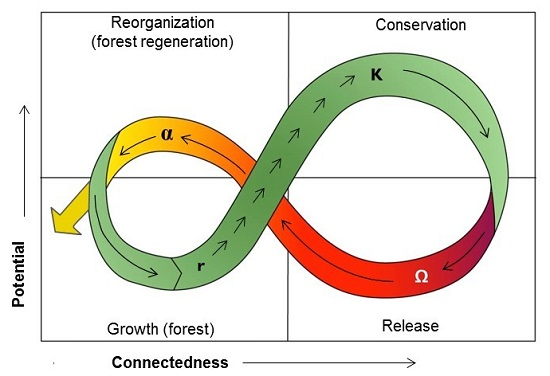
It’s a terrifying scenario, but understanding its dynamics enables us to have greater impact on what actually happens than we may realize. Scientists have studied the life cycles of all kinds of complex systems—ranging in size from single cells to vast ecosystems, and back in time all the way to earlier mass extinctions—and have derived a general theory of change called the Adaptive Cycle model. This model works equally well for human systems such as industries, markets, and societies. As a rule, complex systems pass through a life cycle consisting of four phases: a rapid growth phase when those employing innovative strategies can exploit new opportunities; a more stable conservation phase, dominated by long-established relationships that gradually become increasingly brittle and resistant to change; a release phase, which might be a collapse, characterized by chaos and uncertainty; and finally, a reorganization phase during which small, seemingly insignificant forces can drastically change the future of the new cycle.
The Adaptive Cycle model of change
Right now, many people might agree that our global civilization is at the late stage of its conservation phase, and in many segments, it feels like it’s already entering the chaotic release phase. This is a crucially important moment in the system’s life cycle for those who wish to change the predominant order. As long as the conservation phase remains stable, new ideas can barely make an impact on the established, tightly connected dominant ecosystem of power, relationships, and narrative. However, as things begin to unravel, we see increasing numbers of people begin to question foundational elements of neoliberal capitalism: an economy based on perpetual growth, seeing nature as a resource to plunder, and the pursuit of material wealth as paramount.
This is the time when new ideas can have an outsize impact. Innovative policy ideas previously considered unthinkable begin to enter the domain of mainstream political discourse (known as the Overton window). We see signs of this in the United States in the form of the Green New Deal, or Elizabeth Warren’s plan to hold corporations accountable. We also see it, disturbingly, in dark political forces such as the UK Brexit fiasco and the increasing acceptability of malevolent racist rhetoric around the world.
The stakes are always at their highest when both the economic and cultural norms of a society begin to fall apart in tandem. When Europe underwent a phase of collapse and renewal in the early twentieth-century, after the devastation of World War I, it became fertile terrain for the hate-filled ideologies of Fascism and Nazism that led to the dark abyss of genocide and concentration camps. The ensuing catastrophe of World War II led to another collapse and renewal cycle, this one providing the platform for the current globalized world order that is now entering the final stages of its own life cycle.
Shifting the Overton Window
What will emerge from the current slide into ecological and political chaos? Will the twin dark forces of billionaires’ wealth and xenophobic nationalism lead us into another abyss? Or can we somehow transform our global society peacefully into a fundamentally different system—one that affirms life rather than material wealth as paramount?
One thing is clear: the visionary ideas that will determine the shape of our future will not be based on incremental thinking within the confines of our current system. Achieving needed reforms within the current global power structure is a worthwhile goal, but is not sufficient to lead humanity to a thriving future. For that, we need bold, new ways of structuring our civilization, and of rethinking the human relationship with the natural world. We need to be ready to restructure the legal basis of corporations to serve humanity rather than faceless shareholders. We need global laws that force ecocidal thugs like Bolsonaro to face justice for their crimes against nature.
You won’t currently find these new ways of thinking in the mainstream media, nor in the speeches of politicians trying to get elected. But you will find them in the streets. You’ll find them in the courage of a Greta Thunberg: a solitary teenage girl sitting for days in front of her parliament, who has since inspired millions of schoolchildren to strike for their future. You’ll find them in the demands of the Extinction Rebellion movement, which calls for elected leaders to tell the truth about our ecological and climate crisis, and to empower citizen’s assemblies to develop truly meaningful solutions.
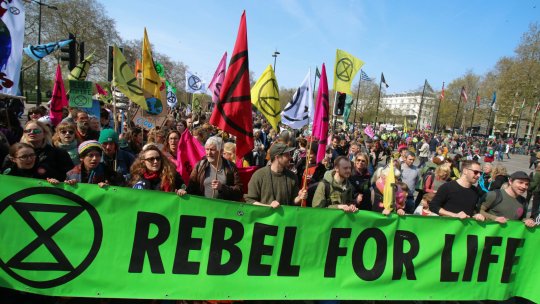
The Extinction Rebellion movement calls for a meaningful response to our ecological crisis
The changes needed for a hopeful future will not come about from our current leaders, which is why all of us who care for future generations and for the richness of life on Earth, must take the leadership role in their place. We need to shift the Overton window until it centers on the real issues that will determine our future. […]
The stakes have never been higher: the threat of catastrophe never more dreadful; and the path to societal transformation never so apparent. Which future are you steering us to? There’s no opting out: anyone with an inkling of what’s happening around the world, but who does nothing about it, is implicitly adding their momentum toward the abyss of collapse.[…]
By Silvia Di Blasio, originally written for the Work that Reconnects Journal Deep Times, in August 2019
Note from publisher: This article was published in 2019 by Silvia di Blasio, one of the most influent weavers of the Work that reconnects international network, as a response to Jem Bendell’s “Deep Adaptation: A Map for Navigating Climate Tragedy.” paper published in May 2019.
This is an interesting political and philosophical debate, at the heart of these times of Great Turning.
Last night, I re-watched “Children of Men” where the depiction of a dystopian future of collapsed cities and ecosystems, garbage clogging the streets and streams, terrorism, armed police and the incarceration, enslavement and torture of displaced peoples (refugees) seem all too close and almost documentary-like in 2019.
Refugee camp – Image by David Mark from Pixabay
A few weeks ago, I re-read the controversial, unorthodox and courageous paper called “Deep Adaptation: A Map for Navigating Climate Tragedy”, where professor Jem Bendell shares the results of his review of the latest climate data and how he “chose to interpret the information as indicating inevitable collapse, probable catastrophe and possible extinction [emphasis added].”
After finishing reading that paper, I gazed through my living room window in Surrey, Canada: children were safely playing on our middle class street, an oblivious neighbour was mowing the lawn, the spring (felt almost as summer) was glorious and I recalled that line I read more than 30 years ago from a Carl Sagan book – a line that has stayed with me all these years: “the last day on Earth will be as perfect as a summer day.” I floated, still in shock, to my kitchen: magically, the tap gave me drinking water, the power was still a switch away, I could walk to the market if I ran out of anything. I recalled the time when this was not my reality, when clothes and furniture were scarce, when water came from a well, when I ran barefoot on unpaved streets. These days were far away now, almost surreal, and yet, I know they are also a flight away, like when I went back home to Argentina for the first time in 15 years and remembered what “societal collapse” looked like.
“I’m safe here” I tell myself …and yet, a sense of urgency burns inside, a sense of uneasiness
“I’m safe here” I tell myself …and yet, a sense of urgency burns inside, a sense of uneasiness: a recent UNHR report showed that we have the highest ever number of displaced peoples: an unprecedented 70.8 million people around the world have been forced from home, with nearly 25.9 million of them being refugees; most treated as a burden, put into camps or worse: into detention centers as if they were criminals, only a small percentage (usually the most privileged among them) make it to Canada, the United States or Europe. Another (UN) report reminds me that we are already experiencing an “unprecedented” rate of species extinction and that up to 50% of the species could be extinct in only a few decades. More recently, the UN warns that we may be having a climate disaster per week! The list is endless… yet I still could sit safe in my balcony.
In a recent post about training people to facilitate Deep Adaptation (DA) conversations, the author calls all this “the end of normal”. The post starts with “it’s started”… What exactly has “started” and for whom? Blood rushes through my cheeks, I feel something else coming: the end of what “normal”? Why is this business as usual called “normal”?
Our “normal” was more important to keep than theirs
Our entire civilization was built on disconnection, hierarchies, othering peoples and species, oppression, not caring for what happens to other humans or other cultures–looking away and not showing up when the worst was happening to “others”. It was easy: our “normal” was more important to keep than theirs, be this the habitat of a species or an entire culture.
After many weeks of reading, joining and creating groups, offering both online and in-person discussions and even exploring the design of a WTR workshop incorporating DA, I came to the conclusion that what scares us most from reading Deep Adaptation is that what has been happening to other cultures and species will now be “coming home.” Those of us accustomed to the middle class we call “normal” may fear losing our privileges, the aberration we thought was a birthright: a sense of control and safety we could buy and demand – jobs, entertainment coming through screens, plenty of packaged and long-distance food to choose from, tap water, fuel for our cars, human rights. We forgot that for decades and sometimes centuries, collapse has been the “normal” for many species and humans, and that many cultures have designed their normal around different values from those above.
Understandably, people have been expressing fear, anger, and anxiety, with many looking at how to “prepare”, how to “survive the hordes” and how this may affect their near future choices: should we cash the retirement moneys, move to the mountains, build a bunker, take survivalism courses? And all these emotions, doubts and questions are valid, just not many of them are available to those where collapse is already underway.
As a WTR facilitator, both the paper and the movement that is arising from it are (as the blog post on “the end of normal” mentions, possibly the only and most important thing we should be considering from now on: at the center of all we do, our facilitation, our groups, our decision-making, our commitments, our going forth. I also invite you to consider: at the center of a radical “seeing with new eyes”.
We may face the different ways people will try to ignore, deny, negotiate and interpret the DA concept; as author Jem Bendell presents in “barriers to discussion on deep adaptation.” How do we focus back on the work we do and how will our work as facilitators, activists and changemakers be affected by this knowledge?
As Jem Bendell writes in “The Love in Deep Adaptation” about what DA is: Deep Adaptation refers to the personal and collective changes that might help us to prepare for – and live with – a climate-induced collapse of our societies.”
Deep Adaptation refers to the personal and collective changes that might help us to prepare for – and live with – a climate-induced collapse of our societies.
He also suggests we explore the questions under what he calls “the four R’s” within ourselves, with or loved ones and our communities:
Resilience: what do we most value that we want to keep and how?
Relinquishment: what do we need to let go of so as not to make matters worse?
Restoration: what could we bring back to help us with these difficult times?
Reconciliation: with what and whom shall we make peace as we awaken to our mutual mortality? to our very real connection and inter-being?
“These questions”, continues Jem: “ invite exploration of Deep Adaptation to our climate predicament in order to develop both collapse-readiness and collapse-transcendence.”
“Collapse-readiness includes the mental and material measures that will help reduce disruption to human life – enabling an equitable supply of the basics like food, water, energy, payment systems and health.
Collapse-transcendence refers to the psychological, spiritual and cultural shifts that may enable more people to experience greater equanimity toward future disruptions and the likelihood that our situation is beyond our control.”
For decades, facilitators of the WTR (starting from our root teacher, Joanna Macy) have been aware of the real possibility of the Great Unravelling. However in our workshops, we usually end the spiral with a positive and proactive note: Going Forth represents our choosing life, choosing the story of the Great Turning. We know that this choice of how we invest our energy and time does not correspond to a guarantee that things will turn out well. We do this because we feel it is the right choice, to side with Life.
But for a long time, the WTR has also been a practice for mostly white middle class people in the so-called First World countries. While there is no doubt the pain, anger and other similar emotions expressed in these workshops are real, most people attending WTR workshops (as well as facilitators), usually come back to homes where there is nothing close to societal collapse happening.
Deep Adaptation brings close the challenge we have to face as facilitators, as well as individuals and communities for whom collapse is still “far” and abstract, but approaching. Jem Bendell says: “collapse is already underway, just unevenly distributed.”
We may need to prepare ourselves to be both hospice workers for a world that is dying and doulas for an uncertain future that may emerge.
We have privilege: we can anticipate this coming; we have time to sit in circles and discuss how this is affecting and will affect us; we have tools and resources to build some resilience; we have means to re-skill and make choices. We can move from dimensions in the work that represented mitigation (not perpetuating and causing further harm) to adaptation (building structures, behaviours and systems that will need to respond to uncertainty, the unknown and unspeakable loss and suffering). We may need to embrace gratitude from a different perspective and we may need to prepare ourselves to be both hospice workers for a world that is dying and doulas for an uncertain future that may emerge.
How does all this look like going forth as facilitators? As carriers of privilege?
I have no answers, so I’m deeply inviting and exploring community: human and beyond.
Only one thing is clear: I am happy for the end of “this” normal. Maybe in the future, if we survive as a species, we will create a very different normal, one where solidarity is present in all our choices.
Click here for a conversation between Jem Bendell and Joanna Macy on Deep Adaptation and the Work That Reconnects.
Silvia Di Blasio is a Work that Reconnects facilitator and activist. She uses principles from permaculture and other regenerative approaches to share workshops on resilience for communities and regenerative livelihood design. Silvia also works as an eLearning consultant and facilitator at Gaia Education, as a Coordinator of the Work that Reconnects Network and support worker for refugees and vulnerable communities at a small NGO in Surrey, BC.
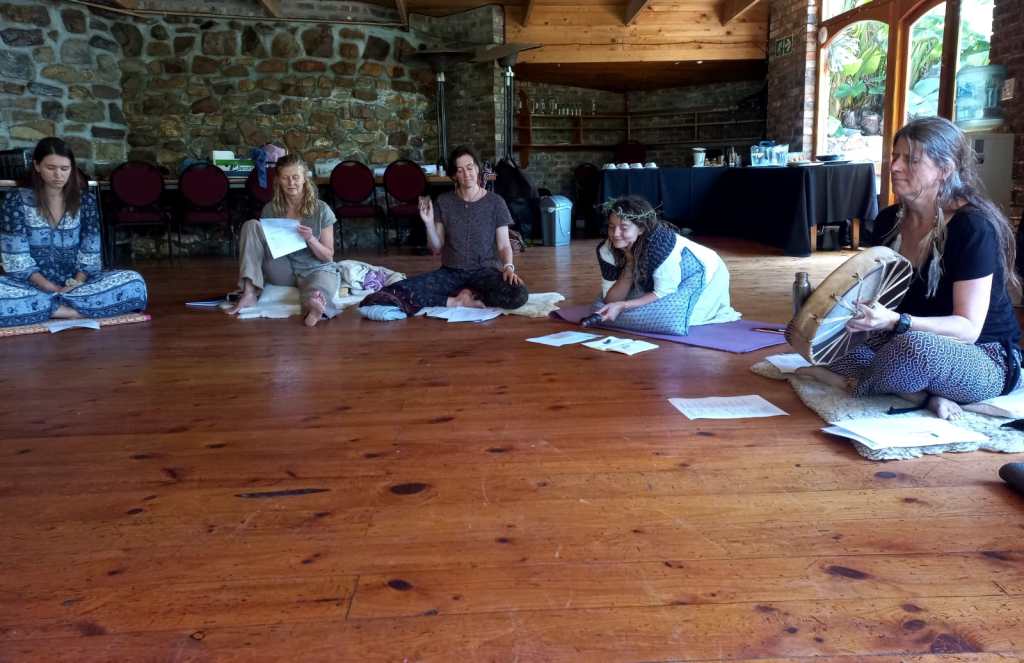
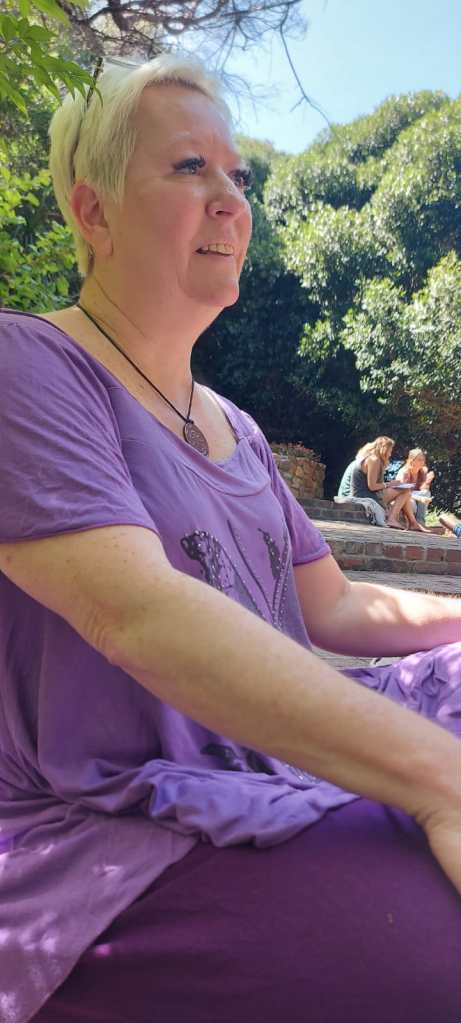
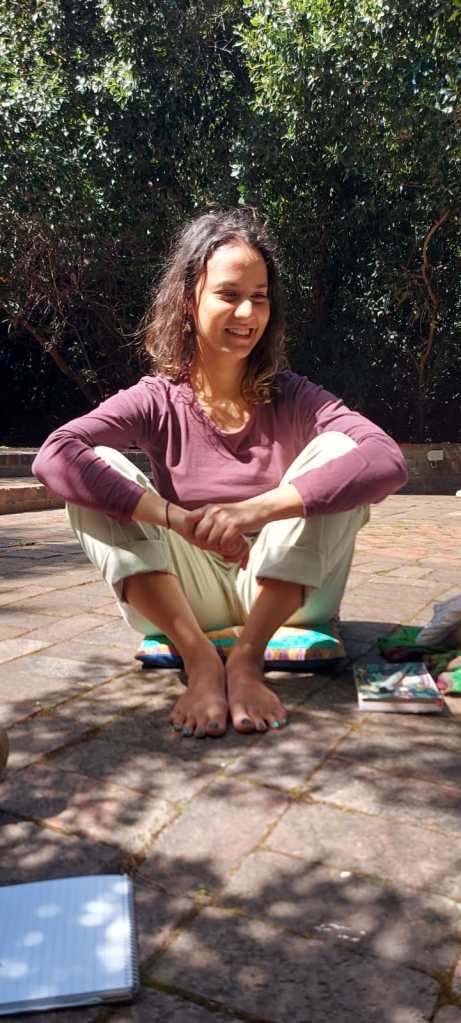
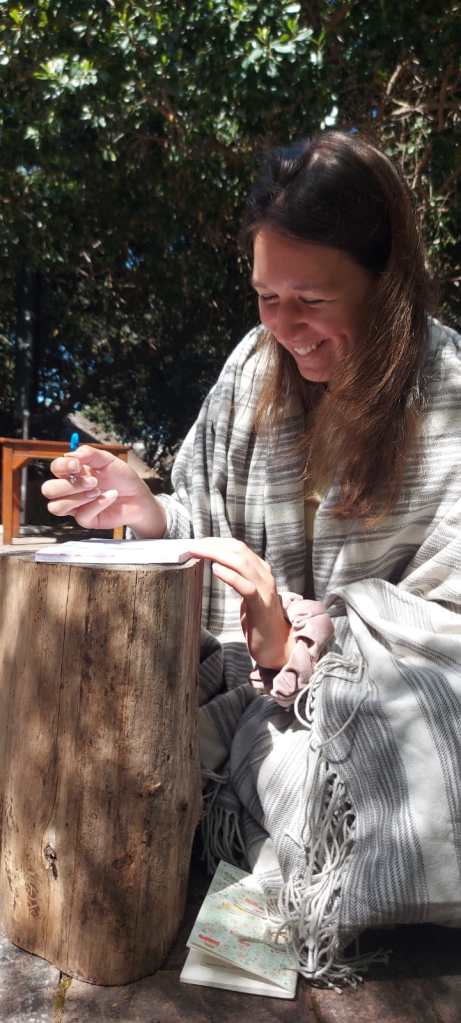
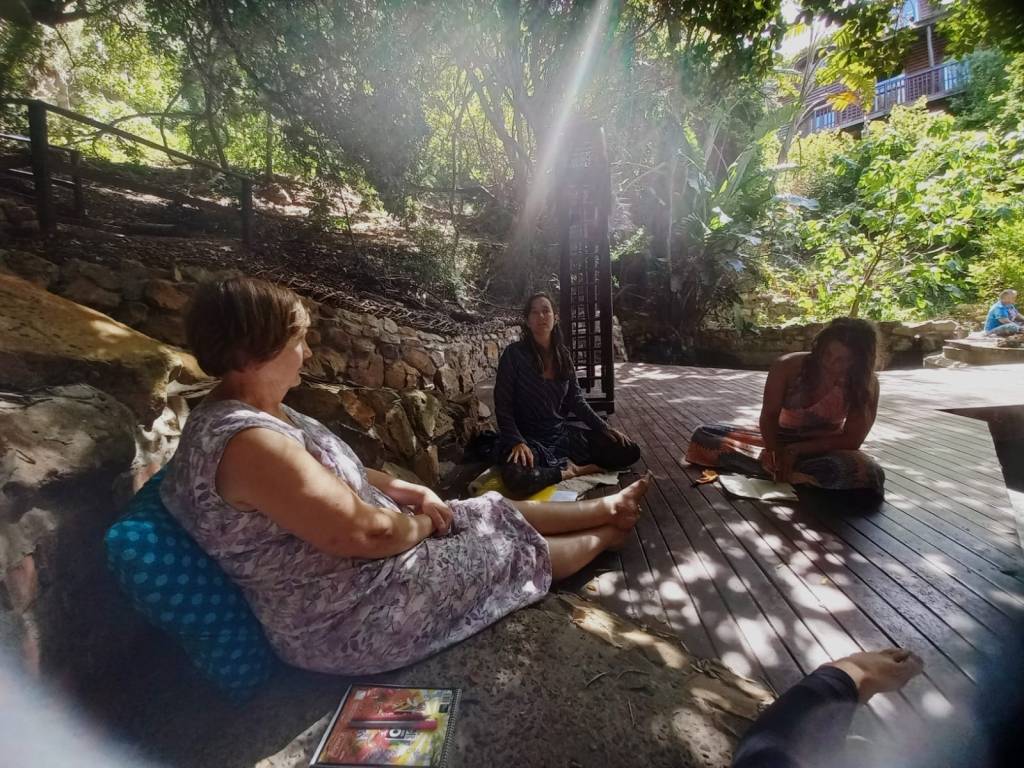
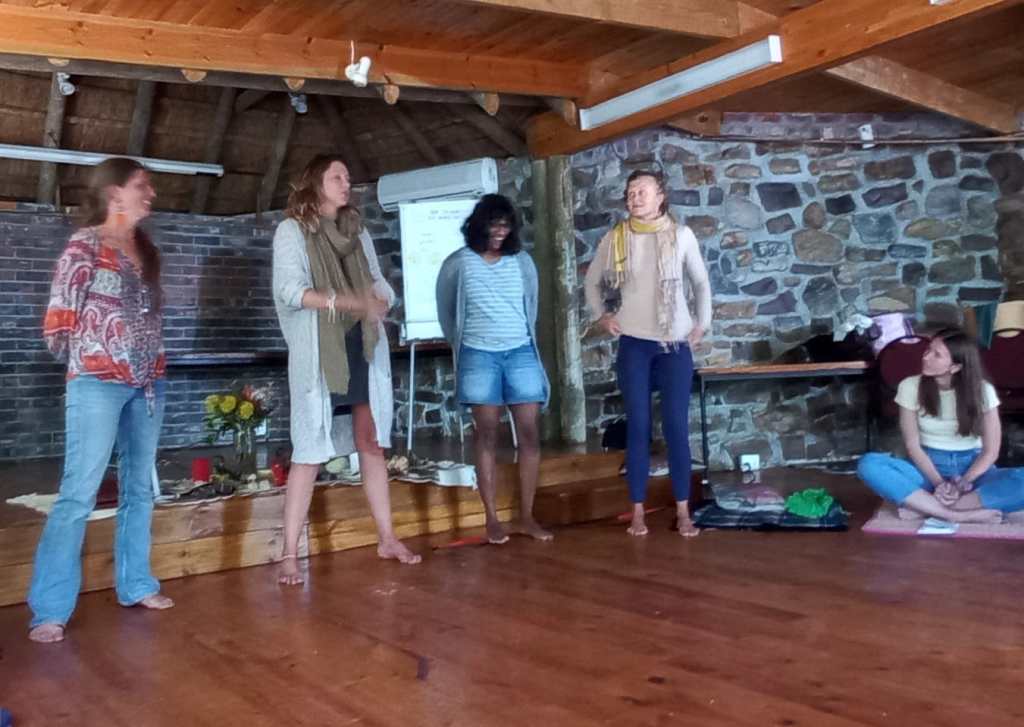
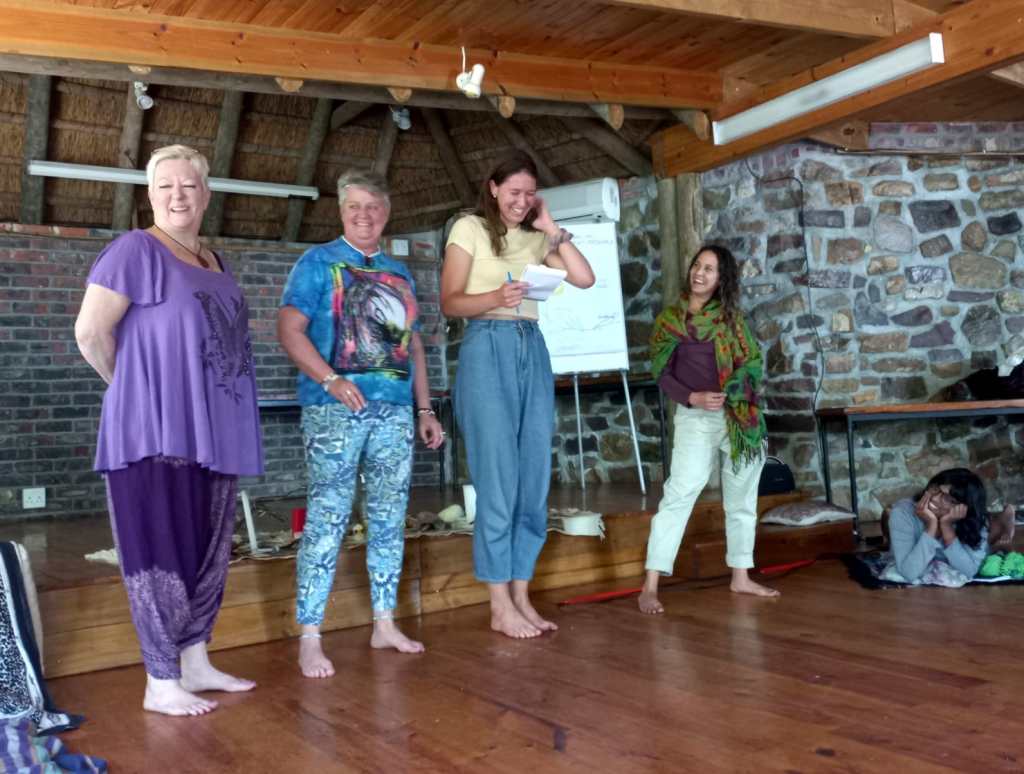
Sharing some of the cherished moments of shared gratitude, pain, renewal and transformation that we experienced during our 2-day annual retreat at the end of October.
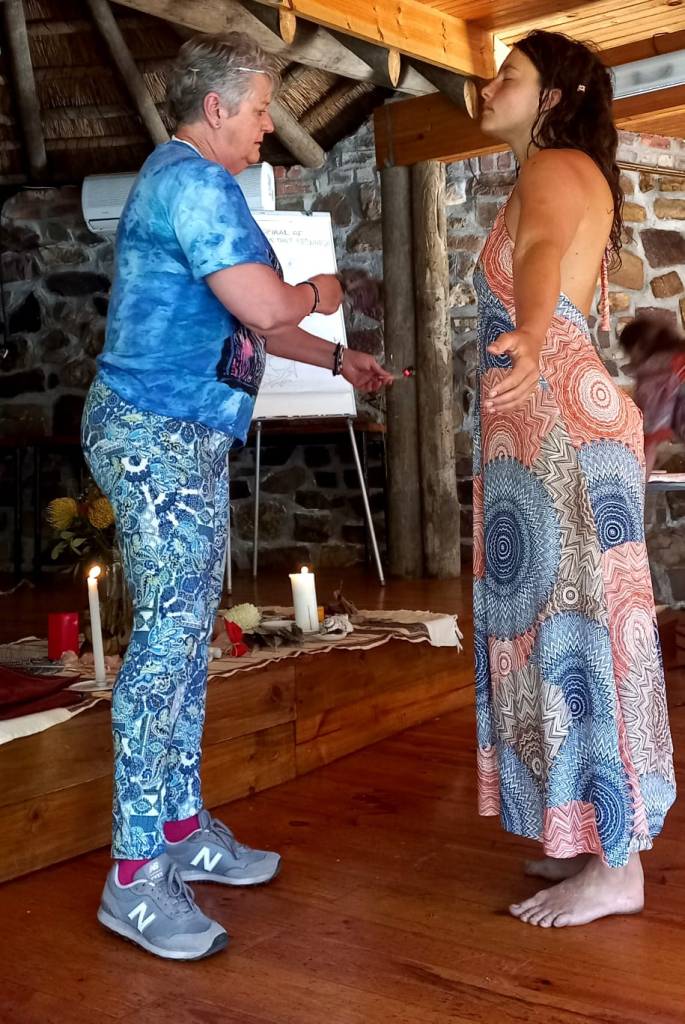
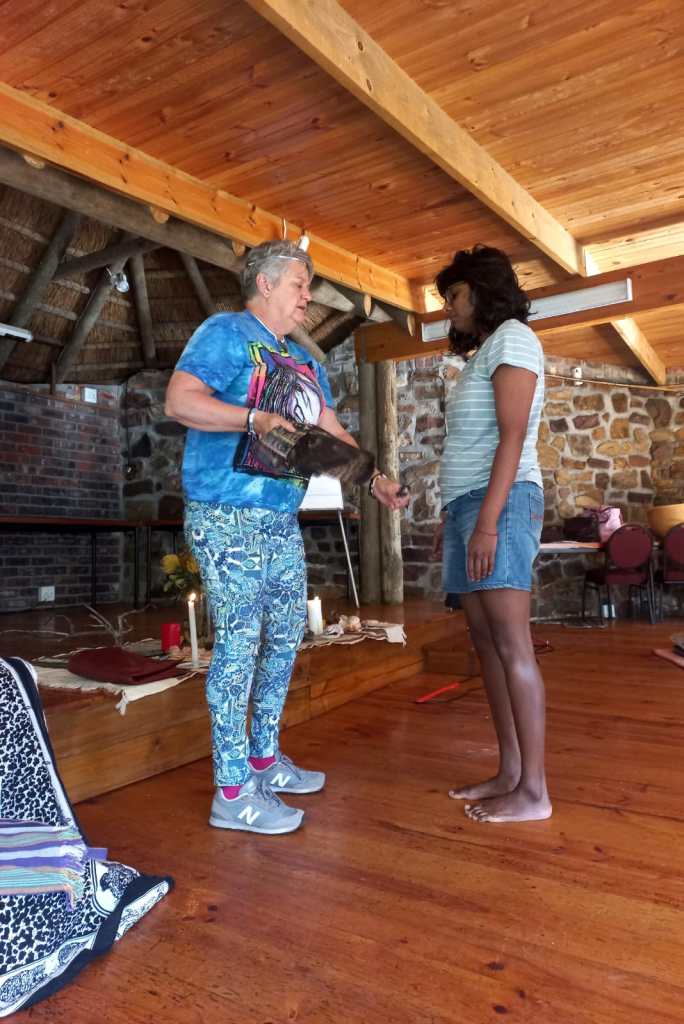
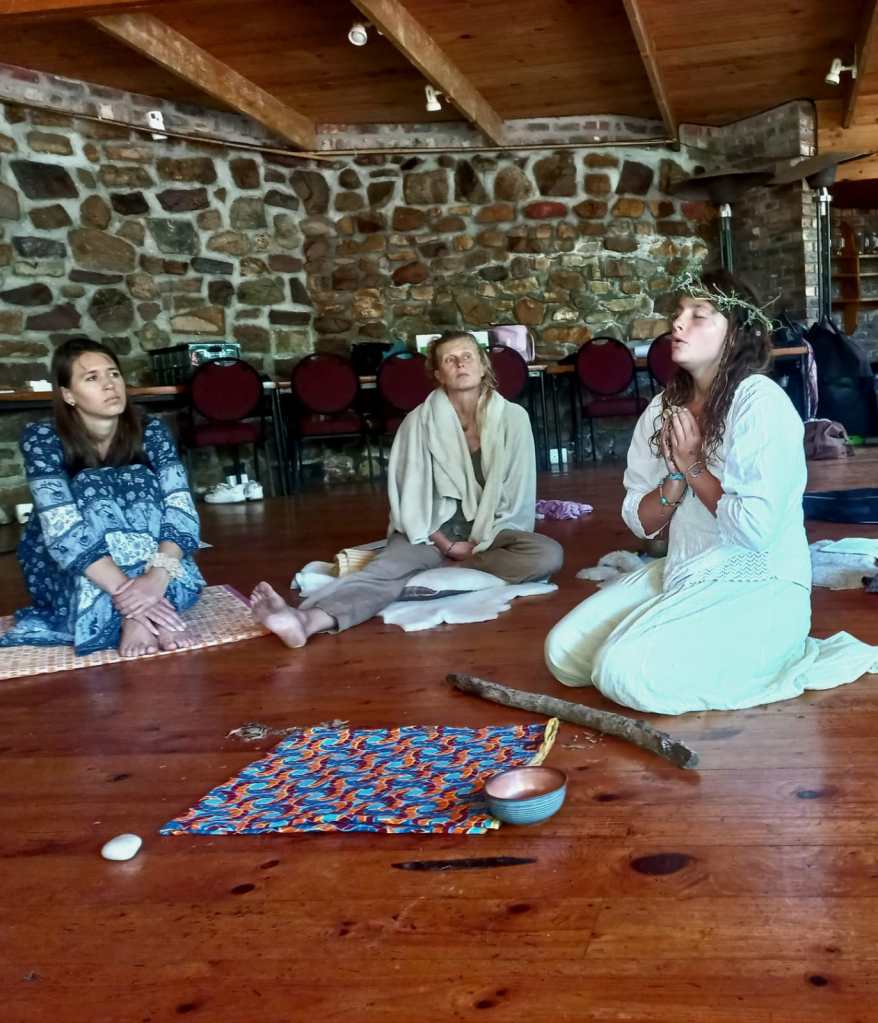
On the first morning, we call upon many sacred rituals to truly and fully land in our bodies, in the space and in the group. Rev Tass Two Crows Flying consecrates us and the altar where we have placed our tokens of reverence for the elements through smudging with burned herbs. Tass calls in the directions and reads the Haudenosaunee Prayer from the Iroquoi first Nation.
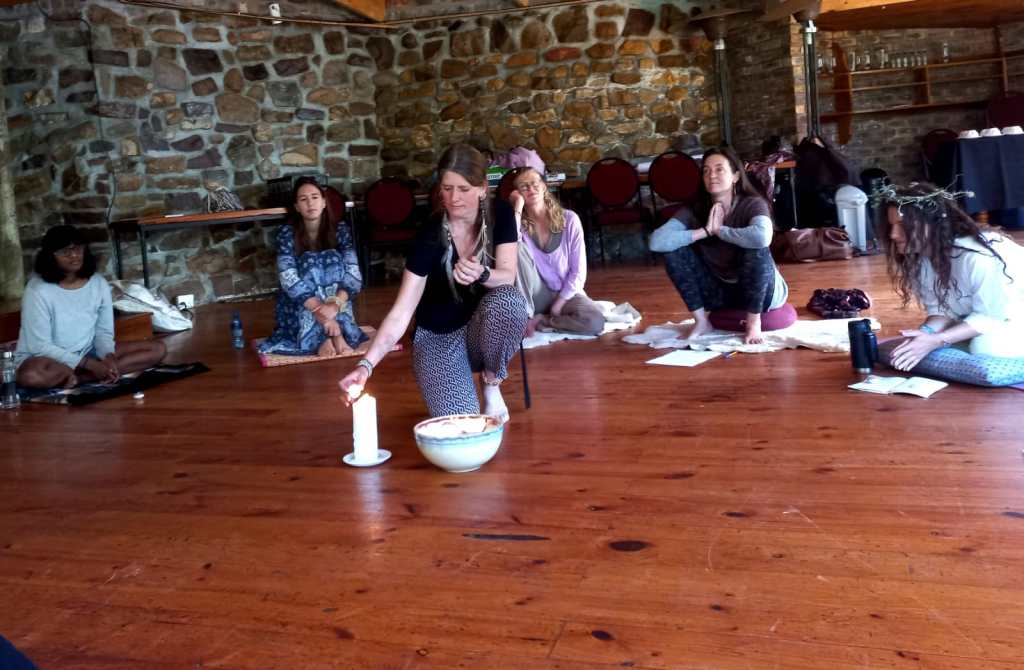
The “lapa” room at Monkey Valley is a beautiful wooden hall with large windows overlooking the beach and surrounded by trees, and the perfect setting for our morning free flow dance. We free our bodies and focus only our ears on the songs of artists that Joanna Tomkins has selected, singing praise to our connection to nature and our journey of transformation in the present times. Rachael Millson leads us through connection rituals, adapted from the Work that Reconnects “milling” formats, where we repeatedly and spontaneously meet in a casual walk through the space, meeting each other through our name and the name of our immediate ancestors, honouring our lineage. May their strength be present in ourselves in support of these tasks.
After a more formal introduction to the programme for the weekend and a grounding meditation, we dedicate the work ahead to the Great Turning and we move together into the first stage of the Spiral of the Work That Reconnects: Gratitude.
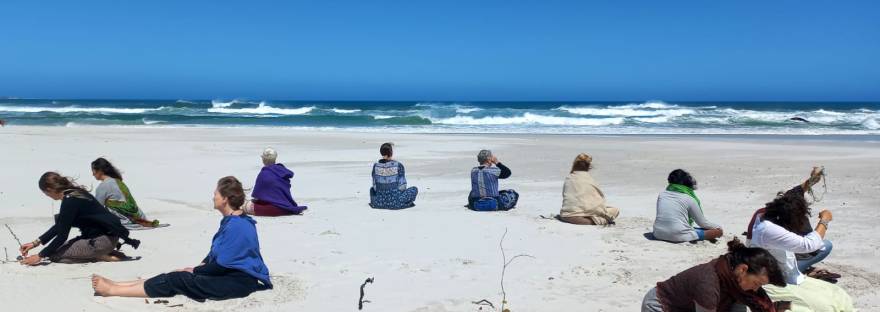
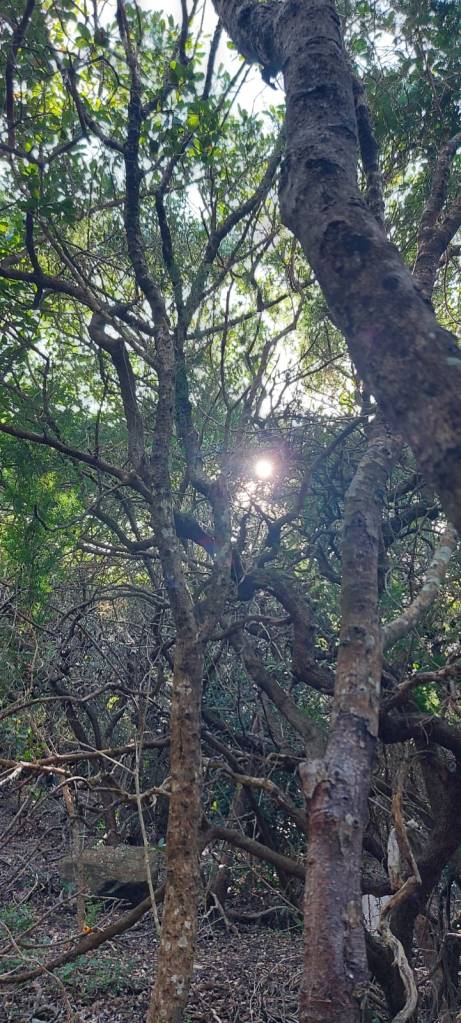
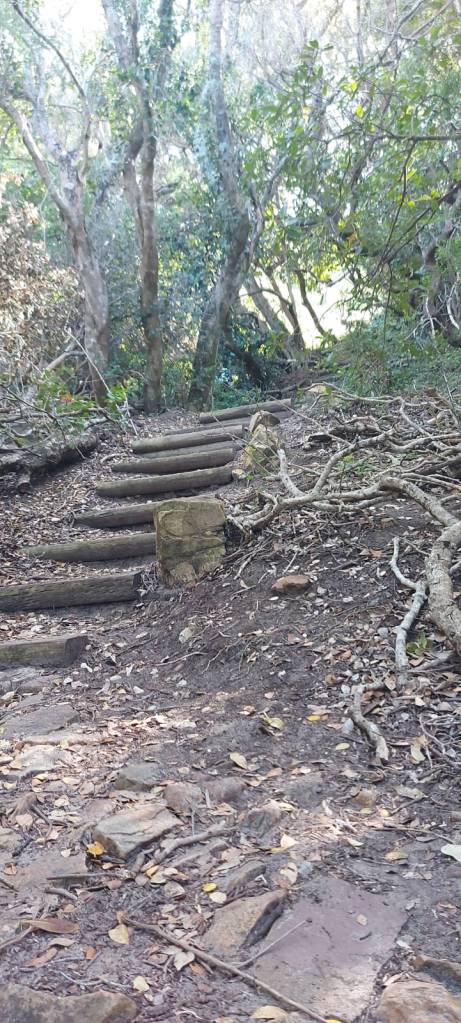
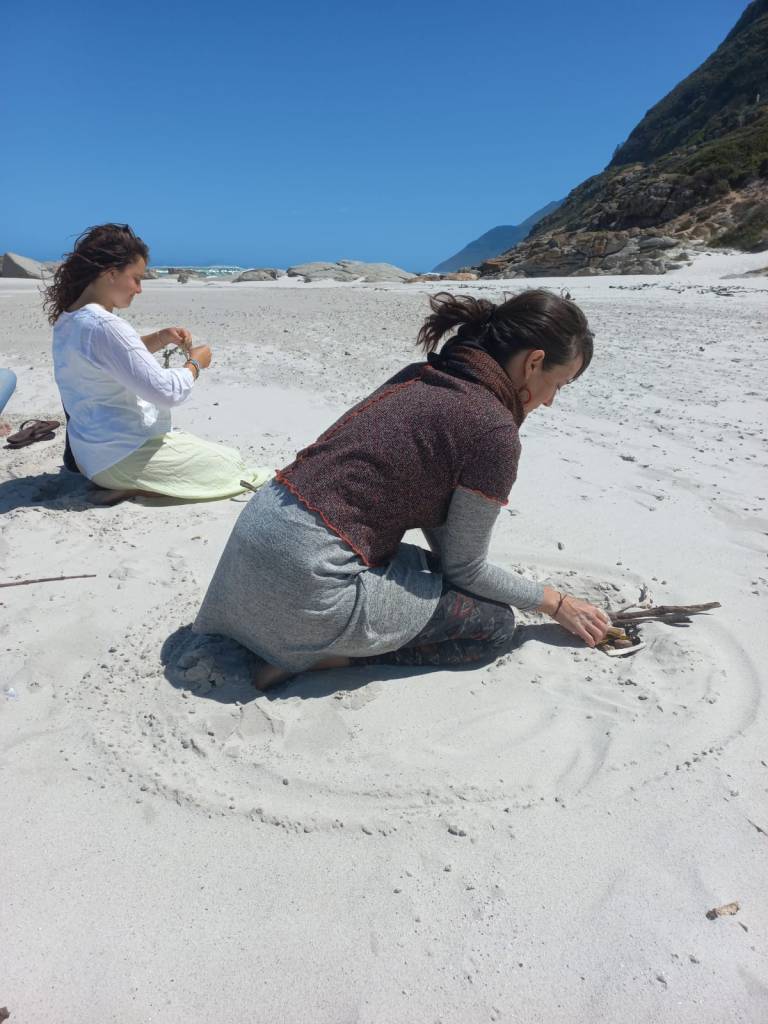
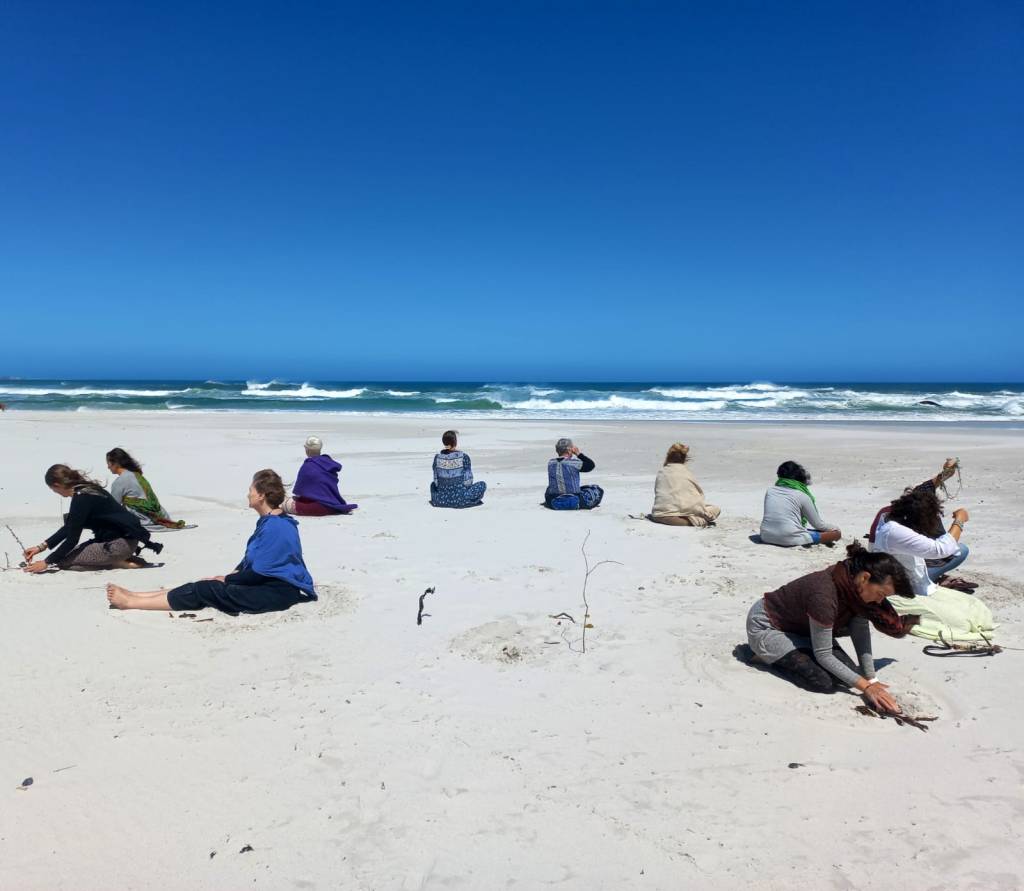
Gratitude is embodied in a silent walk to the beach, harvesting items that nature has left on the ground and building a “Gratitude Circle” on the immense and windswept expanse of Noordhoek Beach. On our silent walk back we return the elements to nature and we choose a spot in the milkwood forest where we will do our solo nature immersion the next day.
In the afternoon the screeches of joy of children splashing in the pool nearby served as a reminder that, as Kahlil Gibran said:
“Some of you say, “Joy is greater than sorrow,” and others say, “Nay, sorrow is the greater.” But I say unto you, they are inseparable. Together they come, and when one sits alone with you at your board, remember that the other is asleep upon your bed.”
In the afternoon, after the buoyant experience of gratitude in our heart-minds, is dedicated to the second stage of the Spiral: Pain for the World. Practices around honouring our pain for the world include the wonderful meditation “Breathing Through” by Joanna Macy and the always powerful ritual of the “Truth Mandala”. We empty our hearts and share with complete vulnerability around feelings of Anger, Emptiness, Sorrow and Fear. This is transformative. We all feel the togetherness, we all feel how the energetic shift inside us and around the room as we move now into the depth of the retreat. With the pain still throbbing within, we move into a spontaneous writing session where our souls free-write through our pens and we release what needs to be freed.
It’s time to introduce the third stage of the spiral and to call in the Beings of the Three Times to remind us of the dimensions of time that we are working across here. This is the stage called Seeing with New Eyes. After a brief for the Nature Immersion the next day, we sing some “songs” from the collection of Songs that Reconnect with Rachael and Joanna on guitar and drum.
Find “that place where your deep gladness and the world’s deep hunger meet.” (Frederick Buechner)
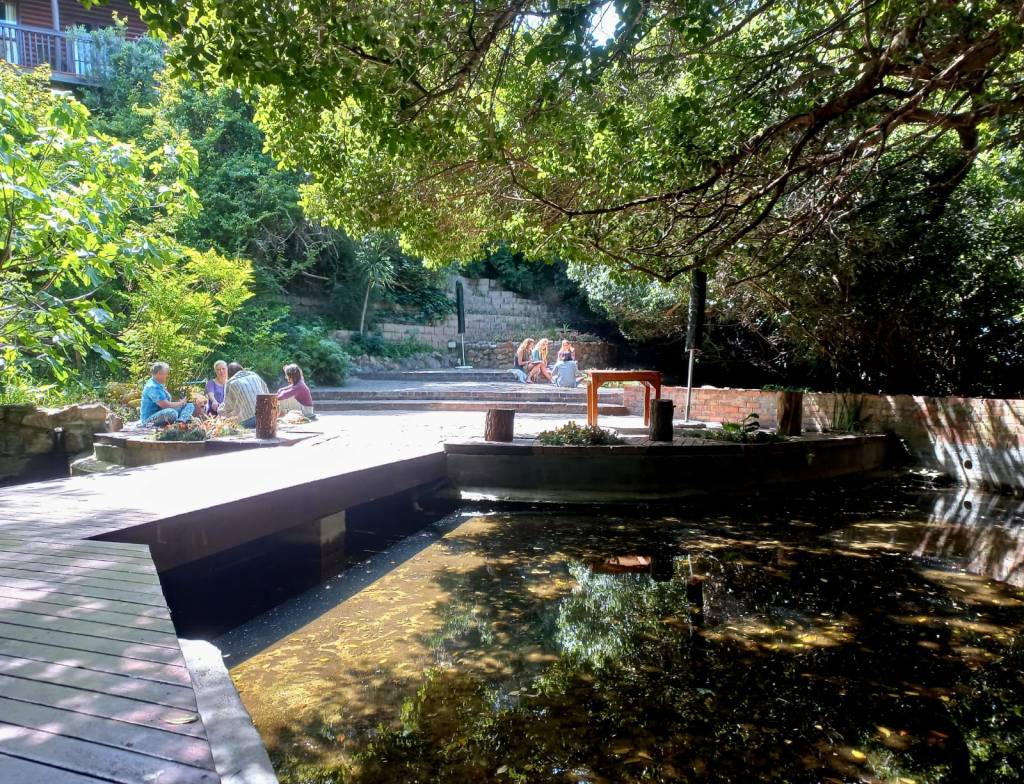
The next day is the one hour nature quest. In stillness and alone, yet held in the knowing of our group, we become present to the sound of the sea, the lives of insects and birds speaking to us, the ripples through the leaves. Deep feelings within us start to surface, framed by this magnificence, where everything is as it should be, in trust and surrender… After we return, still in noble silence, our sharing is rich and diverse and it takes the shape of a story telling workshop. We scatter into three pods of three around the beautiful setting of the Fountain on the Monkey Valley land, fed by the living pure waters pouring from the fynbos covered mountain of Chapman’s Peak that overlooks us. Here we each in turn pour our soul into a story. We then weave that story into a collective thread that is shared with the others as we stand together in our pods, finally back in the hall.
After we eat the foods that we have brought from our homes to share today, what a blessing it is to move again to the free flow of our bodies on the soundtrack woven together by Rachael to accompany the words of wisdom of the “Calling in the Gifts of the Ancestors” meditation!
We end the afternoon, held, grounded, inspired, resourced…,with a renewed sense of purpose, ready to formulate a blueprint of the active hope that wants to be expressed through us. Therefore, after Joanna leads us through the dimensions of the Great Turning, we write in our journals what are the actions we wish to take whilst we Go Forth, in this fourth and last stage of the spiral. And we share lengthly about what we wish to do in a month, and what we actively and collectively hope to be engaged in in a year’s time. We give names to the concrete parts we wish to play in this great transformation we are seeing around us and of which we are part and whole. And Tass closes the directions.
And we know that this spiral does not end, as it is fractal. With the support of this work and strengthened by the increased awareness of the collective energy that supports our ecological beings, we are more prepared now to weave spirals of reawakening into our lives and into the web of life.




.png)













 Gaia Speaking