We were reminded of these vows yesterday during the Gaian Gathering. These are words that we can voice aloud while witnessed in a workshop or to ourselves, as we are always witnessed by the Earth and each other in a myriad of ways. They are such profound anchors for our collective in this time of Great Turning…
I vow to myself and to each of you to commit myself daily to the healing of our world and the welfare of all beings.
I vow to myself and to each of you to live on Earth more lightly and less violently in the food, products and energy I consume.
I vow to myself and to each of you to draw strength and guidance from the living Earth, the ancestors, the future beings and our kin of all species.
I vow to myself and to each of you to seek liberation from patriarchy, colonialism, and racism in all dimensions of my life.
I vow to myself and to each of you to support you in your work for the world, and to ask for help when I need it.
I vow to myself and to each of you to pursue a daily spiritual practice that clarifies my mind, strengthens my heart and supports me in observing these vows.
We are living in challenging times. The systems and culture we have created in our world are showing themselves for the destructive force they are for our planet. Increasing consumption, coupled with population increases means that our human species’ use of resources exceeds the Earth’s capacity by an increasing margin year on year. Today we need around 1.75 planets to provide the resources to meet our demand for consumption and to absorb our waste. According to WWF, by 2050, or even sooner, this will have increased to the need for 2 planets, ‘borrowing nature’ from future generations.
Many of us feel the burden of the irreversible loss of eco-systems, degradation of soils, loss of wild places, pollution of fresh water, and other ecological losses, and experience feelings of deep grief, coupled often with regret for our own lifestyle practices that have contributed towards this.
For others there is continued and growing anxiety about the trajectory the human species is currently following, and further losses that are feeling inevitable- including runaway climate change and species extinctions, even the fear of our own extinction. For many there is a growing feeling of urgency, coupled with the pain of feeling somehow paralysed or powerless.
As we see war unfold again in the Middle East this week, and violence and suffering continuing in many countries across the world, including South Sudan and Ethiopia, the sense of despair and helplessness can feel extremely acute.
Here in South Africa, these feelings of grief and anxiety, present themselves on top of extreme societal ‘complex trauma’, a traumatic history that for many remains unprocessed and unresolved. The adverse living conditions of many South Africans, extreme poverty (currently 45% of South Africa’s population) and extreme inequality (the richest 10% hold 71% of the wealth), compounds this trauma.
All of this can feel extremely distressing and overwhelming.
It’s no surprise it feels this way. The planet Earth is our home, our place of shelter, our provider of all that we need. When we see her change and come under stress, it’s only natural to grieve and to feel concerned. Our fellow people are our brothers and sisters and we all have the capacity to show and receive compassion, deeply rooted in our mammalian instinct of caring.
“We are capable of suffering with our world, and that is the true meaning of compassion. It enables us to recognize our profound interconnectedness with all beings.” – Joanna Macy
And yet, there’s also something much deeper here. All of the losses, the trauma, the destruction, the pain we cause, results from a narrative that still governs our thinking and actions, in a deeply subconscious way – the story of separation. A deep-rooted separation, that stretches back over centuries, from our very selves and our true nature, from each other and from the Earth. This worldview that we exist as individuals, separate from all other individuals and from all other beings in nature, has ripped apart the fabric of what it means to be fully human, and to feel our full belonging first and foremost as members of the Earth community, and to live in the truest sense of ‘Ubuntu’. For many of us, this separation is where our deep grief originates, and it is through holding this grief in community that we will be able to find our way back home.
Grief is not typically invited in our society. The typical response is rather to numb our feelings, finding ways to distract ourselves so we don’t feel the pain. Yet deep grief is a way for us to be present for the world, and to come into our full authentic power to make and support change, with no pretense that we can carry on the way that we are.
“Don’t ever apologize for crying for the trees burning in the Amazon or over the waters polluted from mines in the Rockies. Don’t apologize for the sorrow, grief, and rage you feel. It is a measure of your humanity and your maturity. It is a measure of your open heart, and as your heart breaks open there will be room for the world to heal.” – Joanna Macy
We invite you to join us for a series of Truth Rituals, based on the Work That Reconnects by Buddhist Scholar and Earth Elder, Joanna Macy, and adapted to suit our South African context. These Truth Rituals will be held outdoors in sacred spaces and are open to all. Through coming together and expressing our rage, fear, despair and emptiness, we will find our way back to our hearts and to a way of living in right relation with ourselves, all other beings, and our home planet Earth.
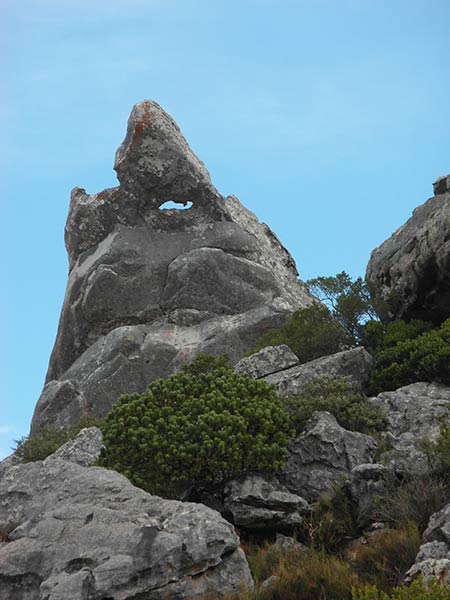
Join us on Sunday 22nd October: 9am – 11.30am for our first ritual of this series, at a very special sacred site – All Seeing Pyramid Rock, Blackhill. Meeting point is at the car park near the top (Sunvalley side) of the Glencairn Expressway and we will all move towards the site together. For more information and bookings please contact us on 061 864 6799 or gaiaspeaking@gmail.com. Recommended donation: R200 – R300
“With this offering, I aim to establish an oasis of sanity, a studio of sanity, and an incubator of sanity for coming times. We have seen in recent years a mounting madness that took on a new and virulent form during the Covid era. Though that particular expression of madness has abated, the social and psychic conditions that spawned it are still in place. Our politics, our culture, and our public discourse swing to new extremes of derangement.
Getting swept up in mass hysteria is just one type of insanity. Resisting it takes a psychic toll. Those who try often succumb instead to despair, depression, addiction, extremism, and conspiracy theories.
I speak here from experience – I too went a little crazy during the Covid years. The experience confirmed that I cannot stay sane alone. At key moments, friends and allies said the right thing to me at the right time and brought me back to sanity. With this program, I aim to pass that gift onward and to create conditions by which many of us can stay sane together.
What do I mean by staying sane?
To hold center, and return to it when you lose it
To hold a good and true story of self and world
To be able to abide in not-knowing for as long as it takes for authentic knowing to emerge
To hold peace amid information warfare
To distinguish and hold your truth in the midst of hysteria
To build sustaining connections with human and other-than-human beings, to have an ongoing experience of kinship.
To build resistance to manipulation and covert fundamentalism
To access a wholesome wellspring of sense, meaning, and identity
To fortify the integrity of body/mind/spirit
To mutually reinforce all of these with others, to form islands of sanity in a world that is still far from sane
To be a seed crystal that brings a higher level of sanity to all you touch”
Hereunder also is an animation that he directed and his interpretation under that…
“Hi everyone, I am so proud to share with you this short film, the first I’ve written and directed myself. It has deep relevance to the theme of this program. I won’t comment on it yet, because I think the story itself exercises more power than any interpretation of it can. So please take it in as you would any other film. Maybe watch it a few times.” – Charles Eisenstein –
“The choice that [this film] represents isn’t only a choice made before lifetimes. It is an ongoing choice, day to day, moment to moment, about how to engage the world.
One way to engage (or really, not engage) is to stay in whatever temporary comfort realm one can manage with distractions, entertainment, addiction. Yet none of these can be permanent, and even the most sublime experiences of immersion in nature or lovemaking cannot be prolonged beyond their right span. At some point, the awareness grows that we are on the brink of a pit, that right beneath us, just a shift of attention away, is a world that begs our service. To rest, to recharge, is important in order to render that service well, but when the batteries are full, restlessness will seize even the most indolent among us. So, the choice to attempt a permanent disengagement from the world to abide in its pleasurable precincts is futile.
A second way to engage is with a heavy spirit of duty, overcoming by force of will a reluctance to enter the fray, carrying a subtle distaste for the lower realms. It comes from a false sense of superiority, and leads as well to a partiality of engagement. One stays half in, half out, never fully committing to embodiment.
The film portrays a third choice. The luminous beings plunge into the pit — all the way in. And they do so in peace, in joy, in serenity. They do not feel sorry for themselves as they take the plunge. They meet their mission gladly.
I will confess — I didn’t actually make this film for you. I made it for me. I’m the one who has so often hung back from life, stayed timidly a little bit above the fray. I’m the one who often engages life joylessly, with too heavy a sense of duty. I’m the one who, sometimes, sees people with ungenerous eyes blind to the truth that they here on the same mission I am.
As I enter more deeply into the “fray” of a political campaign, I hope to do so as the people in the film do — fully, but not as a fighter, not to become a creature of the Pit. I will watch this film from time to time to help me stay serene in the knowledge of what I and all others are really here for. May this film help you, as it has helped me, to see with generous eyes and speak with generous words that summon what is seen into manifestation.”
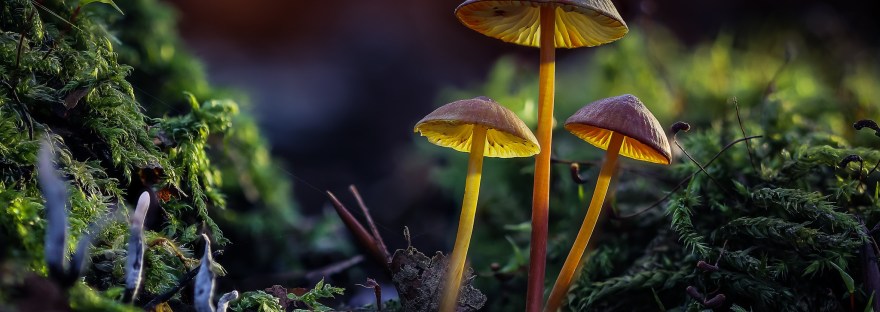
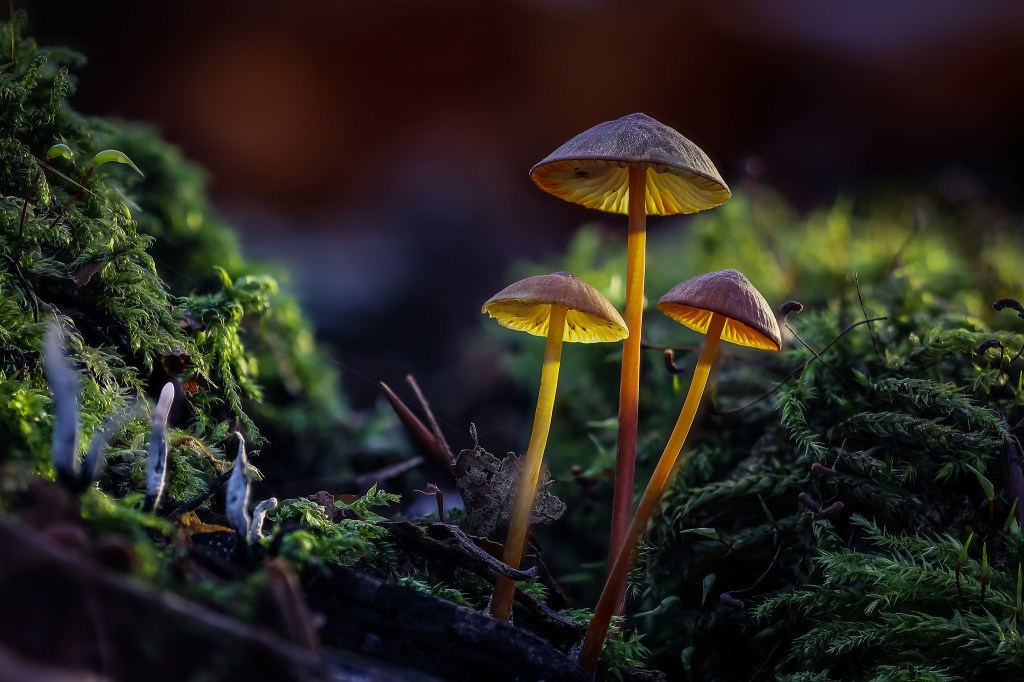
I first heard about the plastic-eating capacity of mycelium during a permaculture course I attended in 2016 when my friend and mycologist Justin White showed us a TED Talk by Paul Stamets about how mushrooms COULD save the world. (You may have seen the 2019 “Fantastic Fungi” documentary that Stamets features in – if you haven’t yet, please do!)
I have felt excited about mycelium ever since because at the time I thought, YES, but of course Mushrooms WILL save the world… It just seemed so clear and I was so grateful for news unusually filled with so much hope.
As I prepare this post today, 14 years after this TED Talk was published, and with an accute sense of urgency, I feel like the mycelium myself, as I navigate from one link to another, from one passionate researcher to another adamant activist, from one fungal function to another attribute of intelligence demonstrated by these incredible species. And I heard someone saying yesterday that mushrooms can absorb radioactive emissions too, and last week I read and shared a campaign from the platform EKO, pitching for funds to develop research for some plastic-devouring heroes. And another mushroom ceremony in the hood. And, and, and…
The healing powers of mushrooms are spreading all over the news just as exponentially as our communication networks themselves. Is there anything they cannot do?!
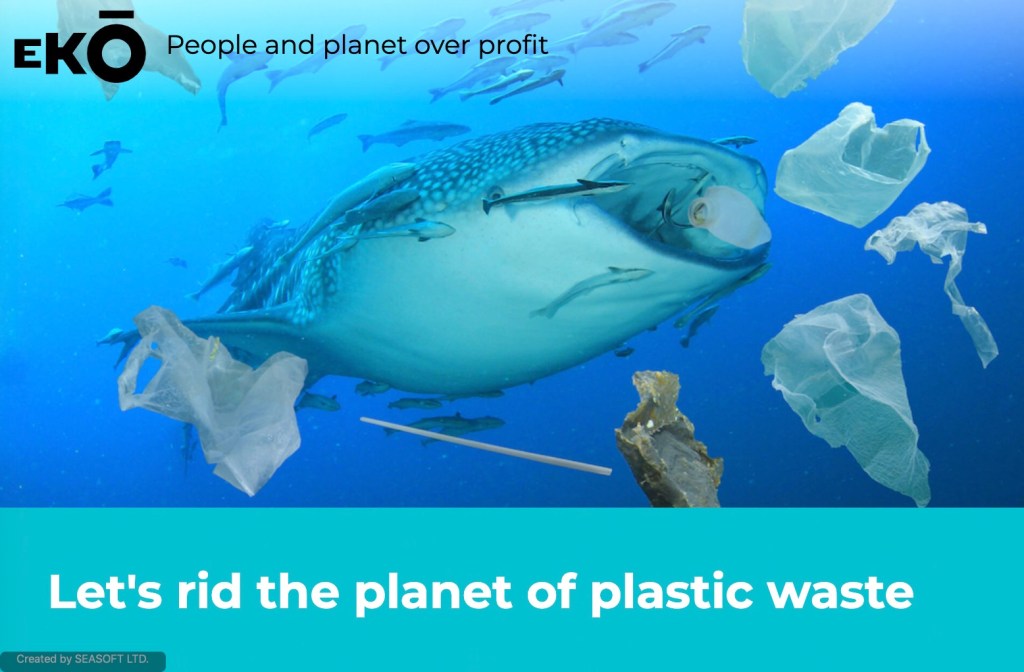
“How amazing is this — scientists have discovered mushrooms that can devour plastic waste in a matter of weeks…plastic that would otherwise remain in the ocean forever.
Right now 91% of the plastics we use can’t be recycled, and every minute another truckloads-worth is dumped into the ocean, suffocating sea life and spreading pollutants across shores.
But scientists say these magnificent mushrooms could eat up to half of the plastic waste being dumped in the ocean. They’re asking for our help to continue their groundbreaking research, and together we could give them the funds they need right away to expand their research in the US and New Zealand.”
The World Wide Web which carries the news became available to us only 30 years ago. On April 30, 1993, the European Organization for Nuclear Research (CERN) put the web that it had developed onto the public domain. In 1993 also, I wrote a research project for university about the “Prospects of Expansion of Electronic Commerce in Spain” . It was minuscule at the time, there were only two shops online in the country (!). I concluded that it seemed unstoppable but that its expansion would depend largely on hardware development and availability – desktop computers I believed at the time!.
Now, in 2023 there are more than 8 billion smart mobile devices in the world, and 65 percent (up from 54 per cent in 2019) of the world’s population are using the Internet.
The speed of technological hardware expansion is terrifying and goes hand in hand with the integration of social networks and software applications, which has gone out of bounds since our society crash landed online after the dramatic “Great Pause” of 2020. The communication system that we call “cloud” is not so ethereal as we wish to believe as we type, record and film on and on. It lives between its massive servers – which would occupy the surface area of entire countries if placed alongside each other– and all our desktop and handheld devices: a vertiginous global network of cell phones, powerbanks, cables, computers, televisions, sound systems, etc, and another even more vertiginous destitute heap of e-waste. This cloud we all float in uses an exponential amount of electricity to manufacture, cool and power. So, to satisfy it we are digging into the Earth, instead of feeding it.
The Earth’s Mushrooms are a form of evolved cointelligence which can support us as we find ways to support the transformation of our own Human society. We/They need a human critical mass to be better connected to the Earth in order to understand the principles of interbeing and cointelligence.
So, want I’m wanting to highlight here I think, is that there is a huge opportunity in the spread of the online ‘aerial’ mycelium that connects us all. Even if there is aggression and waste in its making, for we can indeed share precious news and tools for the shift in consciousness that needs to happen now. Yet, we need to change our worldview so that it can evolve through sustainable and ethical practices, so that the channels we choose and the contents we communicate, exchange and trade via these networks become more life-sustaining and life-enhancing as soon as possible.
Prototaxites hundreds of millions of years old
The story says that between 350 and 420 million years ago, there were already fungal organisms with trunks up to 7 metres high. For hundreds of millions of years, these families have been hard at work. This mycelium constantly transforming matter, sharing information and nutrients has always been working symbiotically with other species to thrive and sustain on behalfof life on Earth. Let’s mimic that better now, while we still have a chance to learn. Let’s aim wide, and wider still!
Originally written by Steve Taylor, Senior Lecturer in Psychology, Leeds Beckett University, and published in theconversation.com.
Throughout history, people who have gained positions of power tend to be precisely the kind of people who should not be entrusted with it. A desire for power often correlates with negative personality traits: selfishness, greed and a lack of empathy. And the people who have the strongest desire for power tend to be the most ruthless and lacking in compassion.
Often those who attain power show traits of psychopathy and narcissism. In recent times, psychopathic leaders have been mostly found in less economically developed countries with poor infrastructures and insecure political and social institutions. People such as Saddam Hussein in Iraq, Muammar Gaddafi in Libya and Charles Taylor in Liberia.
But modern psychopaths generally don’t become leaders in affluent countries (where they are perhaps more likely to join multinational corporations). In these countries, as can be seen in the US and Russia, there has been a movement away from psychopathic to narcissistic leaders.
After all, what profession could be more suited to a narcissistic personality than politics, where the spotlight of attention is constant? Narcissists feel entitled to gain power because of their sense of superiority and self-importance.
Those with narcissistic personalities tend to crave attention and admiration and feel it is right that other people should be subservient to them. Their lack of empathy means they have no qualms about exploiting other people to attain or maintain their power.
Meanwhile, the kind of people who we might think are ideally suited to take on positions of power – people who are empathetic, fair minded, responsible and wise – are naturally disinclined to seek it. Empathetic people like to remain grounded and interact with others, rather than elevating themselves. They don’t desire control or authority, but connection, leaving those leadership roles vacant for those with more narcissistic and psychopathic character traits.
Different types of leader
Yet it would be misleading to say it is only psychopaths and narcissists who gain power. Instead, I would suggest that there are generally three types of leaders.
The first are accidental leaders who gain power without a large degree of conscious intention on their part, but due to privilege or merit (or a combination). Second are the idealistic and altruistic leaders, probably the rarest type. They feel impelled to gain power to improve the lives of other people – or to promote justice and equality, and try to become instruments of change. But the third are the narcissistic and psychopathic leaders, whose motivation for gaining power is purely self-serving.
This doesn’t just apply to politics, of course. It’s an issue in every organisation with a hierarchical structure. In any institution or company, there is a good chance that those who gain power are highly ambitious and ruthless, and lacking in empathy.
Narcissistic leaders may seem appealing because they are often charismatic (they cultivate charisma in order to attract attention and admiration). As leaders they can be confident and decisive and their lack of empathy can promote a single-mindedness which can, in some cases, lead to achievement. Ultimately though, any positive aspects are far outweighed by the chaos and suffering they create.
An anti-Trump demonstration in Washington DC. Shutterstock/bakdc What is needed are checks to power – not just to limit the exercise of power, but to limit its attainment. Put simply, the kind of people who desire power the most should not be allowed to attain positions of authority.
Every potential leader should be assessed for their levels of empathy, narcissism or psychopathy to determine their suitability for power. At the same time, empathetic people – who generally lack the lust to gain power – should be encouraged to take positions of authority. Even if they don’t want to, they should feel a responsibility to do so – if only to get in the way of tyrants.
Models of society
There are many tribal hunter-gatherer societies where great care is taken to ensure that unsuitable individuals don’t attain power.
Instead, anyone with a strong desire for power and wealth is barred from consideration as a leader. According to anthropologist Christopher Boehm, present-day foraging groups “apply techniques of social control in suppressing both dominant leadership and undue competitiveness”.
If a dominant male tries to take control of the group, they practise what Boehm calls “egalitarian sanctioning”. They team up against the domineering person, and ostracise or desert him. In this way, Boehm says, “the rank and file avoid being subordinated by vigilantly keeping alpha-type group members under their collective thumbs”.
Just as importantly, in many simple hunter-gatherer groups power is assigned to people, rather than being sought by them. People don’t put themselves forward to become leaders – other members of the group recommend them, because they are considered to be experienced and wise, or because their abilities suit particular situations.
San hunter gatherers in Southern Africa
In some societies, the role of leader is not fixed, but rotates according to different circumstances. As another anthropologist, Margaret Power, noted: “The leadership role is spontaneously assigned by the group, conferred on some members in some particular situation … One leader replaces another as needed.”
In this way, simple hunter-gatherer groups preserve stability and equality, and minimise the risk of conflict and violence.
It’s true that large modern societies are much more complex and more populous than hunter-gatherer groups. But it may be possible for us to adopt similar principles. At the very least, we should assess potential leaders for their levels of empathy, in order to stop ruthless and narcissistic people gaining power.
We could also try to identify narcissists and psychopaths who already hold positions of power and take measures to curtail their influence. Perhaps we could also ask communities to nominate wise and altruistic people who would take an advisory role in important political decisions.
No doubt all this would entail massive changes of personnel for most of the world’s governments, institutions and companies. But it might ensure that power is in the hands of people who are worthy of it, and so make the world a much less dangerous place.
With much gratitude for this insightful article. Gaia Speaking
Who would have thought that doughnuts could change the world?
by Joanna Tomkins
They certainly get our attention, don’t they? In the same way we may ourselves once have been addicted to eating doughnuts, our policies are still addicted to promoting growth, even if it harms us each and and every time.
But… now we have got your attention, as you will see hereunder in the graphics, the doughnut in this model is in fact the shape that represents a “safe and just space for humanity”…
The text hereunder, originally published on the DEAL website, offers a comprehensive and convincing introduction to the Doughnut or Donut model. This umbrella is very exciting because its design has enough strength and simplicity to allow policy makers to regroup under it. I personally studied international business at university in France and Spain and I was so put off by some of the contents of the studies, particularly the economical theories, seminars with bankers and practicals in marketing, that I swore to never work for a large corporation. Much later, after I rerouted my career towards arts and also started to work in Africa as a wilderness guide, I went back to university in Barcelona to study Post-developmental African Studies. This was before I moved to Cape Town, wanting to learn about some of the original philosophies on the Continent and the forces at work behind the neocolonialism that still stifle them today. I rallied around the ideas of Serge Latouche (Farewell to Growth, 2007) and his peers. Since the 1980s, voices such as his have been loudly coining terms such as “economical footprint”, “eco-feminism, “overshoot”, etc, and claiming urgency. Yet, those voices have been drowned by the constantly renewed pressure from the Industrial Growth Society.
Finally, in the last few years, at the same time as a larger part of humanity starts to call for socio-economical justice – the one with the privilege to do so and be heard- , some strong, credible and conscious voices have created new alternative economical models that can be understood by many. They are now becoming mainstream and can offer politicians solid solutions to build resilience in the communities whose welfare they are responsible for. Gratitude.
If you are interested in learning more, please read some of the Stories on DEAL. This one for example about how the model has been adopted by 5 major cities around the world:
If you know how this model could be introduced to the University of Cape Town, or the City of Cape Town, please get in touch with me, I’d love to get involved.
Introduction
The Doughnut offers a vision of what it means for humanity to thrive in the 21st century – and Doughnut Economics explores the mindset and ways of thinking needed to get us there.
First published in 2012 in an Oxfam report by Kate Raworth, the concept of the Doughnut rapidly gained traction internationally, from the Pope and the UN General Assembly to Extinction Rebellion.
Kate’s 2017 book, Doughnut Economics: seven ways to think like a 21st century economist, further explored the economic thinking needed to bring humanity into the Doughnut, drawing together insights from diverse economic perspectives in a way that everyone can understand. The book has now been published in over 20 languages.
This 2018 TED talk gives a summary of the book’s core messages, and you can read Chapter One here..
The Doughnut’s holistic scope and visual simplicity, coupled with its scientific grounding, has turned it into a convening space for big conversations about reimagining and remaking the future. It is now being discussed, debated and put into practice in education and in communities, in business and in government, in towns, cities and nations worldwide.
Kate Raworth
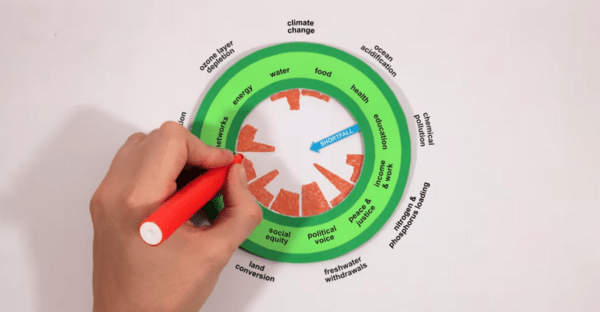
The Doughnut of social and planetary boundaries.
What is the Doughnut?
Think of it as a compass for human prosperity in the 21st century, with the aim of meeting the needs of all people within the means of the living planet.
The Doughnut consists of two concentric rings: a social foundation, to ensure that no one is left falling short on life’s essentials, and an ecological ceiling, to ensure that humanity does not collectively overshoot the planetary boundaries that protect Earth’s life-supporting systems. Between these two sets of boundaries lies a doughnut-shaped space that is both ecologically safe and socially just: a space in which humanity can thrive.
What is Doughnut Economics?
If the 21st century goal is to meet the needs of all people within the means of the living planet – in other words, get into the Doughnut – then how can humanity get there? Not with last century’s economic thinking.
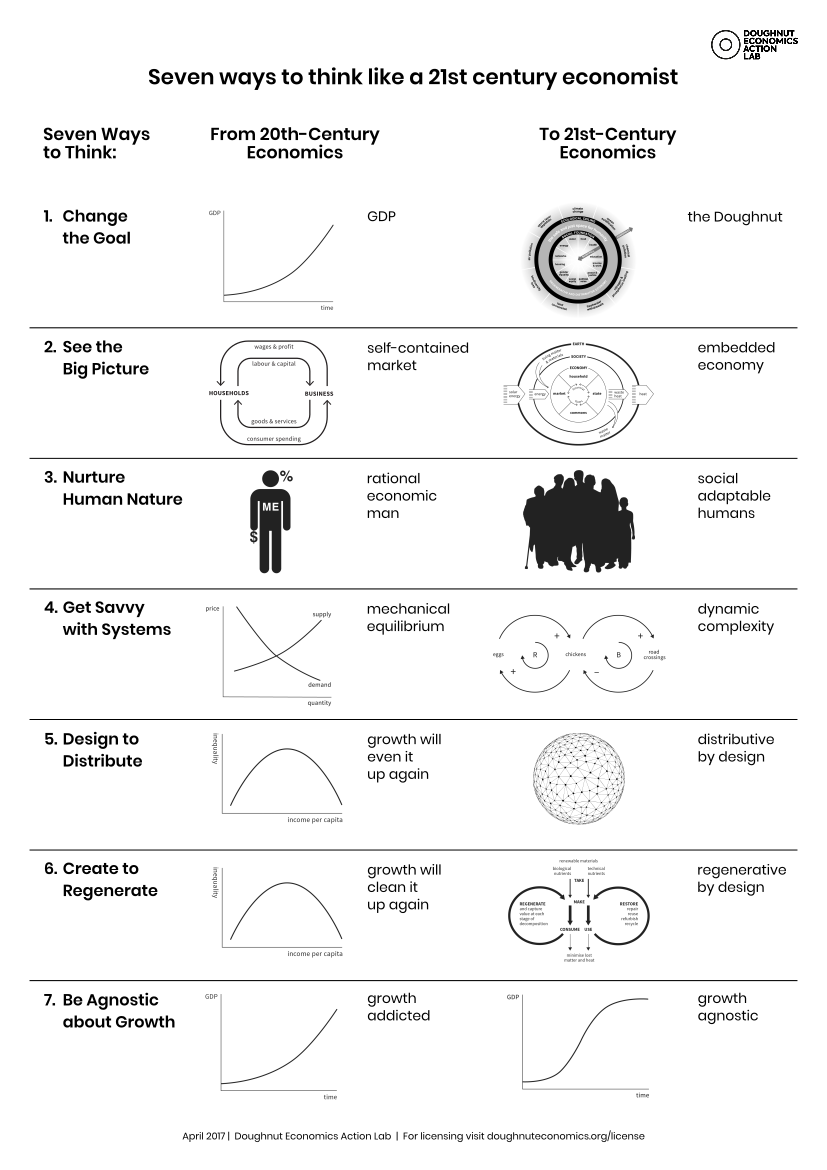
Doughnut Economics proposes an economic mindset that’s fit for our times. It’s not a set of policies and institutions, but rather a way of thinking to bring about the regenerative and distributive dynamics that this century calls for. Drawing on insights from diverse schools of economic thought – including ecological, feminist, institutional, behavioural and complexity economics – it sets out seven ways to think like a 21st century economist in order to transform economies, local to global.
The starting point of Doughnut Economics is to change the goal from endless GDP growth to thriving in the Doughnut. At the same time, see the big picture by recognising that the economy is embedded within, and dependent upon, society and the living world. Doughnut Economics recognises that human behaviour can be nurtured to be cooperative and caring, just as it can be competitive and individualistic.
It also recognises that economies, societies, and the rest of the living world, are complex, interdependent systems that are best understood through the lens of systems thinking. And it calls for turning today’s degenerative economies into regenerative ones, and divisive economies into far more distributive ones. Lastly, Doughnut Economics recognises that growth may be a healthy phase of life, but nothing grows forever: things that succeed do so by growing until it is time to grow up and thrive instead.
Dive deeper into the seven ways to think like a 21st century economist with our series of 90-second animations.
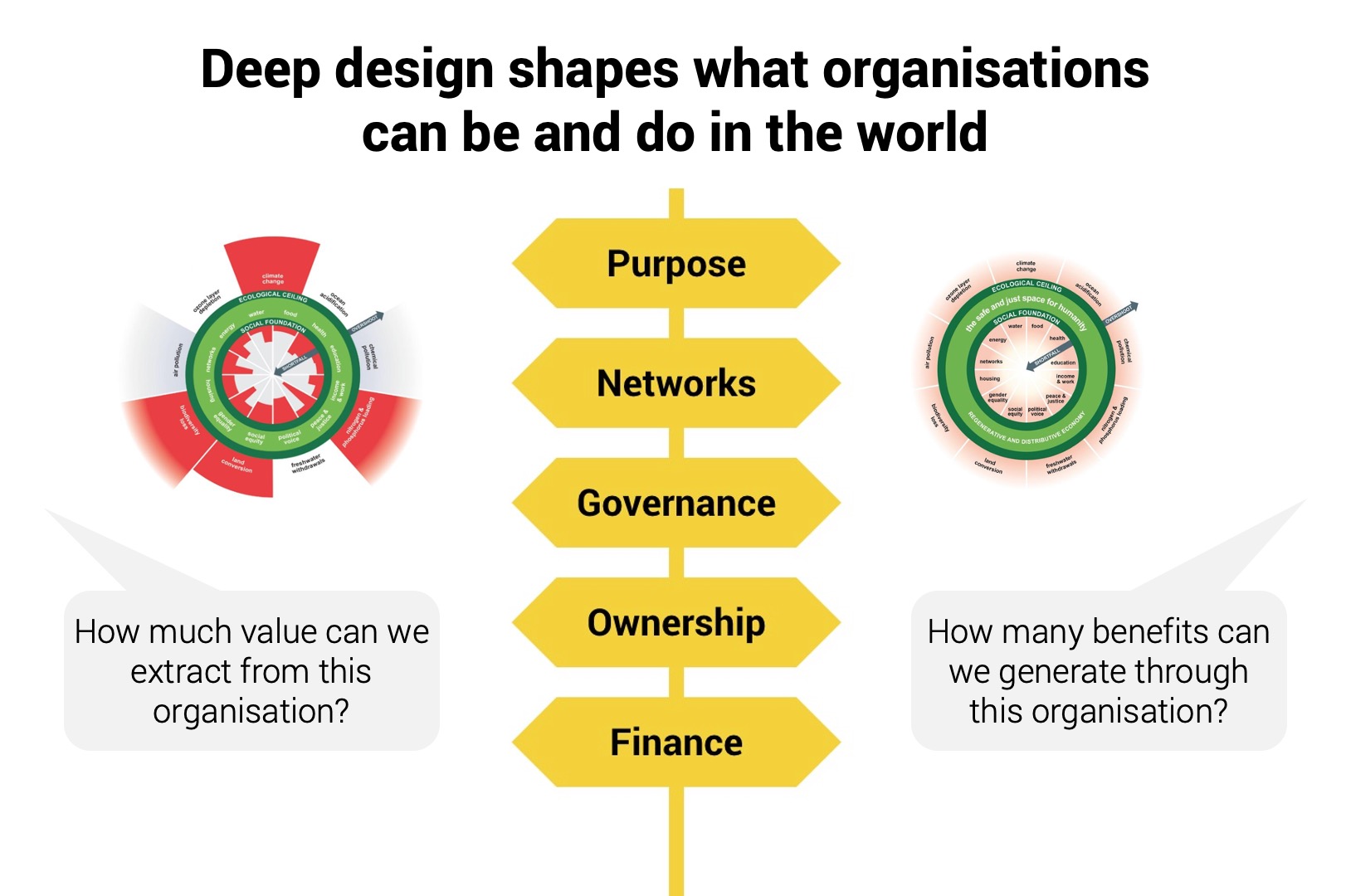
The five layers of organisational design.
Why design matters
What would make it possible for an organisation to become regenerative and distributive so that it helps bring humanity into the Doughnut? DEAL has run workshops with enterprises, city departments, foundations, and other kinds of organisations that want to explore this question, and the implications are transformational.
At the heart of these workshops is a focus on design: not the design of their products and services, or even of their office buildings, but the design of the organisation itself. As described by Marjorie Kelly, a leading theorist in next-generation enterprise design, there are five key layers of design that powerfully shape what an organisation can do and be in the world:
Together these five aspects of organisational design profoundly shape any organisation’s ability to become regenerative and distributive by design, and so help bring humanity into the Doughnut.
Doughnut Principles of Practice
To ensure the integrity of the ideas of Doughnut Economics, we ask that the following principles are followed by any initiative that is working to put the ideas of Doughnut Economics into practice.
Embrace the 21st Century Goal
Aim to meet the needs of all people within the means of the planet. Seek to align your organisation’s purpose, networks, governance, owner-ship and finance with this goal.
See the big picture
Recognise the potential roles of the household, the commons, the market and the state – and their many synergies – in transforming economies. Ensure that finance serves the work rather than drives it.
Nurture human nature
Promote diversity, participation, collaboration and reciprocity. Strengthen community networks and work with a spirit of high trust. Care for the wellbeing of the team.
Think in systems
Experiment, learn, adapt, evolve and aim for continuous improvement. Be alert to dynamic effects, feedback loops and tipping points.
Be distributive
Work in the spirit of open design and share the value created with all who co-created it. Be aware of power and seek to redistribute it to improve equity amongst stakeholders.
Be regenerative
Aim to work with and within the cycles of the living world. Be a sharer, repairer, regenerator, steward. Reduce travel, minimize flights, be climate and energy smart.
Aim to thrive rather than to grow
Don’t let growth become a goal in itself. Know when to let the work spread out via others rather than scale up in size.
Be strategic in practice
Go where the energy is – but always ask whose voice is left out. Balance openness with integrity, so that the work spreads without capture. Share back learning and innovation to unleash the power of peer-to-peer inspiration.
The size of the networks of solidarity expressing and providing support to Ukrainian refugees is another sign of the capacity of human populations to come together to share their feelings and act upon them. When we open our hearts to the other, individual or collective, human or more-than-human, we are apparently able to reverse years of injustice.
Let us take good note, as Gaia teaches us how to come together. Whilst we fight opinion wars around the scary viruses and the dark oils she produces from her bowels, we are coming together through networking. We are developing the capacity to respond en masse to disaster. We are developing resilience as we slowly come to realise that we need to drop what we are doing to run helter-skelter to the bedside of our sick Mother.
Aaah, here you are, she smiles. I Knew you would come! So you took me for granted, did you?, she cries. As Mother squeezes black oil out of her body, she moans, Can you not see me crying!?
Although our planet shows signs of illness daily with unbalanced ecosystems, biodiversity loss and climate change, she is widely ignored. So, she sent a message for all to receive, from the tyrants of the Kremlin to the humblest Amazonian tribesmen, one that at the core of our ego, one that can threaten our life if we ignore it. This hyper-sophisticated virus carries varying ethos-changing messages for all, whether awoken by fear of suffering, or toppled into passionate love for life, no-one has been left unshaken. Have we heard her plea now? Can we decrypt and put to good use the information we received as individuals, who are also part of the human collective and part and parcel of the Earth? As first world refugees are in the spotlight, do we remember the hunger-stuck refugees who have been huddling in tents in the desert for years? As we breathe through plastic ventilators or clad our beautiful faces with plastic masks, do we remember how our bodies deserve to be fed and cared for, the bodies that our Mother gave us?
Our collective Pain for the World is breaking free now so that we can prioritise and get our response armies trained and organised… Yet, can we feel the urgency in the ecological unravelling that we still perceive as intangible? Surely, yes! If we are able to feel pangs of solidarity in response to these recent crises, even at a distance, our fingers brushing our screens, we must be reviving the muscles of our natural response to danger, we must be noting that it is all connected. And when our fingers brush the leaves, our eyes sweep the horizon, our hearts will open to the realisation that we Knew, we always Knew, that this is why we are here. Close to eight billion individuals have a role to play, with two hundred thousand newcomers daily. We have been called to be a part of the Great Turning.
Focusing on regeneration in all aspects of life is a truly possible solution to the mess that we are in. From an economical perspective, in the Business as Usual set up, there are more companies who realise today that higher long term benefits will be reaped by investing in soils instead of pesticides, investing in community cohesion instead of privileged elites, investing in nutritious food and not in pharma, etc. On an individual scale, we are awakening to the reality that we can regenerate our mind and our gut, by respectively introducing awareness practices in our lives and by buying and growing alive foods.
Triggered by the mediatising of global, polarising medico-political debates, major ideological shifts are planting roots in our society in opposing directions. It seems that all Three Dimensions of the Great Turning are being accelerated. Although pharma is churning out more products and plastic masks are getting tangled in the feet of our already compromised wild birds, individuals are also realising that it is time to reclaim sovereignty over our lives.
For some – as for Vandana Shiva in the video added to this post – increased digitalisation has placed digital barons in a position of dictators, ready to their rules to control. For others, work online and the availability of educational material and live video material has allowed for new forms of expression. Part of the ongoing Shift in Consciousness is happening online through healing modalities, podcasts and blogs, but this does come at the cost of disconnecting us from the Earth and from a much needed, hands-on Regenerative Movement.
After such a long pause, we are all capitalising our hopes on these shifts, in one way or another, awaiting to see a clear picture of our future when the dust settles. But it’s important to act so that these shifts bring us closer to authentic connection to our community and our planet. Are we ready to represent Mother Earth above ourselves and as part of ourselves? Can we focus on deep time, thinking 7 generations back and 7 generations forward, like our indigenous ancestors knew?
We can regenerate dignified lifestyles, where we truly honour ourselves collectively as a society of sovereign beings and as organs of the Earth. Borrowing the terminology that Joanna Macy uses to determine the 3 dimensions of the Great Turning, we need to focus to help birth a radical Shift in Consciousness and like Vandana Shiva, we can also engage and support the Holding Actions thatcan buy us time to do so – all to varying degrees. And importantly, we can exponentially carve out time from our imposed work schedules to dedicate our lives to Sustainable Practices that are honouring of a self affirming Interconnectedness.
In this recent talk, Dr Vandana Shiva warns us about a Digital Dictatorship that threatens our sovereignty.










.png)


 Gaia Speaking