Work That Reconnects facilitator, wilderness guide, documentary maker, ceramicist, singer, soul quester, lover and mother.
Interested in community, rewilding, holistic and systemic thinking.
“I often tell this story in workshops, for it describes the work we aim to do, and the training we engage in. It is about the coming of the Kingdom of Shambhala, and it is about you, and me.”
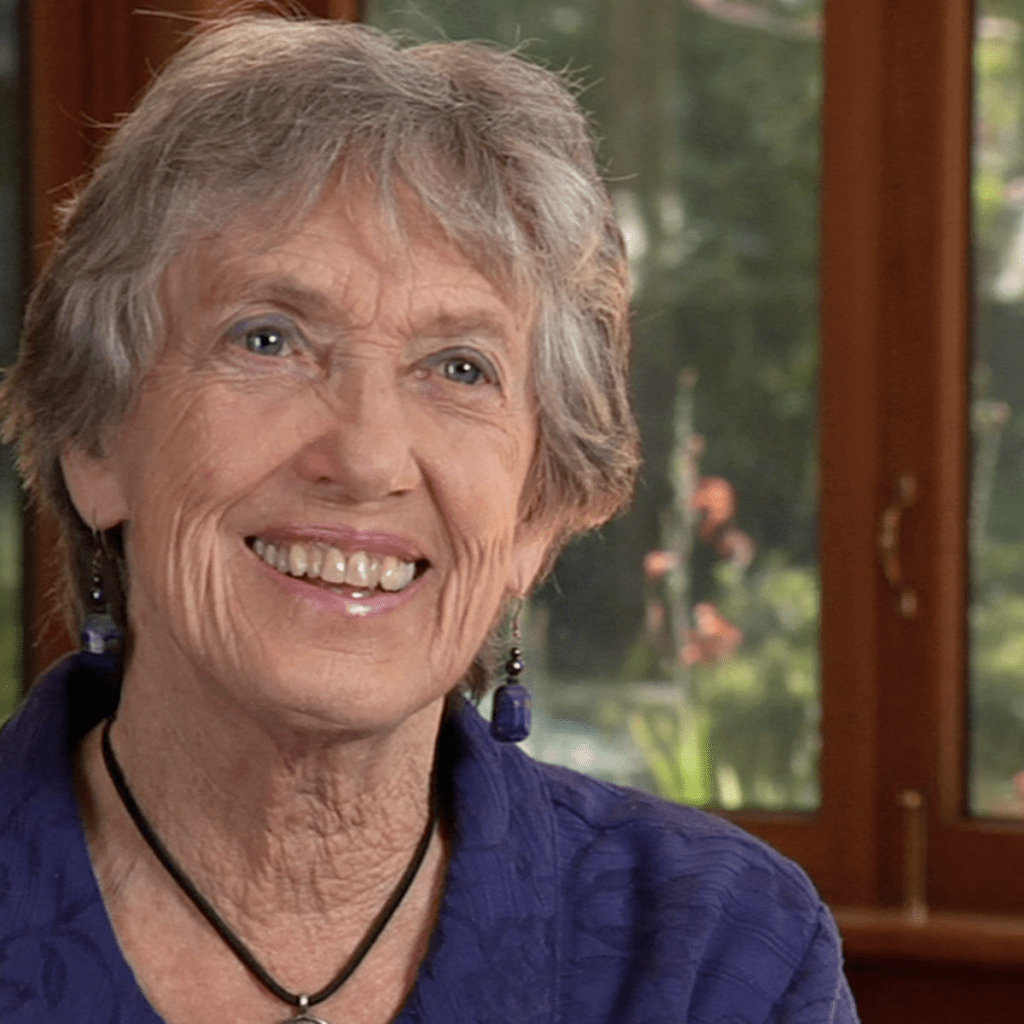
Joanna Macy
The story that we transcribe us here is a twelve-centuries-old prophecy from the Tibetan Buddhist tradition. The heroes of this story are called Shambhala warriors. The term Shambhala warrior is a metaphor for the Buddhist figure of the bodhisattva, one who deeply understands the core teaching of the Lord Buddha. That central doctrine is the radical interdependence of all things. When taken seriously, this leads to the recognition that if one person has the capacity to be a bodhisattva, then all others do too.
Here is a particular version of the prophecy as it was given to Joanna by her dear friend and teacher Dugu Choegyal Rinpoche of the community of Tashi Jong in northwest India. Read it as if it were about you.
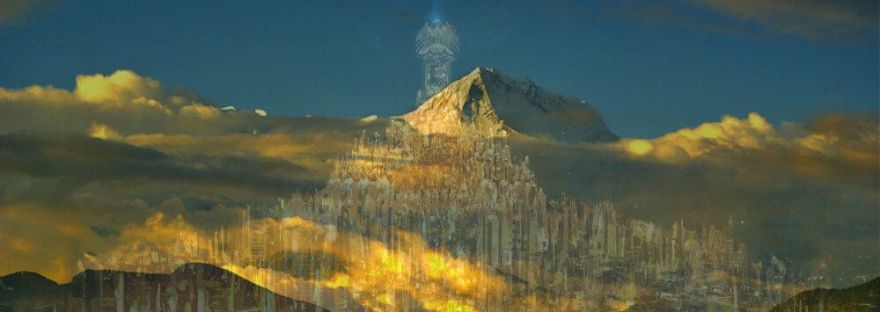
“Coming to us across twelve centuries, the Shambhala prophecy comes from ancient Tibetan Buddhism. The prophecy foretells of a time when all life on Earth is in danger. Great barbarian powers have arisen. Although these powers spend much of their wealth in preparations to annihilate each other, they have much in common: weapons of unfathomable destructive power, and technologies that lay waste our world. In this era, when the future of sentient life hangs by the frailest of threads, the kingdom of Shambhala emerges.
You cannot go there, for it is not a place; it is not a geopolitical entity. It exists in the hearts and minds of the Shambhala warriors. That is the term the prophecy used – “warriors.” You cannot recognize the Shambhala warrior when you see him or her, for they wear no uniforms or insignia, and they carry no specific banners. They have no barricades on which to climb or threaten the enemy, or behind which they can hide to rest or regroup. They do not even have any home turf. Always they must move on the terrain of the barbarians themselves.
Now the time comes when great courage – moral and physical courage – is required of the Shambhala warriors, for they must go into the very heart of the barbarian power, into the pits and pockets and citadels where the weapons are kept, to dismantle them. To dismantle weapons, in every sense of the word, they must go into the corridors of power where decisions are made.
The Shambhala warriors have the courage to do this because they know that these weapons are “manomaya.” They are mind made. Made by the human mind, they can be unmade by the human mind. The Shambhala warriors know that the dangers threatening life on Earth are not visited on us by any extraterrestrial power, satanic deities, or pre-ordained evil fate. They arise from our own decisions, our own lifestyles, and our own relationships.
So in this time, the Shambhala warriors go into training in the use of two weapons. The weapons are compassion and insight. Both are necessary, the prophecy foretells. The Shambhalla warriors must have compassion because it gives the juice, the power, the passion to move. It means not to be afraid of the pain of the world. Then you can open to it, step forward, act.
But that weapon by itself is not enough. It can burn you out, so you need the other – you need insight into the radical interdependence of all phenomena. With that wisdom you know that it is not a battle between “good guys” and “bad guys,” because the line between good and evil runs through the landscape of every human heart. With insight into our profound inter-relatedness, you know that actions undertaken with pure intent have repercussions throughout the web of life, beyond what you can measure or discern. By itself, that insight may appear too cool, conceptual, to sustain you and keep you moving, so you need the heat of compassion.
Together these two can sustain us as agents of wholesome change. They are gifts for us to claim now in the healing of our world. Many in the Tibetan lineage believe that this is the time of this ancient prophecy. If so, perhaps we are among the Shambhala warriors.”
by Joanna Macy
These are powerful words and a call to action, reaching across time. We must find the strength and courage to arise and be the best we can be at this time of challenge. We stand with you, brave warriors of the heart, dear Bodhisattvas. May we have courage.
This beautiful blog post is an excerpt from the book “Raising Children in the Midst of Global Crisis: A Compassionate Guidebook for Parenting in Turbulent Times”
by Jo delAmor, Work that Reconnects facilitator
“In a very real way we are writing our own future, the future of our world, on the hearts and minds of our children. Let’s think deeply, love selflessly, and act intentionally to write messages of peace and goodness and generosity of spirit on the hearts and minds of our children, our messengers, our hope for a better tomorrow.”— L.R. KNOST, WHISPERS THROUGH TIME
Messages to the Future
As we come to terms with the brutal intensities of the world our children have been born into and feel all the feelings that realization stirs in us, we can begin to see our place in the world with new eyes. We can begin to see that, as parents, we are planting seeds for the future in every moment of our children’s lives. We understand that the impressions that they form as young children about the world and who they are within it will inform who they are as adults. They will create the parameters of what they think is possible and how they choose to show up in the world. We see that we are writing the future, as L.R. Knost says “on the hearts and minds of our children.”
Moving beyond the Power Over Paradigm and into the cultivation of a Life Sustaining Society will require children who grow into adults with a commitment to collective wellness and mutual thriving. Creating this future in which our children can thrive, along with the rest of the Family of Life, will call for a completely different way of thinking and behaving than the dominant paradigm that we’ve been living in. It will require a deep healing of wounds and dismantling of lies. It will require raising human beings who are not driven by fear, scarcity, trauma and patterns of woundedness. It will require creating different conditions for our children and cultivating particular qualities and strengths in them that will allow them to be capable of truly caring for the Earth, each other and themselves.
The Power Over Paradigm has obscured our perception of the world. It has caused harm and trauma and polluted our minds and hearts as much as it has polluted the water, soil and air. But it has not destroyed the beauty and brilliance in our souls and in the Soul of the World. There is so much beauty still resiliently alive and waiting to be restored. The magic of Life still exists and will persist as we bring ourselves to its loving care. As we dream into the vision of this new Life Sustaining Society let’s consider the characteristics of a paradigm and the human qualities that would sustain life,justice and wellness for all so we can nurture them in our young ones.
I’m sure the list below doesn’t cover every possible quality that the new paradigm will need but as I dream into this potentiality and reflect on the children I’ve cared for these are the qualities that come to my mind and heart. When I look at this list as a whole and imagine a generation of children within whom these qualities flourish, I see a world in which all beings can thrive. I know, from direct experience, that even here in the midst of this dysfunctional society, it’s possible for us, as parents, to influence the development of these qualities in our children. We may or may not be able to knock each and every one of these out of the park, but the more of these qualities our children develop the more resiliently they will navigate their lives and the more healing they will bring to the world.
Wonder, Awe, Reverence and Gratitude
As children of a magnificent, miraculous Universe our most natural and authentic state is awe. I love that Rachel Carson wishes she could call on the fairies to preserve this inborn sense of wonder but recognizes that, in lieu of that, the companionship of an adult who is willing to experience wonder and awe alongside the growing child is what is needed. We are those adults. We are being invited to practice awe and swim in wonder as our children grow. A person in awe is connected to the Source of Life, the sources of our strength and not one easily manipulated by the power plays of the dominant paradigm.
[…]Teaching our children how to live in a practice of radical gratitude and reverence is a powerfully subversive way to detach from the Power Over Paradigm. It is also a brilliant way to deepen our connection with Life, itself. As our children experience appreciation for the ways in which their life is sustained they learn how the sustenance of Life works and can find their role in the great Web of Life more easily.
Loving Connection, Empathy and Compassion
Children are full of love when they are little. They love their parents and siblings to the moon and back. When that love is returned and children are raised in a loving environment, with encouragement for positive connection they become capable of growing that love far beyond the edges of their immediate families. “Pro-social” human beings that are comfortable with loving connection will definitely be required in order to cultivate a Life Sustaining Society.
As our children grow it is also important to foster their natural tendencies toward empathy and compassion. Most of the children I’ve worked with display an amazing ability to feel for others and a desire to help. As we heal from the damages done by the Power Over Paradigm we need a generation of people who are willing to put themselves in each other’s shoes and help each other grow into a more equitable and mutually beneficial way of living.
Respect, Consent, Equity and Justice
From a very young age (even 1 or 2 years old) children can learn that they have autonomy over their own bodies and other people have autonomy over theirs. We can teach children that each person has a right to their own choices and that, as we make our choices, we need to consider whether they cause harm to others. Teaching our children how to ask permission before touching or taking helps our kids grow into adults that respect themselves and others. This awareness of consent protects our children from predators and keeps our children from being harmful to others.
Making the dismantling of oppression and an understanding of privilege and bias a central part of your parenting will help your children break free from the Power Over Paradigm and see the world through the lens of equity and justice. As we attempt to plant the seeds of a new paradigm in the hearts and minds of our children it is essential to reframe our orientation to power and agency so we can grow a culture in which all are empowered. This work is particularly important if you and your children are part of the dominant, privileged class or sector of a society based on the genocide, enslavement and/or disenfranchisement of others (like if you are white in the USA or Australia, for example). Raising our children to understand that we have inherited an unjust system that needs to be fixed is critical to a future of equity and justice.
Reciprocity, Cooperation and Collaboration
Reciprocity [is] an expression of gratitude for the Earth and towards other people. As we raise our children within this practice we can teach our children to see themselves as being part of a team. Whether the team is made up of a single parent and a single child or it’s a whole big family or it’s a classroom or a neighborhood or the Family of Life, we’re always working with others. This orientation in teamwork helps our kids learn how to bring their gifts to the team generously and graciously receive the gifts of others in the collaboration and cooperation that’s necessary for a Life Sustaining Society.
Humility, Vulnerability and Emotional Fluency
As we move beyond the Power Over Paradigm we begin to understand that true power doesn’t come from force and dominance and that putting on a tough image doesn’t get us very far. True power is a connection to the Source of Life that comes through our intuition and emotions. We can help our children maintain and strengthen their access to these inner channels by teaching them that it is okay to be vulnerable and express their feelings.
You can create a safe environment for expression in your own home by modeling humility and vulnerability and by holding a respectful, loving space for them when they express themselves. As they get older, you can also teach them skills for regulating their energy, staying tuned in to their intuition and inner guidance and expressing their emotions effectively to others. These are the skills necessary for healthy adults and the leaders we need to guide us into a functional way of living.
Curiosity, Critical Thinking, Creativity and Innovative Problem Solving
Our world is full of seemingly unsolvable problems and we basically have to create an entirely different way of living if we are going to survive the collapse of the Power Over Paradigm. We are in need of some very creative problem solving. Fortunately, our children come into the world with a natural propensity for curiosity, critical thinking and creative problem solving. If we encourage this natural gift, rather than squelch it the way conventional education does, there is no telling what remarkably innovative responses they may have to the situation in which we find ourselves.
As our children learn and grow we can stand beside them in wonder. Instead of giving them the answers and showing off what we think we know we can stimulate meaningful inquiry by guiding them through the discovery process. We can suspend our “knowledge” momentarily while they wrestle with a new thought and see what they come up with.
Courage, Confidence, Self-worth, Honor and Dignity
Our children’s lives are not going to be easy. They will encounter many obstacles and many forces that seek to diminish them and make them feel powerless. One of the central tactics of the Power Over Paradigm is to rob its subjects of their honor and dignity. Every single one of us descends from human beings who, at one time, maybe very long ago, knew that they were brilliant, beautiful, sacred members of the Family of Life. Although people like this are wonderful stewards of a Life Sustaining Society, they are not easy to control. As the forces of oppressive empires and colonization ravaged the surface of the Earth they stripped the people of their honor and dignity in every way they possibly could.
For our children to grow beyond the constraints of this dominant paradigm and create a future that feeds Life they will need their natural honor, dignity and self-worth intact. Fortunately it is another natural endowment of every little being and can be cultivated and encouraged as they grow. Teach your children that they are needed in this world. Teach them that they have a purpose and that their lives matter so they can move forward with the courage and confidence they’ll need.
Honesty, Authenticity and Self Expression
Along with self-worth and dignity comes the ability to be honestly and authentically yourself. Each and every one of us comes to Earth with our own special gifts, our own way of seeing and understanding, our own particularities that make us who we are. The world needs each and every one of us, exactly as we are. It is in this diversity of perspective and expression that we really thrive. Diversity makes every system stronger. And, when we are not hemmed in by the prejudices and boxes of an oppressive society we can be much more powerfully beautiful stewards of Life.
There are countless ways that our Power Over Paradigm enforces these boxes and tells our children that they need to hide parts of themselves and fit into one of the pre-programmed boxes that has been designed for them. From relentless genderization and fashion trends to compliance with a consumer economy and political ideologies our kids are inundated with expectations and fabricated answers to the questions of who they are. As parents, we can insulate them to some extent from these external pressures and consciously create space in our homes and families for them to blossom as the authentically individual human beings that they are.
Resilience and Adaptability
We can’t even begin to imagine how much change our children will have to navigate in their lifetimes. All we know is that things are not going to continue on as they have. The Earth simply doesn’t have the resources to keep sustaining an extractive capitalistic human society. So, one way or another, everything is going to change and our kids will have to be resilient and adaptive in order to make it through and be of any use to the world. This is why it’s so essential for us to teach our children how to deal with challenges and hardship gracefully and healthfully. Everyone knows that facing and working through real life challenges is character building, but modern parents often have a hard time staying out of the way enough to allow their children to build character in this way.
Even if we have plenty of money, we should not bend over backwards to create a fantastical childhood of constant pleasure and gratification for our children. It doesn’t serve them at all. In fact, it interferes with their growth and development terribly and creates an unnaturally insatiable appetite for ease. As part of a healthy childhood that prepares a person for the rest of their lives a child should have to learn how to wait, give others a turn, make mistakes, fall down and get hurt, experience disappointment, get bored, etc.. That doesn’t mean we should intentionally create suffering for our children. And it doesn’t mean we shouldn’t let our kids have fun. But if we insulate them too much from the normal discomforts of life and try to make everyday and every moment a magical theme park adventure then we are actually impeding their healthy development and stunting their resilience.
Joy, Humor and Playfulness
Even as our children must struggle and learn from their struggles, they have got to have some fun too! A sense of natural joy, playfulness and an ability to see the humor in any situation may be the quality that helps our kids the most. When we feel connected to the living world and see our lives as an important, but small, part of a grand unfolding this sense of joy comes easily. Humor and lightheartedness are essential to resilience. Without an appreciation for irony, mystery and playfulness we would all be brought to our knees before we even make it through the gate. Being able to laugh at ourselves, try things out and fail, notice the ironic humor of the way life unfolds helps us make it through the more difficult moments we’ll have to face. Feeling joy and carrying joy in our hearts are also essential practices for caring for and sustaining Life.
When these qualities are cultivated in young people, the natural human spirit that is so alive in them can come through even more strongly. That doesn’t mean that every freedom fighter and youth activist had perfect parenting. It also doesn’t mean that if you nourish these qualities ‘perfectly’ in your children that they’ll save the world with their activism. This is not an all or nothing scenario. This is an opportunity to understand the power, possibility and potential of young people who are informed and supported, young people who have the confidence to be courageous, who have the critical thinking skills and creativity to address some of our biggest challenges and who deeply care about our world and feel a responsibility to Life and future generations. Whether our children’s care for the world plays out on the international stage for all to see or in small, personal, less seen ways, these qualities will guide them and support them in contributing their unique gift to the world.
Originally written by Steve Taylor, Senior Lecturer in Psychology, Leeds Beckett University, and published in theconversation.com.
Throughout history, people who have gained positions of power tend to be precisely the kind of people who should not be entrusted with it. A desire for power often correlates with negative personality traits: selfishness, greed and a lack of empathy. And the people who have the strongest desire for power tend to be the most ruthless and lacking in compassion.
Often those who attain power show traits of psychopathy and narcissism. In recent times, psychopathic leaders have been mostly found in less economically developed countries with poor infrastructures and insecure political and social institutions. People such as Saddam Hussein in Iraq, Muammar Gaddafi in Libya and Charles Taylor in Liberia.
But modern psychopaths generally don’t become leaders in affluent countries (where they are perhaps more likely to join multinational corporations). In these countries, as can be seen in the US and Russia, there has been a movement away from psychopathic to narcissistic leaders.
After all, what profession could be more suited to a narcissistic personality than politics, where the spotlight of attention is constant? Narcissists feel entitled to gain power because of their sense of superiority and self-importance.
Those with narcissistic personalities tend to crave attention and admiration and feel it is right that other people should be subservient to them. Their lack of empathy means they have no qualms about exploiting other people to attain or maintain their power.
Meanwhile, the kind of people who we might think are ideally suited to take on positions of power – people who are empathetic, fair minded, responsible and wise – are naturally disinclined to seek it. Empathetic people like to remain grounded and interact with others, rather than elevating themselves. They don’t desire control or authority, but connection, leaving those leadership roles vacant for those with more narcissistic and psychopathic character traits.
Different types of leader
Yet it would be misleading to say it is only psychopaths and narcissists who gain power. Instead, I would suggest that there are generally three types of leaders.
The first are accidental leaders who gain power without a large degree of conscious intention on their part, but due to privilege or merit (or a combination). Second are the idealistic and altruistic leaders, probably the rarest type. They feel impelled to gain power to improve the lives of other people – or to promote justice and equality, and try to become instruments of change. But the third are the narcissistic and psychopathic leaders, whose motivation for gaining power is purely self-serving.
This doesn’t just apply to politics, of course. It’s an issue in every organisation with a hierarchical structure. In any institution or company, there is a good chance that those who gain power are highly ambitious and ruthless, and lacking in empathy.
Narcissistic leaders may seem appealing because they are often charismatic (they cultivate charisma in order to attract attention and admiration). As leaders they can be confident and decisive and their lack of empathy can promote a single-mindedness which can, in some cases, lead to achievement. Ultimately though, any positive aspects are far outweighed by the chaos and suffering they create.
An anti-Trump demonstration in Washington DC. Shutterstock/bakdc What is needed are checks to power – not just to limit the exercise of power, but to limit its attainment. Put simply, the kind of people who desire power the most should not be allowed to attain positions of authority.
Every potential leader should be assessed for their levels of empathy, narcissism or psychopathy to determine their suitability for power. At the same time, empathetic people – who generally lack the lust to gain power – should be encouraged to take positions of authority. Even if they don’t want to, they should feel a responsibility to do so – if only to get in the way of tyrants.
Models of society
There are many tribal hunter-gatherer societies where great care is taken to ensure that unsuitable individuals don’t attain power.
Instead, anyone with a strong desire for power and wealth is barred from consideration as a leader. According to anthropologist Christopher Boehm, present-day foraging groups “apply techniques of social control in suppressing both dominant leadership and undue competitiveness”.
If a dominant male tries to take control of the group, they practise what Boehm calls “egalitarian sanctioning”. They team up against the domineering person, and ostracise or desert him. In this way, Boehm says, “the rank and file avoid being subordinated by vigilantly keeping alpha-type group members under their collective thumbs”.
Just as importantly, in many simple hunter-gatherer groups power is assigned to people, rather than being sought by them. People don’t put themselves forward to become leaders – other members of the group recommend them, because they are considered to be experienced and wise, or because their abilities suit particular situations.
San hunter gatherers in Southern Africa
In some societies, the role of leader is not fixed, but rotates according to different circumstances. As another anthropologist, Margaret Power, noted: “The leadership role is spontaneously assigned by the group, conferred on some members in some particular situation … One leader replaces another as needed.”
In this way, simple hunter-gatherer groups preserve stability and equality, and minimise the risk of conflict and violence.
It’s true that large modern societies are much more complex and more populous than hunter-gatherer groups. But it may be possible for us to adopt similar principles. At the very least, we should assess potential leaders for their levels of empathy, in order to stop ruthless and narcissistic people gaining power.
We could also try to identify narcissists and psychopaths who already hold positions of power and take measures to curtail their influence. Perhaps we could also ask communities to nominate wise and altruistic people who would take an advisory role in important political decisions.
No doubt all this would entail massive changes of personnel for most of the world’s governments, institutions and companies. But it might ensure that power is in the hands of people who are worthy of it, and so make the world a much less dangerous place.
With much gratitude for this insightful article. Gaia Speaking
I find myself often pressured by my fear of the passing of time, by my feeling of not doing enough to change the course of events in these challenging times. And in doing I forget to honour the things that I do gift the universe, and other human and more than human beings around me, even if they seem not transcendental or “productive” in the business from the business as usual or “y.o.l.o.” perspective.
We are all essential parts, fractals in the Great Turning. We are like the messages that travel to and fro in the mycelium under our feet… There is no knowing what will be the penny that drops or the smile that tips the balance.
Let’s celebrate the pauses in between the breaths of inspiration and expiration. Let’s remember the magic that happens while we sleep, the digestion that happens while we rest, the flourishing that happens when we are rested…
Bodhisattvas, your warrior’s rest is an essential weapon for these times…
Gratitude for this poem….
REST by David Whyte
Rest is the conversation between what we love to do and how we love to be. Rest is the essence of giving and receiving; an act of remembering, imaginatively and intellectually but also psychologically and physically. To rest is to give up on the already exhausted will as the prime motivator of endeavor, with its endless outward need to reward itself through established goals. To rest is to give up on worrying and fretting and the sense that there is something wrong with the world unless we are there to put it right; to rest is to fall back literally or figuratively from outer targets and shift the goal not to an inner static bull’s eye, an imagined state of perfect stillness, but to an inner state of natural exchange.
The template of natural exchange is the breath, the autonomic giving and receiving that forms the basis and the measure of life itself. We are rested when we are a living exchange between what lies inside and what lies outside, when we are an intriguing conversation between the potential that lies in our imagination and the possibilities for making that internal image real in the world; we are rested when we let things alone and let ourselves alone, to do what we do best, breathe as the body intended us to breathe, to walk as we were meant to walk, to live with the rhythm of a house and a home, giving and taking through cooking and cleaning. When we give and take in an easy foundational way, we are closest to the authentic self, and closest to that self when perhaps, most importantly, we arrive at a place where we are able to understand what we have already been given.
In the first state of rest is the sense of stopping, of giving up on what we have been doing or how have been being. In the second, is the sense of slowly coming home, the physical journey into the body’s uncoerced and unbullied self, as if trying to remember the way or even the destination itself. In the third state is a sense of healing and self-forgiveness and of arrival. In the fourth state, deep in the primal exchange of the breath, is the give and the take, the blessing and the being blessed and the ability to delight in both. The fifth stage is a sense of absolute readiness and presence, a delight in and an anticipation of the world and all its forms; a sense of being the meeting itself between inner and outer, and that receiving and responding occur in one spontaneous moment.
A deep experience of rest is the template of perfection in the human imagination, a perspective from which we are able to perceive the outer specific forms of our work and our relationships whilst being nourished by the shared foundational gift of the breath itself.
From this perspective we can be rested while putting together an elaborate meal for an arriving crowd, whilst climbing the highest mountain or sitting at home surrounded by the chaos of a loving family.
Rested, we are ready for the world but not held hostage by it, rested we care again for the right things and the right people in the right way. In rest we reestablish the goals that make us more generous, more courageous, more of an invitation, someone we want to remember, and someone others would want to remember too.
The Work that Reconnects International Network has just announced the Gaian Gathering to be happening in the second half of 2023…
We will be bringing further information to you as this event gets closer.
About the Gaian Gathering
In these challenging and pivotal times, the Work That Reconnects (WTR) is a powerful resource for people who are suffering from anxiety and trauma related to environmental disasters and ongoing social injustice and who are committed to serving the Great Turning. The WTR Network is growing to meet this continuously increasing need by supporting the global community of WTR facilitators, practitioners and lovers with education, inspiration and connection.
In 2023, we’re excited to bring this support to our global community through a comprehensive Gaian Gathering. This global summit experience will be a combination of online events and guided gatherings of local communities around the world. Beyond the typical online summit experience, this gathering will include inspiring and educational content, opportunities to practice WTR together, training for community members to up-level their skills and facilitated conversations for collaborative learning. As we envision this Gaian Gathering we see it moving through the Spiral of the WTR and comprised of four main components:
Learn – Experience – Engage – Celebrate
Learn – This component will include educational presentations and panels to explore the foundations of the WTR and its many applications in our changing world. These events will feature world renowned speakers who have been inspired by and love the Work That Reconnects, like Fritjof Capra, Bayo Akomalafe, Jem Bendel, Matthew Fox and Nina Simons as well as several of our own WTR Facilitator Members.
Experience – Events from this component will be woven into the schedule of the gathering to allow participants to experience the WTR and move more deeply into the practices and shared experiences that transmute our anxiety and grief into empowered action. In addition to online WTR experiences, music, movement and ritual engagement, this component will include facilitated guidance for gathering local Communities of Practices to plant seeds of resilience in communities all over the world.
Engage – This component will create opportunities for participants to engage in collaborative learning, up-level their facilitation skills and deepen their practices and gather together around certain topics and affinities. This aspect of the gathering will include Conversation Cafes and training as well as opportunities for participants to initiate ongoing connections with each other through our newly designed Online Community forum space.
Celebrate – Throughout the gathering, we will create opportunities to celebrate and honour Joanna Macy, founder and Root Teacher of the Work That Reconnects, as she moves towards her 94th birthday.
Who would have thought that doughnuts could change the world?
by Joanna Tomkins
They certainly get our attention, don’t they? In the same way we may ourselves once have been addicted to eating doughnuts, our policies are still addicted to promoting growth, even if it harms us each and and every time.
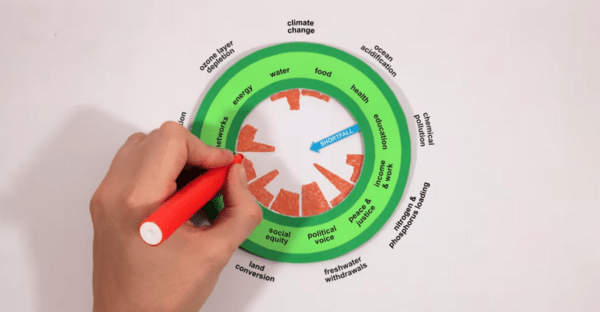
But… now we have got your attention, as you will see hereunder in the graphics, the doughnut in this model is in fact the shape that represents a “safe and just space for humanity”…
The text hereunder, originally published on the DEAL website, offers a comprehensive and convincing introduction to the Doughnut or Donut model. This umbrella is very exciting because its design has enough strength and simplicity to allow policy makers to regroup under it. I personally studied international business at university in France and Spain and I was so put off by some of the contents of the studies, particularly the economical theories, seminars with bankers and practicals in marketing, that I swore to never work for a large corporation. Much later, after I rerouted my career towards arts and also started to work in Africa as a wilderness guide, I went back to university in Barcelona to study Post-developmental African Studies. This was before I moved to Cape Town, wanting to learn about some of the original philosophies on the Continent and the forces at work behind the neocolonialism that still stifle them today. I rallied around the ideas of Serge Latouche (Farewell to Growth, 2007) and his peers. Since the 1980s, voices such as his have been loudly coining terms such as “economical footprint”, “eco-feminism, “overshoot”, etc, and claiming urgency. Yet, those voices have been drowned by the constantly renewed pressure from the Industrial Growth Society.
Finally, in the last few years, at the same time as a larger part of humanity starts to call for socio-economical justice – the one with the privilege to do so and be heard- , some strong, credible and conscious voices have created new alternative economical models that can be understood by many. They are now becoming mainstream and can offer politicians solid solutions to build resilience in the communities whose welfare they are responsible for. Gratitude.
If you are interested in learning more, please read some of the Stories on DEAL. This one for example about how the model has been adopted by 5 major cities around the world:
If you know how this model could be introduced to the University of Cape Town, or the City of Cape Town, please get in touch with me, I’d love to get involved.
Introduction
The Doughnut offers a vision of what it means for humanity to thrive in the 21st century – and Doughnut Economics explores the mindset and ways of thinking needed to get us there.
First published in 2012 in an Oxfam report by Kate Raworth, the concept of the Doughnut rapidly gained traction internationally, from the Pope and the UN General Assembly to Extinction Rebellion.
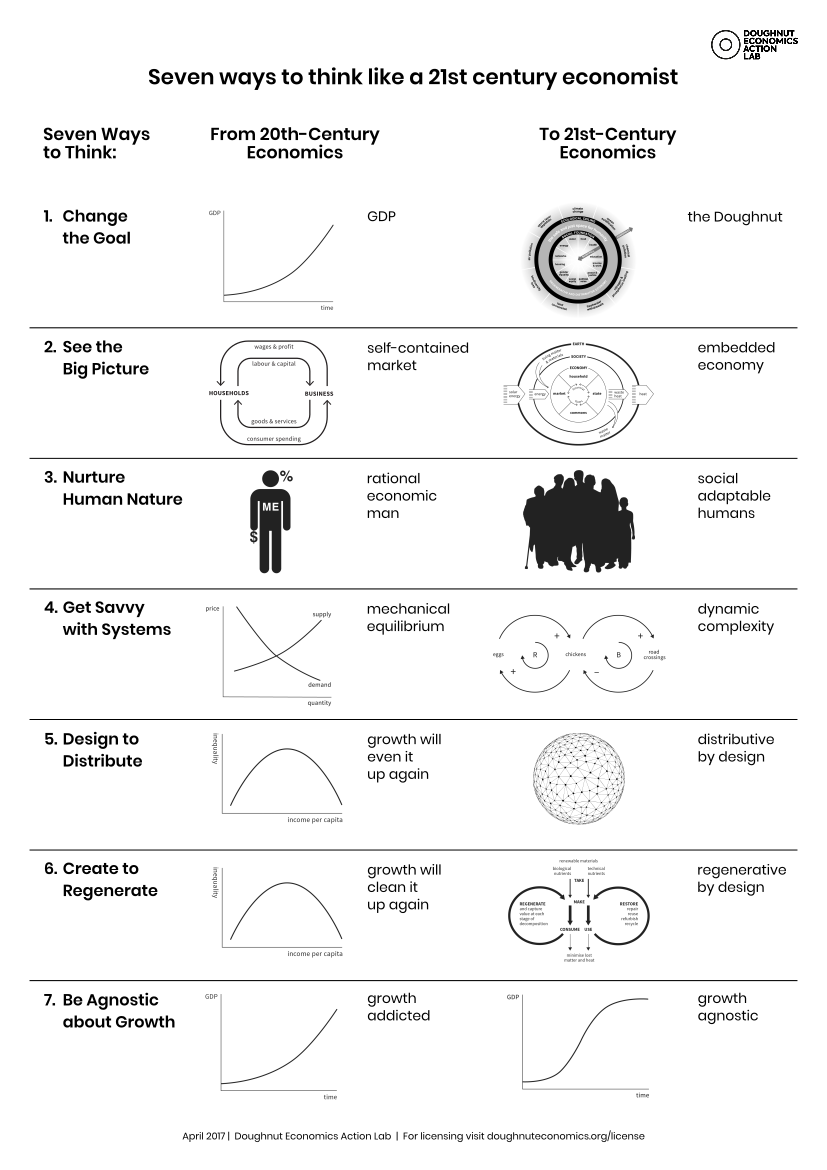
Kate’s 2017 book, Doughnut Economics: seven ways to think like a 21st century economist, further explored the economic thinking needed to bring humanity into the Doughnut, drawing together insights from diverse economic perspectives in a way that everyone can understand. The book has now been published in over 20 languages.
This 2018 TED talk gives a summary of the book’s core messages, and you can read Chapter One here..
The Doughnut’s holistic scope and visual simplicity, coupled with its scientific grounding, has turned it into a convening space for big conversations about reimagining and remaking the future. It is now being discussed, debated and put into practice in education and in communities, in business and in government, in towns, cities and nations worldwide.
Kate Raworth
The Doughnut of social and planetary boundaries.
What is the Doughnut?
Think of it as a compass for human prosperity in the 21st century, with the aim of meeting the needs of all people within the means of the living planet.
The Doughnut consists of two concentric rings: a social foundation, to ensure that no one is left falling short on life’s essentials, and an ecological ceiling, to ensure that humanity does not collectively overshoot the planetary boundaries that protect Earth’s life-supporting systems. Between these two sets of boundaries lies a doughnut-shaped space that is both ecologically safe and socially just: a space in which humanity can thrive.
What is Doughnut Economics?
If the 21st century goal is to meet the needs of all people within the means of the living planet – in other words, get into the Doughnut – then how can humanity get there? Not with last century’s economic thinking.
Doughnut Economics proposes an economic mindset that’s fit for our times. It’s not a set of policies and institutions, but rather a way of thinking to bring about the regenerative and distributive dynamics that this century calls for. Drawing on insights from diverse schools of economic thought – including ecological, feminist, institutional, behavioural and complexity economics – it sets out seven ways to think like a 21st century economist in order to transform economies, local to global.
The starting point of Doughnut Economics is to change the goal from endless GDP growth to thriving in the Doughnut. At the same time, see the big picture by recognising that the economy is embedded within, and dependent upon, society and the living world. Doughnut Economics recognises that human behaviour can be nurtured to be cooperative and caring, just as it can be competitive and individualistic.
It also recognises that economies, societies, and the rest of the living world, are complex, interdependent systems that are best understood through the lens of systems thinking. And it calls for turning today’s degenerative economies into regenerative ones, and divisive economies into far more distributive ones. Lastly, Doughnut Economics recognises that growth may be a healthy phase of life, but nothing grows forever: things that succeed do so by growing until it is time to grow up and thrive instead.
Dive deeper into the seven ways to think like a 21st century economist with our series of 90-second animations.
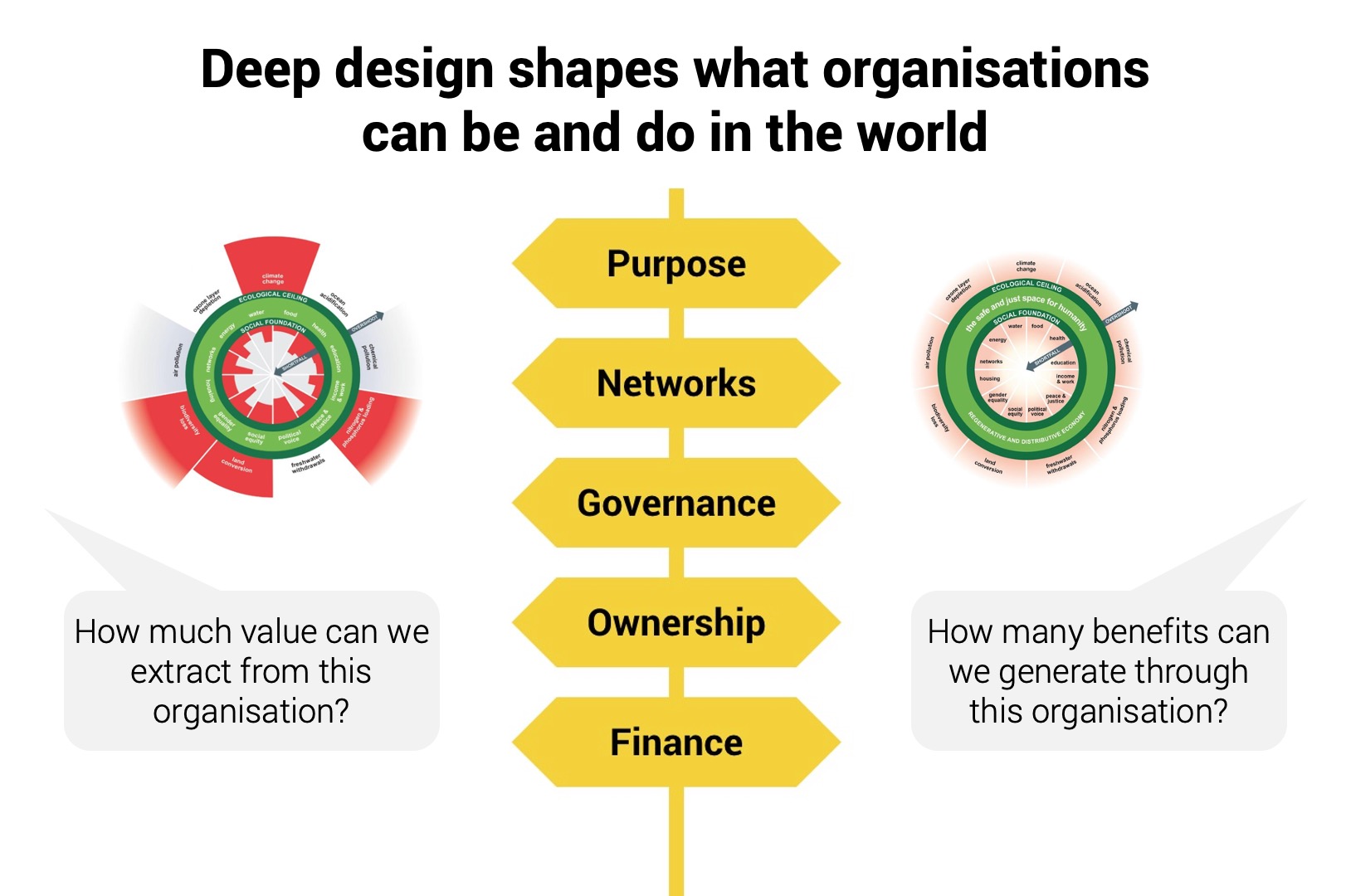
The five layers of organisational design.
Why design matters
What would make it possible for an organisation to become regenerative and distributive so that it helps bring humanity into the Doughnut? DEAL has run workshops with enterprises, city departments, foundations, and other kinds of organisations that want to explore this question, and the implications are transformational.
At the heart of these workshops is a focus on design: not the design of their products and services, or even of their office buildings, but the design of the organisation itself. As described by Marjorie Kelly, a leading theorist in next-generation enterprise design, there are five key layers of design that powerfully shape what an organisation can do and be in the world:
Together these five aspects of organisational design profoundly shape any organisation’s ability to become regenerative and distributive by design, and so help bring humanity into the Doughnut.
Doughnut Principles of Practice
To ensure the integrity of the ideas of Doughnut Economics, we ask that the following principles are followed by any initiative that is working to put the ideas of Doughnut Economics into practice.
Embrace the 21st Century Goal
Aim to meet the needs of all people within the means of the planet. Seek to align your organisation’s purpose, networks, governance, owner-ship and finance with this goal.
See the big picture
Recognise the potential roles of the household, the commons, the market and the state – and their many synergies – in transforming economies. Ensure that finance serves the work rather than drives it.
Nurture human nature
Promote diversity, participation, collaboration and reciprocity. Strengthen community networks and work with a spirit of high trust. Care for the wellbeing of the team.
Think in systems
Experiment, learn, adapt, evolve and aim for continuous improvement. Be alert to dynamic effects, feedback loops and tipping points.
Be distributive
Work in the spirit of open design and share the value created with all who co-created it. Be aware of power and seek to redistribute it to improve equity amongst stakeholders.
Be regenerative
Aim to work with and within the cycles of the living world. Be a sharer, repairer, regenerator, steward. Reduce travel, minimize flights, be climate and energy smart.
Aim to thrive rather than to grow
Don’t let growth become a goal in itself. Know when to let the work spread out via others rather than scale up in size.
Be strategic in practice
Go where the energy is – but always ask whose voice is left out. Balance openness with integrity, so that the work spreads without capture. Share back learning and innovation to unleash the power of peer-to-peer inspiration.
Farmers in Niger are nurturing gao trees to drive Africa’s biggest environmental change
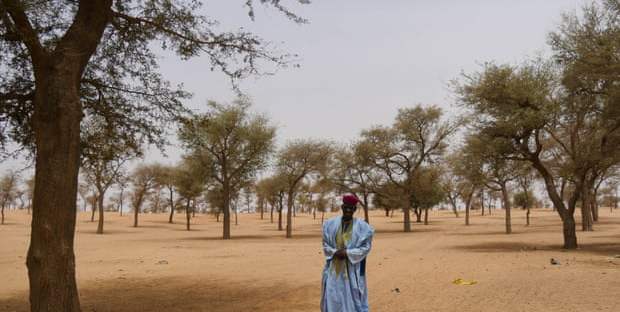
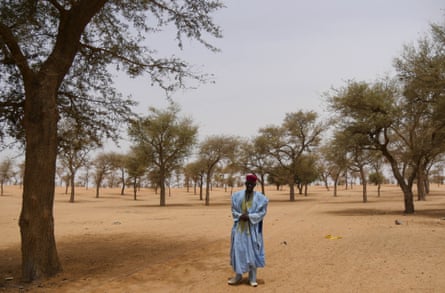
Rain had come to nearby villages, but not yet to Droum in south-east Niger. The sand under its stately trees looked completely barren, but Souley Cheibou, a farmer in his 60s, was not worried. He crooked a finger, fished in the sand, and brought out a millet seed. In a week or two, this seed would germinate and sprout, and soon the whole field would be green.
Cheibou’s peace of mind stemmed from the trees encircling him, which had been standing long before he was born. Despite appearances, these were not any old acacias. They were gao trees – known as winterthorns in English – with unique, seemingly magical powers.
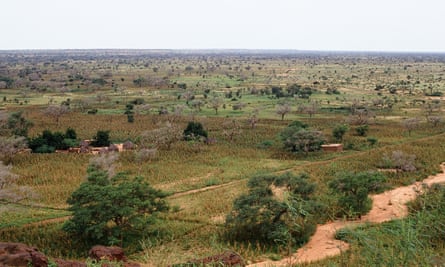
From the peanut basin of Senegal to the Seno plains of Mali, to Yatenga, formerly the most degraded region of Burkina Faso, and as far south as Malawi: gaos are thriving in Africa. And over the past three decades, the landscape of southern Niger has been transformed by more than 200m new trees, many of them gaos. They have not been planted but have grown naturally on over 5m hectares of farmland, nurtured by thousands of farmers.
A valley near the town of Dogondoutchi in the east of Niger. The valley is completely devoted to rainfed cropland. Photograph: Gray Tappan
According to scientists, what has happened in Niger – one of the world’s poorest countries – is the largest-scale positive transformation of the environment in the whole of Africa. This is not a grand UN-funded project aiming to offset climate change. Small-scale farmers have achieved it because of what the trees can do for crop yields and other aspects of farming life.
“It’s a magic tree, a very wonderful tree,” said Abasse Tougiani of Niger’s National Institute of Agricultural Research, who has travelled all over Niger studying Faidherbia albida – the gao’s Latin name.
Shielded from the sun, crops planted under the canopy of a tree usually do not do well in the short term, although there can be longer-term benefits. That’s one reason why many west African rainforests have been decimated. But with gaos, it’s the other way round. The root system of the gao is nearly as big as its branches, and unusually it draws nitrogen from the air, fertilising the soil. And unlike other trees in the area, gao tree leaves fall in the rainy season, allowing more sunlight through to the crops at a key moment.
Used along with mineral fertilisers, crop yields double under gaos, and the gao-nourished soil holds water better, ensuring a better crop in drought years.
A seed-pod of the gao tree. Photograph: Ruth Maclean/Ruth Maclean for the Guardian
Counterintuitively, the great gao regreening is only happening in areas of Niger with high-density populations. With less space to expand into as more people are born, hard-up farmers are increasingly realising that the trees can regenerate degraded land.
“It’s literally a story of more people, more trees,” said Chris Reij, a sustainable land management specialist. “The whole point is that the trees are not protected and managed by farmers for their environmental beauty, but because they are part of the agricultural production system.”
Inadvertently, the farmers are also doing their bit to offset climate change. Trees are crucial for storing carbon, absorbing it out of the atmosphere. “In mature, fairly dense areas, you get 30 tons of wood per hectare. Half of that is carbon,” said Gray Tappan, a geographer.
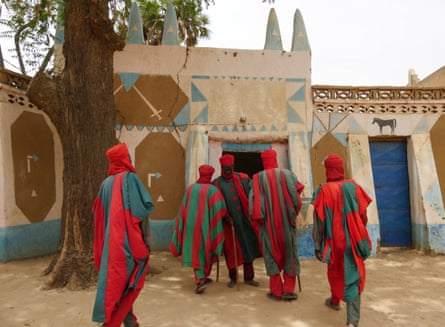
The guards of Droum gather outside the district chief’s palace. Photograph: Ruth Maclean/Ruth Maclean for the Guardian
But none of these grand political projects explains why gaos have caught on. The trees’ pods make very nutritious animal fodder, and fallen branches make good firewood, meaning Droum’s women and children – whose job it is to collect fuel for cooking fires – rarely have to venture further than a few kilometres to find it.
A Droum resident with the village’s mature gao trees. Photograph: Ruth Maclean/Ruth Maclean for the Guardian
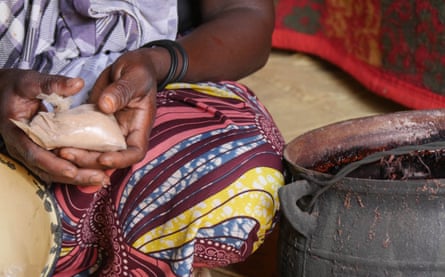
Women in Droum have also made medicine from their gaos for generations. “People come all the way from Zinder [Niger’s second largest city] to buy it,” said Husseina Ibrahim, a busy mother, next to a pot of boiling gao bark. “I’m the only one who makes this here. It’s great for me, it earns me a bit of money which I pay into the women’s cooperative.”
Tales about how the gao came to be so revered abound. Legend has it that crimes against gaos have been taken very seriously since the mid-19th century. “If you touched a branch, you would go to jail,” Tougiani said. In splendid brocade robes and curly-toed velvet slippers, surrounded by self-portraits and stick-wielding guards dressed in red and green, today’s district chief in Droum takes a slightly softer approach.
Gao bark powder and infusion, which locals say cures haemmerhoids. Photograph: Ruth Maclean/Ruth Maclean for the Guardian
“It’s shameful to have to come before the chief and explain yourself. Often that’s punishment enough,” Maman Ali Kaoura said. Droum’s reoffenders face fines of between 5,000 to 10,000 West African CFA francs (€8 to 15), a huge amount for hard-up farmers.
A sense of ownership has been key in the regreening of Niger. Until the mid-1980s, every tree was considered to belong to the state. When this changed, regreening began, as people were happier to look after trees that belonged to them. In areas with the best cover, they organised patrols to protect their trees from passing farmers and neighbouring villagers seeking firewood.
Once people discovered that “one gao was equal to 10 cows” for fertilising, as Tougiani put it, the tree’s popularity took off. Several schemes, including one where farmers with more than 50 gaos were paid 50 CFA for each one, helped it along.
A Droum farmer opens his millet store. Photograph: Ruth Maclean/Ruth Maclean for the Guardian
But their loyalty to their gaos could make areas around Zinder the most vulnerable to a disease that Reij and Tougiani have recently spotted killing trees near Niamey, the capital. If it spreads, the losses could be enormous, particularly in places where there is a near-monoculture of gaos.
“I’m worried, because it’s green oil for farmers – it’s their wealth,” said Tougiani. “If they lose Faidherbia albida, they’ll lose their way of life. They’ll have to leave the village.”
For Cheibou, losing his trees is unthinkable – they were his birthright. “I have nearly 100 gao trees in my fields, which I inherited from my father,” he said. On his way back to the village, he paused by a particularly large one, and cracked open its round seedpod. “This one was here when I was a boy. Just like it is now.”
A note from the Guardian:
Ever wondered why you feel so gloomy about the world – even at a time when humanity has never been this healthy and prosperous? Could it be because news is almost always grim, focusing on confrontation, disaster, antagonism and blame?
This series is an antidote, an attempt to show that there is plenty of hope, as our journalists scour the planet looking for pioneers, trailblazers, best practice, unsung heroes, ideas that work, ideas that might and innovations whose time might have come.
Readers can recommend other projects, people and progress that we should report on by contacting us at theupside@theguardian.com
A note from Gaia Speaking to the Guardian:
We thank you for your independent journalism, which is such an important aspect of the Great Turning, your holding actions create awareness around the negative and the positive actions of thousands of individuals and corporations worldwide. Your writing in turn sparks initiatives in people’s hearts, by informing them about issues that would otherwise go unnoticed, but also by giving them hope through a sense of possibility and togetherness with stories like this one. Gratitude.
One of the most invigorating experiences for me in the last two years, since I became a WTR facilitator – and recently also as volunteer for the International WTR Network, is to listen to the conversations that take place on the WTR webinars. I feel such relief when I hear my thoughts reflected in the words of others in such a away.
I highly recommend to browse through the recording that are on the page below and listen to some of them. Even in the aftermath, the buzz of the Community that gather around these thoughts is tangible, and I’m sure you will gain a lot of insight and inspiration.
A lot of links are shared, so you will find the experience grows your branches out towards other authors and thinkers too.
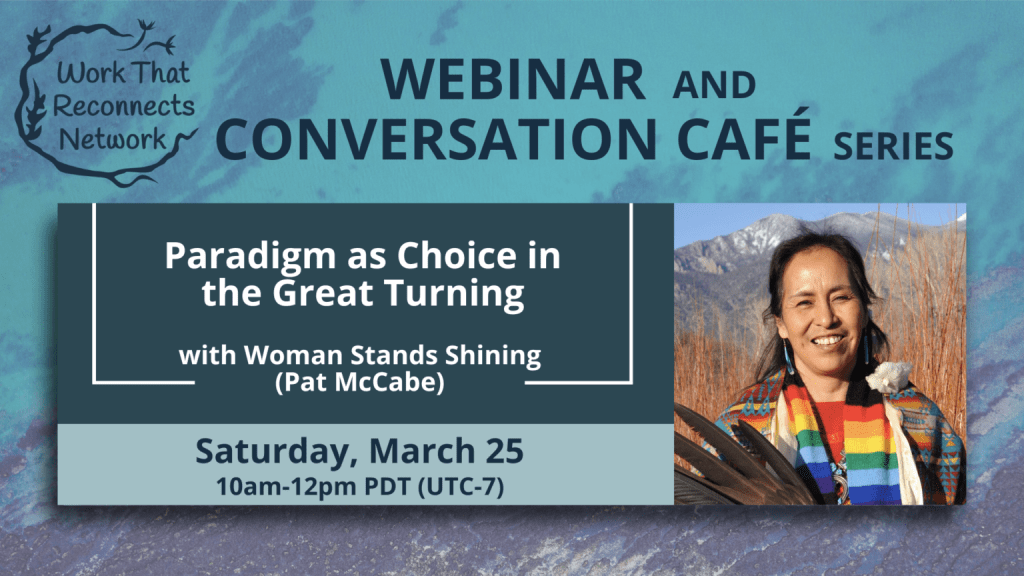
And if you prefer to be present in live, please don’t miss the one coming this month, on Saturday, 25th March at 9 am PST or 20 pm SAST (in South Africa). Here’s the link to join and a bit more info. I’ll be there.
Join the international network mailing list on their website if you want to received future notifications.
Hereunder is the information published on the WTR international site.
The suggested requested donation for this webinar is between $25-$35USD. However, no one will be turned away for lack of funds. Please donate generously within your means but feel free to join us even if you can’t contribute financially.
The Great Turning requires profound shifts in consciousness and in our perceptions of reality. In a society that’s so heavily influenced by the Power Over Paradigm that defines reality in static, concrete terms, we often don’t realize that it’s within our ability to choose to see and experience reality through different paradigmatic lenses.
As a holy earth surface walker of the Dine’ people, Woman Stands Shining (Pat McCabe) understands that the Power Over Paradigm is not the only way to understand and move through reality. She knows that the Earth operates within the Thriving Life Paradigm and that it is well within our ability to choose alignment with that paradigm.
Join us in a rich conversation as we explore our capacity, as humans, to participate with Earth in service to Thriving Life and muse on questions like:
What structures (hidden, overt, internal, external) exist to keep the Power Over Paradigm firmly in place?
How can we, here and now, wherever we are, cultivate a Thriving Life Paradigm within our own consciousness and in the world around us?
What are some radical, joyful, meaningful ways to step into that lifegiving empowerment?
We highly recommend listening to this episode of the Science and Nonduality (SAND) podcast with Woman Stands Shining (Pat McCabe) before our live webinar, if you’re able. It’s not required at all, but is a perfect lead-in for the conversation we’ll be having on March 25th.
Woman Stands Shining (Pat McCabe), is of the Diné Nation (often known incorrectly as “Navajo”), and was also adopted into the Lakota Spiritual way of Life. She is a mother, grandmother, activist, artist, and international speaker. She identifies as a “radical bridger” of worlds and paradigms, with a focus on sharing from her own deep inquiry into Thriving Life Paradigm: “How do I become that being, that human, whose presence and way of being supports and causes all other life to Thrive?” She calls upon her lived experience from her indigenous cultures to make hypotheses and proposals to “Modern World Paradigm” as all of humanity is faced with its current crisis of relationship, with ourselves, with each other, and with the Earth.
The Weavers and Volunteers working for The Work that Reconnects International Network are currently preparing a new website and an important online conference, both due later this year, in a huge collective effort to share wider and louder the valuable support resources that the network offers.
The Gaian Gathering has been in the collective dreams of the network for several years and 2023 is the year it comes into fruition! This global summit will combine online events and guided gatherings of local communities around the world. Watch out for further updates!
In the past years, the organisation has both strengthened and widened its web, by inviting in much novelty in all areas of thinking, being and doing. This represents a vast attempt to move away from the old paradigm, opening up to the astounding potential of transformation that is awakening in us at these times of the Great Turning. Some of the themes for reflection that have been highlighted over the last few years have been included on the website under the umbrella “Evolving Edge”.
This new breadth encourages more resilience within the network by shifting our patterns of thought, encouraging discussions and resources around topics such as white privilege, trauma informed practices, undoing oppression, collective and ancestral trauma, etc…
Secondly, the ongoing evolution of the network also intelligently considers the emergence of more multidisciplinary formats and specific applications for the original Work that Reconnects methodology. Indeed, whilst all the workshops and events by registered facilitators are always inspired by the Foundations of the Work that Reconnects and its Spiral, they now often are themed in areas like the Arts, Permaculture, Nature Quests, Parenting, etc. This allows the Work to expand as a tool in wider, younger and more active circles. And of course since 2020, many new formats have emerged online, following broad acceptance on distance workshopping by audiences worldwide.
And thirdly, I would add that some of the the other aspects that make the Work that Reconnects so stable in these wobbly times are its inherent diversity and inclusivity. Indeed, Joanna Macy already included different fields of knowledge in the philosophy at the roots of the Work, from indigenous wisdom to buddhist principles, or from deep ecology to systems thinking. She thereby made sure to utilise the principles at the base of the most resilient strains of knowledge available on Earth and inspired by Earth. Additionally, the co-founders guaranteed that the training remained open source, so as to make it available to a wide variety of facilitators worldwide, independently of their area of activism, location or income.
Increasingly, the resources and practices of the Work that Reconnects are incorporating contributions by activists from a variety of influential organisations worldwide, helped by the ease of online conversations and events. These activists often in turn have been inspired by the Work that Reconnects or Joanna Macy over the years and this reciprocity is at the base of the strength of this web.
Most of the recordings of the webinars organised over the last few years are available here:
Above is the last one I watched. As always, I found it revitalising and brimming with active hope and insight.
You will also receive the Deep Times Newsletter termly. Watch out for the next edition which talks about the vocabulary of these shifting times. The more we consolidate the “Gaianist” vocabulary, the more emergence and resilience can be birthed… Think “Great Turning”, “Business as Usual”, “Post-colonialism”, “Whiteness”, “Ecological Civilisation”, etc… We need a solid ground of expression to move forward as one humanity.
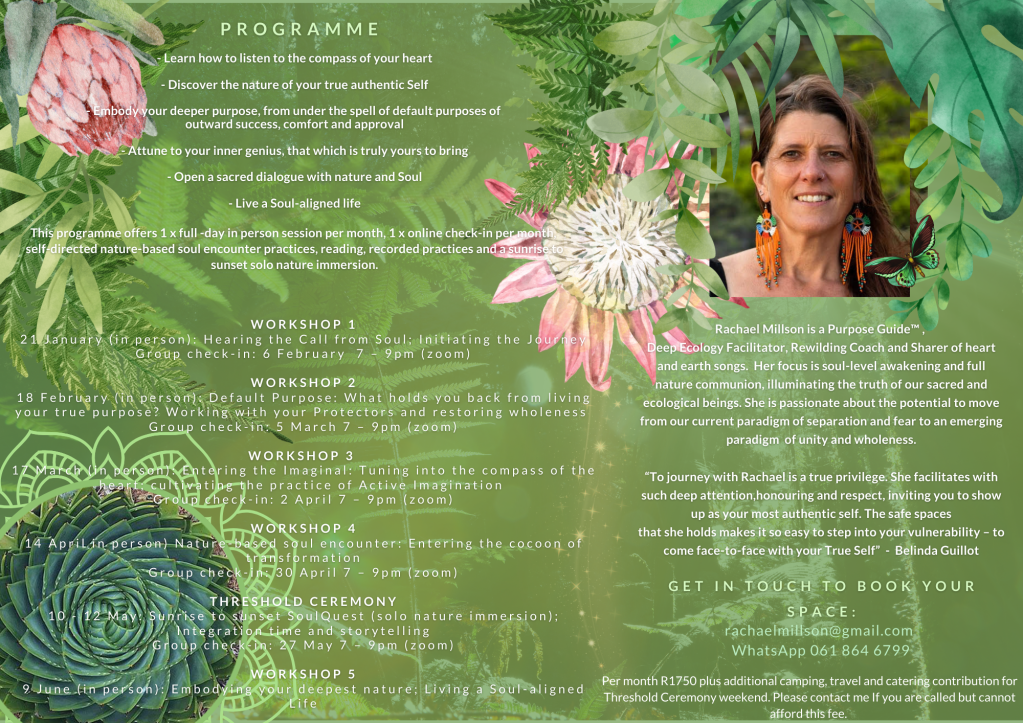
True Nature Soul Quest with Rachael Millson – starts January 2024
More and more of us are sensing that, collectively, we are in the process of huge transition – a critical time in our planetary and species’ history and evolution. The crises we find ourselves in connect to both culture and nature and how we each choose to live our lives in this moment is significant for many reasons. Not least with respect to what type of future we want to leave for the coming generations of beings, both human and non-human.
What is needed now is for each of us to stand in our full power, together, to invent new regenerative human cultures and ways of living, that will allow us to live in harmony with the Earth, and with love, compassion and justice for our fellow humans.
At the deepest level, the crises we are facing stem from a type of forgetfulness. We have forgotten who we are, forgotten our true selves as sacred beings. We have bought into the current world mythos of separation, not seeing the truth of our interbeing, and we have forgotten that we are nature, it’s not something apart from us, to be used as a resource alone. It’s from this worldview, of separation, and of mechanistic linearity, that cultures have been formed and systems have been invented, and continue to grow. If we want to see widespread systems-change, we need to question the very basis on which our cultures have been formed. And this begins with a radical personal journey of transformation.
Yet how do we respond to the call that so many of us are hearing, for more depth and meaning, and for a different way, a more beautiful way for all, for life on earth to unfold? There are many actions that can be taken, but perhaps the most important and the bravest, is the willingness to radically come back to the truth at the core of our beings, and to awaken the unique spark and inner resiliency of genius that sits there. Once we find that inner genius (that has been alive all along, but often hidden under the confines of what society and culture has taught us about ourselves), we can begin to live our lives in full alignment with it, weaving it into life in the here and now, despite and because of all the troubles we are facing.
And by developing a sacred reciprocal relationship with nature, collectively we will shift towards decisions that can truly regenerate our home planet.
If you would like to explore your deepest nature, live in alignment with wild nature, embody your inner genius and Soul’s purpose, and contribute your unique gifts towards a more beautiful world, join the True Nature Soul Quest, a 6-month intensive journey into the mysteries of nature and soul.







.png)




 Gaia Speaking