Articles, Uncategorized

Of Mushrooms and Clouds

by Joanna Tomkins, Gaia Speaking

I first heard about the plastic-eating capacity of mycelium during a permaculture course I attended in 2016 when my friend and mycologist Justin White showed us a TED Talk by Paul Stamets about how mushrooms COULD save the world. (You may have seen the 2019 “Fantastic Fungi” documentary that Stamets features in – if you haven’t yet, please do!)

I have felt excited about mycelium ever since because at the time I thought, YES, but of course Mushrooms WILL save the world… It just seemed so clear and I was so grateful for news unusually filled with so much hope.
As I prepare this post today, 14 years after this TED Talk was published, and with an accute sense of urgency, I feel like the mycelium myself, as I navigate from one link to another, from one passionate researcher to another adamant activist, from one fungal function to another attribute of intelligence demonstrated by these incredible species. And I heard someone saying yesterday that mushrooms can absorb radioactive emissions too, and last week I read and shared a campaign from the platform EKO, pitching for funds to develop research for some plastic-devouring heroes. And another mushroom ceremony in the hood. And, and, and…

The healing powers of mushrooms are spreading all over the news just as exponentially as our communication networks themselves. Is there anything they cannot do?!
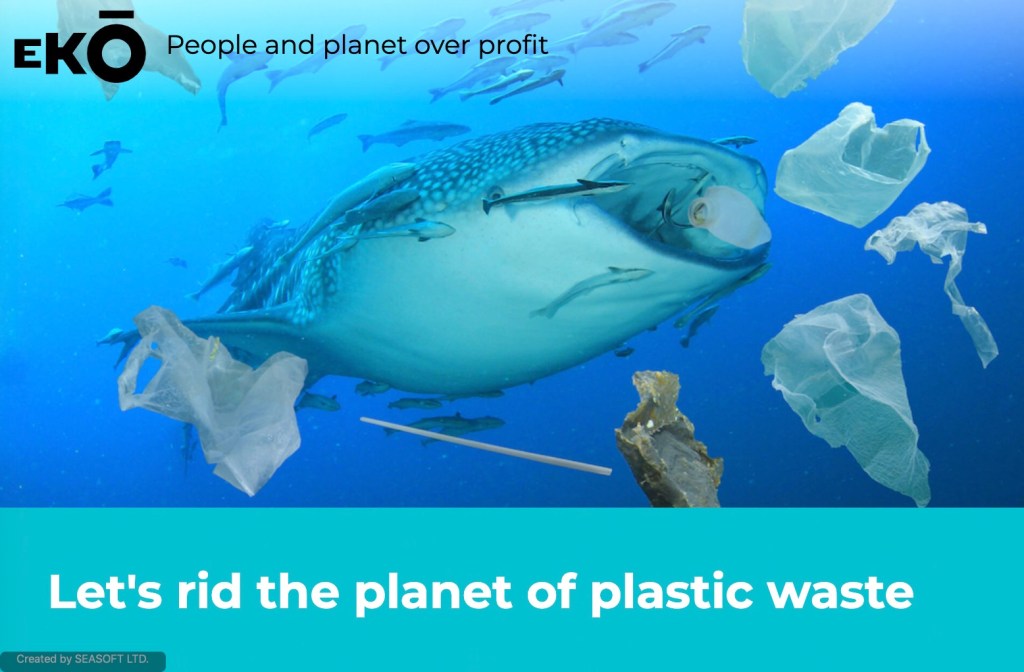
“How amazing is this — scientists have discovered mushrooms that can devour plastic waste in a matter of weeks…plastic that would otherwise remain in the ocean forever.

Right now 91% of the plastics we use can’t be recycled, and every minute another truckloads-worth is dumped into the ocean, suffocating sea life and spreading pollutants across shores.

But scientists say these magnificent mushrooms could eat up to half of the plastic waste being dumped in the ocean. They’re asking for our help to continue their groundbreaking research, and together we could give them the funds they need right away to expand their research in the US and New Zealand.”

Click here for campaign information

The World Wide Web which carries the news became available to us only 30 years ago. On April 30, 1993, the European Organization for Nuclear Research (CERN) put the web that it had developed onto the public domain. In 1993 also, I wrote a research project for university about the “Prospects of Expansion of Electronic Commerce in Spain” . It was minuscule at the time, there were only two shops online in the country (!). I concluded that it seemed unstoppable but that its expansion would depend largely on hardware development and availability – desktop computers I believed at the time!.

Now, in 2023 there are more than 8 billion smart mobile devices in the world, and 65 percent (up from 54 per cent in 2019) of the world’s population are using the Internet.

The speed of technological hardware expansion is terrifying and goes hand in hand with the integration of social networks and software applications, which has gone out of bounds since our society crash landed online after the dramatic “Great Pause” of 2020. The communication system that we call “cloud” is not so ethereal as we wish to believe as we type, record and film on and on. It lives between its massive servers – which would occupy the surface area of entire countries if placed alongside each other– and all our desktop and handheld devices: a vertiginous global network of cell phones, powerbanks, cables, computers, televisions, sound systems, etc, and another even more vertiginous destitute heap of e-waste. This cloud we all float in uses an exponential amount of electricity to manufacture, cool and power. So, to satisfy it we are digging into the Earth, instead of feeding it.

The Earth’s Mushrooms are a form of evolved cointelligence which can support us as we find ways to support the transformation of our own Human society. We/They need a human critical mass to be better connected to the Earth in order to understand the principles of interbeing and cointelligence.

So, want I’m wanting to highlight here I think, is that there is a huge opportunity in the spread of the online ‘aerial’ mycelium that connects us all. Even if there is aggression and waste in its making, for we can indeed share precious news and tools for the shift in consciousness that needs to happen now. Yet, we need to change our worldview so that it can evolve through sustainable and ethical practices, so that the channels we choose and the contents we communicate, exchange and trade via these networks become more life-sustaining and life-enhancing as soon as possible.

Prototaxites
hundreds of millions of years old

The story says that between 350 and 420 million years ago, there were already fungal organisms with trunks up to 7 metres high. For hundreds of millions of years, these families have been hard at work. This mycelium constantly transforming matter, sharing information and nutrients has always been working symbiotically with other species to thrive and sustain on behalf of life on Earth. Let’s mimic that better now, while we still have a chance to learn. Let’s aim wide, and wider still!

Articles, Resources & Networks, Uncategorized

Do mushrooms really use language to talk to each other? A fungi expert investigates

Extract from an article in theconversation.com by Katie Field, Professor in Plant-Soil Processes, University of Sheffield

Nearly all of Earth’s organisms communicate with each other in one way or another, from the nods and dances and squeaks and bellows of animals, through to the invisible chemical signals emitted by plant leaves and roots. But what about fungi? Are mushrooms as inanimate as they seem – or is something more exciting going on beneath the surface?

New research by computer scientist Andrew Adamatzky at the Unconventional Computing Laboratory of the University of the West of England, suggests this ancient kingdom has an electrical “language” all of its own – far more complicated than anyone previously thought. According to the study, fungi might even use “words” to form “sentences” to communicate with neighbours.

Almost all communication within and between multi-cellular animals involves highly specialised cells called nerves (or neurones). These transmit messages from one part of an organism to another via a connected network called a nervous system. The “language” of the nervous system comprises distinctive patterns of spikes of electrical potential (otherwise known as impulses), which help creatures detect and respond rapidly to what’s going on in their environment.

Despite lacking a nervous system, fungi seem to transmit information using electrical impulses across thread-like filaments called hyphae. The filaments form a thin web called a mycelium that links fungal colonies within the soil. These networks are remarkably similar to animal nervous systems. By measuring the frequency and intensity of the impulses, it may be possible to unpick and understand the languages used to communicate within and between organisms across the kingdoms of life.

Using tiny electrodes, Adamatzky recorded the rhythmic electrical impulses transmitted across the mycelium of four different species of fungi.

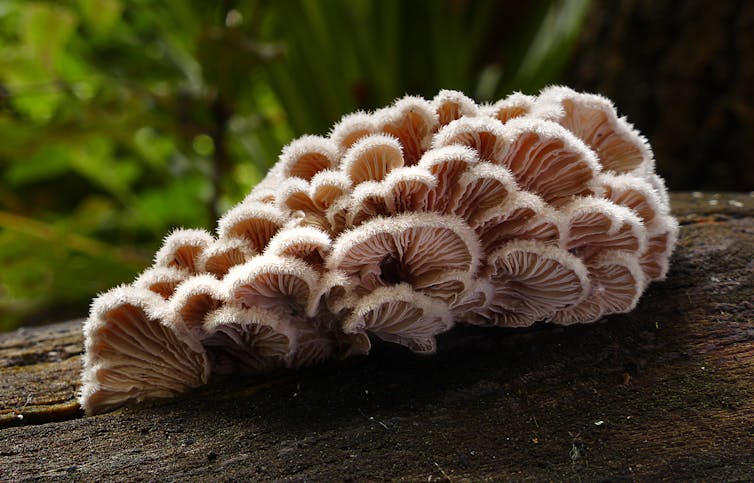
He found that the impulses varied by amplitude, frequency and duration. By drawing mathematical comparisons between the patterns of these impulses with those more typically associated with human speech, Adamatzky suggests they form the basis of a fungal language comprising up to 50 words organised into sentences. The complexity of the languages used by the different species of fungi appeared to differ, with the split gill fungus (Schizophyllum commune) using the most complicated lexicon of those tested.

A collection of mushrooms with frilly edges.
The split gill fungus is common in rotting wood and is reported to have more than 28,000 sexes. Bernard Spragg/Wikipedia

This raises the possibility that fungi have their own electrical language to share specific information about food and other resources nearby, or potential sources of danger and damage, between themselves or even with more distantly connected partners.

Underground communication networks

This isn’t the first evidence of fungal mycelia transmitting information.

Mycorrhizal fungi – near-invisible thread-like fungi that form intimate partnerships with plant roots – have extensive networks in the soil that connect neighbouring plants. Through these associations, plants usually gain access to nutrients and moisture supplied by the fungi from the tiniest of pores within the soil. This vastly expands the area that plants can draw sustenance from and boosts their tolerance of drought. In return, the plant transfers sugars and fatty acids to the fungi, meaning both benefit from the relationship.

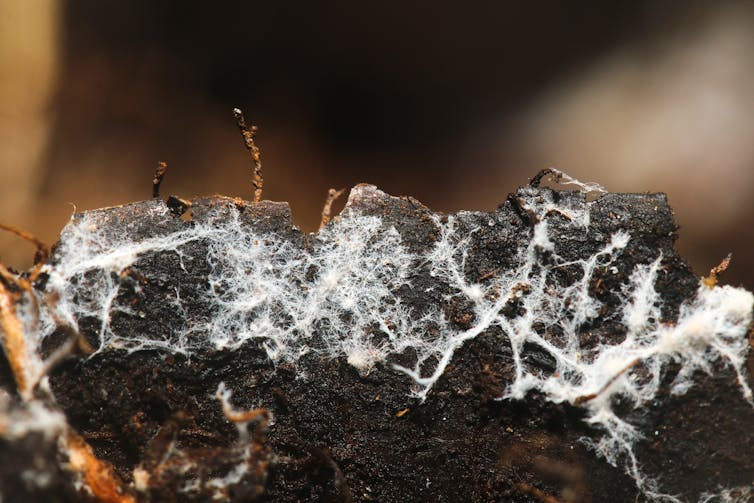
A clump of soil containing fine, white threads.
The mycelium of mycorrhizal fungi enable symbiotic relationships with plants. KYTan/Shutterstock

Experiments using plants connected only by mycorrhizal fungi have shown that when one plant within the network is attacked by insects, the defence responses of neighbouring plants activate too. It seems that warning signals are transmitted via the fungal network.

Other research has shown that plants can transmit more than just information across these fungal threads. In some studies, it appears that plants, including trees, can transfer carbon-based compounds such as sugars to neighbours. These transfers of carbon from one plant to another via fungal mycelia could be particularly helpful in supporting seedlings as they establish. This is especially the case when those seedlings are shaded by other plants and so limited in their abilities to photosynthesise and fix carbon for themselves.

Exactly how these underground signals are transmitted remains a matter of some debate though. It is possible the fungal connections carry chemical signals from one plant to another within the hyphae themselves, in a similar way to how the electrical signals featured in the new research are transmitted. But it is also possible that signals become dissolved in a film of water held in place and moved across the network by surface tension. Alternatively, other microorganisms could be involved. Bacteria in and around fungal hyphae might change the composition of their communities or function in response to changing root or fungal chemistry and induce a response in neighbouring fungi and plants.

The new research showing transmission of language-like electrical impulses directly along fungal hyphae provides new clues about how messages are conveyed by fungal mycelium.