Articles, Resources & Networks, Uncategorized

‘Everything is a being’ for South Africa’s amaMpondo fighting to protect nature

  • amaMpondo environmental defenders on South Africa’s Wild Coast bring the same spirit of resistance to extractive mining interests today as their forebears did to the apartheid state in the 1960s.
  • Their connection with the land, and the customs that underpin this, makes them mindful custodians of the wilderness.
  • The amaMpondo say they welcome economic development, but want it on their own terms, many preferring light-touch tourism over extractive mining.
  • The amaMpondo’s worldview and values are passed down through the generations through the oral tradition.

By LEONIE JOUBERT originally published in Mongabay

MPONDOLAND, South Africa — The day the prospectors came, so did the storm. It was 2007, and clouds barreled toward the coast, driven by a wind that churned up dust and foretold of the downpour to come. Beyond the rusty dunes, the Indian Ocean surged with equal force.

“It was scary,” says Mamjozi Danca, a traditional healer who has lived here all her life.

Her family couldn’t bring the cattle in from grazing, and “even cooking wasn’t easy.” They hunkered down in their rondavel, a round homestead with a thatched roof not far from the mineral-dense dunes of Xolobeni on South Africa’s Wild Coast, to wait it out.

Xolobeni is a village on a 24-kilometer (15-mile) stretch of wilderness about four hours’ drive south of the port city of Durban. It has become synonymous with a two-decade-long fight by the Indigenous amaMpondo against extractive mining interests that had sights on the powdered titanium in the dunes. There have also been more recent attempts to conduct seismic surveys for offshore oil and gas.

When traditional healer Mamjozi Danca was born into a violent apartheid state that tried to dispossess her people of their land and culture, the amaMpondo fought back. Now they are fighting to protect their heritage from mining corporations.
When traditional healer Mamjozi Danca was born into a violent apartheid state that tried todispossess her people of their land and culture, the amaMpondo fought back. Now they are fighting to protect their heritage from mining corporations. Image by Leonie Joubert for Mongabay.
Herbalists burn imphepho, African sage (Helichrysum odoratissimum), as an incense during prayer. This fragrant herb grows wild in the Mpondoland grasslands.
Herbalists burn imphepho, African sage (Helichrysum odoratissimum), as an incense during prayer. This fragrant herb grows wild in the Mpondoland grasslands. Image by Leonie Joubert for Mongabay.

On the day the mining prospectors came for their sand samples, the storm drove them away, Danca says. It was frightening. But it was a sign, she says, a miracle even.

This, by her interpretation, was the spirits of the ancestors bringing a message to the people, using the vocabulary of the elements.

“If we allow [mining], [we] will never be able to access any medicine, the beach, the sea, or food,” Danca says. According to her, it was a message of solidarity: we, your forebears, will fight alongside you, the living, who are protecting our ancestral lands.

When the government later granted a prospecting license to Mineral Sand Resources, an Australian company, the community challenged its legality in court, resulting in the license being suspended.

The spirit of resistance to these would-be profiteers is the same one that fueled the amaMpondo’s fight against the apartheid government in the 1950s and early 1960s, sources tell Mongabay. And it is their connection with “the land” — the web of life that surrounds them, and where the spiritual world is said to exist — that environmental defenders say they are willing to die for.

Some already have.

The amaMpondo want economic development, but on their own terms, with many preferring light-touch tourism over extractive mining. Some families offer rustic catered accommodation for hikers trekking up and down the coast, such as here at the popular Mtentu River mouth. Image courtesy of Travis Bailey/Siyasizisa Trust.

Nature: Where the living and the spirit realm meet

It’s no accident that this place is well preserved, the locals say. Their custodianship has kept it this way.

The land is their mother, they say; it is their identity, something they respect. In their belief system, the land owns the people; the people don’t own the land.

When the amaMpondo speak of “the land,” they aren’t referring merely to the soil beneath their feet, which can yield X bushels of corn that can be sold for Y dollars at the market.

They’re talking about the rains that roll in on a storm, and the water filtering into the wetland where the grass aloes grow. They’re talking about the springs where they collect bathwater, the grasslands where their herds graze, and where they gather plants for medicines and mystical charms. They speak of the forests that burst with fruit, and offer firewood or timber. They mean the rivers that run into the ocean where they cast their fishing lines, and the fish that nourish them.

Xolobeni’s rusty titanium-rich coastal dunes are synonymous with the amaMpondo’s 20-year battle to keep extractive mining out of their ancestral lands.
Xolobeni’s rusty titanium-rich coastal dunes are synonymous with the amaMpondo’s 20-year battle to keep extractive mining out of their ancestral lands. Image by Leonie Joubert for Mongabay.

The Pondoland Centre of Endemism is globally recognized for its unique plant diversity, with rarities such as the Pondoland coconut (Jubaeopsis afra), the Pondoland conebush (Leucadendron pondoense) and the Pondoland ghost bush (Raspalia trigyna).

It is also here, in nature, where the amaMpondo connect with the spirit realm.

The amaMpondo’s spiritualism is a blend of African animism and Christianity. They say that when someone dies, their spirit doesn’t go away to a far-off realm — a heaven, or hell, or a cycle of reincarnation — but lingers close by, staying near to places they loved when they were here in their physical bodies.

“Those who have passed on cling to the places close to their hearts,” says Sinegugu Zukulu, a conservationist, ecological infrastructure expert and Indigenous knowledge specialist. “Just like living people are everywhere, so are those who have passed on.

“There are those who reside in the ocean,” Zukulu says, “some are in the mountains. Some reside in waterfalls; some in beautiful, peaceful pools; some in forests.”

Everything is said to be a being. That means protecting individual species and the ecosystems in which they occur — the grasslands, forests, rivers and ocean — is as much about ensuring people can meet their daily needs as it is about protecting the spiritual places where they connect with the numinous.

To understand this, Zukulu says, a person must witness their daily practices.

Traditional healer Malibongwe Ndovela collects plants for medicines and mystical charms thatgrow in the grasslands and forests at the Mtentu River mouth, a popular overnight stop for hikers.
Traditional healer Malibongwe Ndovela collects plants for medicines and mystical charms that grow in the grasslands and forests at the Mtentu River mouth, a popular overnight stop for hikers. Image by Leonie Joubert for Mongabay.

A walk through the grasslands uncovers the medicinal plants tucked away among the grazing, which explains why they won’t plow all the virgin land. Most of the natural veld remains intact, with just a few small vegetable beds for each family.

Healers only collect bark from the north-facing side of a medicinal tree, so it doesn’t die.

“In customary law, we are not allowed to cut down fruit-bearing trees,” Zukulu says, “because they give food to wildlife, like birds, bees and insects, and to strangers on long journeys.”

Out of respect for the ancestors, and the need to keep in good standing with them — ancestors are said to have the power to punish, if someone strays — conservation practices take the shape of a ritual or lore, becoming practical while being imbued with the metaphysical.

Losing their land to extractive development will break these lores and customs, they say.

But fighting to protect their way of life has come at a cost.

Traditional healers use the smoke from the coals of a yellow wood tree (Podocarpus latifolius) tocleanse a cattle herd of problematic spirits and stop the animals from fighting.
Traditional healers use the smoke from the coals of a yellow wood tree (Podocarpus latifolius) to cleanse a cattle herd of problematic spirits and stop the animals from fighting. Image by Leonie Joubert for Mongabay.

In 2016, a community leader with the Amadiba Crisis Committee (ACC) — which, together with civil society organization Sustaining the Wild Coast (SWC), helped spearhead the legal challenges to the titanium mine and other extractive development efforts — was killed. Sikhosiphi “Bazooka” Rhadebe was shot in a suspected hit linked with resistance to the titanium mine. His death has not been thoroughly investigated and his killers remain at large. Zukulu and fellow activist Nonhle Mbuthuma, another ACC leader, found their names on a purported hit list that began circulating before Rhadebe’s murder, believed to be issued by a person or people in the community who were pro-mining.

This hasn’t stopped the community. Now they continue with a protracted legal battle against the energy giant Shell, which planned offshore seismic surveys about 770 km (480 mi) south of Xolobeni to find oil and gas. So far, they’ve kept Shell’s prospecting license application snarled up in legal proceedings. Meanwhile, in April 2024, Zukulu and Mbuthuma received the prestigious Goldman Environmental Prize for the community’s efforts to thwart Shell.

The legal case centers around more than just the potential environmental impacts of the sonic blasting, such as injury to sound-sensitive marine life like dolphins, whales and the near-extinct African penguin (Spheniscus demersus).

The amaMpondo argue that it’s also a threat to their cosmology.

“Shell’s disruption of the ocean risks disrupting and disturbing those who have passed on, and the living don’t know what it may lead to in their lives,” Zukululu says.

It is no accident that Mpondoland is well preserved, the locals say. Their custodianship has kept itthis way. They want economic development, but on their own terms, with many preferring light- touch tourism over extractive mining.
It is no accident that Mpondoland is well preserved, the locals say. Their custodianship has kept it this way. They want economic development, but on their own terms, with many preferring light-touch tourism over extractive mining. Image by Leonie Joubert for Mongabay.

Remembering hard times

Today, Mamjozi Danca is in her 60s. Like most of her generation, she doesn’t have a precise calendar date for her birthday, but uses the oral tradition to mark her arrival in the world.

She was born, her father told her, when the amabulu, the soldiers, stormed into their home, ripped off people’s jewelry and amulets, and looted the kitchen for food. This was the kind of intimidation tactic that the state used to bully the amaMpondo to submit to a national land-grab policy that aimed to push the country’s majority Black population into reserves and keep the country’s best farmlands for the minority white elite.

Part of this included imposing “betterment schemes” on Indigenous communities that were intended to upend traditional governance structures and communal land and grazing customs. State-sponsored chiefs drove wedges between communities. Extractive taxes forced Indigenous men to head to the mines, mostly in Johannesburg, as part of a conveyor belt of exploitative migrant labor.

The amaMpondo may not live solely off the produce of their farms, but being able to keep animalsand grow vegetables and maize goes a long way towards boosting their food resilience.
The amaMpondo may not live solely off the produce of their farms, but being able to keep animals and grow vegetables and maize goes a long way towards boosting their food resilience. Image by Leonie Joubert for Mongabay.

The amaMpondo were having none of it, rising up in a peasant resistance to this violent and illegitimate state in the 1950s and early 1960s. The culmination of the Mpondo Revolt came on June 6, 1960, when a group gathered at Ngquza Hill, not far from Xolobeni. The military flew in, dropped tear gas and gunned down 11 people. In the months that followed, the state hunted down and arrested others believed to be complicit, sentencing 30 to death for their part in the uprising.

It was into this maelstrom that Danca was born.

Today, Danca, a member of the ACC, is defiant. The amaMpondo were fighting to protect their land and way of life during the revolt; now they’re fighting the same system that wants to dispossess them of their inheritance today.

“I will never give up. I will never stop fighting,” she says.

Stories keep customs and cosmology alive

On the day the helicopters came, before Christmas 1960, Nozilayi Gwalagwala clutched her newborn boy as she felt the pah-pah-pah-pah-pah of the propellers’ vibrations. She recalls the choppers wobbling as they hovered near her rondavel.

Today, at 98, she crumples her housecoat into a tiny bundle to show how small her infant was, not even 24 hours old.

It was six months since the Ngquza Hill massacre, and a fortnight after the government issued draconian measures to suppress the revolt. Soldiers had returned to round up resistance stragglers who were boycotting tax payments and rabble-rousing against puppet chiefs.

Nozilayi Gwalagwala, 98, is a “living library” of stories and history. The amaMpondo’s care for the environmental is rooted in their customs and cosmology which are passed down through the oral tradition.
Nozilayi Gwalagwala, 98, is a “living library” of stories and history. The amaMpondo’s care for the environmental is rooted in their customs and cosmology which are passed down through the oral tradition. Image by Leonie Joubert for Mongabay.
Nozilayi Gwalagwala, 98, has lived off the land for a whole lifetime, growing crops such as maize, beans, and potatoes, and investing in cattle as a way to build wealth.
Nozilayi Gwalagwala, 98, has lived off the land for a whole lifetime, growing crops such as maize, beans, and potatoes, and investing in cattle as a way to build wealth. Image by Leonie Joubert for Mongabay.

Gwalagwala’s husband was captured that day. He was locked in the back of a truck to ship the prisoners away when it got into trouble at a tricky river crossing and overturned. Many were injured. When news reached Gwalagwala, she feared her husband was dead.

It took a week to track him down, alive but seriously injured in a hospital 55 km (34 mi) away. Much of the journey to find him was on foot, carrying her infant. The baby was later named Gunyazile, because he was born during a time when the “authorities forced the people.”

These were hard times, and her child would forever carry this history in his name.

Today, Gwalagwala tells this story in the presence of her grandson, Lungelo Mtwa, born to the late Gunyazile. Mtwa is 29. After he completed his diploma in tourism management, he returned to the land of his forebears, where he now works as a tour guide.

Tour guide Lungelo Mtwa (29) is taking on the mantle of storyteller from his grandmother NozilayiGwalagwala (98), and brings the amaMpondo history to life for the hikers who trek along the coast.
Tour guide Lungelo Mtwa (29) is taking on the mantle of storyteller from his grandmother Nozilayi Gwalagwala (98), and brings the amaMpondo history to life for the hikers who trek along the coast. Image by Leonie Joubert for Mongabay.

Their tale encapsulates the amaMpondo’s wishes. Many welcome development, but want it on their own terms. Light-touch tourism allows them to draw on their culture and the region’s unique biodiversity by offering authentic catered accommodation and guiding services to hiking parties that trek up and down the coast.

“She is a living library,” Mtwa says of his grandmother. “You can hike the Mpondo coast alone, but it is these stories that bring the place to life.”

The amaMponodo’s stories, archived in the oral tradition, carry the customs and cosmology that have ensured the Wild Coast remains wild, then and now, and burns with the spirit of resistance to external powers that wish to profit from their inheritance.

Banner image: Traditional healers use the smoke from the coals of a yellow wood tree (Podocarpus latifolius) to cleanse a cattle herd of problematic spirits and stop the animals from fighting. Image by Leonie Joubert for Mongabay.

Books, Uncategorized

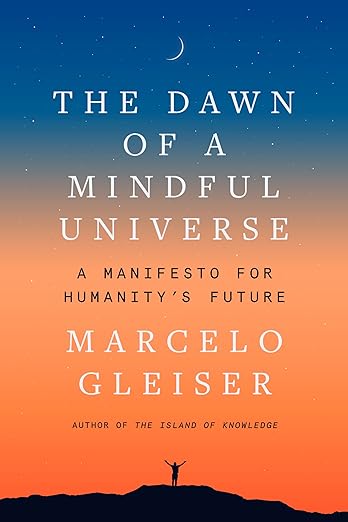
Books that Reconnect: “The Dawn of a Mindful Universe: A Manifesto for Humanity’s Future”

An award-winning astronomer and physicist’s spellbinding and urgent call for a new Enlightenment and the recognition of the preciousness of life using reason and curiosity—the foundations of science—to study, nurture, and ultimately preserve humanity as we face the existential crisis of climate change.

Since Copernicus, humanity has increasingly seen itself as adrift, an insignificant speck within a large, cold universe. Brazilian physicist, astronomer, and winner of the 2019 Templeton Prize Marcelo Gleiser argues that it is because we have lost the spark of the Enlightenment that has guided human development over the past several centuries. While some scientific efforts have been made to overcome this increasingly bleak perspective—the ongoing search for life on other planets, the recent idea of the multiverse—they have not been enough to overcome the core problem: we’ve lost our moral mission and compassionate focus in our scientific endeavors.

Gleiser argues that we’re using the wrong paradigm to relate to the universe and our position in it. In this deeply researched and beautifully rendered book, he calls for us to embrace a new life-centric perspective, one which recognizes just how rare and precious life is and why it should be our mission to preserve and nurture it. The Dawn of a Mindful Universe addresses the current environmental and scientific impasses and how the scientific community can find solutions to them.

Gleiser’s paradigm rethinks the ideals of the Enlightenment, and proposes a new direction for humanity, one driven by human reason and curiosity whose purpose is to save civilization itself. Within this model, we can once again see ourselves as the center of the universe—the place where life becomes conscious—and regain a clear moral compass which can be used to guide both science and the politics around it.

Articles, Uncategorized

‘The heart that breaks open can contain the whole universe.’

By Joanna Tomkins

Today we took yet another ‘combi’, this time from Chinchero, our last stop in Peru, where my kids and I have spent 5 weeks, during our visit to South America.

I feel my heart breaking during the ride. It’s not a bad feeling at all, it’s a feeling of openness, a sensitivity around the heart. I will miss these trips in public transport. These trips in public. It’s been very useful for me to speak Spanish, but I know that the warmth of these intimate connections of people on the go, together, would have melted any language barrier.

A very old man, with a cane, hails the bus.
‘Necesita ayuda’, he needs help, a lady says from behind. One lady bends over to open the door, I bend over to help him up by his other blackened hand, immediately enveloped by the scents of boiled corn cobs and infinite layers of wood smoke. I remember entering a Himba hut. He asks me if we are at ‘la terminal’ a few times and I help to prop him up when he slips on the seat in the abrupt Andean bends in the road. He sips on the ‘chicha morada’ (black corn fermented drink) he brought for the ride in an ancient 20cl Inka Cola bottle, reused time and time again.

‘Gracias Mamita!’… He trusts me like his daughter. When we all get off in Cusco he can’t find his money, and remembers he forgot to remember his other bag. ‘Pago para los cuatro’ I say as my kids slip out from the front row, where they had found two free seats. It seems natural to all. And we drift off in between the busy Saturday market stalls.

I wonder if he remembers where he is going. I wonder who will help him find his way home today. I wonder when he lost his wife. I wonder who will take care of him, when his eyesight and his memory get worse, yet I know there will be care for him, for there is community. 

Nowadays, my heart breaks open in a similar way when it feels sorrow and when it feels joy. Sorrow feels like gladness when there exists a non dual sense of greatness that binds them both together. That I have felt strongly here in the Andean mountains and the creases of the Sacred Valley: the greatness of the mountains, revered for their divinity, named Apus. And how men can ‘move mountains’ when led by a vast and sacred sense of purpose. This purpose was driven for the Incas by their trust in their kings and leaders, trust in their elders, trust in the nature gods, and trust in themselves. I quote Robert Bly, whose book ‘Iron John’ I took on travel: ‘The inner King is the one in us who knows what we want to do for the rest of our lives, or the rest of the month, or the rest of the day.’ 

Each stone in the Incan temples in Peru is a masterpiece. Some of them weigh several tons (one in the Sacsayhuaman -pronounce ‘sexy woman’- weighs 125 tons!) and have been quarried several kilometres away. It is a miracle of human will power that we can admire here today. The Spanish used these works of art as convenient bricks for their monotheist humancentric churches, with the added excuse of ‘extirping idolatry’ from the minds and hearts of the invaded. But they could not move the greater of the stones!

Some of the original Incan pieces have up to 20 different angles that are adjusted without mortar to the next stones, forming a mosaic that not only is creatively diverse in its assembly but also has the perfect structure to resist the earthquakes that the dramatic Pachamama bestows upon this region every few decades. Archaeological prowess is everywhere: in the exact inclination of each temple wall, the drainage of each terrace, the elaboration of door hinges and jambs so that each element collaborates with the others to defy the tricks of gods.

What I have felt all around in the communities that inhabit the Andes is a great sense of belonging, deeper than the Western scattered, individual pursuit of purposefulness. What wisdom the atrocious conquests tried to eradicate is still alive with roots as deep as the mountains are high. Quechuan sounds powerful, indigenous rhythms transpire in the music…, there is no legacy from Spain that has not been blended and sublimed with Incan heritage, more ancient, seeped with spirit, hence more coherent.

And what makes more sense than to revere the nature gods, Inti/Sun the highest of all? And what is more kingly than to present them with the gift of a lifetime of labour? These walls were not built for oneself, for one’s own, they were built for the generations to come, for the Empire, for the Sun itself. Imagine how many lives communed to place each Intipuntu/Sun gate in the exact position where Sun can kiss through it at the exact hour that honours Him?

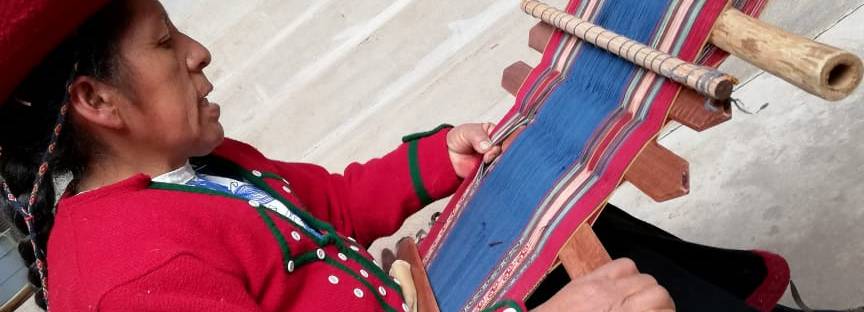
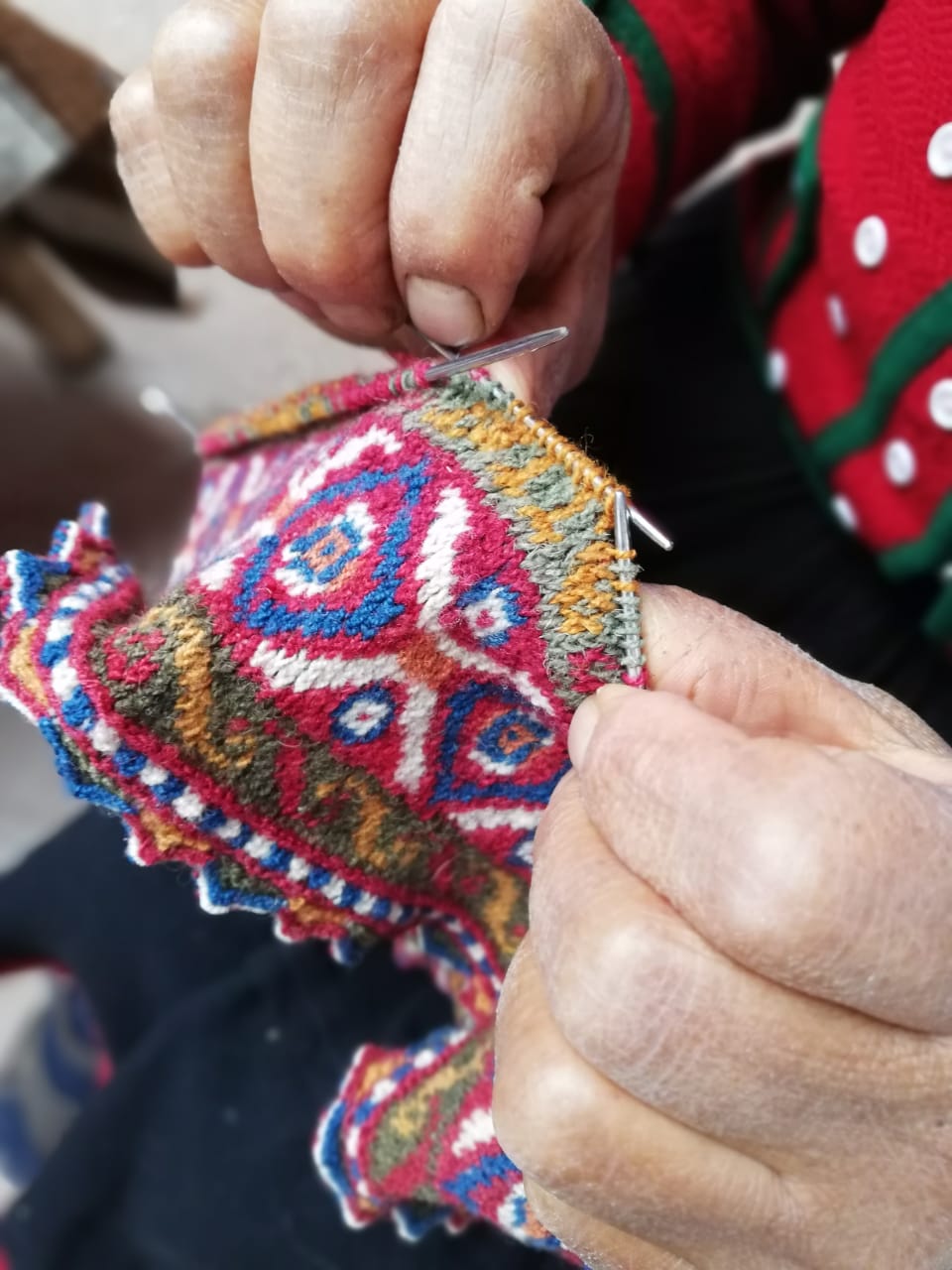
Yesterday we watched Mama Sonia weave, the inner King in her thumbs knowing which string to move next, which colour to represent her tribe, which shape to represent her land. The tradition of weaving withholds the passing of time in the communities of Chinchero, young women still queuing to learn from the elders the traditional ways, fully aware of the privilege of their culture.

In different ways, this witnessing breaks my heart.

The heart that breaks open can contain the whole universe.

A Quote by Joanna Macy
Uncategorized

Staying Sane in the Next 5 Years

Transcript of a Q&A by Charles Eisenstein, before he and Patsy Eisenstein launched the Sanity project last year.

I transcribed this talk to text for you readers because for me each of these words are gold and are very helpful to come back to. His talk is longer and the link is below if you wish to access it (or many of his other masterful downloads) Love Joanna”

by Charles Eisenstein:

In these turbulent times, we live amidst a breakdown of sense and meaning that leaves us susceptible to going crazy.

There were times during Covid actually where I felt like I was going crazy. I was holding a story that so contradicted what the culture overall was saying, thinking and appearing to believe that there were times where I thought “Well, maybe I’m the crazy one”. I had thoughts such as “maybe every single thing I’ve done in my entire career is simply coming from my reflexive opposition to my father and my discontent, and I just couldn’t hack it in the real world, so I became a dissident.”

When your truth is so different from what prevails that you are toppled from the seat of the Soul, the robbers get into the castle, the bandits get in and they run amok. And you become a fugitive in your own castle with your hidden truth, skulking around not daring even to say it to yourself, but on some level still knowing this can’t be right. And so, during those times, I always came back again and again to “what do I know for real from my direct experience?”. Then I found I had even started doubting my direct experience! I’d started gas lighting myself.

Every one of us has had direct experiences that contradict what we are being told. The economy tells us what is valuable. The economy says what society values and does not value. Yet so much of what we know in our bodies is valuable is not economically rewarded.

How do you stay sane if you don’t have other people to affirm what you know as the right choice? That is the key to maintaining sanity in coming times. Sanity is a group project. We cannot hold a story alone. We need a community to hold a reality because as I said reality is not an objective thing outside of ourselves. It’s not a given, neither present nor future, it is a relationship.

Our choice is whether to say yes or no to the future and the present that is offered to us and through our yes and no we create ourselves. “Who am I to be? I am also not a given.” That is the essence of what sovereignty is: who am I to be? Therefore, through that choice, through that acceptance of the offering, is who you can be. Through that acceptance, through that choice, we also create a world that is an intimate mirror of ourselves.

Part of why I am here and doing this work is to be part of that collective holding of sanity and to invoke realities and states of being that many of us are ready and willing to step into. We all need a little help from each other to do that. Many challenges lie ahead as the old structures break down and we are left alone in the gale. When we start gas lighting ourselves and when the truth that has touched us in the past blows away in the gusts, leaving us susceptible to predatory substitutes for the structures of sense, meaning and identity that have fallen away.

Because the story that that I grew up in anyway was a totalising story. It explained everything from the origin and purpose of humanity to why the birds sing. And when that breaks down, there comes a sense of vertigo and therefore an intense discomfort and a desperation to find some substitute, a new story of everything in which we can rest, and that’s what I call going insane. So, one way to hold it all together is to become even more entrenched and more orthodox in the story that is breaking down even though it’s not working. “I’m gonna double down and believe in it more” is actually a classic response to a challenge to a world view. In certain studies, they present people with evidence that contradicts their worldview and then they interview them about the result of that challenge. Most people become more convinced of their world view when it is challenged. Because it’s an assault on your identity. Opinions aren’t just opinions, they’re woven into everything and tear your self-worth. And so that’s one response: you get even more entrenched, which requires that you ignore more and more of what’s real in order to believe for example right now that civilisation is basically on the right track and that science and technology are ushering in a better and better world every year. In this mythos, you have to ignore more and more things to actually think that’s true, calling in more insanity…

Once you accept one lie you start to accept all the other lies that are required to maintain it and the result is that we live in a matrix of lies right now, where we take for granted being lied to. We’re not shocked when politicians lie to us, it’s normal advertising. It’s one lie after another. We automatically discount all speech, which is part of the reason for speech inflation, [with the use of superlatives], where everything’s “awesome” for example.

So, that’s one path to madness. Another path to madness is to jump to another totalizing discourse that explains everything. It could be religious fundamentalism; it could be a cult; it could be conspiracy theories… When I say conspiracy theories, I do not mean that in a derogatory sense because I do think that actual conspiracies happen and have a bigger influence on current affairs than most people think. Conspiracy theory can be used to dismiss any dissent or unorthodox opinion, or any protest. But when the conspiracy theory offers you an explanation for everything, be careful.

And then another form of madness is nihilism. It’s to become attached to the space between stories which is really supposed to be a transition. It’s a deprogramming time, it’s a letting go and it does take some time for a gentle falling away of what you thought was real and who you thought you were. That’s the empty space that allows something new to be born. It’s also why I like to take pauses in my speaking, so that I don’t go on autopilot, so something new can be born.

So yes, we are at a crossroads, indeed, a choice point, multiple timelines converge on the present moment and you can feel them sometimes. You maybe feel yourself moving from one to another to another which kind of explains how we can feel so much despondency at one moment and feel so much hope at another moment. It’s because you’re actually occupying a different timeline toward a different future. So, the task in front of us in the next five years is to: first recognize the choice that we are making and learn how to solidify the timeline that we actually want to experience for ourselves and the future generations. How do you actually make this choice? It’s not just to check a box, it’s to recognize the moments that we are choosing it. One way to do that is when facing a choice ask “What declaration am I making about human nature?”, ”What am I saying about the human being making this choice?”.

To watch the full Q&A you can access https://www.youtube.com/watch?v=BE7DXxE_q6o

You can also follow Charles on his networks and enroll in his new programme Turning of the Age here: https://charleseisenstein.org/

The Turning of the Age centers on monthly livestreams with Charles Eisenstein, who will report on Earth’s evolution toward “the more beautiful world our hearts know is possible.” Each monthly livestream will have a live Q&A session held in the week that follows. These reports each bring together some or all of the following elements:

Mystic River by Ági Novák
  • Meta-political commentary
  • Off-the-radar events of global significance
  • “Sign of the times” stories
  • Developments in conventional and alternative science & technology
  • Earth changes, ecological illness and healing
  • Newly emerging and dying myths
  • Insights from astrologers, channels, and mystics
  • Short guided meditations and/or prayers
Articles, Legal Rights, Resources & Networks

UN: “Children have the right to a clean, healthy and sustainable environment”

I am excited about this news from the United Nations, an excerpt of which is hereunder. Of course we know that within traditional institutions like this, with slow heavy politically-engineered routes to actions, big steps like this on paper are only baby steps on the ground, and we have no time to spare. Yet it gives me courage to read this vision from this global bureaucratic body. And hopefully this will encourage states to adopt new laws in that respect.

This immediately gives credit to the work of countless NPOs working with children on the one hand and with environment on the other, and can possibly also fuel more synergy between both those areas of focus. I think this can also create a much needed bridge between the field of education and environmental and ecospiritual awareness. With conventions like this isn’t it time to reform the curriculum so that we are not teaching our children how to destroy their future?

The Rights of the Planet also need urgent recognition on a global scale. These rights are essential to support the work of other activists working on the front line today, defending what is left of wilderness and regenerative life. Together with the rights of our children and the future generations, rights for the Earth herself leave no space for more plundering. – Joanna Tomkins

See hereunder an extract from the UN press release:

Resources & Networks

The Sanity Project by Charles Eisenstein

Rachael and I joined the Sanity Project in June. Hereunder some words from its emissary….

Introduction to the Sanity Project (on the network New And Ancient Story – NAAS)

“With this offering, I aim to establish an oasis of sanity, a studio of sanity, and an incubator of sanity for coming times. We have seen in recent years a mounting madness that took on a new and virulent form during the Covid era. Though that particular expression of madness has abated, the social and psychic conditions that spawned it are still in place. Our politics, our culture, and our public discourse swing to new extremes of derangement.

Getting swept up in mass hysteria is just one type of insanity. Resisting it takes a psychic toll. Those who try often succumb instead to despair, depression, addiction, extremism, and conspiracy theories.

I speak here from experience – I too went a little crazy during the Covid years. The experience confirmed that I cannot stay sane alone. At key moments, friends and allies said the right thing to me at the right time and brought me back to sanity. With this program, I aim to pass that gift onward and to create conditions by which many of us can stay sane together.

What do I mean by staying sane?

  • To hold center, and return to it when you lose it
  • To hold a good and true story of self and world
  • To be able to abide in not-knowing for as long as it takes for authentic knowing to emerge
  • To hold peace amid information warfare
  • To distinguish and hold your truth in the midst of hysteria
  • To build sustaining connections with human and other-than-human beings, to have an ongoing experience of kinship.
  • To build resistance to manipulation and covert fundamentalism
  • To access a wholesome wellspring of sense, meaning, and identity
  • To fortify the integrity of body/mind/spirit
  • To mutually reinforce all of these with others, to form islands of sanity in a world that is still far from sane
  • To be a seed crystal that brings a higher level of sanity to all you touch”

Join here | The Sanity Project (charleseisenstein.org)

Hereunder also is an animation that he directed and his interpretation under that…

“Hi everyone, I am so proud to share with you this short film, the first I’ve written and directed myself. It has deep relevance to the theme of this program. I won’t comment on it yet, because I think the story itself exercises more power than any interpretation of it can. So please take it in as you would any other film. Maybe watch it a few times.” 
– Charles Eisenstein –

“The choice that [this film] represents isn’t only a choice made before lifetimes. It is an ongoing choice, day to day, moment to moment, about how to engage the world.

One way to engage (or really, not engage) is to stay in whatever temporary comfort realm one can manage with distractions, entertainment, addiction. Yet none of these can be permanent, and even the most sublime experiences of immersion in nature or lovemaking cannot be prolonged beyond their right span. At some point, the awareness grows that we are on the brink of a pit, that right beneath us, just a shift of attention away, is a world that begs our service. To rest, to recharge, is important in order to render that service well, but when the batteries are full, restlessness will seize even the most indolent among us. So, the choice to attempt a permanent disengagement from the world to abide in its pleasurable precincts is futile.

A second way to engage is with a heavy spirit of duty, overcoming by force of will a reluctance to enter the fray, carrying a subtle distaste for the lower realms. It comes from a false sense of superiority, and leads as well to a partiality of engagement. One stays half in, half out, never fully committing to embodiment.

The film portrays a third choice. The luminous beings plunge into the pit — all the way in. And they do so in peace, in joy, in serenity. They do not feel sorry for themselves as they take the plunge. They meet their mission gladly.

I will confess — I didn’t actually make this film for you. I made it for me. I’m the one who has so often hung back from life, stayed timidly a little bit above the fray. I’m the one who often engages life joylessly, with too heavy a sense of duty. I’m the one who, sometimes, sees people with ungenerous eyes blind to the truth that they here on the same mission I am.

As I enter more deeply into the “fray” of a political campaign, I hope to do so as the people in the film do — fully, but not as a fighter, not to become a creature of the Pit. I will watch this film from time to time to help me stay serene in the knowledge of what I and all others are really here for. May this film help you, as it has helped me, to see with generous eyes and speak with generous words that summon what is seen into manifestation.”

Articles, Uncategorized

Can we ban?

by Joanna Tomkins

Yesterday was the UN “World Environment Day”. under the theme BeatPlasticPollution. And on 8th June it will be the World Ocean Day. Two drops of awareness in a vast ocean of Great Unravelling, which made me wonder what is being done in the country I call home, South Africa. Whilst we do have admirable local initiatives to clean our beaches, ecobrick and recycle ‘sea plastic’ into art, it made me realise I have no idea if,in the meantime, there are any lobbies working towards the actual ban of single use plastics in our country. Is the government -immersed in other energetic and economic challenges and scandals – needing more pressure from citizens? Do we not, as an economically privileged country within the continent have a certain responsibility to pioneer political and technological innovation in that field? What can we do on an individual level to make the ban happen?

Last week a small group of activists created a social media group and urged participants to request the ban of the use of harmful Round Up pesticides in the highly sensitive Cape Peninsula biodiversity hotspot we live in. It only took the support of a few hundred concerned residents writing letters to their local ward councillors and the extra initiative of a few of them to take the matter right up to the Premier of the Western Cape Province, where it was taken very seriously. It was an inspiring course of events for many, illustrating that we should not consider any action to be powerless, and how fast shift can happen nowadays. We all care, we all care for our mother. Some emerging political programmes are deeply engaged with her cause. Even if we have been programmed to believe nature is a machine, and corporate greed is still a widespread habit, in all areas there is knowing that radical change is necessary and urgent.

A shift to a more ecological civilisation is underway. Hereunder is an article published by theconversation.com

“Single-use plastic bans: research shows three ways to make them effective”

Published: January 13, 2023 8.15am SAST
Authors: Antaya March, Steve Fletcher and Tegan Evans, University of Portsmouth, UK

Governments around the world are introducing single-use plastic product bans to alleviate pollution.

Zimbabwe banned plastic packaging and bottles as early as 2010. Antigua and Barbuda banned single-use catering and takeaway items in 2016, and the Pacific island of Vanuatu did the same for disposable containers in 2018.

The EU prohibited cotton buds, balloon sticks, plastic catering items and takeaway containers, including those made from expanded polystyrene, in 2021.

The UK government has followed suit by announcing a ban on the supply of single-use plastic plates, cutlery, balloon sticks, and polystyrene cups and containers supplied to restaurants, cafes and takeaways in England. The measure will start in April 2023. The same products sold in supermarkets and shops will be exempt from the ban, but subject to new regulations expected in 2024.

While the forthcoming ban is a step in the right direction, the production, use and disposal of plastics typically spans several countries and continents. The success of any policy aimed at restricting the use of plastic products in one country should not be taken for granted.

Our research continues to highlight that policies which influence what consumers buy, such as bans, taxes or charges, lack the reach to confront the global scale of pollution. The effect of banning single-use plastic items is limited to the jurisdiction in which it is implemented, unless it inspires a wider shift in public or commercial behaviour across international boundaries.

Without supporting measures, or by failing to treat the ban as the beginning of a broader phase-down of plastic, banning some items does little to change the attitudes which reinforce a throwaway culture.


The Global Plastics Policy Centre of the University of Portsmouth reviewed 100 policies aimed at tackling plastic pollution worldwide in 2022 to understand what makes them successful. Here are three key lessons which can make [bans] more effective.

  1. Make it easy to use alternatives
    Consumers and businesses are less likely to comply with a ban if they are expected to go entirely without plastic overnight. Ensuring businesses can source affordable alternatives is critical. Antigua and Barbuda did this by investing in the research of more sustainable materials and listing approved alternatives to plastic, such as bagasse, a byproduct of sugar-cane processing.

To maintain public support, it helps if there are measures which prevent cost hikes being passed directly on to consumers.

Alternative materials or products must have a lower environmental impact than the banned product, but this isn’t always guaranteed. Substituting plastic bags for paper, for example, may not be the best idea when the entire life cycle of a product is accounted for.

  1. Phase in a ban
    A phased approach to a ban improves how well it works but requires consistent and clear messaging about what products are banned and when. In Antigua and Barbuda, phased plastic bag bans in 2016 and 2017 generated support for banning other plastic products between 2017 and 2018.

In both cases, importing these products was restricted first, followed by a ban on distributing them, which gave suppliers time to find alternatives and use up existing stock.

This approach was used to good effect in an English ban on plastic straws, cotton buds and stirrers in 2020, allowing retailers to use up their supplies during the six months following the ban’s introduction.

  1. Involve the public
    Information campaigns which explain why a ban is needed, what it means for the public and businesses and what alternatives are available serve to support a ban. This was evident from Vanuatu, where the inclusion of diapers in a ban was postponed due to public concerns around the availability of sustainable alternatives.

Working closely with the public like this can also encourage innovation. For example, in Vanuatu in 2018, weavers and crafting communities filled the gap left by banned plastic bags and polystyrene takeaway containers with natural alternatives made locally, including bags and food containers woven from palm leaves.

Single-use plastic bans can inspire wider changes to social systems and the relationship each person has with plastic. But without planned access to alternatives, a phased introduction, efforts to nurture public support and broader consideration of the entire life cycle of plastic, product bans have a limited effect on plastic pollution, and can even give the false impression of progress.

Thanks to the writers of this article. Various ideas here are examples of what could soon also happen in South Africa if we have enough voices and consensus.

If you want to read more of their articles, every Wednesday, The Conversation’s environment editor writes Imagine, a short email that goes a little deeper into a “climate” issue. Check their website.

Articles, Uncategorized

Of Mushrooms and Clouds

by Joanna Tomkins, Gaia Speaking

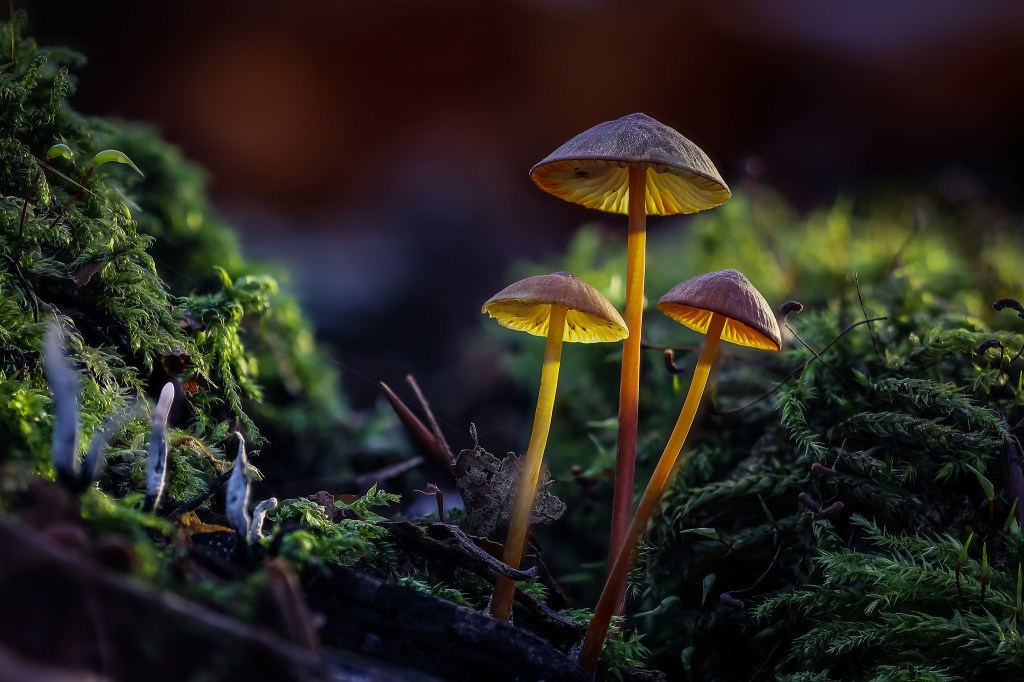
I first heard about the plastic-eating capacity of mycelium during a permaculture course I attended in 2016 when my friend and mycologist Justin White showed us a TED Talk by Paul Stamets about how mushrooms COULD save the world. (You may have seen the 2019 “Fantastic Fungi” documentary that Stamets features in – if you haven’t yet, please do!)

I have felt excited about mycelium ever since because at the time I thought, YES, but of course Mushrooms WILL save the world… It just seemed so clear and I was so grateful for news unusually filled with so much hope.

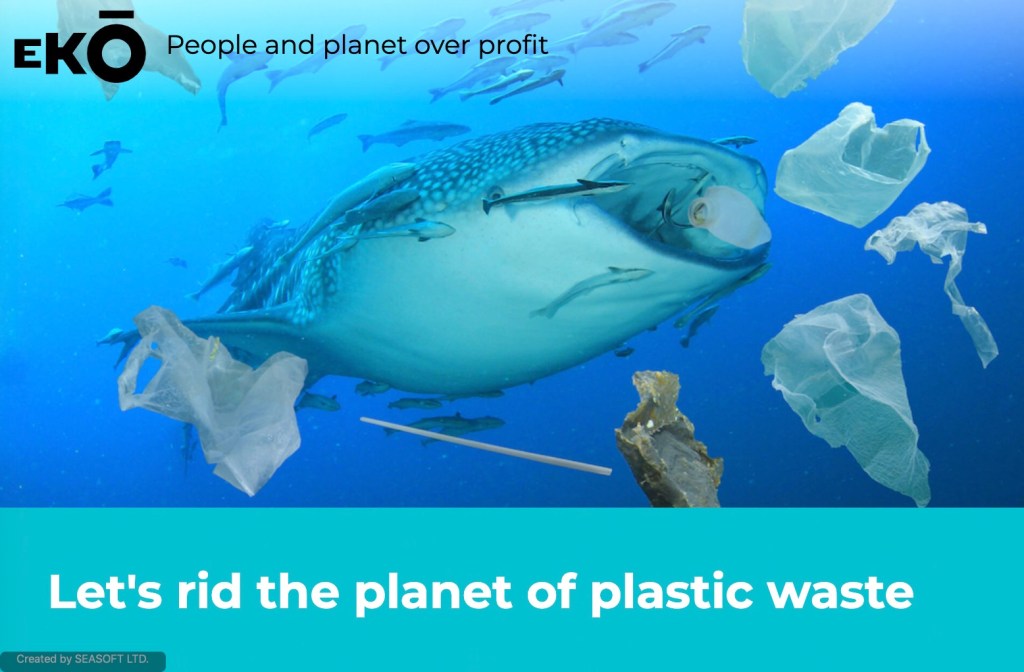
As I prepare this post today, 14 years after this TED Talk was published, and with an accute sense of urgency, I feel like the mycelium myself, as I navigate from one link to another, from one passionate researcher to another adamant activist, from one fungal function to another attribute of intelligence demonstrated by these incredible species. And I heard someone saying yesterday that mushrooms can absorb radioactive emissions too, and last week I read and shared a campaign from the platform EKO, pitching for funds to develop research for some plastic-devouring heroes. And another mushroom ceremony in the hood. And, and, and…

The healing powers of mushrooms are spreading all over the news just as exponentially as our communication networks themselves. Is there anything they cannot do?!

“How amazing is this — scientists have discovered mushrooms that can devour plastic waste in a matter of weeks…plastic that would otherwise remain in the ocean forever.

Right now 91% of the plastics we use can’t be recycled, and every minute another truckloads-worth is dumped into the ocean, suffocating sea life and spreading pollutants across shores.

But scientists say these magnificent mushrooms could eat up to half of the plastic waste being dumped in the ocean. They’re asking for our help to continue their groundbreaking research, and together we could give them the funds they need right away to expand their research in the US and New Zealand.”

Click here for campaign information

The World Wide Web which carries the news became available to us only 30 years ago. On April 30, 1993, the European Organization for Nuclear Research (CERN) put the web that it had developed onto the public domain. In 1993 also, I wrote a research project for university about the “Prospects of Expansion of Electronic Commerce in Spain” . It was minuscule at the time, there were only two shops online in the country (!). I concluded that it seemed unstoppable but that its expansion would depend largely on hardware development and availability – desktop computers I believed at the time!.

Now, in 2023 there are more than 8 billion smart mobile devices in the world, and 65 percent (up from 54 per cent in 2019) of the world’s population are using the Internet.

The speed of technological hardware expansion is terrifying and goes hand in hand with the integration of social networks and software applications, which has gone out of bounds since our society crash landed online after the dramatic “Great Pause” of 2020. The communication system that we call “cloud” is not so ethereal as we wish to believe as we type, record and film on and on. It lives between its massive servers – which would occupy the surface area of entire countries if placed alongside each other– and all our desktop and handheld devices: a vertiginous global network of cell phones, powerbanks, cables, computers, televisions, sound systems, etc, and another even more vertiginous destitute heap of e-waste. This cloud we all float in uses an exponential amount of electricity to manufacture, cool and power. So, to satisfy it we are digging into the Earth, instead of feeding it.

The Earth’s Mushrooms are a form of evolved cointelligence which can support us as we find ways to support the transformation of our own Human society. We/They need a human critical mass to be better connected to the Earth in order to understand the principles of interbeing and cointelligence.

So, want I’m wanting to highlight here I think, is that there is a huge opportunity in the spread of the online ‘aerial’ mycelium that connects us all. Even if there is aggression and waste in its making, for we can indeed share precious news and tools for the shift in consciousness that needs to happen now. Yet, we need to change our worldview so that it can evolve through sustainable and ethical practices, so that the channels we choose and the contents we communicate, exchange and trade via these networks become more life-sustaining and life-enhancing as soon as possible.

Prototaxites
hundreds of millions of years old

The story says that between 350 and 420 million years ago, there were already fungal organisms with trunks up to 7 metres high. For hundreds of millions of years, these families have been hard at work. This mycelium constantly transforming matter, sharing information and nutrients has always been working symbiotically with other species to thrive and sustain on behalf of life on Earth. Let’s mimic that better now, while we still have a chance to learn. Let’s aim wide, and wider still!

Articles, Uncategorized

Narcissists and psychopaths: how some societies ensure these dangerous people never wield power

Originally written by Steve Taylor, Senior Lecturer in Psychology, Leeds Beckett University, and published in theconversation.com.

Throughout history, people who have gained positions of power tend to be precisely the kind of people who should not be entrusted with it. A desire for power often correlates with negative personality traits: selfishness, greed and a lack of empathy. And the people who have the strongest desire for power tend to be the most ruthless and lacking in compassion.

Often those who attain power show traits of psychopathy and narcissism. In recent times, psychopathic leaders have been mostly found in less economically developed countries with poor infrastructures and insecure political and social institutions. People such as Saddam Hussein in Iraq, Muammar Gaddafi in Libya and Charles Taylor in Liberia.

But modern psychopaths generally don’t become leaders in affluent countries (where they are perhaps more likely to join multinational corporations). In these countries, as can be seen in the US and Russia, there has been a movement away from psychopathic to narcissistic leaders.

After all, what profession could be more suited to a narcissistic personality than politics, where the spotlight of attention is constant? Narcissists feel entitled to gain power because of their sense of superiority and self-importance.

Those with narcissistic personalities tend to crave attention and admiration and feel it is right that other people should be subservient to them. Their lack of empathy means they have no qualms about exploiting other people to attain or maintain their power.

Meanwhile, the kind of people who we might think are ideally suited to take on positions of power – people who are empathetic, fair minded, responsible and wise – are naturally disinclined to seek it. Empathetic people like to remain grounded and interact with others, rather than elevating themselves. They don’t desire control or authority, but connection, leaving those leadership roles vacant for those with more narcissistic and psychopathic character traits.

Different types of leader


Yet it would be misleading to say it is only psychopaths and narcissists who gain power. Instead, I would suggest that there are generally three types of leaders.

The first are accidental leaders who gain power without a large degree of conscious intention on their part, but due to privilege or merit (or a combination). Second are the idealistic and altruistic leaders, probably the rarest type. They feel impelled to gain power to improve the lives of other people – or to promote justice and equality, and try to become instruments of change. But the third are the narcissistic and psychopathic leaders, whose motivation for gaining power is purely self-serving.

This doesn’t just apply to politics, of course. It’s an issue in every organisation with a hierarchical structure. In any institution or company, there is a good chance that those who gain power are highly ambitious and ruthless, and lacking in empathy.

Narcissistic leaders may seem appealing because they are often charismatic (they cultivate charisma in order to attract attention and admiration). As leaders they can be confident and decisive and their lack of empathy can promote a single-mindedness which can, in some cases, lead to achievement. Ultimately though, any positive aspects are far outweighed by the chaos and suffering they create.

An anti-Trump demonstration in Washington DC. Shutterstock/bakdc
What is needed are checks to power – not just to limit the exercise of power, but to limit its attainment. Put simply, the kind of people who desire power the most should not be allowed to attain positions of authority.

Every potential leader should be assessed for their levels of empathy, narcissism or psychopathy to determine their suitability for power. At the same time, empathetic people – who generally lack the lust to gain power – should be encouraged to take positions of authority. Even if they don’t want to, they should feel a responsibility to do so – if only to get in the way of tyrants.

Models of society

There are many tribal hunter-gatherer societies where great care is taken to ensure that unsuitable individuals don’t attain power.

Instead, anyone with a strong desire for power and wealth is barred from consideration as a leader. According to anthropologist Christopher Boehm, present-day foraging groups “apply techniques of social control in suppressing both dominant leadership and undue competitiveness”.

If a dominant male tries to take control of the group, they practise what Boehm calls “egalitarian sanctioning”. They team up against the domineering person, and ostracise or desert him. In this way, Boehm says, “the rank and file avoid being subordinated by vigilantly keeping alpha-type group members under their collective thumbs”.

Just as importantly, in many simple hunter-gatherer groups power is assigned to people, rather than being sought by them. People don’t put themselves forward to become leaders – other members of the group recommend them, because they are considered to be experienced and wise, or because their abilities suit particular situations.

San hunter gatherers in Southern Africa

In some societies, the role of leader is not fixed, but rotates according to different circumstances. As another anthropologist, Margaret Power, noted: “The leadership role is spontaneously assigned by the group, conferred on some members in some particular situation … One leader replaces another as needed.”

In this way, simple hunter-gatherer groups preserve stability and equality, and minimise the risk of conflict and violence.

It’s true that large modern societies are much more complex and more populous than hunter-gatherer groups. But it may be possible for us to adopt similar principles. At the very least, we should assess potential leaders for their levels of empathy, in order to stop ruthless and narcissistic people gaining power.

We could also try to identify narcissists and psychopaths who already hold positions of power and take measures to curtail their influence. Perhaps we could also ask communities to nominate wise and altruistic people who would take an advisory role in important political decisions.

No doubt all this would entail massive changes of personnel for most of the world’s governments, institutions and companies. But it might ensure that power is in the hands of people who are worthy of it, and so make the world a much less dangerous place.

With much gratitude for this insightful article. Gaia Speaking

Articles, Resources & Networks, Uncategorized

Meet the Doughnut and the concepts at the heart of Doughnut Economics

Who would have thought that doughnuts could change the world?

by Joanna Tomkins

They certainly get our attention, don’t they? In the same way we may ourselves once have been addicted to eating doughnuts, our policies are still addicted to promoting growth, even if it harms us each and and every time.

But… now we have got your attention, as you will see hereunder in the graphics, the doughnut in this model is in fact the shape that represents a “safe and just space for humanity”

The text hereunder, originally published on the DEAL website, offers a comprehensive and convincing introduction to the Doughnut or Donut model. This umbrella is very exciting because its design has enough strength and simplicity to allow policy makers to regroup under it. I personally studied international business at university in France and Spain and I was so put off by some of the contents of the studies, particularly the economical theories, seminars with bankers and practicals in marketing, that I swore to never work for a large corporation. Much later, after I rerouted my career towards arts and also started to work in Africa as a wilderness guide, I went back to university in Barcelona to study Post-developmental African Studies. This was before I moved to Cape Town, wanting to learn about some of the original philosophies on the Continent and the forces at work behind the neocolonialism that still stifle them today. I rallied around the ideas of Serge Latouche (Farewell to Growth, 2007) and his peers. Since the 1980s, voices such as his have been loudly coining terms such as “economical footprint”, “eco-feminism, “overshoot”, etc, and claiming urgency. Yet, those voices have been drowned by the constantly renewed pressure from the Industrial Growth Society.

Finally, in the last few years, at the same time as a larger part of humanity starts to call for socio-economical justice – the one with the privilege to do so and be heard- , some strong, credible and conscious voices have created new alternative economical models that can be understood by many. They are now becoming mainstream and can offer politicians solid solutions to build resilience in the communities whose welfare they are responsible for. Gratitude.

If you are interested in learning more, please read some of the Stories on DEAL. This one for example about how the model has been adopted by 5 major cities around the world:

If you know how this model could be introduced to the University of Cape Town, or the City of Cape Town, please get in touch with me, I’d love to get involved.

Introduction

The Doughnut offers a vision of what it means for humanity to thrive in the 21st century – and Doughnut Economics explores the mindset and ways of thinking needed to get us there.

First published in 2012 in an Oxfam report by Kate Raworth, the concept of the Doughnut rapidly gained traction internationally, from the Pope and the UN General Assembly to Extinction Rebellion.

Kate’s 2017 book, Doughnut Economics: seven ways to think like a 21st century economist,  further explored the economic thinking needed to bring humanity into the Doughnut, drawing together insights from diverse economic perspectives in a way that everyone can understand. The book has now been published in over 20 languages.

This 2018 TED talk gives a summary of the book’s core messages, and you can read Chapter One here..

The Doughnut’s holistic scope and visual simplicity, coupled with its scientific grounding, has turned it into a convening space for big conversations about reimagining and remaking the future. It is now being discussed, debated and put into practice in education and in communities, in business and in government, in towns, cities and nations worldwide.

Kate Raworth

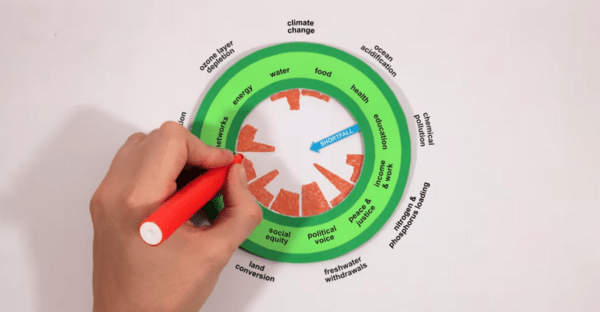
The Doughnut of social and planetary boundaries.

What is the Doughnut?

Think of it as a compass for human prosperity in the 21st century, with the aim of meeting the needs of all people within the means of the living planet.

The Doughnut consists of two concentric rings: a social foundation, to ensure that no one is left falling short on life’s essentials, and an ecological ceiling, to ensure that humanity does not collectively overshoot the planetary boundaries that protect Earth’s life-supporting systems. Between these two sets of boundaries lies a doughnut-shaped space that is both ecologically safe and socially just: a space in which humanity can thrive.

What is Doughnut Economics?

If the 21st century goal is to meet the needs of all people within the means of the living planet – in other words, get into the Doughnut – then how can humanity get there? Not with last century’s economic thinking.

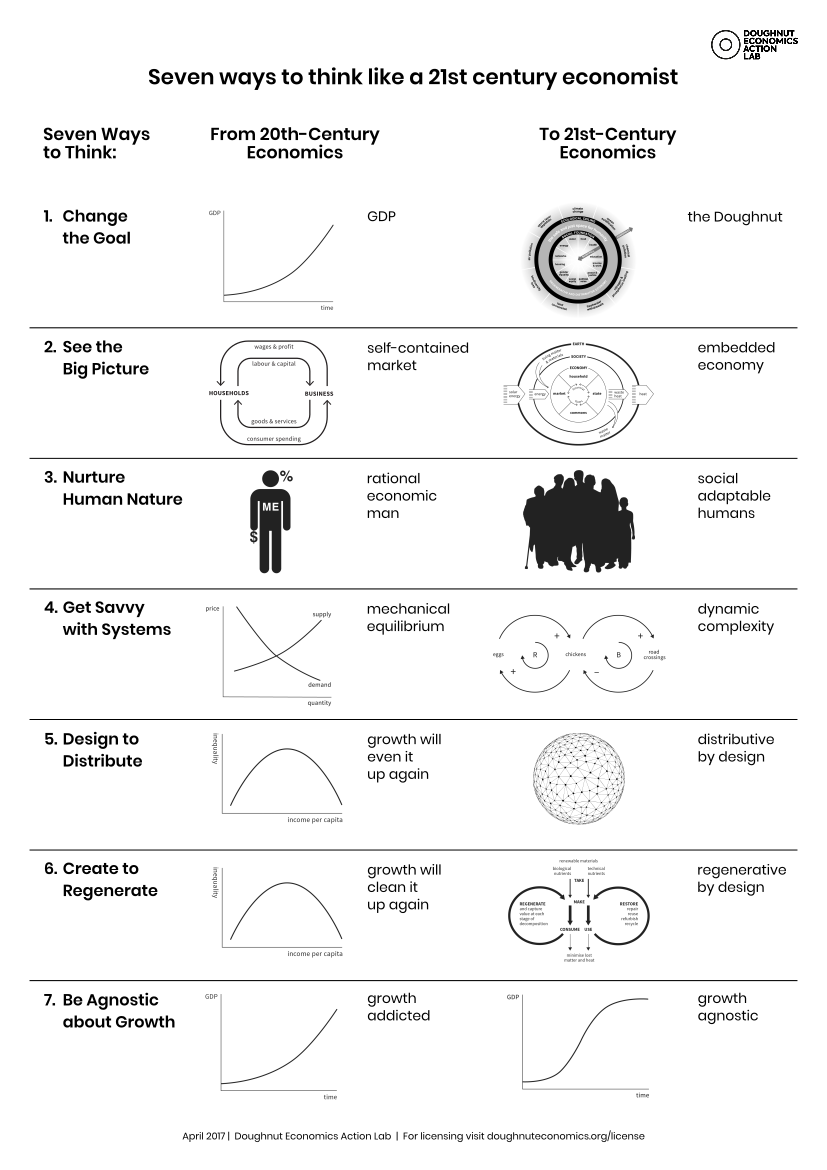
Doughnut Economics proposes an economic mindset that’s fit for our times. It’s not a set of policies and institutions, but rather a way of thinking to bring about the regenerative and distributive dynamics that this century calls for. Drawing on insights from diverse schools of economic thought – including ecological, feminist, institutional, behavioural and complexity economics – it sets out seven ways to think like a 21st century economist in order to transform economies, local to global.

The starting point of Doughnut Economics is to change the goal from endless GDP growth to thriving in the Doughnut. At the same time, see the big picture by recognising that the economy is embedded within, and dependent upon, society and the living world. Doughnut Economics recognises that human behaviour can be nurtured to be cooperative and caring, just as it can be competitive and individualistic.

It also recognises that economies, societies, and the rest of the living world, are complex, interdependent systems that are best understood through the lens of systems thinking. And it calls for turning today’s degenerative economies into regenerative ones, and divisive economies into far more distributive ones. Lastly, Doughnut Economics recognises that growth may be a healthy phase of life, but nothing grows forever: things that succeed do so by growing until it is time to grow up and thrive instead.

Dive deeper into the seven ways to think like a 21st century economist with our series of 90-second animations

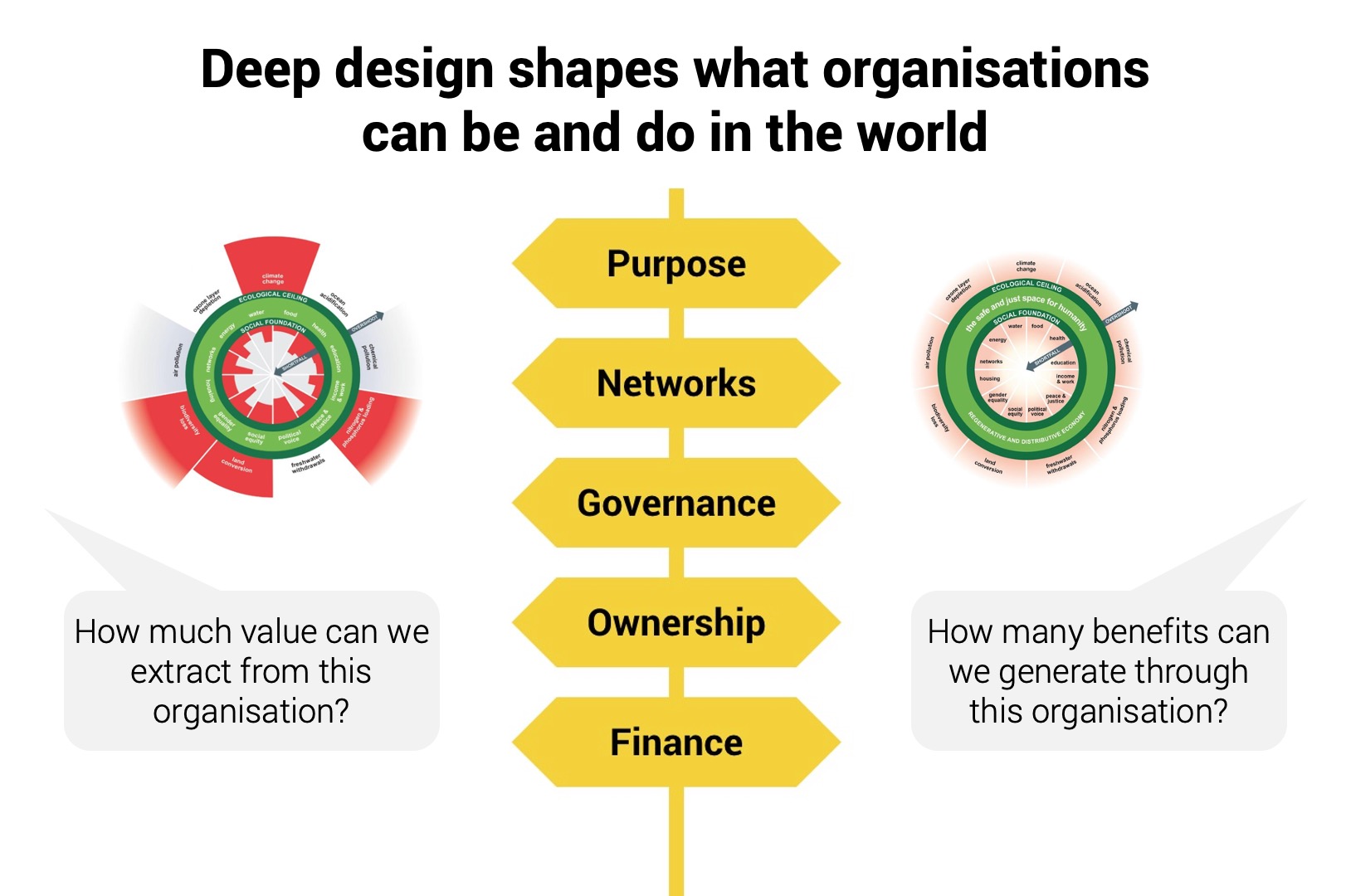
The five layers of organisational design.

Why design matters

What would make it possible for an organisation to become regenerative and distributive so that it helps bring humanity into the Doughnut? DEAL has run workshops with enterprises, city departments, foundations, and other kinds of organisations that want to explore this question, and the implications are transformational.

At the heart of these workshops is a focus on design: not the design of their products and services, or even of their office buildings, but the design of the organisation itself. As described by Marjorie Kelly, a leading theorist in next-generation enterprise design, there are five key layers of design that powerfully shape what an organisation can do and be in the world:

Purpose. Networks. Governance. Ownership. Finance.

Together these five aspects of organisational design profoundly shape any organisation’s ability to become regenerative and distributive by design, and so help bring humanity into the Doughnut. 

Doughnut Principles of Practice

To ensure the integrity of the ideas of Doughnut Economics, we ask that the following principles are followed by any initiative that is working to put the ideas of Doughnut Economics into practice.
Embrace the 21st Century Goal

Aim to meet the needs of all people within the means of the planet. Seek to align your organisation’s purpose, networks, governance, owner-ship and finance with this goal.

See the big picture

Recognise the potential roles of the household, the commons, the market and the state – and their many synergies – in transforming economies. Ensure that finance serves the work rather than drives it.

Nurture human nature

Promote diversity, participation, collaboration and reciprocity. Strengthen community networks and work with a spirit of high trust. Care for the wellbeing of the team.

Think in systems

Experiment, learn, adapt, evolve and aim for continuous improvement. Be alert to dynamic effects, feedback loops and tipping points.

Be distributive

Work in the spirit of open design and share the value created with all who co-created it. Be aware of power and seek to redistribute it to improve equity amongst stakeholders.

Be regenerative

Aim to work with and within the cycles of the living world. Be a sharer, repairer, regenerator, steward. Reduce travel, minimize flights, be climate and energy smart.

Aim to thrive rather than to grow

Don’t let growth become a goal in itself. Know when to let the work spread out via others rather than scale up in size.

Be strategic in practice

Go where the energy is – but always ask whose voice is left out. Balance openness with integrity, so that the work spreads without capture. Share back learning and innovation to unleash the power of peer-to-peer inspiration.