We were reminded of these vows yesterday during the Gaian Gathering. These are words that we can voice aloud while witnessed in a workshop or to ourselves, as we are always witnessed by the Earth and each other in a myriad of ways. They are such profound anchors for our collective in this time of Great Turning…
I vow to myself and to each of you to commit myself daily to the healing of our world and the welfare of all beings.
I vow to myself and to each of you to live on Earth more lightly and less violently in the food, products and energy I consume.
I vow to myself and to each of you to draw strength and guidance from the living Earth, the ancestors, the future beings and our kin of all species.
I vow to myself and to each of you to seek liberation from patriarchy, colonialism, and racism in all dimensions of my life.
I vow to myself and to each of you to support you in your work for the world, and to ask for help when I need it.
I vow to myself and to each of you to pursue a daily spiritual practice that clarifies my mind, strengthens my heart and supports me in observing these vows.
We are living in challenging times. The systems and culture we have created in our world are showing themselves for the destructive force they are for our planet. Increasing consumption, coupled with population increases means that our human species’ use of resources exceeds the Earth’s capacity by an increasing margin year on year. Today we need around 1.75 planets to provide the resources to meet our demand for consumption and to absorb our waste. According to WWF, by 2050, or even sooner, this will have increased to the need for 2 planets, ‘borrowing nature’ from future generations.
Many of us feel the burden of the irreversible loss of eco-systems, degradation of soils, loss of wild places, pollution of fresh water, and other ecological losses, and experience feelings of deep grief, coupled often with regret for our own lifestyle practices that have contributed towards this.
For others there is continued and growing anxiety about the trajectory the human species is currently following, and further losses that are feeling inevitable- including runaway climate change and species extinctions, even the fear of our own extinction. For many there is a growing feeling of urgency, coupled with the pain of feeling somehow paralysed or powerless.
As we see war unfold again in the Middle East this week, and violence and suffering continuing in many countries across the world, including South Sudan and Ethiopia, the sense of despair and helplessness can feel extremely acute.
Here in South Africa, these feelings of grief and anxiety, present themselves on top of extreme societal ‘complex trauma’, a traumatic history that for many remains unprocessed and unresolved. The adverse living conditions of many South Africans, extreme poverty (currently 45% of South Africa’s population) and extreme inequality (the richest 10% hold 71% of the wealth), compounds this trauma.
All of this can feel extremely distressing and overwhelming.
It’s no surprise it feels this way. The planet Earth is our home, our place of shelter, our provider of all that we need. When we see her change and come under stress, it’s only natural to grieve and to feel concerned. Our fellow people are our brothers and sisters and we all have the capacity to show and receive compassion, deeply rooted in our mammalian instinct of caring.
“We are capable of suffering with our world, and that is the true meaning of compassion. It enables us to recognize our profound interconnectedness with all beings.” – Joanna Macy
And yet, there’s also something much deeper here. All of the losses, the trauma, the destruction, the pain we cause, results from a narrative that still governs our thinking and actions, in a deeply subconscious way – the story of separation. A deep-rooted separation, that stretches back over centuries, from our very selves and our true nature, from each other and from the Earth. This worldview that we exist as individuals, separate from all other individuals and from all other beings in nature, has ripped apart the fabric of what it means to be fully human, and to feel our full belonging first and foremost as members of the Earth community, and to live in the truest sense of ‘Ubuntu’. For many of us, this separation is where our deep grief originates, and it is through holding this grief in community that we will be able to find our way back home.
Grief is not typically invited in our society. The typical response is rather to numb our feelings, finding ways to distract ourselves so we don’t feel the pain. Yet deep grief is a way for us to be present for the world, and to come into our full authentic power to make and support change, with no pretense that we can carry on the way that we are.
“Don’t ever apologize for crying for the trees burning in the Amazon or over the waters polluted from mines in the Rockies. Don’t apologize for the sorrow, grief, and rage you feel. It is a measure of your humanity and your maturity. It is a measure of your open heart, and as your heart breaks open there will be room for the world to heal.” – Joanna Macy
We invite you to join us for a series of Truth Rituals, based on the Work That Reconnects by Buddhist Scholar and Earth Elder, Joanna Macy, and adapted to suit our South African context. These Truth Rituals will be held outdoors in sacred spaces and are open to all. Through coming together and expressing our rage, fear, despair and emptiness, we will find our way back to our hearts and to a way of living in right relation with ourselves, all other beings, and our home planet Earth.
Join us on Sunday 22nd October: 9am – 11.30am for our first ritual of this series, at a very special sacred site – All Seeing Pyramid Rock, Blackhill. Meeting point is at the car park near the top (Sunvalley side) of the Glencairn Expressway and we will all move towards the site together. For more information and bookings please contact us on 061 864 6799 or gaiaspeaking@gmail.com. Recommended donation: R200 – R300
Yesterday was the UN “World Environment Day”. under the theme BeatPlasticPollution. And on 8th June it will be the World Ocean Day. Two drops of awareness in a vast ocean of Great Unravelling, which made me wonder what is being done in the country I call home, South Africa. Whilst we do have admirable local initiatives to clean our beaches, ecobrick and recycle ‘sea plastic’ into art, it made me realise I have no idea if,in the meantime, there are any lobbies working towards the actual ban of single use plastics in our country. Is the government -immersed in other energetic and economic challenges and scandals – needing more pressure from citizens? Do we not, as an economically privileged country within the continent have a certain responsibility to pioneer political and technological innovation in that field? What can we do on an individual level to make the ban happen?
Last week a small group of activists created a social media group and urged participants to request the ban of the use of harmful Round Up pesticides in the highly sensitive Cape Peninsula biodiversity hotspot we live in. It only took the support of a few hundred concerned residents writing letters to their local ward councillors and the extra initiative of a few of them to take the matter right up to the Premier of the Western Cape Province, where it was taken very seriously. It was an inspiring course of events for many, illustrating that we should not consider any action to be powerless, and how fast shift can happen nowadays. We all care, we all care for our mother. Some emerging political programmes are deeply engaged with her cause. Even if we have been programmed to believe nature is a machine, and corporate greed is still a widespread habit, in all areas there is knowing that radical change is necessary and urgent.
A shift to a more ecological civilisation is underway. Hereunder is an article published by theconversation.com
“Single-use plastic bans: research shows three ways to make them effective”
Published: January 13, 2023 8.15am SAST Authors: Antaya March, Steve Fletcher and Tegan Evans, University of Portsmouth, UK
Governments around the world are introducing single-use plastic product bans to alleviate pollution.
Zimbabwe banned plastic packaging and bottles as early as 2010. Antigua and Barbuda banned single-use catering and takeaway items in 2016, and the Pacific island of Vanuatu did the same for disposable containers in 2018.
The EU prohibited cotton buds, balloon sticks, plastic catering items and takeaway containers, including those made from expanded polystyrene, in 2021.
The UK government has followed suit by announcing a ban on the supply of single-use plastic plates, cutlery, balloon sticks, and polystyrene cups and containers supplied to restaurants, cafes and takeaways in England. The measure will start in April 2023. The same products sold in supermarkets and shops will be exempt from the ban, but subject to new regulations expected in 2024.
While the forthcoming ban is a step in the right direction, the production, use and disposal of plastics typically spans several countries and continents. The success of any policy aimed at restricting the use of plastic products in one country should not be taken for granted.
Our research continues to highlight that policies which influence what consumers buy, such as bans, taxes or charges, lack the reach to confront the global scale of pollution. The effect of banning single-use plastic items is limited to the jurisdiction in which it is implemented, unless it inspires a wider shift in public or commercial behaviour across international boundaries.
Without supporting measures, or by failing to treat the ban as the beginning of a broader phase-down of plastic, banning some items does little to change the attitudes which reinforce a throwaway culture.
The Global Plastics Policy Centre of the University of Portsmouth reviewed 100 policies aimed at tackling plastic pollution worldwide in 2022 to understand what makes them successful. Here are three key lessons which can make [bans] more effective.
Make it easy to use alternatives Consumers and businesses are less likely to comply with a ban if they are expected to go entirely without plastic overnight. Ensuring businesses can source affordable alternatives is critical. Antigua and Barbuda did this by investing in the research of more sustainable materials and listing approved alternatives to plastic, such as bagasse, a byproduct of sugar-cane processing.
To maintain public support, it helps if there are measures which prevent cost hikes being passed directly on to consumers.
Alternative materials or products must have a lower environmental impact than the banned product, but this isn’t always guaranteed. Substituting plastic bags for paper, for example, may not be the best idea when the entire life cycle of a product is accounted for.
Phase in a ban A phased approach to a ban improves how well it works but requires consistent and clear messaging about what products are banned and when. In Antigua and Barbuda, phased plastic bag bans in 2016 and 2017 generated support for banning other plastic products between 2017 and 2018.
In both cases, importing these products was restricted first, followed by a ban on distributing them, which gave suppliers time to find alternatives and use up existing stock.
This approach was used to good effect in an English ban on plastic straws, cotton buds and stirrers in 2020, allowing retailers to use up their supplies during the six months following the ban’s introduction.
Involve the public Information campaigns which explain why a ban is needed, what it means for the public and businesses and what alternatives are available serve to support a ban. This was evident from Vanuatu, where the inclusion of diapers in a ban was postponed due to public concerns around the availability of sustainable alternatives.
Working closely with the public like this can also encourage innovation. For example, in Vanuatu in 2018, weavers and crafting communities filled the gap left by banned plastic bags and polystyrene takeaway containers with natural alternatives made locally, including bags and food containers woven from palm leaves.
Single-use plastic bans can inspire wider changes to social systems and the relationship each person has with plastic. But without planned access to alternatives, a phased introduction, efforts to nurture public support and broader consideration of the entire life cycle of plastic, product bans have a limited effect on plastic pollution, and can even give the false impression of progress.
Thanks to the writers of this article. Various ideas here are examples of what could soon also happen in South Africa if we have enough voices and consensus.
If you want to read more of their articles, every Wednesday, The Conversation’s environment editor writes Imagine, a short email that goes a little deeper into a “climate” issue. Check their website.
I first heard about the plastic-eating capacity of mycelium during a permaculture course I attended in 2016 when my friend and mycologist Justin White showed us a TED Talk by Paul Stamets about how mushrooms COULD save the world. (You may have seen the 2019 “Fantastic Fungi” documentary that Stamets features in – if you haven’t yet, please do!)
I have felt excited about mycelium ever since because at the time I thought, YES, but of course Mushrooms WILL save the world… It just seemed so clear and I was so grateful for news unusually filled with so much hope.
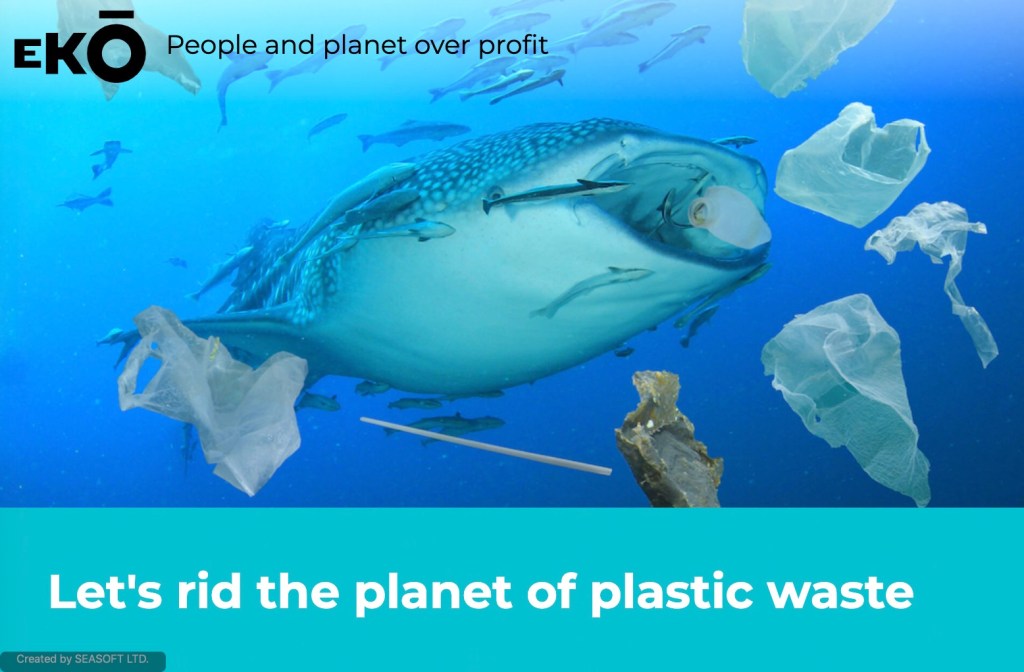
As I prepare this post today, 14 years after this TED Talk was published, and with an accute sense of urgency, I feel like the mycelium myself, as I navigate from one link to another, from one passionate researcher to another adamant activist, from one fungal function to another attribute of intelligence demonstrated by these incredible species. And I heard someone saying yesterday that mushrooms can absorb radioactive emissions too, and last week I read and shared a campaign from the platform EKO, pitching for funds to develop research for some plastic-devouring heroes. And another mushroom ceremony in the hood. And, and, and…
The healing powers of mushrooms are spreading all over the news just as exponentially as our communication networks themselves. Is there anything they cannot do?!
“How amazing is this — scientists have discovered mushrooms that can devour plastic waste in a matter of weeks…plastic that would otherwise remain in the ocean forever.
Right now 91% of the plastics we use can’t be recycled, and every minute another truckloads-worth is dumped into the ocean, suffocating sea life and spreading pollutants across shores.
But scientists say these magnificent mushrooms could eat up to half of the plastic waste being dumped in the ocean. They’re asking for our help to continue their groundbreaking research, and together we could give them the funds they need right away to expand their research in the US and New Zealand.”
The World Wide Web which carries the news became available to us only 30 years ago. On April 30, 1993, the European Organization for Nuclear Research (CERN) put the web that it had developed onto the public domain. In 1993 also, I wrote a research project for university about the “Prospects of Expansion of Electronic Commerce in Spain” . It was minuscule at the time, there were only two shops online in the country (!). I concluded that it seemed unstoppable but that its expansion would depend largely on hardware development and availability – desktop computers I believed at the time!.
Now, in 2023 there are more than 8 billion smart mobile devices in the world, and 65 percent (up from 54 per cent in 2019) of the world’s population are using the Internet.
The speed of technological hardware expansion is terrifying and goes hand in hand with the integration of social networks and software applications, which has gone out of bounds since our society crash landed online after the dramatic “Great Pause” of 2020. The communication system that we call “cloud” is not so ethereal as we wish to believe as we type, record and film on and on. It lives between its massive servers – which would occupy the surface area of entire countries if placed alongside each other– and all our desktop and handheld devices: a vertiginous global network of cell phones, powerbanks, cables, computers, televisions, sound systems, etc, and another even more vertiginous destitute heap of e-waste. This cloud we all float in uses an exponential amount of electricity to manufacture, cool and power. So, to satisfy it we are digging into the Earth, instead of feeding it.
The Earth’s Mushrooms are a form of evolved cointelligence which can support us as we find ways to support the transformation of our own Human society. We/They need a human critical mass to be better connected to the Earth in order to understand the principles of interbeing and cointelligence.
So, want I’m wanting to highlight here I think, is that there is a huge opportunity in the spread of the online ‘aerial’ mycelium that connects us all. Even if there is aggression and waste in its making, for we can indeed share precious news and tools for the shift in consciousness that needs to happen now. Yet, we need to change our worldview so that it can evolve through sustainable and ethical practices, so that the channels we choose and the contents we communicate, exchange and trade via these networks become more life-sustaining and life-enhancing as soon as possible.
Prototaxites hundreds of millions of years old
The story says that between 350 and 420 million years ago, there were already fungal organisms with trunks up to 7 metres high. For hundreds of millions of years, these families have been hard at work. This mycelium constantly transforming matter, sharing information and nutrients has always been working symbiotically with other species to thrive and sustain on behalfof life on Earth. Let’s mimic that better now, while we still have a chance to learn. Let’s aim wide, and wider still!
Extract from an article in theconversation.com by Katie Field, Professor in Plant-Soil Processes, University of Sheffield
Nearly all of Earth’s organisms communicate with each other in one way or another, from the nods and dances and squeaks and bellows of animals, through to the invisible chemical signals emitted by plant leaves and roots. But what about fungi? Are mushrooms as inanimate as they seem – or is something more exciting going on beneath the surface?
New research by computer scientist Andrew Adamatzky at the Unconventional Computing Laboratory of the University of the West of England, suggests this ancient kingdom has an electrical “language” all of its own – far more complicated than anyone previously thought. According to the study, fungi might even use “words” to form “sentences” to communicate with neighbours.
Almost all communication within and between multi-cellular animals involves highly specialised cells called nerves (or neurones). These transmit messages from one part of an organism to another via a connected network called a nervous system. The “language” of the nervous system comprises distinctive patterns of spikes of electrical potential (otherwise known as impulses), which help creatures detect and respond rapidly to what’s going on in their environment.
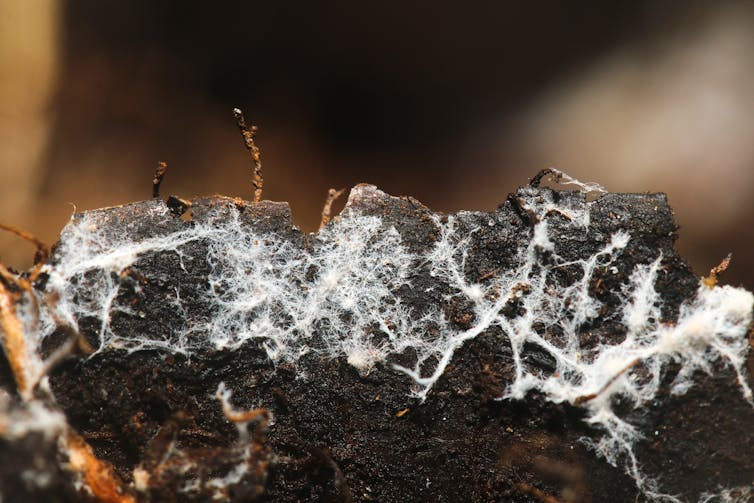
Despite lacking a nervous system, fungi seem to transmit information using electrical impulses across thread-like filaments called hyphae. The filaments form a thin web called a mycelium that links fungal colonies within the soil. These networks are remarkably similar to animal nervous systems. By measuring the frequency and intensity of the impulses, it may be possible to unpick and understand the languages used to communicate within and between organisms across the kingdoms of life.
Using tiny electrodes, Adamatzky recorded the rhythmic electrical impulses transmitted across the mycelium of four different species of fungi.
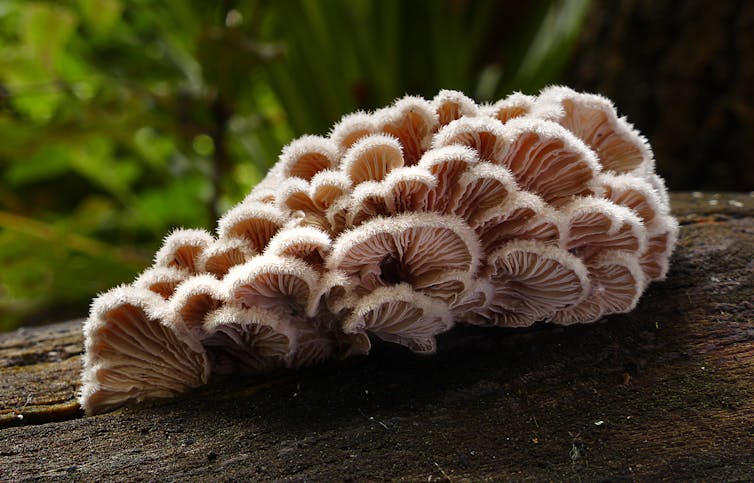
He found that the impulses varied by amplitude, frequency and duration. By drawing mathematical comparisons between the patterns of these impulses with those more typically associated with human speech, Adamatzky suggests they form the basis of a fungal language comprising up to 50 words organised into sentences. The complexity of the languages used by the different species of fungi appeared to differ, with the split gill fungus (Schizophyllum commune) using the most complicated lexicon of those tested.
The split gill fungus is common in rotting wood and is reported to have more than 28,000 sexes. Bernard Spragg/Wikipedia
This raises the possibility that fungi have their own electrical language to share specific information about food and other resources nearby, or potential sources of danger and damage, between themselves or even with more distantly connected partners.
Underground communication networks
This isn’t the first evidence of fungal mycelia transmitting information.
Mycorrhizal fungi – near-invisible thread-like fungi that form intimate partnerships with plant roots – have extensive networks in the soil that connect neighbouring plants. Through these associations, plants usually gain access to nutrients and moisture supplied by the fungi from the tiniest of pores within the soil. This vastly expands the area that plants can draw sustenance from and boosts their tolerance of drought. In return, the plant transfers sugars and fatty acids to the fungi, meaning both benefit from the relationship.
The mycelium of mycorrhizal fungi enable symbiotic relationships with plants. KYTan/Shutterstock
Experiments using plants connected only by mycorrhizal fungi have shown that when one plant within the network is attacked by insects, the defence responses of neighbouring plants activate too. It seems that warning signals are transmitted via the fungal network.
Other research has shown that plants can transmit more than just information across these fungal threads. In some studies, it appears that plants, including trees, can transfer carbon-based compounds such as sugars to neighbours. These transfers of carbon from one plant to another via fungal mycelia could be particularly helpful in supporting seedlings as they establish. This is especially the case when those seedlings are shaded by other plants and so limited in their abilities to photosynthesise and fix carbon for themselves.
Exactly how these underground signals are transmitted remains a matter of some debate though. It is possible the fungal connections carry chemical signals from one plant to another within the hyphae themselves, in a similar way to how the electrical signals featured in the new research are transmitted. But it is also possible that signals become dissolved in a film of water held in place and moved across the network by surface tension. Alternatively, other microorganisms could be involved. Bacteria in and around fungal hyphae might change the composition of their communities or function in response to changing root or fungal chemistry and induce a response in neighbouring fungi and plants.
The new research showing transmission of language-like electrical impulses directly along fungal hyphae provides new clues about how messages are conveyed by fungal mycelium.
By Jiddu Krishnamurti, in “Krishnnamurti’s Notebook”, first published in 1976
Without sensitivity there can be no affection; personal reaction does not indicate sensitivity; you may be sensitive about your family, about your achievement, about your status and capacity. This kind of sensitivity is a reaction, limited, narrow, and is deterioration. Sensitivity is not good taste for good taste is personal and the freedom from personal reaction is the awareness of beauty. Without the appreciation of beauty and without the sensitive awareness of it, there is no love. This sensitive awareness of nature, of the river, of the sky, of the people, of the filthy road, is affection. The essence of affection is sensitivity.But most people are afraid of being sensitive; to them to be sensitive is to get hurt and so they harden themselves and so preserve their sorrow. Or they escape into every form of entertainment, the church, the temple, the gossip and cinema and social reform. But being sensitive is not personal and when it is, it leads to misery. To break through this personal reaction is to love, and love is for the one and the many; it is not restricted to the one or to the many.
To be sensitive, all the senses must be fully alive, active, and the fear of being a slave to the senses is merely the avoidance of a natural fact. The awareness of the fact does not lead to slavery; it is the fear of the fact that leads to bondage. Thought is of the senses and thought makes for limitation but yet you are not afraid of thought. On the contrary; it is ennobled with respectability and enshrined with conceit. To be sensitively aware of thought, feeling, of the world around you, of your office and of nature, is to explode from moment to moment in affection. Without affection, every action becomes burdensome and mechanical and leads to decay.
All of us who are on the spiritual path and passionate about spiritual living, realize that often the hustle and bustle of life can pull us away from moment to moment awareness, which then requires us remember our practice and true purpose. That is why I love the idea of sensitivity so much. Just remember to practice this one thing, and you are back on the path. Just remember to be sensitive and love will sweetly blossom and flow.
There are essentially 6 key aspects to the idea of sensitivity, understanding which will go a long way in giving you deep insight into meditation, spiritual living and enlightenment.
1. Awaken the Senses:
Sensitivity means to really listen, see, smell, taste and feel. To not just glance at the world, but to really take some time to behold it, to really taste the food you are eating, instead of just gobbling it down, while watching TV. In other words to really come into significant contact with the world at a basic perceptual level.
2. Observe all 4 Environments:
There are 4 environments that you need to be sensitive to. Your physical, mental and emotional dimensions being 3 very important environments, with the fourth being the world around you. The more you are able to stay present to what is taking place inside and outside you, the more you will develop your awareness and the further you will move towards Self Realization.
3. Sensitivity Means Vulnerability:
If you are really interested in spiritual growth, you have to be willing to embrace the unknown and face the danger that lurks there. As Krishnamurti points out, you can build walls around yourself, or simply keep yourself lost in entertainment, but if you are truly interested in living a full life, you will have to open yourself up to whatsoever the moment has to offer.
4. All Inclusive Sensitivity:
Along the lines of vulnerability I mentioned above, it is important to note, that to be sensitive means to be sensitive to both beauty and ugliness, to both pleasure and pain. That then really means to be open and going with the flow of life.
5. Impersonal Sensitivity:
Normally sensitivity is attributed to ego related attachments and self image, but Krishnamurti is trying to clarify here that by sensitivity he is speaking of the impersonal observation of the 4 dimensions mentioned above. It is the awareness of what the ego is up to, and the endless chaos that creates. This state of careful observation is sensitivity.
6. Insensitivity Leads to Misery:
If we live without sensitivity, without awareness of the moment, we simply reduce ourselves to being a mechanical, robotic process. Such repetitive living leads to a meaningless existence and exclusively pleasure based activity. The outcome of such activity, breeds attachment, fear and greed, which is devoid of love and always ends in suffering.
“I often tell this story in workshops, for it describes the work we aim to do, and the training we engage in. It is about the coming of the Kingdom of Shambhala, and it is about you, and me.”
Joanna Macy
The story that we transcribe us here is a twelve-centuries-old prophecy from the Tibetan Buddhist tradition. The heroes of this story are called Shambhala warriors. The term Shambhala warrior is a metaphor for the Buddhist figure of the bodhisattva, one who deeply understands the core teaching of the Lord Buddha. That central doctrine is the radical interdependence of all things. When taken seriously, this leads to the recognition that if one person has the capacity to be a bodhisattva, then all others do too.
Here is a particular version of the prophecy as it was given to Joanna by her dear friend and teacher Dugu Choegyal Rinpoche of the community of Tashi Jong in northwest India. Read it as if it were about you.
“Coming to us across twelve centuries, the Shambhala prophecy comes from ancient Tibetan Buddhism. The prophecy foretells of a time when all life on Earth is in danger. Great barbarian powers have arisen. Although these powers spend much of their wealth in preparations to annihilate each other, they have much in common: weapons of unfathomable destructive power, and technologies that lay waste our world. In this era, when the future of sentient life hangs by the frailest of threads, the kingdom of Shambhala emerges.
You cannot go there, for it is not a place; it is not a geopolitical entity. It exists in the hearts and minds of the Shambhala warriors. That is the term the prophecy used – “warriors.” You cannot recognize the Shambhala warrior when you see him or her, for they wear no uniforms or insignia, and they carry no specific banners. They have no barricades on which to climb or threaten the enemy, or behind which they can hide to rest or regroup. They do not even have any home turf. Always they must move on the terrain of the barbarians themselves.
Now the time comes when great courage – moral and physical courage – is required of the Shambhala warriors, for they must go into the very heart of the barbarian power, into the pits and pockets and citadels where the weapons are kept, to dismantle them. To dismantle weapons, in every sense of the word, they must go into the corridors of power where decisions are made.
The Shambhala warriors have the courage to do this because they know that these weapons are “manomaya.” They are mind made. Made by the human mind, they can be unmade by the human mind. The Shambhala warriors know that the dangers threatening life on Earth are not visited on us by any extraterrestrial power, satanic deities, or pre-ordained evil fate. They arise from our own decisions, our own lifestyles, and our own relationships.
So in this time, the Shambhala warriors go into training in the use of two weapons. The weapons are compassion and insight. Both are necessary, the prophecy foretells. The Shambhalla warriors must have compassion because it gives the juice, the power, the passion to move. It means not to be afraid of the pain of the world. Then you can open to it, step forward, act.
But that weapon by itself is not enough. It can burn you out, so you need the other – you need insight into the radical interdependence of all phenomena. With that wisdom you know that it is not a battle between “good guys” and “bad guys,” because the line between good and evil runs through the landscape of every human heart. With insight into our profound inter-relatedness, you know that actions undertaken with pure intent have repercussions throughout the web of life, beyond what you can measure or discern. By itself, that insight may appear too cool, conceptual, to sustain you and keep you moving, so you need the heat of compassion.
Together these two can sustain us as agents of wholesome change. They are gifts for us to claim now in the healing of our world. Many in the Tibetan lineage believe that this is the time of this ancient prophecy. If so, perhaps we are among the Shambhala warriors.”
by Joanna Macy
These are powerful words and a call to action, reaching across time. We must find the strength and courage to arise and be the best we can be at this time of challenge. We stand with you, brave warriors of the heart, dear Bodhisattvas. May we have courage.
This beautiful blog post is an excerpt from the book “Raising Children in the Midst of Global Crisis: A Compassionate Guidebook for Parenting in Turbulent Times”
by Jo delAmor, Work that Reconnects facilitator
“In a very real way we are writing our own future, the future of our world, on the hearts and minds of our children. Let’s think deeply, love selflessly, and act intentionally to write messages of peace and goodness and generosity of spirit on the hearts and minds of our children, our messengers, our hope for a better tomorrow.”— L.R. KNOST, WHISPERS THROUGH TIME
Messages to the Future
As we come to terms with the brutal intensities of the world our children have been born into and feel all the feelings that realization stirs in us, we can begin to see our place in the world with new eyes. We can begin to see that, as parents, we are planting seeds for the future in every moment of our children’s lives. We understand that the impressions that they form as young children about the world and who they are within it will inform who they are as adults. They will create the parameters of what they think is possible and how they choose to show up in the world. We see that we are writing the future, as L.R. Knost says “on the hearts and minds of our children.”
Moving beyond the Power Over Paradigm and into the cultivation of a Life Sustaining Society will require children who grow into adults with a commitment to collective wellness and mutual thriving. Creating this future in which our children can thrive, along with the rest of the Family of Life, will call for a completely different way of thinking and behaving than the dominant paradigm that we’ve been living in. It will require a deep healing of wounds and dismantling of lies. It will require raising human beings who are not driven by fear, scarcity, trauma and patterns of woundedness. It will require creating different conditions for our children and cultivating particular qualities and strengths in them that will allow them to be capable of truly caring for the Earth, each other and themselves.
The Power Over Paradigm has obscured our perception of the world. It has caused harm and trauma and polluted our minds and hearts as much as it has polluted the water, soil and air. But it has not destroyed the beauty and brilliance in our souls and in the Soul of the World. There is so much beauty still resiliently alive and waiting to be restored. The magic of Life still exists and will persist as we bring ourselves to its loving care. As we dream into the vision of this new Life Sustaining Society let’s consider the characteristics of a paradigm and the human qualities that would sustain life,justice and wellness for all so we can nurture them in our young ones.
I’m sure the list below doesn’t cover every possible quality that the new paradigm will need but as I dream into this potentiality and reflect on the children I’ve cared for these are the qualities that come to my mind and heart. When I look at this list as a whole and imagine a generation of children within whom these qualities flourish, I see a world in which all beings can thrive. I know, from direct experience, that even here in the midst of this dysfunctional society, it’s possible for us, as parents, to influence the development of these qualities in our children. We may or may not be able to knock each and every one of these out of the park, but the more of these qualities our children develop the more resiliently they will navigate their lives and the more healing they will bring to the world.
Wonder, Awe, Reverence and Gratitude
As children of a magnificent, miraculous Universe our most natural and authentic state is awe. I love that Rachel Carson wishes she could call on the fairies to preserve this inborn sense of wonder but recognizes that, in lieu of that, the companionship of an adult who is willing to experience wonder and awe alongside the growing child is what is needed. We are those adults. We are being invited to practice awe and swim in wonder as our children grow. A person in awe is connected to the Source of Life, the sources of our strength and not one easily manipulated by the power plays of the dominant paradigm.
[…]Teaching our children how to live in a practice of radical gratitude and reverence is a powerfully subversive way to detach from the Power Over Paradigm. It is also a brilliant way to deepen our connection with Life, itself. As our children experience appreciation for the ways in which their life is sustained they learn how the sustenance of Life works and can find their role in the great Web of Life more easily.
Loving Connection, Empathy and Compassion
Children are full of love when they are little. They love their parents and siblings to the moon and back. When that love is returned and children are raised in a loving environment, with encouragement for positive connection they become capable of growing that love far beyond the edges of their immediate families. “Pro-social” human beings that are comfortable with loving connection will definitely be required in order to cultivate a Life Sustaining Society.
As our children grow it is also important to foster their natural tendencies toward empathy and compassion. Most of the children I’ve worked with display an amazing ability to feel for others and a desire to help. As we heal from the damages done by the Power Over Paradigm we need a generation of people who are willing to put themselves in each other’s shoes and help each other grow into a more equitable and mutually beneficial way of living.
Respect, Consent, Equity and Justice
From a very young age (even 1 or 2 years old) children can learn that they have autonomy over their own bodies and other people have autonomy over theirs. We can teach children that each person has a right to their own choices and that, as we make our choices, we need to consider whether they cause harm to others. Teaching our children how to ask permission before touching or taking helps our kids grow into adults that respect themselves and others. This awareness of consent protects our children from predators and keeps our children from being harmful to others.
Making the dismantling of oppression and an understanding of privilege and bias a central part of your parenting will help your children break free from the Power Over Paradigm and see the world through the lens of equity and justice. As we attempt to plant the seeds of a new paradigm in the hearts and minds of our children it is essential to reframe our orientation to power and agency so we can grow a culture in which all are empowered. This work is particularly important if you and your children are part of the dominant, privileged class or sector of a society based on the genocide, enslavement and/or disenfranchisement of others (like if you are white in the USA or Australia, for example). Raising our children to understand that we have inherited an unjust system that needs to be fixed is critical to a future of equity and justice.
Reciprocity, Cooperation and Collaboration
Reciprocity [is] an expression of gratitude for the Earth and towards other people. As we raise our children within this practice we can teach our children to see themselves as being part of a team. Whether the team is made up of a single parent and a single child or it’s a whole big family or it’s a classroom or a neighborhood or the Family of Life, we’re always working with others. This orientation in teamwork helps our kids learn how to bring their gifts to the team generously and graciously receive the gifts of others in the collaboration and cooperation that’s necessary for a Life Sustaining Society.
Humility, Vulnerability and Emotional Fluency
As we move beyond the Power Over Paradigm we begin to understand that true power doesn’t come from force and dominance and that putting on a tough image doesn’t get us very far. True power is a connection to the Source of Life that comes through our intuition and emotions. We can help our children maintain and strengthen their access to these inner channels by teaching them that it is okay to be vulnerable and express their feelings.
You can create a safe environment for expression in your own home by modeling humility and vulnerability and by holding a respectful, loving space for them when they express themselves. As they get older, you can also teach them skills for regulating their energy, staying tuned in to their intuition and inner guidance and expressing their emotions effectively to others. These are the skills necessary for healthy adults and the leaders we need to guide us into a functional way of living.
Curiosity, Critical Thinking, Creativity and Innovative Problem Solving
Our world is full of seemingly unsolvable problems and we basically have to create an entirely different way of living if we are going to survive the collapse of the Power Over Paradigm. We are in need of some very creative problem solving. Fortunately, our children come into the world with a natural propensity for curiosity, critical thinking and creative problem solving. If we encourage this natural gift, rather than squelch it the way conventional education does, there is no telling what remarkably innovative responses they may have to the situation in which we find ourselves.
As our children learn and grow we can stand beside them in wonder. Instead of giving them the answers and showing off what we think we know we can stimulate meaningful inquiry by guiding them through the discovery process. We can suspend our “knowledge” momentarily while they wrestle with a new thought and see what they come up with.
Courage, Confidence, Self-worth, Honor and Dignity
Our children’s lives are not going to be easy. They will encounter many obstacles and many forces that seek to diminish them and make them feel powerless. One of the central tactics of the Power Over Paradigm is to rob its subjects of their honor and dignity. Every single one of us descends from human beings who, at one time, maybe very long ago, knew that they were brilliant, beautiful, sacred members of the Family of Life. Although people like this are wonderful stewards of a Life Sustaining Society, they are not easy to control. As the forces of oppressive empires and colonization ravaged the surface of the Earth they stripped the people of their honor and dignity in every way they possibly could.
For our children to grow beyond the constraints of this dominant paradigm and create a future that feeds Life they will need their natural honor, dignity and self-worth intact. Fortunately it is another natural endowment of every little being and can be cultivated and encouraged as they grow. Teach your children that they are needed in this world. Teach them that they have a purpose and that their lives matter so they can move forward with the courage and confidence they’ll need.
Honesty, Authenticity and Self Expression
Along with self-worth and dignity comes the ability to be honestly and authentically yourself. Each and every one of us comes to Earth with our own special gifts, our own way of seeing and understanding, our own particularities that make us who we are. The world needs each and every one of us, exactly as we are. It is in this diversity of perspective and expression that we really thrive. Diversity makes every system stronger. And, when we are not hemmed in by the prejudices and boxes of an oppressive society we can be much more powerfully beautiful stewards of Life.
There are countless ways that our Power Over Paradigm enforces these boxes and tells our children that they need to hide parts of themselves and fit into one of the pre-programmed boxes that has been designed for them. From relentless genderization and fashion trends to compliance with a consumer economy and political ideologies our kids are inundated with expectations and fabricated answers to the questions of who they are. As parents, we can insulate them to some extent from these external pressures and consciously create space in our homes and families for them to blossom as the authentically individual human beings that they are.
Resilience and Adaptability
We can’t even begin to imagine how much change our children will have to navigate in their lifetimes. All we know is that things are not going to continue on as they have. The Earth simply doesn’t have the resources to keep sustaining an extractive capitalistic human society. So, one way or another, everything is going to change and our kids will have to be resilient and adaptive in order to make it through and be of any use to the world. This is why it’s so essential for us to teach our children how to deal with challenges and hardship gracefully and healthfully. Everyone knows that facing and working through real life challenges is character building, but modern parents often have a hard time staying out of the way enough to allow their children to build character in this way.
Even if we have plenty of money, we should not bend over backwards to create a fantastical childhood of constant pleasure and gratification for our children. It doesn’t serve them at all. In fact, it interferes with their growth and development terribly and creates an unnaturally insatiable appetite for ease. As part of a healthy childhood that prepares a person for the rest of their lives a child should have to learn how to wait, give others a turn, make mistakes, fall down and get hurt, experience disappointment, get bored, etc.. That doesn’t mean we should intentionally create suffering for our children. And it doesn’t mean we shouldn’t let our kids have fun. But if we insulate them too much from the normal discomforts of life and try to make everyday and every moment a magical theme park adventure then we are actually impeding their healthy development and stunting their resilience.
Joy, Humor and Playfulness
Even as our children must struggle and learn from their struggles, they have got to have some fun too! A sense of natural joy, playfulness and an ability to see the humor in any situation may be the quality that helps our kids the most. When we feel connected to the living world and see our lives as an important, but small, part of a grand unfolding this sense of joy comes easily. Humor and lightheartedness are essential to resilience. Without an appreciation for irony, mystery and playfulness we would all be brought to our knees before we even make it through the gate. Being able to laugh at ourselves, try things out and fail, notice the ironic humor of the way life unfolds helps us make it through the more difficult moments we’ll have to face. Feeling joy and carrying joy in our hearts are also essential practices for caring for and sustaining Life.
When these qualities are cultivated in young people, the natural human spirit that is so alive in them can come through even more strongly. That doesn’t mean that every freedom fighter and youth activist had perfect parenting. It also doesn’t mean that if you nourish these qualities ‘perfectly’ in your children that they’ll save the world with their activism. This is not an all or nothing scenario. This is an opportunity to understand the power, possibility and potential of young people who are informed and supported, young people who have the confidence to be courageous, who have the critical thinking skills and creativity to address some of our biggest challenges and who deeply care about our world and feel a responsibility to Life and future generations. Whether our children’s care for the world plays out on the international stage for all to see or in small, personal, less seen ways, these qualities will guide them and support them in contributing their unique gift to the world.
On 20 March here in the Southern Hemisphere we celebrated Mabon, or the Autumn Equinox. Hosted by the Center, a beautiful venue in Noordhoek, we gathered to celebrate and offer our prayers.
Altar created by Luciana do Cabo, with gratitude
Like all sacred times, the Equinox is a perfect time to reflect on our inner spiritual work. Because we are a reflection of the universe surrounding us, what takes place outside must also occur within us.
This time of year, as we move from summer to autumn, is the time of Harvest. The Earth, by this time of year, has given us everything. Fruits, grains, and vegetables. Now, tired and withered, she lies down to rest. At this time, we can give thanks for the abundance of the Earth, and all that she provides. Equally it is an opportunity to reflect on the abundance in each of our lives, and all the things we can be grateful for. It is an opportunity to turn within and to reflect on what gifts, strengths, experiences and skills we can harvest and take forwards with us into the darker months.
What are you grateful for? What life lessons have helped you learn and grow? What can you harvest internally that may be supportive in the coming months?
The Equinox, both Autumn and Spring, is the only time when both the northern and southern hemispheres experience roughly equal amounts of daytime and night-time. These are the days when the sun is exactly above the equator making day and night equal in length. Equinox is a Latin word that means ‘equal night; – It is the time of equal day and night.
Energetically, the Autumn Equinox is a time of balance and pause, a transitional moment between the bright half of the year and the dark half of the year. This time brings the light and darkness to the front together, neither one preceding nor following the other. Spiritual guidance can be taken from this rhythm of nature. The Autumn Equinox is a perfect time to consider and invite balance into your life – shadow and light, inner and outer, masculine and feminine, the dance between ego and Soul.
Take a moment to slow down and listen inwardly. Is there something your body is asking you for? In which areas of life do you need to re-find balance?
To think of the Equinoxes and Solstices in terms of a life, the year is “born” on the winter solstice, matures at the spring equinox, and reaches the prime of life at the summer solstice. The autumnal equinox marks the descent into old age, and, finally, the moment of the winter solstice marks simultaneous death and rebirth, starting the cycle anew.
And so, from a spiritual growth perspective, Autumn is about endings, as reflected in our natural environment, with the trees losing their leaves and plants dying off. It’s all a very natural process. And so the Autumn is also a time to descend into one’s own darkness. Darkness, when ignored and exiled, grows and takes over. But when given the opportunity to be worked with and exposed, provides an opportunity for growth once the light returns.
Autumn is a time to feel into the areas of your life that need to be let go of, consider what no longer serves you, gets in your way, and needs to wither. Remember—we all have leaves, of a sort. For a time, they gather energy unto us, but at a certain point, they no longer serve us. They lose their chlorophyll, turn brown, wither, and must be released. As you watch those earthly leaves fall to the ground to nourish the next generation of nature, consider your own leaves.
What do you need to let go? Are you allowing for this release or are you hanging on to the dead?
I’m so grateful for the opportunity to celebrate these ceremonies of the ‘Wheel of the Year’, an annual cycle of seasonal festivals that were celebrated by our foremothers and fathers. As we find ourselves in the midst of ecological chaos, one of the most potent ways for us to find ways to come back into balance with the earth is to reconnect to her seasons and cycles, honouring these, as we learn to tune in, celebrate and adapt to her natural cycles. Happy Equinox everyone.
Originally written by Steve Taylor, Senior Lecturer in Psychology, Leeds Beckett University, and published in theconversation.com.
Throughout history, people who have gained positions of power tend to be precisely the kind of people who should not be entrusted with it. A desire for power often correlates with negative personality traits: selfishness, greed and a lack of empathy. And the people who have the strongest desire for power tend to be the most ruthless and lacking in compassion.
Often those who attain power show traits of psychopathy and narcissism. In recent times, psychopathic leaders have been mostly found in less economically developed countries with poor infrastructures and insecure political and social institutions. People such as Saddam Hussein in Iraq, Muammar Gaddafi in Libya and Charles Taylor in Liberia.
But modern psychopaths generally don’t become leaders in affluent countries (where they are perhaps more likely to join multinational corporations). In these countries, as can be seen in the US and Russia, there has been a movement away from psychopathic to narcissistic leaders.
After all, what profession could be more suited to a narcissistic personality than politics, where the spotlight of attention is constant? Narcissists feel entitled to gain power because of their sense of superiority and self-importance.
Those with narcissistic personalities tend to crave attention and admiration and feel it is right that other people should be subservient to them. Their lack of empathy means they have no qualms about exploiting other people to attain or maintain their power.
Meanwhile, the kind of people who we might think are ideally suited to take on positions of power – people who are empathetic, fair minded, responsible and wise – are naturally disinclined to seek it. Empathetic people like to remain grounded and interact with others, rather than elevating themselves. They don’t desire control or authority, but connection, leaving those leadership roles vacant for those with more narcissistic and psychopathic character traits.
Different types of leader
Yet it would be misleading to say it is only psychopaths and narcissists who gain power. Instead, I would suggest that there are generally three types of leaders.
The first are accidental leaders who gain power without a large degree of conscious intention on their part, but due to privilege or merit (or a combination). Second are the idealistic and altruistic leaders, probably the rarest type. They feel impelled to gain power to improve the lives of other people – or to promote justice and equality, and try to become instruments of change. But the third are the narcissistic and psychopathic leaders, whose motivation for gaining power is purely self-serving.
This doesn’t just apply to politics, of course. It’s an issue in every organisation with a hierarchical structure. In any institution or company, there is a good chance that those who gain power are highly ambitious and ruthless, and lacking in empathy.
Narcissistic leaders may seem appealing because they are often charismatic (they cultivate charisma in order to attract attention and admiration). As leaders they can be confident and decisive and their lack of empathy can promote a single-mindedness which can, in some cases, lead to achievement. Ultimately though, any positive aspects are far outweighed by the chaos and suffering they create.
An anti-Trump demonstration in Washington DC. Shutterstock/bakdc What is needed are checks to power – not just to limit the exercise of power, but to limit its attainment. Put simply, the kind of people who desire power the most should not be allowed to attain positions of authority.
Every potential leader should be assessed for their levels of empathy, narcissism or psychopathy to determine their suitability for power. At the same time, empathetic people – who generally lack the lust to gain power – should be encouraged to take positions of authority. Even if they don’t want to, they should feel a responsibility to do so – if only to get in the way of tyrants.
Models of society
There are many tribal hunter-gatherer societies where great care is taken to ensure that unsuitable individuals don’t attain power.
Instead, anyone with a strong desire for power and wealth is barred from consideration as a leader. According to anthropologist Christopher Boehm, present-day foraging groups “apply techniques of social control in suppressing both dominant leadership and undue competitiveness”.
If a dominant male tries to take control of the group, they practise what Boehm calls “egalitarian sanctioning”. They team up against the domineering person, and ostracise or desert him. In this way, Boehm says, “the rank and file avoid being subordinated by vigilantly keeping alpha-type group members under their collective thumbs”.
Just as importantly, in many simple hunter-gatherer groups power is assigned to people, rather than being sought by them. People don’t put themselves forward to become leaders – other members of the group recommend them, because they are considered to be experienced and wise, or because their abilities suit particular situations.
San hunter gatherers in Southern Africa
In some societies, the role of leader is not fixed, but rotates according to different circumstances. As another anthropologist, Margaret Power, noted: “The leadership role is spontaneously assigned by the group, conferred on some members in some particular situation … One leader replaces another as needed.”
In this way, simple hunter-gatherer groups preserve stability and equality, and minimise the risk of conflict and violence.
It’s true that large modern societies are much more complex and more populous than hunter-gatherer groups. But it may be possible for us to adopt similar principles. At the very least, we should assess potential leaders for their levels of empathy, in order to stop ruthless and narcissistic people gaining power.
We could also try to identify narcissists and psychopaths who already hold positions of power and take measures to curtail their influence. Perhaps we could also ask communities to nominate wise and altruistic people who would take an advisory role in important political decisions.
No doubt all this would entail massive changes of personnel for most of the world’s governments, institutions and companies. But it might ensure that power is in the hands of people who are worthy of it, and so make the world a much less dangerous place.
With much gratitude for this insightful article. Gaia Speaking
















 Gaia Speaking
_(33389628036).jpg)