Uncategorized

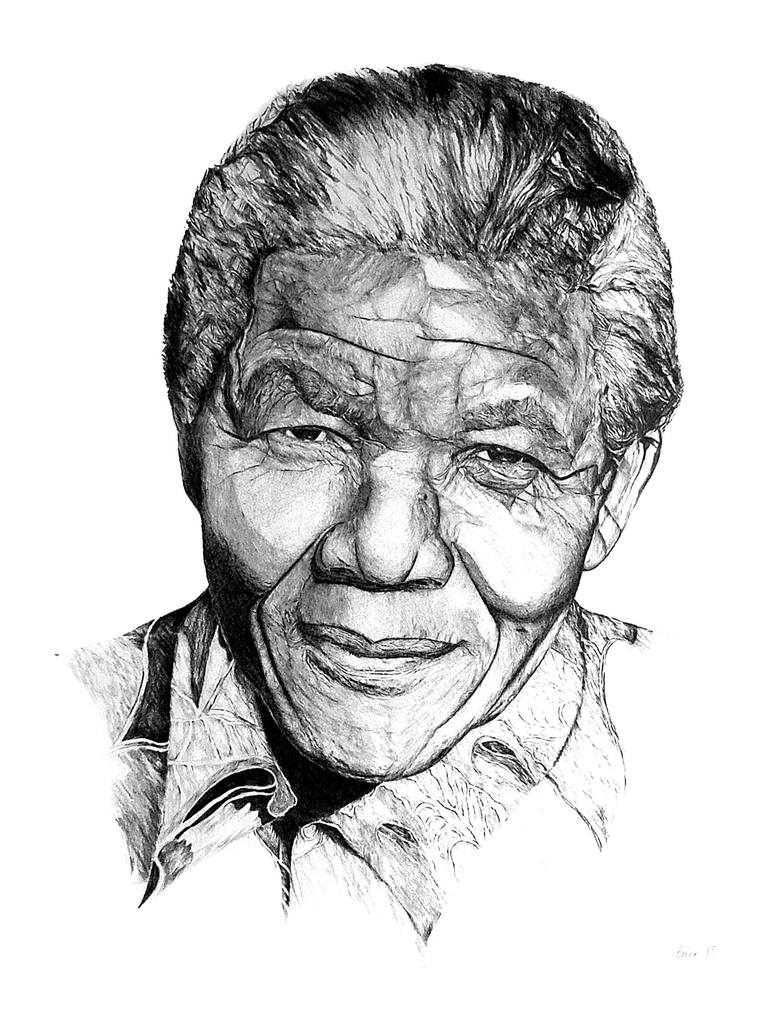
Nelson Mandela, a Symbol of Positive Collective Power By Chris Johnstone

By Chris Johnstone , in Active Hope

As in South Africa we celebrate Mandela Day on 18th July, we commemorate not only a powerful leader but a symbol of collaborative power. I wanted to include a few words about Madiba on our website and I remembered the references to Mandela that Chris Johnstone and Joanna Macy have quoted in their book Active Hope to illustrate the following

A NEW STORY OF POWER

The word power comes from the Latin possere, meaning โ€œto be able.โ€ The kind of power we will now focus on is not about dominating others but about being able to address the mess weโ€™re in. Rather than being based on how much stuff or status we have, this view of power is rooted in insights and practices, in strengths and relationships, in compassion and connection with the web of life.
One person who has embraced the collaborative model of power is Nelson Mandela. In the early 1980s, the apartheid government of South Africa had a highly trained army with advanced weaponry and nuclear missiles. Mandela, representing the African National Congress (ANC), had been in prison for more then twenty years. While many feared it might take a civil war to end it, apartheid didnโ€™t end because of victory in battle. Rather, the transformation came about through discussion and agreement. For that process to start, it needed, as Mandela put it, โ€œjaw, jaw, jaw, not war, war, war.โ€ In his autobiography, Long Walk to Freedom, he describes coming to a decision to move this process forward while in solitary confinement:

My solitude gave me a certain liberty, and I resolved to use it to do something I had been pondering for a long time: begin discussions with the government. This would be extremely sensitive. Both sides regarded discussions as a sign of weakness and betrayal. Neither would come to the table until the other made significant concessionsโ€ฆ. Someone from our side needed to take the first step.


When we respond to a situation in a way that promotes healing and transformation, we are expressing power. Mandelaโ€™s contributions to establishing a multiracial democracy in South Africa offer a wonderfully inspiring example.

Because Mandela didnโ€™t have the authorization of the ANCโ€™s organizing committee, beginning talks with the enemy could have been seen as betrayal or as selling out. Taking this first step for peace took courage, determination, and foresight. Inner strengths like these are often thought of as things some people just have and others donโ€™t. These qualities, however, are linked to skills we can develop and practices we can learn. Thinking of courage and determination as things we do rather than things we have helps us to develop these qualities. They emerge out of our engagement with actual situations and the dynamics that arise from our interactions. This approach is relational, and we call it power-with.
1 + 1 = 2 AND A BIT

The discussions Mandela undertook were effective because both sides recognized that they stood to lose by going to war and that they would gain by finding a way to peace. They moved from a win-lose model of conflict to one aiming for a win-win outcome. The alternative to negotiations was likely to be a war in which both sides lost.

Power-with is based on synergy, where two or more parties working together bring results that would not have occurred if they had worked alone. Because something new and different emerges out of the interaction, we can think of it as โ€œ1 + 1 = 2 and a bit.โ€ This is another way of saying โ€œthe whole is more than the sum of the parts.โ€

Emergence and synergy lie right at the heart of power-with. They generate new possibilities and capacities, adding a mystery element that means we can never be certain how a situation will go just from looking at the elements within it. We can know the strength of copper and of tin yet still be surprised by how much stronger bronze is, which comes from mixing the two together. The same thing can happen when we interact with others for a shared purpose.

D. H. Lawrence wrote:
Water is H20,
Hydrogen two parts
Oxygen one
But there is also a third thing that makes it water
And nobody knows what that is.

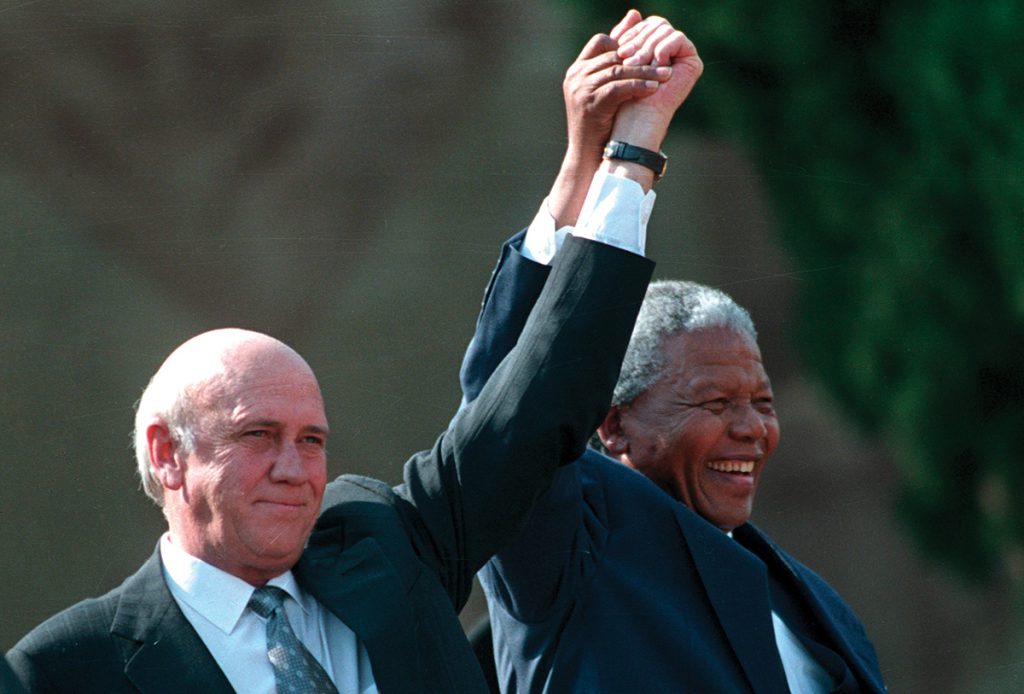
One place we can experience synergy is in conversation. If both sides have the courage and willingness to explore new ground, talking and listening to one another can open a creative space from which new possibilities emerge. Thatโ€™s what happened in the negotiations between Mandela and F. W. de Klerk, the South African president at the time. This unlikely duo jointly won the Nobel Peace Prize in 1993 for their extraordinary feat of navigating toward a peaceful settlement.

EMERGENCE

While the conversations between Mandela and de Klerk played a pivotal role in bringing apartheid to an end, this historic change wouldnโ€™t have happened without a much larger context of support. Within South Africa, people risked their lives daily to engage in the struggle for change. Around the world, millions of people played supporting roles by joining boycotts and campaigns. If we focus only on each separate activity, it is easy to dismiss it by thinking, โ€œThat wonโ€™t do much.โ€ To see the power of a step, we need to ask, โ€œWhat is it part of?โ€ An action that might seem inconsequential by itself adds to and interacts with other actions in ways that contribute to a much bigger picture of change.

Remember our example of the newspaper photograph? When seen under a magnifying glass it appears as just a collection of tiny dots, but when, from a little distance, we see the photo as a whole, the larger pattern comes into view. In a similar fashion, a bigger picture of change emerges out of the many tiny dots of separate actions and choices. This link between small steps and big changes opens up our power in an entirely new way. Each individual step doesnโ€™t have to make a big impact on its own โ€” because we can understand that the benefit of an action may not be visible at the level at which that action is taken.

Shared visions, values, and purposes flow through and between people. Nelson Mandela was deeply committed to a vision for his country that many were holding; the power of that vision moved through him and was transmitted to others. This type of power canโ€™t be hoarded or held back by prison walls; it is like a kind of electricity that lights us up inside and inspires those around us. When a vision moves through us, it becomes expressed in what we do, how we are, and what we say. The alignment of these three creates a whole that is more than the sum of its parts. The words below, from Mandelaโ€™s defense at his trial in the 1960s, mean so much more because of the actions that followed them:
During my lifetime I have dedicated myself to this struggle of the African people. I have fought against white domination and I have fought against black domination. I have cherished the ideal of a democratic and free society in which all persons live together in harmony and with equal opportunities. It is an ideal which I hope to live for and to achieve. But if needs be, it is an ideal for which I am prepared to die.

THE POWER OF EMERGENCE

The concept of power-with contains hidden depths; so far weโ€™ve described four aspects. First, there is the power of inner strengths drawn from us when we engage with challenges and rise to the occasion. Second, there is the power arising out of cooperation with others. Third, there is the subtle power of small steps whose impact only becomes evident when we step back and see the larger picture they contribute to. And last, there is the energizing power of an inspiring vision that moves through and strengthens us when we act for a purpose bigger than ourselves. All these are products of synergy and emergence; they come about when different elements interact to become a whole that is more than the sum of its parts.
At every level, from atoms and molecules to cells, organs, and organisms, complex wholes arise bringing new capacities into existence. At each level, the whole acts through its parts to achieve more than we could ever imagine from examining the parts alone. So what new capacities emerge when groups of people act together to form larger complex social systems?
Our technologically advanced society has achieved wonders our ancestors could never have envisioned. Weโ€™ve put people on the moon, decoded DNA, and cured diseases. The problem is this collective level of power is also destroying our world. Countless seemingly innocent activities and choices are acting together to bring about the sixth mass extinction in our planetโ€™s history.

Seeing with new eyes, we recognize that weโ€™re not separate individuals in our own little bubbles but connected parts in a much larger story. A question that helps us develop this wider view is โ€œWhat is happening through me?โ€ Is the sixth mass extinction happening through us as a result of our habits, choices, and actions? By recognizing the ways we contribute to the unraveling of our world, we identify choice points at which we can turn toward its healing. The question โ€œHow could the Great Turning happen through me?โ€ invites a different story to flow through us. This type of power happens through our choices, through what we say and do and are.โ€

For more information on the author Chris Johnstone, please read here

Uncategorized

What Does it Mean to Experience an Eco-awakening?

by Rachael Millson

What does it mean to experience an eco-awakening? For most people, awareness is rising quickly about the need to care for and protect the planet we all live on. Itโ€™s hard to avoid or ignore the fact that we are entering into climate crisis. We see first hand that severe weather events, like flooding or drought, are becoming more common, both here in South Africa and around the world. The causes of bio-diversity loss and the threat of species extinction are more clearly being linked to human activity – the over-exploitation of natural areas (seen as โ€˜resourcesโ€™ for human living, e.g. fishing, forests), habitat loss, large-scale โ€˜conventionalโ€™ agriculture, deforestation and climate change.

With this recognition can come deep grief, sorrow, anger and accompanying anxiety, as we start to see that human-designed constructs and systems, of which we are all a part, are life-threatening, rather than life-affirming. What future do we want to leave our children? And our childrenโ€™s children? And the children of all those more-than-human beings in the greater Earth community?


I was reminded recently of a beautiful quote, often tributed to Chief Seattle โ€“ โ€˜the Earth does not belong to us, we belong to the Earthโ€™. For me, this fundamental shift in consciousness is at the core of what will enable each of us to step up to the challenge of changing our relationship to nature, to no longer tolerate the term โ€˜natural resourcesโ€™, as if this Earth was here purely to provide resources for our human lives. And to shift our way of being, of living on this Earth, towards being in right relation – the birthing of a life-sustaining future.

True eco-awakening is when we have a bodily experience of ourselves as nature, not separate or distinct from it, but absolutely intertwined. It is a gnosis that this Earth is our primary place of belonging โ€“ rather than oneโ€™s primary partnership, workplace, similar-interest group, family, place of worship, neighbourhood or village. While connection with these groupings of other humans brings colour and vitality to life, it will always be secondary to our primary way of belonging to Earth, as integral beings in this ecological web of life.

This gnosis is visceral. This is the movement towards eco-centrism, a centre of gravity far removed from our Western ego-centric worldview and culture. Our loyalty will forever shift; from human-bound to Earth-bound. In the process we will likely also begin to experience our belonging to the greater Universe and Cosmos.

This is the revelatory experience Thomas Berry wrote about in his book ‘The Dream of the Earth’: โ€œAn experience wherein human consciousness awakens to the grandeur and sacred quality of the Earth process. This awakening is our human participation in the dream of the Earth.โ€

Eco-awakening is a full -body and truly transformational experience, not an experience that is merely cognitive. And for me thatโ€™s why wide-spread eco-awakening has so much power to truly shift our human trajectory, and the future for all beings. Automatically, it will shift the Western worldview, the lens through which all human structures and constructs are built. Many would say eco-awakening is also a spiritual experience. As Bill Plotkin so eloquently writes โ€˜it is the somatic, heart-rending, and world-shifting realization that you are as natural, as wild, as interconnected and related, and as magical as anything else on our planet.โ€™


This simple movement of falling back in love and seeing the majesty, beauty, and enchantment of this Earth, has the power to completely shift our relationship(s) with and within Earth. By truly experiencing the animate and sacred nature of all life- ourselves as part of that- we can cultivate the heart-centered courage to give ourselves fully to this world and to enable the โ€˜Dream of the Earthโ€™ to enact through us.

Author Rachael Millson is a member of the collective Gaia Speaking, founder of Soul Nature and producer of the SoulCraft Africa events in South Africa, in collaboration with the Animas Institute.

Articles, Legal Rights, Resources & Networks, Uncategorized

To Protect Nature, our Law Should be Based on Interconnection

By Alex May – Earth Jurisprudence to Defend the Rights of Nature

Hereunder is an extract from an essay by British author Alex May, which explains how the writing of new biocentric laws is instrumental in the Great Turning.

Reviewing our jurisprudence means studying and rewriting the principles on which our laws concerning the rights of Nature are based. These Gaian Practices are crucial for the regeneration and rewilding of our planet. On the one hand, Holding Actions denouncing crimes against other-than-human beings will achieve stronger arguments and rally wider groups of population if they are backed by official laws. And, on the other hand this regulatory approach to the rights of Nature will have a snowball effect on prescription and adoption of new laws across all areas of our capitalistic societies, and this will eventually have a incremental impact on the global Shift in Consciousness, therefore affecting all Three Dimensions of the Work that Reconnects.

Atomised

We know that radical change is needed to avoid catastrophe, and it is vital that we think about this in terms of system change. Relying on each person to doing their bit, in a political framework based on individual responsibility, has failed, and we must change the systems that we all act within.

For the most part, we know what sort of change is required in terms of social change, political change and economic change, with reports, targets, frameworks and new systemic approaches proposed. But law as a system has been, for the most part, overlooked.

Our law should shift to looking at relationships, such as between humans and their ecosystems, instead of just being about individual rights and rights-claims.

Our legal system is an interwoven part of our society and our economy. It structures human activity and social relations, and it affects how we understand the ourselves and the world.

For example, the way law focuses on individual rights reproduces our individualistic conception of society and the way we think of freedom as individual entitlement without responsibility. Yet despite this role law plays, it has mostly faded into the background, seen as a neutral and technical social system instead of a powerful influence in our way of life that itself must be changed.

Humans are interconnected with each other and with the natural world. Yet our society, economic models and legal systems do not recognise this, seeing us instead as atomised individuals.

Harmonious

In our legal systems, individual (and corporate) rights are the primary building block, and when we think about freedom, it is individual freedom that we think about. This is mistaken: in our interconnected world, individuals live in a dense network of relations and relationships. Society is not an aggregation of individuals, but a dense, interwoven web.

Our legal system is based in this flawed individualistic model, seeing us as separate from each other and from the natural world. Instead, it must shift to a paradigm based on interconnection, recognising and working to change the network of relationships we live in.

The network of relationships which make up our society can be empowering and sustaining, or they can be harmful and destructive. They can create conditions of freedom and allow us to live fulfilling and sustainable lives, or they can smother, abuse and exploit us. Law, as part of this, can be used to oppress people or to liberate them.

Once we recognise this, we should see that lawโ€™s role should be to transform this web of relationships โ€“ social, economic and ecological relationships โ€“ from harmful to harmonious.

To be clear, the argument is not that law should be used to influence these relationships, and nor is it that law is the only way we should do this.

Life

Instead, the point is that law already influences all sorts of relationships in society, and that our legal system itself must be transformed as part of the broader social and political change that is needed.

Earth Jurisprudence points to the way that the relationship between humans and the rest of Nature is currently mediated by law. In our legal systems, nature features chiefly as property which can be owned, dominated and plundered by human owners.

Individuals and corporate actors are free to destroy ecosystems and cause ecological harm in their search of profit. Environmental law is secondary, almost an afterthought. Instead, protecting Nature should be the norm, not the exception, and sustainability should be a core principle across our entire legal system.

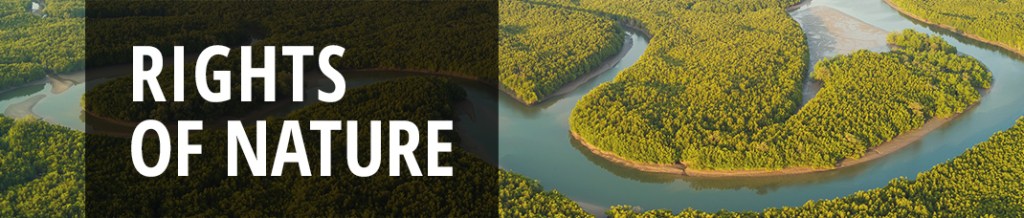
Earth Jurisprudence proposes a transformation of legal systems to address this: to make Nature an equal part of our legal system by granting it rights. This would give Nature the ability to protect itself, via human intermediaries.

Recognising Natureโ€™s rights in our legal system would also help us to see nature as valuable in its own right, instead of just as a resource for us to use. It would also embed in our culture the idea that we are part of a community of life on this Earth, instead of that our environment is some โ€˜otherโ€™ which we are separate from and more important than.

Personhood

Legal transformation has been mostly overlooked in the last decade, with one exception: the idea of ecocide.

The Stop Ecocide campaign seeks to make the destruction of nature an international crime. This call has been picked up by the Extinction Rebellion movement and mentioned by youth climate strikers as part of the change they call for. Making ecocide a crime is certainly welcome, but the transformation that our legal system needs is far bigger, and it is a shame that ideas like Rights of Nature have not yet received broader recognition.

Legal rights of nature have been introduced in some places around the world. They are recognised in Ecuadorโ€™s constitution, and have entered the court in legals challenges seeking to protect nature reserves from mining permits.

In New Zealand, a particular river system was given legal personhood, and in Colombia and India courts have developed rights for particular ecosystems.

Transform

Rights of Nature is only one part of the transformation of law that we need. The idea of interconnection can be the core of this framework, helping us to see the broader shift that is needed.

Our law should shift to looking at relationships, such as between humans and their ecosystems, instead of just being about individual rights and rights-claims. It has the potential to help change how we relate to each other, seeing ourselves collectively instead of individually.

We could also see the role of law as being about transforming the network of relationships that make up our society, instead of being about protecting individual right and individual freedoms. In this view, law could be used to transform social relations which are unjust or exploitative to being just, harmonious and empowering.

About the Author

Alex May is the founder of the Interconnected Law Project which seeks to develop and share ideas about law and ultimately transform our legal systems.

Interconnected Law is an approach to law based on interconnection, care, nurture, community and love. 

With Gratitude to Alex May for this sharing for our blog and for the clarity of other students of nature’s jurisprudence around the world.

I also recommend reading the Bioneers website for more information on the Rights of Nature: https://bioneers.org/earthlings/

Books, Uncategorized

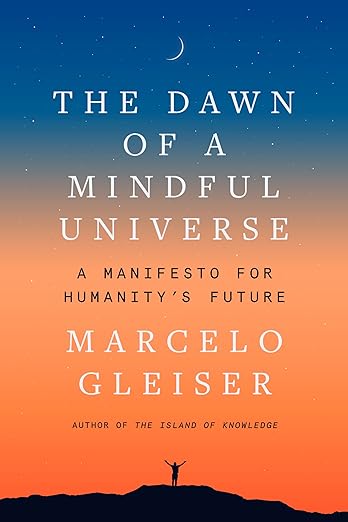
Books that Reconnect: “The Dawn of a Mindful Universe: A Manifesto for Humanity’s Future”

An award-winning astronomer and physicistโ€™s spellbinding and urgent call for a new Enlightenment and the recognition of the preciousness of life using reason and curiosityโ€”the foundations of scienceโ€”to study, nurture, and ultimately preserve humanity as we face the existential crisis of climate change.

Since Copernicus, humanity has increasingly seen itself as adrift, an insignificant speck within a large, cold universe. Brazilian physicist, astronomer, and winner of the 2019 Templeton Prize Marcelo Gleiser argues that it is because we have lost the spark of the Enlightenment that has guided human development over the past several centuries. While some scientific efforts have been made to overcome this increasingly bleak perspectiveโ€”the ongoing search for life on other planets, the recent idea of the multiverseโ€”they have not been enough to overcome the core problem: weโ€™ve lost our moral mission and compassionate focus in our scientific endeavors.

Gleiser argues that weโ€™re using the wrong paradigm to relate to the universe and our position in it. In this deeply researched and beautifully rendered book, he calls for us to embrace a new life-centric perspective, one which recognizes just how rare and precious life is and why it should be our mission to preserve and nurture it. The Dawn of a Mindful Universe addresses the current environmental and scientific impasses and how the scientific community can find solutions to them.

Gleiserโ€™s paradigm rethinks the ideals of the Enlightenment, and proposes a new direction for humanity, one driven by human reason and curiosity whose purpose is to save civilization itself. Within this model, we can once again see ourselves as the center of the universeโ€”the place where life becomes consciousโ€”and regain a clear moral compass which can be used to guide both science and the politics around it.

Articles, Uncategorized

‘The heart that breaks open can contain the whole universe.’

By Joanna Tomkins

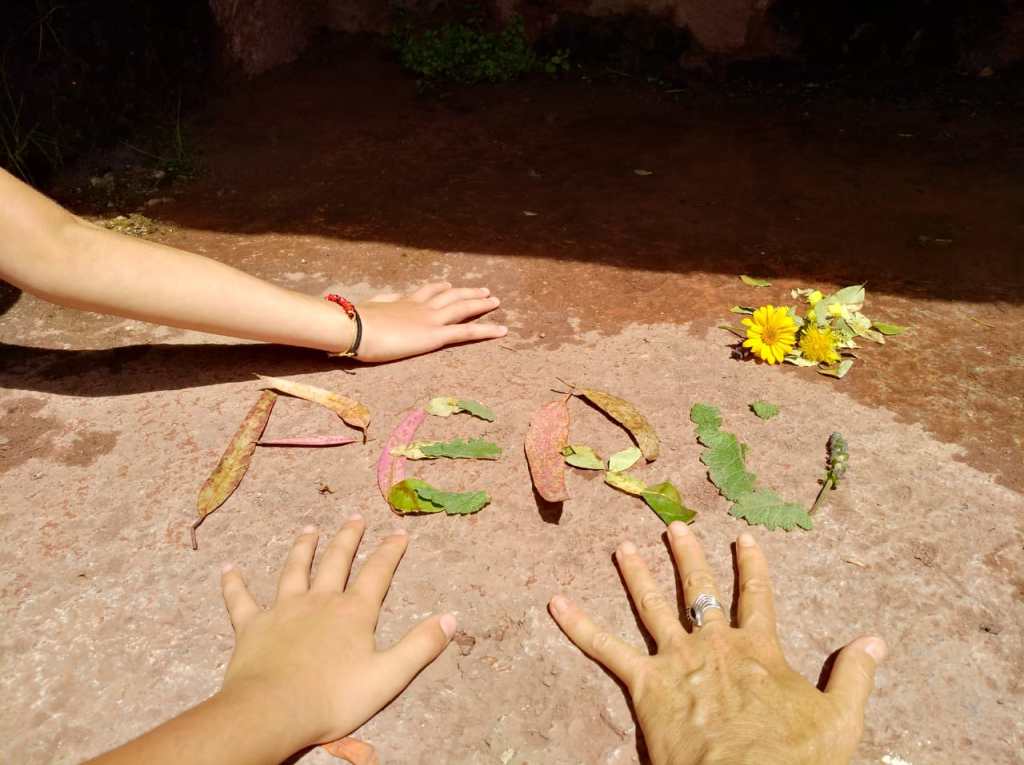
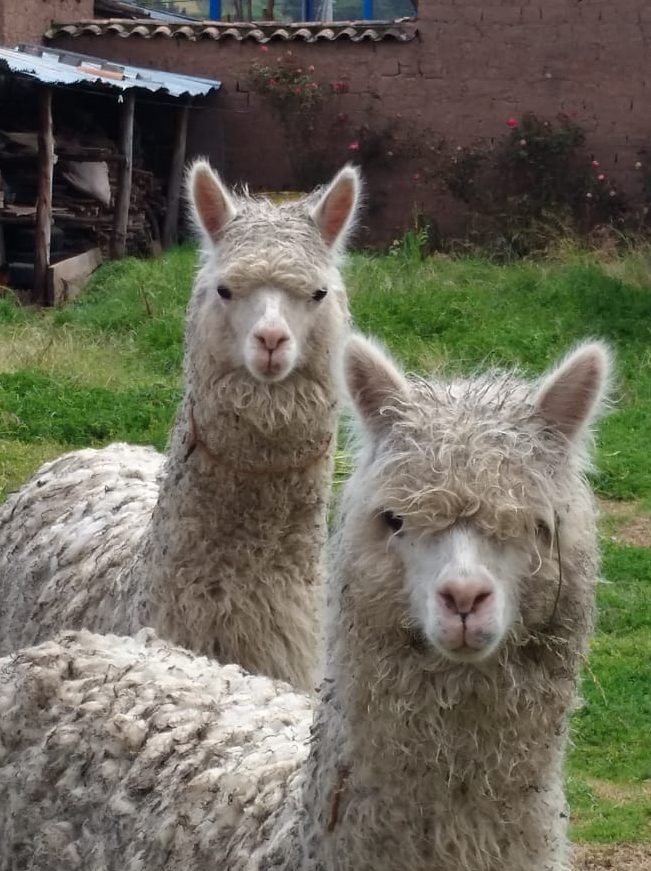
Today we took yet another ‘combi’, this time from Chinchero, our last stop in Peru, where my kids and I have spent 5 weeks, during our visit to South America.

I feel my heart breaking during the ride. It’s not a bad feeling at all, it’s a feeling of openness, a sensitivity around the heart. I will miss these trips in public transport. These trips in public. It’s been very useful for me to speak Spanish, but I know that the warmth of these intimate connections of people on the go, together, would have melted any language barrier.

A very old man, with a cane, hails the bus.
‘Necesita ayuda’, he needs help, a lady says from behind. One lady bends over to open the door, I bend over to help him up by his other blackened hand, immediately enveloped by the scents of boiled corn cobs and infinite layers of wood smoke. I remember entering a Himba hut. He asks me if we are at ‘la terminal’ a few times and I help to prop him up when he slips on the seat in the abrupt Andean bends in the road. He sips on the ‘chicha morada’ (black corn fermented drink) he brought for the ride in an ancient 20cl Inka Cola bottle, reused time and time again.

‘Gracias Mamita!’โ€ฆ He trusts me like his daughter. When we all get off in Cusco he can’t find his money, and remembers he forgot to remember his other bag. ‘Pago para los cuatro’ I say as my kids slip out from the front row, where they had found two free seats. It seems natural to all. And we drift off in between the busy Saturday market stalls.

I wonder if he remembers where he is going. I wonder who will help him find his way home today. I wonder when he lost his wife. I wonder who will take care of him, when his eyesight and his memory get worse, yet I know there will be care for him, for there is community. 

Nowadays, my heart breaks open in a similar way when it feels sorrow and when it feels joy. Sorrow feels like gladness when there exists a non dual sense of greatness that binds them both together. That I have felt strongly here in the Andean mountains and the creases of the Sacred Valley: the greatness of the mountains, revered for their divinity, named Apus. And how men can ‘move mountains’ when led by a vast and sacred sense of purpose. This purpose was driven for the Incas by their trust in their kings and leaders, trust in their elders, trust in the nature gods, and trust in themselves. I quote Robert Bly, whose book ‘Iron John’ I took on travel: ‘The inner King is the one in us who knows what we want to do for the rest of our lives, or the rest of the month, or the rest of the day.’ 

Each stone in the Incan temples in Peru is a masterpiece. Some of them weigh several tons (one in the Sacsayhuaman -pronounce ‘sexy woman’- weighs 125 tons!) and have been quarried several kilometres away. It is a miracle of human will power that we can admire here today. The Spanish used these works of art as convenient bricks for their monotheist humancentric churches, with the added excuse of ‘extirping idolatry’ from the minds and hearts of the invaded. But they could not move the greater of the stones!

Some of the original Incan pieces have up to 20 different angles that are adjusted without mortar to the next stones, forming a mosaic that not only is creatively diverse in its assembly but also has the perfect structure to resist the earthquakes that the dramatic Pachamama bestows upon this region every few decades. Archaeological prowess is everywhere: in the exact inclination of each temple wall, the drainage of each terrace, the elaboration of door hinges and jambs so that each element collaborates with the others to defy the tricks of gods.

What I have felt all around in the communities that inhabit the Andes is a great sense of belonging, deeper than the Western scattered, individual pursuit of purposefulness. What wisdom the atrocious conquests tried to eradicate is still alive with roots as deep as the mountains are high. Quechuan sounds powerful, indigenous rhythms transpire in the musicโ€ฆ, there is no legacy from Spain that has not been blended and sublimed with Incan heritage, more ancient, seeped with spirit, hence more coherent.

And what makes more sense than to revere the nature gods, Inti/Sun the highest of all? And what is more kingly than to present them with the gift of a lifetime of labour? These walls were not built for oneself, for one’s own, they were built for the generations to come, for the Empire, for the Sun itself. Imagine how many lives communed to place each Intipuntu/Sun gate in the exact position where Sun can kiss through it at the exact hour that honours Him?

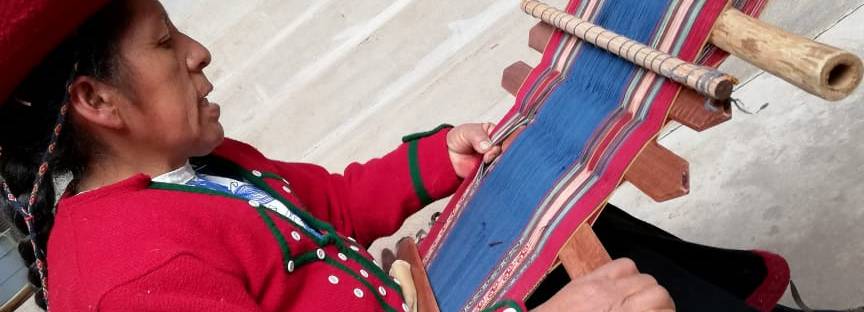
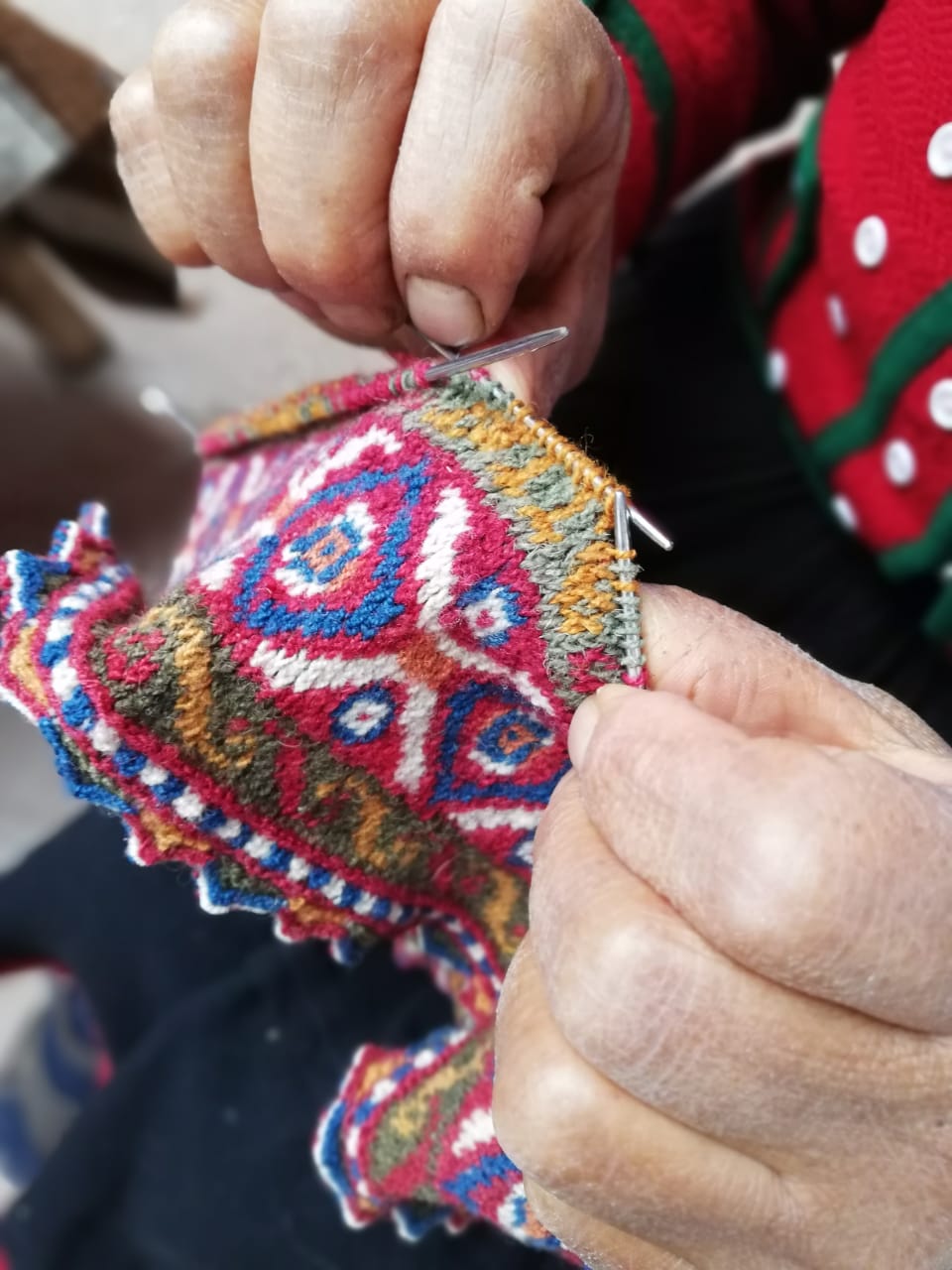
Yesterday we watched Mama Sonia weave, the inner King in her thumbs knowing which string to move next, which colour to represent her tribe, which shape to represent her land. The tradition of weaving withholds the passing of time in the communities of Chinchero, young women still queuing to learn from the elders the traditional ways, fully aware of the privilege of their culture.

In different ways, this witnessing breaks my heart.

The heart that breaks open can contain the whole universe.

A Quote by Joanna Macy
Uncategorized

Staying Sane in the Next 5 Years

Transcript of a Q&A by Charles Eisenstein, before he and Patsy Eisenstein launched the Sanity project last year.

I transcribed this talk to text for you readers because for me each of these words are gold and are very helpful to come back to. His talk is longer and the link is below if you wish to access it (or many of his other masterful downloads) Love Joanna”

by Charles Eisenstein:

In these turbulent times, we live amidst a breakdown of sense and meaning that leaves us susceptible to going crazy.

There were times during Covid actually where I felt like I was going crazy. I was holding a story that so contradicted what the culture overall was saying, thinking and appearing to believe that there were times where I thought โ€œWell, maybe I’m the crazy oneโ€. I had thoughts such as โ€œmaybe every single thing I’ve done in my entire career is simply coming from my reflexive opposition to my father and my discontent, and I just couldn’t hack it in the real world, so I became a dissident.โ€

When your truth is so different from what prevails that you are toppled from the seat of the Soul, the robbers get into the castle, the bandits get in and they run amok. And you become a fugitive in your own castle with your hidden truth, skulking around not daring even to say it to yourself, but on some level still knowing this can’t be right. And so, during those times, I always came back again and again to โ€œwhat do I know for real from my direct experience?โ€. Then I found I had even started doubting my direct experience! I’d started gas lighting myself.

Every one of us has had direct experiences that contradict what we are being told. The economy tells us what is valuable. The economy says what society values and does not value. Yet so much of what we know in our bodies is valuable is not economically rewarded.

How do you stay sane if you don’t have other people to affirm what you know as the right choice? That is the key to maintaining sanity in coming times. Sanity is a group project. We cannot hold a story alone. We need a community to hold a reality because as I said reality is not an objective thing outside of ourselves. Itโ€™s not a given, neither present nor future, it is a relationship.

Our choice is whether to say yes or no to the future and the present that is offered to us and through our yes and no we create ourselves. โ€œWho am I to be? I am also not a given.โ€ That is the essence of what sovereignty is: who am I to be? Therefore, through that choice, through that acceptance of the offering, is who you can be. Through that acceptance, through that choice, we also create a world that is an intimate mirror of ourselves.

Part of why I am here and doing this work is to be part of that collective holding of sanity and to invoke realities and states of being that many of us are ready and willing to step into. We all need a little help from each other to do that. Many challenges lie ahead as the old structures break down and we are left alone in the gale. When we start gas lighting ourselves and when the truth that has touched us in the past blows away in the gusts, leaving us susceptible to predatory substitutes for the structures of sense, meaning and identity that have fallen away.

Because the story that that I grew up in anyway was a totalising story. It explained everything from the origin and purpose of humanity to why the birds sing. And when that breaks down, there comes a sense of vertigo and therefore an intense discomfort and a desperation to find some substitute, a new story of everything in which we can rest, and that’s what I call going insane. So, one way to hold it all together is to become even more entrenched and more orthodox in the story that is breaking down even though it’s not working. โ€œI’m gonna double down and believe in it moreโ€ is actually a classic response to a challenge to a world view. In certain studies, they present people with evidence that contradicts their worldview and then they interview them about the result of that challenge. Most people become more convinced of their world view when it is challenged. Because it’s an assault on your identity. Opinions aren’t just opinions, they’re woven into everything and tear your self-worth. And so that’s one response: you get even more entrenched, which requires that you ignore more and more of what’s real in order to believe for example right now that civilisation is basically on the right track and that science and technology are ushering in a better and better world every year. In this mythos, you have to ignore more and more things to actually think that’s true, calling in more insanity…

Once you accept one lie you start to accept all the other lies that are required to maintain it and the result is that we live in a matrix of lies right now, where we take for granted being lied to. We’re not shocked when politicians lie to us, it’s normal advertising. It’s one lie after another. We automatically discount all speech, which is part of the reason for speech inflation, [with the use of superlatives], where everything’s โ€œawesomeโ€ for example.

So, that’s one path to madness. Another path to madness is to jump to another totalizing discourse that explains everything. It could be religious fundamentalism; it could be a cult; it could be conspiracy theories… When I say conspiracy theories, I do not mean that in a derogatory sense because I do think that actual conspiracies happen and have a bigger influence on current affairs than most people think. Conspiracy theory can be used to dismiss any dissent or unorthodox opinion, or any protest. But when the conspiracy theory offers you an explanation for everything, be careful.

And then another form of madness is nihilism. It’s to become attached to the space between stories which is really supposed to be a transition. It’s a deprogramming time, it’s a letting go and it does take some time for a gentle falling away of what you thought was real and who you thought you were. That’s the empty space that allows something new to be born. It’s also why I like to take pauses in my speaking, so that I don’t go on autopilot, so something new can be born.

So yes, we are at a crossroads, indeed, a choice point, multiple timelines converge on the present moment and you can feel them sometimes. You maybe feel yourself moving from one to another to another which kind of explains how we can feel so much despondency at one moment and feel so much hope at another moment. It’s because you’re actually occupying a different timeline toward a different future. So, the task in front of us in the next five years is to: first recognize the choice that we are making and learn how to solidify the timeline that we actually want to experience for ourselves and the future generations. How do you actually make this choice? It’s not just to check a box, it’s to recognize the moments that we are choosing it. One way to do that is when facing a choice ask โ€œWhat declaration am I making about human nature?โ€, โ€What am I saying about the human being making this choice?โ€.

To watch the full Q&A you can access https://www.youtube.com/watch?v=BE7DXxE_q6o

You can also follow Charles on his networks and enroll in his new programme Turning of the Age here: https://charleseisenstein.org/

The Turning of the Age centers on monthly livestreams with Charles Eisenstein, who will report on Earthโ€™s evolution toward โ€œthe more beautiful world our hearts know is possible.โ€ Each monthly livestream will have a live Q&A session held in the week that follows. These reports each bring together some or all of the following elements:

Mystic River by รgi Novรกk
  • Meta-political commentary
  • Off-the-radar events of global significance
  • โ€œSign of the timesโ€ stories
  • Developments in conventional and alternative science & technology
  • Earth changes, ecological illness and healing
  • Newly emerging and dying myths
  • Insights from astrologers, channels, and mystics
  • Short guided meditations and/or prayers
Articles, Poems, Resources & Networks, Uncategorized

The Empty Bowl and the Alchemy of Uncertainty

by Barbara Ford

To listen to this article read by the author, please visit the Deep Times Journal where it was originally published last year: https://journal.workthatreconnects.org/2023/09/02/the-empty-bowl-and-the-alchemy-of-uncertainty/

Last year, I had the great good luck to visit my beloved friend and teacher, Joanna Macy, a brilliant elder of our time. We spent the afternoon together, catching up on family and news in the dappled sunshine in her backyard. Ukraine was on her mind. She traveled throughout Russia after the Chernobyl nuclear disaster in 1986 and had dedicated herself to supporting the communities there as they coped with the physical, emotional, and cultural injuries of that event. (As an aside, some communities there are still using Geiger counters to find the least radioactive spots in their environs, so that they can plant gardens and guard the children from the ongoing threat of exposure as toxic particles move with the wind and the dust.)

At some point after this deep and thoroughly unvarnished conversation about the state of the world, she looked up into the tree branches above us, newly opening buds filtering the sunlight, turned to me smiling widely and said, โ€œI am so grateful to be alive at this moment in history!โ€

how to stay present in the face of those reckonings, and the unavoidable truth of uncertainty as our constant companion on the journey. 

This is not uncharacteristic of her, to be honest, but I was sitting with a kind of stunned awe, again, at this person who, while willing to stare deeply into the abyss of the pain of the world, still found herself in this place of deep gratitude. That statement, and that moment, reminded me of all the times over the years she talked about the reckonings our world was bound for, the tumult of fires, literal and cultural, that threaten our world. Her work, and mine, is largely centered on how to stay present in the face of those reckonings, and the unavoidable truth of uncertainty as our constant companion on the journey. 

In the Work That Reconnects, a body of practices developed by Joanna, there is one practice called the Truth Mandala, or Circle of Truth. Within a circle of witnesses, a person enters and interacts with objects symbolic of emotional states that might arise in confronting oneโ€™s pain for the world. For example, a pile of dead leaves symbolizes grief. A large stick, tightly held, symbolizes anger. One of the objects I have a great resonance with is an empty bowl, which is connected to confusion, uncertainty, numbness. Each object has a correlating quality to each emotional state. Grief is connected to love. Anger, to oneโ€™s passion for justice. The emptiness in the bowl makes a space for the new to arise.

That empty space is a kind of scrying bowl, a place to seek new meanings, new ways of being with the unknown.

For me, the empty bowl has been a deeply meaningful image in my life and creative work. It comes up in dreams, in paintings, in poetry. That empty space is a kind of scrying bowl, a place to seek new meanings, new ways of being with the unknown. As such, the bowl becomes the container of process that helps transform my struggles with uncertainty and reclaim qualities that are born out of that alchemy.

Iโ€™ve been a climate activist for over twenty years now, and the climate crisis has been a difficult but important teacher in this endeavor. We are still learning so much along the way, including how the climate crisis intersects with so many other crises of the human and more-than human world. As more and more communities start to experience, first-hand, the unprecedented changes in climate phenomena, more of us are faced with a deep uncertainty about everything: Where can we live, safely? What will our children have to contend with? What is worth focusing on? And, lastly, is there a future at all?

Climate futurist Alex Steffen is a voice Iโ€™ve come to appreciate in this moment. He writes, 

โ€ฆthe planetary crisis ainโ€™t the Apocalypse. We do not face the End of Everything. We face the obliteration of our certainties, sure. We also face the destruction of many of the wonders of nature. And we face the reality that for billions of people, life will feel pretty damned apocalyptic, even as humanity as a whole staggers along. We live now in a trans-apocalyptic world. (1)

I need to breathe here, as I write. To breathe, and to also mention that the word โ€œapocalypseโ€ does not mean the end of everything, but, in fact, comes from the Greek words that mean โ€œto uncover or reveal.โ€

So much is being revealed.

The truth is, whole communities of people have gone through some version of apocalypse

All the cultural crises of our timeโ€“climate chaos, fascism, racism, inequalityโ€“have deep roots in time, and in consciousness. The truth is, whole communities of people have gone through some version of apocalypse, whether it is the genocide of Native American communities, the enslavement of African people, or the Holocaust. Worlds have ended, if not the world. The results of colonization and domination cultures have spread to the entire planet. While some communities are disproportionately affected, whatโ€™s new is that, now, all people, species, landscapes, and living systems are threatened by the effects of the mindset that put climate chaos into motion.

Alex goes on to say:

Itโ€™s important to live when we are. Being native to now, I think, is our deepest responsibilityโ€ฆ being at home in the world we actually inhabit means refusing to consign ourselves to living in the ruins of continuity, but instead realizing we live in the rising foundations of a future that actually works. It may be a fierce, wild, unrecognizable future, but that doesnโ€™t mean itโ€™s a broken future. Indeed, itโ€™s the present thatโ€™s broken beyond redemption. (1)

 Itโ€™s not that our future is broken, but our present. And, if enough people find a way to offer themselves to this present brokenness, a viable, less broken, and more just future might be built.

Nothing has ever been certain, actually. Crops fail. Health fails. Accidents happen. This has always been true. Joanna Macy says this: 

I know weโ€™re not sure how the story will end.  I want so much to feel sure. I want to be able to tell peopleโ€ฆitโ€™s going to be alright.โ€ And I realize  that wouldnโ€™t be doing anybody a favor. First of all, we canโ€™t know. But secondly, ifโ€ฆ we could be given a pill to be convinced, โ€œdonโ€™t worry, itโ€™s going to be okayโ€, would that elicit from us our greatest creativity and courage? No. Itโ€™s that knife edge of uncertainty where we come alive to our greatest power. (2)

We all have different lived experiences of uncertainty, and varied capacities to cope. People are facing houselessness, disability, family difficulties, oppression. Iโ€™m not here to tell anyone how they should be strong in any adversity. However, some folks might find comfort in the exploration of ways to navigate these times.

Letโ€™s talk about the connection between uncertainty and creativity, for example. The writer Meg Wheatley says that we canโ€™t be creative if we refuse to be confused. She states: โ€œChange always starts with confusion; cherished interpretations must dissolve to make way for whatโ€™s new. Great ideas and inventions miraculously appear in the space of not knowing.โ€ (3)

Fire bowl by Barbara Ford

Artists of all kinds have always known this. The very act of creating is dependent in a large part on opening to possibility, to emergence, to unpredictable discoveries.  As an artist and a poet, I find that the best work is born out of not knowing what the hell Iโ€™m doing, honestly. I continue to struggle with the process. Itโ€™s not an easy path. It is humbling and sometimes disorienting. At the same time, when something unexpected and wonderful arises, it feels like I have been a vessel for some other, larger truth teller. Call it Muse, or God, or Trickster, it is a feeling of deep connection.

One creative practice Iโ€™ve tried is improvisational singing. Thatโ€™s when you literally open your mouth and sing sounds or words and you donโ€™t know what they will be until they are sung. In the beginning, I was afraid- of sounding bad, of getting it wrong, even of being boring. But the truth is, the more you just throw yourself out there, risking shame and oblivion, there are moments of clarity and communion between all the so-called โ€œbadโ€ notes. The power of those moments can eclipse the fear of failure.

two of the gifts of uncertainty are artistry and emergence, the empty bowl that holds all that can be born

So, I posit that two of the gifts of uncertainty are artistry and emergence, the empty bowl that holds all that can be born. Releasing ourselves from โ€œneeding to knowโ€ in order to act can lead us through a portal to the mystery, a sometimes messy, divine truth.

And, as you might imagine, this portal also can lead to wonder. What is wonder, after all, but a kind of beautiful, embodied acknowledgement of the workings of mystery? The fact of a sunset isnโ€™t what makes us wonder. The confluence of color, space, the moment as it meets our open heart is where wonder arises.

Another gift of uncertainty is honesty. Many of us have grown up with a bias towards facts over truth. Our educational systems reward the learning of facts, sometimes more than the gifts of curiosity and wonder. If more of us were taught the valuable skill of honoring what we donโ€™t know, of being okay with the vulnerability of that stance, I think our capacity for rich and honest relationships, for experimentation, for creativity, would grow our hearts and communities in some lovely ways. 

Ironically, if we were honest about our not-knowing, we would be more in touch with our own truth and the truth of others.

Right now, around the world, there is a growing tide of fascism. Fascism, in effect, is a kind of evil sureness of oneโ€™s right to absolute power over a populace and the planet. We watch in horror as Russia invades Ukraine. We see in the United States actions by politicians and plutocrats asserting similar ideals. This kind of toxic certainty, coupled with a disdain for empathy and mutuality, is at the heart of so much unnecessary pain and destruction. It is the antithesis of justice. It is the antithesis of care.

The ones who embrace uncertainty are the ones who, through their vulnerability, reap the twin gifts of humility and empathy.

The ones who embrace uncertainty are the ones who, through their vulnerability, reap the twin gifts of humility and empathy. Humility reminds us of what we still need to learn, and what to unlearn. It softens our armor, our resistance to change the parts of ourselves who, unknowingly, have learned habits and assumptions that perpetrate harm. Hereโ€™s one example from my life: As a white person striving to unlearn the racism I absorbed growing up, I strive to read and learn as much as I can about racism. However, it has taken some experiences that broke me a little, interactions and truth-telling that brought me into a deeper conversation with my humility. At first it was difficult. I resisted. I was attached to my innocence. When, over time, I became more comfortable with not-knowing, and less attached to protecting myself, I found myself better able to learn, more grateful for the learning. Itโ€™s definitely an ongoing journey, but one, now, I value as some of the deepest learning of my life.

Humility and empathy dwell together. They both depend on focusing outside of the self, on the willingness to see and honor other viewpoints. Both remind us of our true belonging to each other and the world, and of the pointlessness of perfection. Both are born out of an acceptance of the uncertainties we all face, and the truth that we need each other to face and navigate them together.

The writer Rebecca Solnit has made it her business to address ideas of hope, courage, and what she calls โ€œradical uncertaintyโ€. Her book, Hope in the Dark, is essential reading. She writes:

Hope locates itself in the premise that we donโ€™t know what will happen and that in the spaciousness of uncertainty is room to act. When you recognize uncertainty, you recognize that you may be able to influence the outcomes โ€“ you alone or you in concert with a few dozen or several million others. Hope is an embrace of the unknown and the unknowable, an alternative to the certainty of both optimists and pessimists. Optimists think it will all be fine without our involvement; pessimists adopt the opposite position; both excuse themselves from acting. (4)

Did you notice how she links uncertainty with possibility? And how she links certainty, in either direction, as a potential limitation to take action in the world?

โ€œWho shall I be, no matter what?โ€

As a result of this kind of inquiry, my deepest question right now as an activist, and, indeed, just as an individual, is โ€œWho shall I be, no matter what?โ€ It releases me from the false binary choice of success or failure. What is courage, after all, but the heartโ€™s strong dance forward in the face of uncertainty? In fact, uncertainty is a parent of courage, and the sibling of hope. Not a passive, waiting kind of hope, but an active hope that compels us toward the future with agency and love.

Hereโ€™s another quote from Rebecca that I hold dear:

Hope is not a lottery ticket you can sit on the sofa and clutch, feeling lucky. It is an axe you break down doors with in an emergency. Hope should shove you out the door, because it will take everything you have to steer the future away from endless war, from the annihilation of the earthโ€™s treasures and the grinding down of the poor and marginalโ€ฆ To hope is to give yourself to the future โ€“ and that commitment to the future is what makes the present inhabitable. (4)

Creativity. Vulnerability. Honesty. Humility. Empathy. Courage. Hope.  May these alchemical qualities guide us into the complicated and tumultuous future, and may we find joy in the company of brave, artful, and loving friends in the journey.

Song for the Empty Bowl

we fill the emptiness with stones
with firewith memory and bones
with fury songs and quiet poems
and prayers for all the quiet ones

this emptiness can hold a drum
a knife, a seed, a place to hide
but mostly what I fear has come
a bowl of tearsa rising tide

uncertainty is my lament
my prayermy homemy quiet friend
the spells of all the breaths we hold
the songs unsung, the tales untold

to find this dance, to sing this song
an ancient sphere, to waltz upon
this empty bowl, my deep unknown
my curve of grace, my silent koan


References:

  1. Steffen, A.,โ€We All Live in California Now,โ€ essay at:   https://alexsteffen.substack.com/p/we-all-live-in-california-now. June 10, 2022.
  2. Macy, J., interview Joanna Macy and the Great Turning in film by Christopher Landry, 2016.
  3. Wheatley, M. J., Turning to One Another, Berrett-Koehler Publishers Inc., 2009, p.45.
  4. Solnit, R., Hope in the Dark: Untold Histories, Wild Possibilities, Haymarket Books, Chicago IL, 2016.


Barbara Ford is a longtime WTR facilitator, artist, writer, and activist living in Portland, Oregon. She has been active in the climate justice movement for over twenty years as an arts organizer, as well as supporting the activist community with WTR inspired events to grow a culture of self and community care. She has created the Radical Gratitude model for expanding our ideas about gratitude, and is offering new writings in her Substack newsletter called Cultural Artisanship in a Changing World (https://barbaraford.substack.com). 

Check out Barbara’s new artist website at:
www.confluence-arts.net
Uncategorized

The Song of Understanding…

Weโ€™re being called to come to terms with the truth of ourselves, the purity of ourselves, the innocence of our love, that we havenโ€™t had access to for a long time. And eventually come to be that one that sends out the song of understanding of the beauty of how we are, where we are and how it is to be humanโ€ฆโ€  Pat McCabe, Woman Standing Shining

When I heard these words on a podcast I was listening to, in preparation for being with Pat McCabe, who is a guest teacher on a programme I mentor on, I could just feel my whole nervous system relax. A deep inner knowing of this sacred truth, shared by this incredible Navajo mother, grandmother, activist, artist, writer, ceremonial leader, and international speaker.

Since a very young age, Iโ€™ve know that something has gone very wrong with our systems and constructs that have come to be seen as โ€˜normalโ€™ in our Western cultures.  And ultimately the prevailing worldview or myth that shapes and directs the way we interact โ€“ this story of separation, as Charles Eisenstein names it. Itโ€™s truly heartbreaking to witness the increasing polarisation, demonstrated through the ongoing wars and continued violence. And indeed the continued violence towards the ecosystems that sustain us and all of life. Iโ€™m brought to tears when I realise that only 4% of the mammal kingdom (both land and sea) are wild animals, for example. The rest are either humans or animals we have domesticated for our use.

Throughout all of my young and adult life, leading almost to the time where I began to make the transition towards cronehood, I can see now that I have lived within the archetype of Atlas- the Greek Titan condemned to hold up the heavens or sky for eternity- but instead of holding up the sky, and the stars, I have been carrying the weight of the world on my shoulders.

I need to save the world was my mantra…

Of course, not only has this placed an impossible burden on me over the years, which has felt extremely heavy and has filled me with anxiety, but it also feeds directly into the story of separation- me separate from all others โ€“ and also separate from the companionship and support of all our relations, both human and non-human.

Iโ€™m sharing this story with the curiosity as to whether some of you who are reading it may resonate? A lot of us carry anxiety about whatโ€™s happening in the world right now, or guilt that we are not doing enough. And this, in itself, can ironically (and yet inevitably) lead to inaction, or freeze.
The answer isnโ€™t to close our eyes to what is happening around us, to โ€˜keep calm and carry onโ€™.  Rather, a complete shift in how we experience ourselves, and all of life, is the piece that will truly transform our relationship with ourselves, with each other and with our natural environment.

Itโ€™s time to tune back into the earth-based wisdom that resides within us all, the seeds of which are carried by the wisdom keepers, indigenous people such as Pat McCabe, from around the world. Including, of course, bushmen elders right here in South Africa.

So, first to come back into โ€˜right relationโ€™. To remember our place of belonging in this ecological web of life โ€“ as nature โ€“ not separate from it.  This is a shift from an anthropocentric view of life, where humans are at the centre, and the rest of nature exists for our use or enjoyment, to a way of seeing life on Earth with humans in their rightful place, as co-contributors of the Earth community, not with dominion over.

Pat McCabe poses some serious questions: Can we do all that we dream up to doโ€ฆ and have life on this planet?  Are we ready to give up some of what we dream we can do, in order to give space to the other beings?

And how can we live in a way that does not undermine the right of other beings to survive and thrive? Or the ecosystem to re-find equilibrium? What does consent really mean in this context?

On a practical note, this might mean really taking responsibility for the waste we create through our consumption. Or looking at our inputs, for example within the food we eat -can we truthfully say we have not contributed towards the degradation of soil, and all that means, through the choices we have made?

The second piece of this puzzle-  tuning back into what is truthful, and reverberating that song out into the world  – is something which, as a Purpose Guide, is just as dear to my heart.  Each one of us, when we tune in at a deep level, has something entirely unique to offer to this world, in service of more beauty, more truth, more goodness. Itโ€™s waiting there for us, when we allow ourselves to be still and to remove all the layers that might be getting in the way.

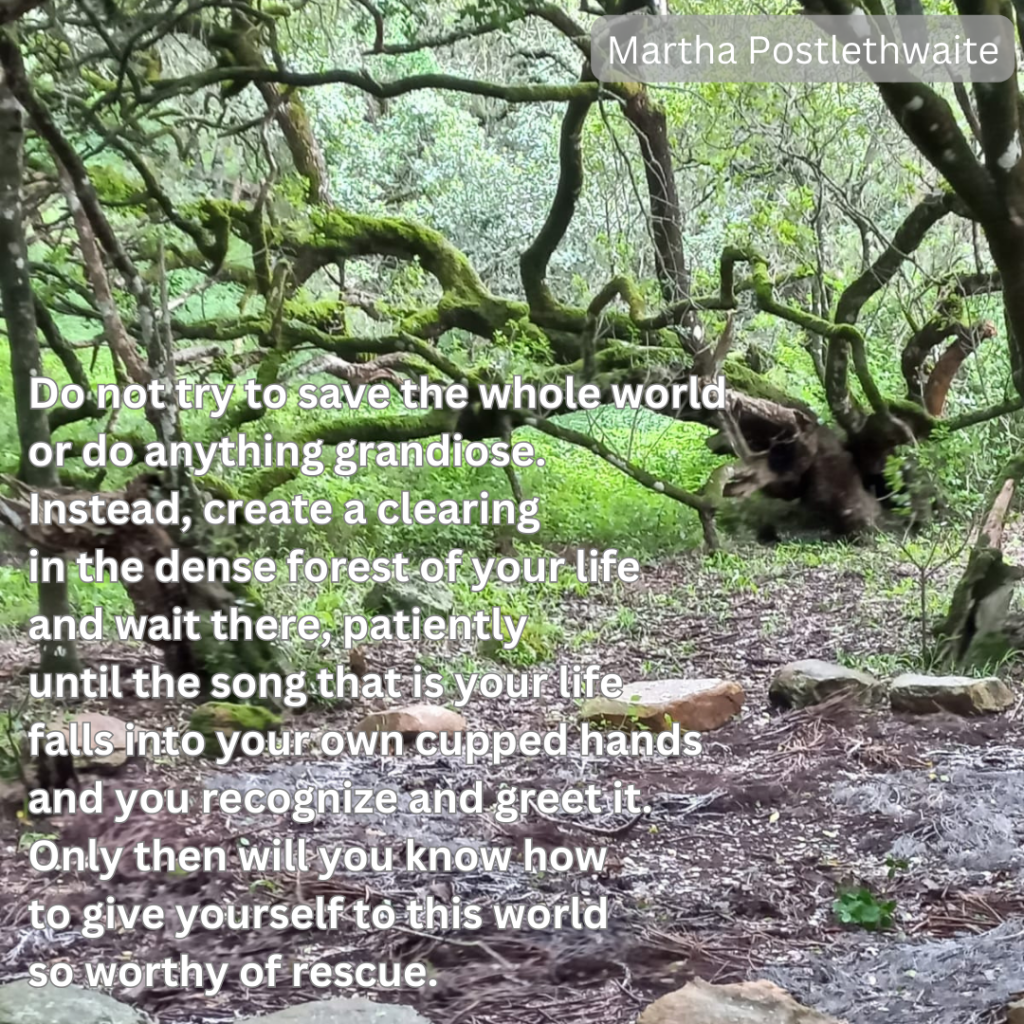
Martha Postlethwaiteโ€™s most beautiful poem feels so relevant here.  It doesnโ€™t happen when we take on the archetype of Atlas, or when we approach it from a place of fear or anxiety. But from the  knowing that each of us has hidden within us a unique gift to offer this world. And it is exactly the medicine that is needed right now.

Pat McCabeโ€™s way of expressing it is like this: โ€˜My biology gives me a way of contributing to the sacred hoop in a way that only I canโ€™. The sacred hoop is a powerful Native American symbol that represents the interconnectedness of all life, and within that the importance of balance and respect for nature.

An enquiry might be  – โ€˜In what ways can I tune into what is rightfully mine to bring in service of humanity and the greater Earth community?โ€™

Or โ€˜how is the dream of the forth calling me forth, at this moment in time?โ€™

We are all related. What is mine to bring interweaves with what is yours. And so it goes on, as we weave the tapestry of this miracle we call life.

Articles, Events & Reviews, Uncategorized

SAMAD 2023 – The Sacred Music and Dance Festival in McGregor last week

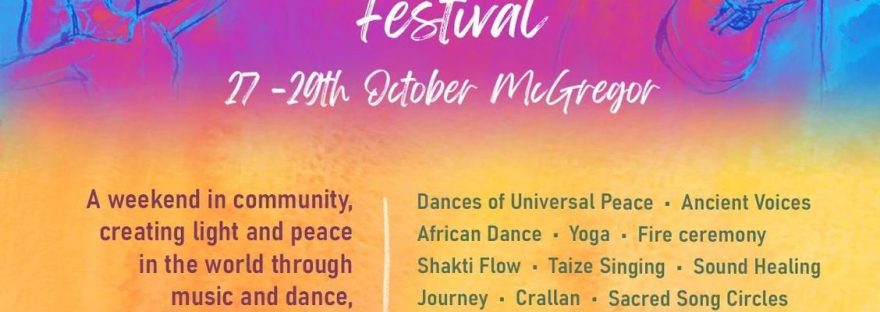
Here are a few images of the Sacred Music and Dance Festival that Gaia Speaking took part in last week. Participants and facilitators danced and sang, shared movement, poems and prayers, and all came together in a multicoloured multifaceted work of art and soul. It was truly a pleasure to be a part of this co-creation.

The festival, which was born out of a deep love for music, spirituality, humanity, and a reverence for all of life, is non profit and is held in McGregor, a village nestled in the Klein Karoo, 2 to 3 hours from Cape Town. It is a great setting for this festival, where the events are held in two exceptional venues: Temenos – a retreat centre and absolute treasure embraced by the Gardens of the Beloved – and the Wisdom School, at slow walking distance, housed in historical buildings, which have been carefully and tastefully restored.

It was nice to amble around the village and enjoy its scattered and quaint coffee shops and restaurants and then a little bit strange to watch rugby on Saturday night, for the World Cup final that South Africa won.

Rachael and I participated in the opening ritual around the fire, which ended at dusk with a performance from the Zolani choir from Ashton.

Wisdom School Courtyard above and Hall below

Both our Songs that Reconnect circles felt very resonant with the vision of the festival. They were were both held at Temenos, First in the Caritas Library, surrounded by the wealth of knowledge contained in thousands of spiritual books, and then at the very special venue called “The Well”. We are grateful for our participation in SAMAD for many reasons and in particular because we felt a lot of connection with the embodied forms of the Work that Reconnects that Rachael and I practice.

We celebrated and strengthened with powerful songs Coming From Gratitude into the Spiral, the soft sound of sacred water reminding us of the essence of impermanence and flow. At the Well itself, in the centre of the temple, we facilitated the ritual of the Bowl of Tears as we sang the soft chant “Rivers of Tears” to Honour our Pain for the World. Seeing with New Eyes and Going Forth around the Spiral, we sang and danced a little and we shared some words of reconnection too. It is always an honour to provide these offerings inspired by the Work that Reconnects, in our own particular style, and this festival and these venues were very auspicious places to do so. All our events and all those that I had the privilege to participate in were so unique and filled my heart with a sense of appreciation of community. I felt an upsurge of energy and gratitude for all the gifts that we carry and how this fosters in me hope for a more beautiful world for all. Thank you.

As we come together to sing and dance in this way, through sound, movement, meditation and consciousness, we touch something deeply within our beings. In such moments it is the soul which is dancing. In those rare moments of recognising that it is that great Love which is present behind all that exists, one experiences a kind of ecstasy. So it is with the experience of sacred music and dance that brings us back to the unity of community, the unity of being.

This festival is a celebration of all spiritual paths. The time we find ourselves in at present reveals that there is a greater need than ever before to find common ground, to unite and bring peace to the world. By coming together we can learn about, open to, and sing and dance the unity of creation, while respecting and honouring each unique spiritual path toward the One. This is a journey of creativity and joy.

Harold Epstein

If you want to join next year’s festival, you can stay connected with the organisers, Harold and Anja, on the following website or facebook:

https://www.healing-waters.co.za/about-3

https://www.healing-waters.co.za/sacred-music-and-dance-festival

https://www.facebook.com/waters.healing

https://www.temenosretreat.co.za/

Resources & Networks, Uncategorized

The Vows of the Work That Reconnects

King Protea

We were reminded of these vows yesterday during the Gaian Gathering. These are words that we can voice aloud while witnessed in a workshop or to ourselves, as we are always witnessed by the Earth and each other in a myriad of ways. They are such profound anchors for our collective in this time of Great Turning…

I vow to myself and to each of you to commit myself daily to the healing of our world and the welfare of all beings. 

 I vow to myself and to each of you to live on Earth more lightly and less violently in the food, products and energy I consume.

 I vow to myself and to each of you to draw strength and guidance from the living Earth, the ancestors, the future beings and our kin of all species. 

I vow to myself and to each of you to seek liberation from patriarchy, colonialism, and racism in all dimensions of my life.

 I vow to myself and to each of you to support you in your work for the world, and to ask for help when I need it.

 I vow to myself and to each of you to pursue a daily spiritual practice that clarifies my mind, strengthens my heart and supports me in observing these vows.