By Diony Lalieu, Ocean Pledge founder and director,
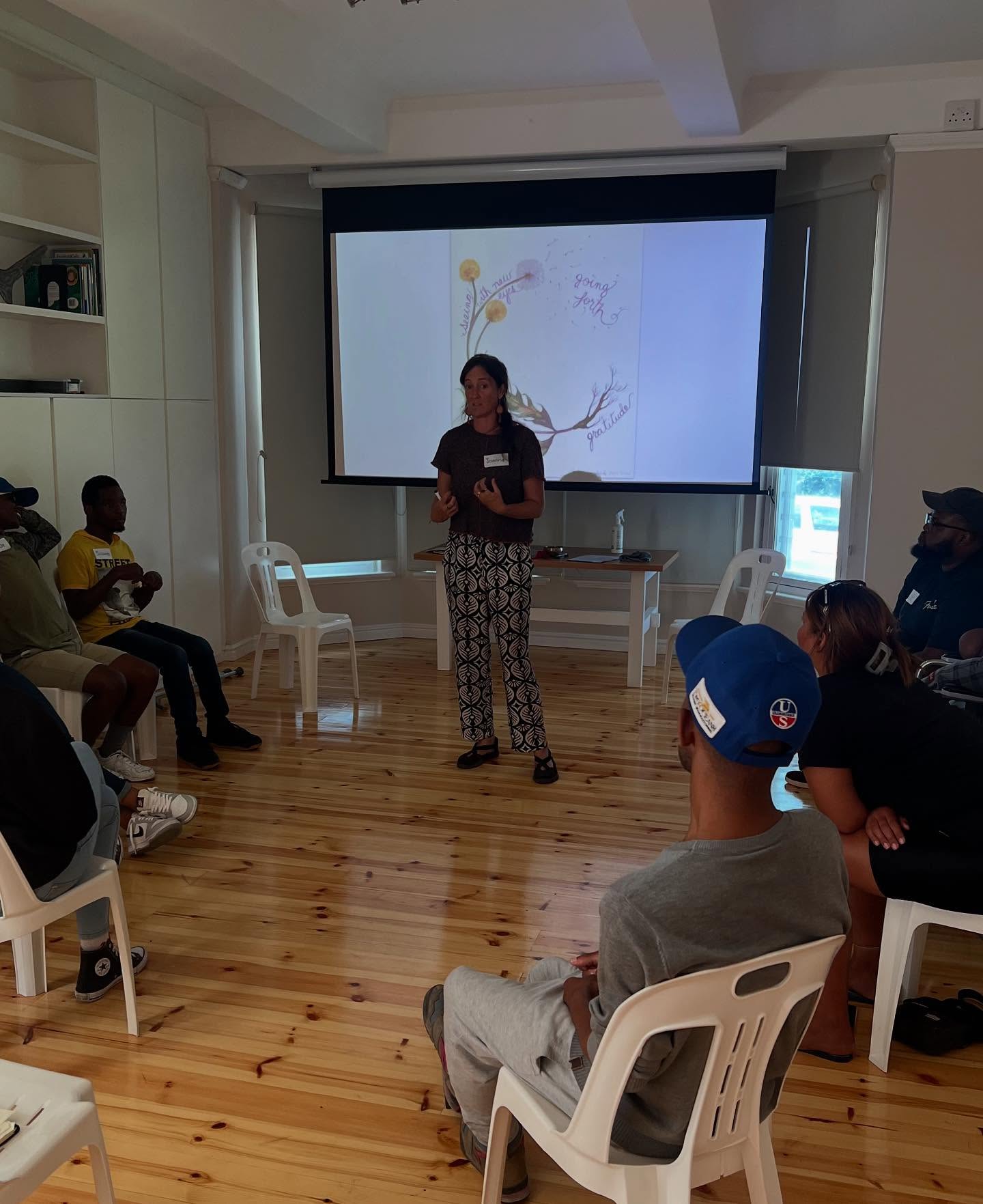
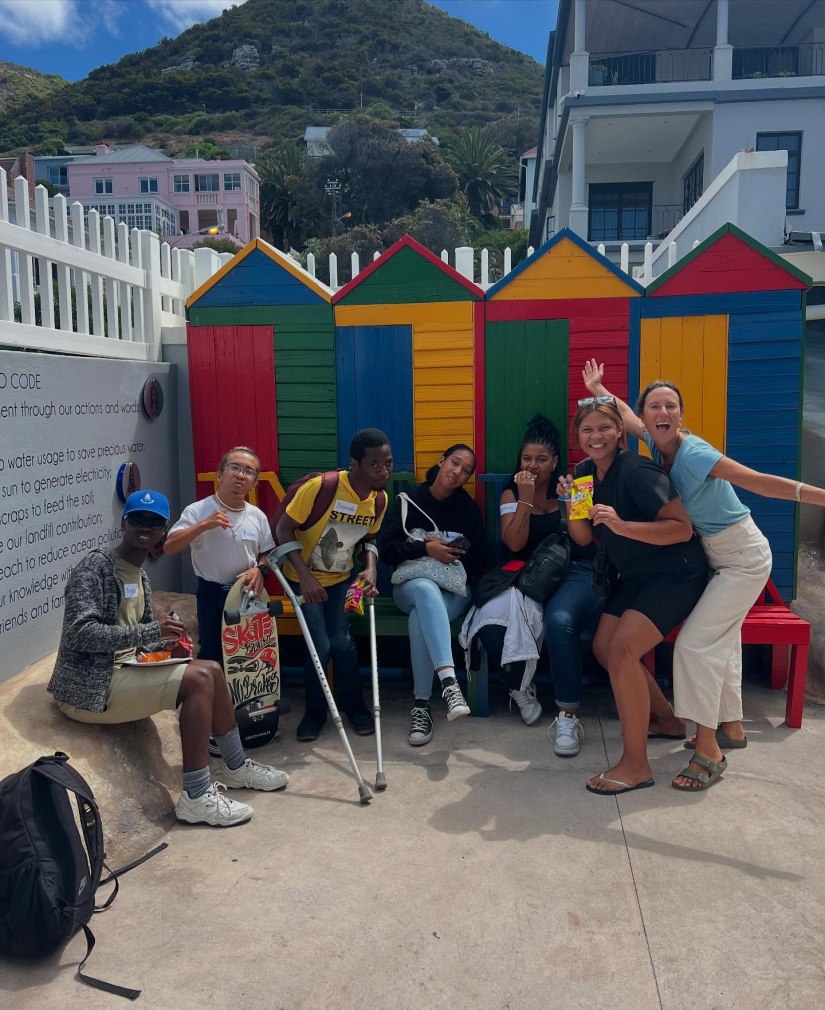
After the workshop held in Kalk Bay on 6th March 2025
โA single tear can carry a heart of many emotions. When it falls, itโs not just about sadness, itโs about letting go. Sometimes, after we cry, we find ourselves smiling because weโve allowed ourselves to truly feel, to release the weight weโve been carrying. Now, picture a group of people coming together in a safe space, each person with their own story, their own journey, their own struggles and challenges. But theyโve arrived here, together, to share their hopes for a better world. In this space, they can talk about their sadness without guilt or shame, and share their dreams without fear, knowing theyโre supported and their vision for a better tomorrow is held. In the Work that Reconnects, there is a deep acknowledgment that each personโs journey has shaped them into who they are today. Some paths were hard, others full of joy, but all have led them here, where they can listen, understand, and re-connect with themselves, with the planet and with all forms of life who share the planet with us. As they share their hopes, they realise that by being open with one another, theyโre not only healing themselves but helping to support each other in shaping a better world. With deep gratitude to Joanna Tomkins from Gaia Speaking for holding this space. And for the Shark Centre for a gloriously educative morning of learning about sharks and interacting with life below the ocean.โ
For more information on these groundbreaking Ocean-based leadership initiatives, please contact Ocean Pledge https://www.facebook.com/OceanPledge,
Indra’s Net, a profound metaphor from Mahayana Buddhism, illustrates the universe as an expansive web where each node holds a jewel reflecting all others. This imagery encapsulates the concept of radical interdependence, suggesting that every entity is interconnected and mutually influential. Joanna Macy, a scholar of Buddhism and deep ecology, draws upon this metaphor to articulate our intrinsic connection within the web of life. She describes Indra’s Net as “a huge net where at every node is a jewel, and each jewel reflects the other jewels and catches the reflections back and forth,” emphasizing the tapestry of universal interconnectedness.
โThis vision resonates with contemporary understandings in systems theory and deep ecology, which recognize that life is not organized hierarchically but through intricate interdependencies. Macy highlights that “nature doesnโt work that way, and great mystics of many traditions have seen this radical interdependence of all life.”
By embracing this perspective, we acknowledge that our actions ripple throughout the entire web, affecting all beings and the environment.โ
In the context of the Great Turningโa term Macy uses to describe the essential shift from an industrial-growth society to a life-sustaining civilisationโrecognising our place within Indra’s Net becomes transformative. It fosters a sense of mutual belonging and shared responsibility. Macy asserts, “We belong to each other. We belong to the living body of Earth and nothing can ever separate us. We are already home.” This understanding compels us to act for the well-being of the whole, knowing that individual and collective destinies are intertwined.โ (Source: Article on the Deep Time Journal of the Work that Reconnects International Network)
By internalising the metaphor of Indra’s Net, we move beyond the illusion of separateness and embrace our role as active participants in the web of life. This shift in perception is vital for the Great Turning, as it encourages actions rooted in awareness, compassion, and a deep commitment to the flourishing of all beings.โ
For a deeper exploration of these concepts, you may find Joanna Macy’s talk “Waking Up in Indra’s Net: Acting for the Sake of Life on Earth” insightful.โ
I recently found a completely nontechnical way to summarise it in terms of four โprinciples of lifeโ, which, according to the systems view, constitute its very essence. They are principles of organisation shared by all living systems, from the smallest bacteria through the wide range of fungi, plants, humans and other animals. In other words, these four principles are embodied in all forms of life, including social systems and ecosystems.ย ย ย ย ย ย
I am happy to announce that my article on the systemic principles of life, whichI developed over the last two years, has been published in Resurgence magazine, Issue 346, September/October 2024.I found this new language, summarizing my synthesis of the systems view of life, in conversations with the students of my online Capra Course. I am very grateful to them for countless stimulating discussions.
Photo by Elizabeth Hawk.
I was trained as a physicist and spent twenty years doing research in theoretical high-energy physics. I left physics in the mid-eighties and turned towards the life sciences, where a new conception of life has recently emerged. It involves a profound shift in perspective from seeing the world as a machine composed of elementary building blocks to understanding that it is a network of inseparable patterns of relationships.
Over the last few decades, I have developed a synthesis of this new understanding, a conceptual framework that integrates four dimensions of life: the biological, the cognitive, the social and the ecological. I have presented summaries of this framework, as it evolved, in several books. My final synthesis is published in a textbook entitled The Systems View of Life,which is co-authored with Pier Luigi Luisi (Cambridge University Press, 2014). I call my synthesis a โsystems viewโ because it requires a new kind of thinking โ thinking in terms of relationships, patterns and context. In science this is known as systemic thinking, or โsystems thinkingโ.
What is systems thinking?
Systems thinking emerged in the 1920s from a series of interdisciplinary dialogues among biologists, psychologists and ecologists. In all these fields, scientists realised that a living system โ an organism, ecosystem, or social system โ is an integrated whole whose properties cannot be reduced to those of smaller parts. The meaning of this statement is actually quite subtle and is often misunderstood. There is nothing wrong with saying that the structures of all living organisms are composed of smaller parts, ultimately of molecules. But this does not mean that their properties can be explained in terms of molecules alone. The systemic properties derive from the processes and relationships in which these molecules are involved. Systemic properties are properties of the whole, which none of its parts have. Thus, systems thinking involves a shift of perspective from the parts to the whole. The early systems thinkers expressed this in the now well-known phrase โThe whole is more than the sum of its parts.โ
Thinking in terms of relationships is crucial for ecology, because the word โecologyโ, which is derived from the Greek oikos (โhouseholdโ), means the science of the relationships among various members of the Earth household. I should also mention that systems thinking is not limited to science. Many Indigenous cultures embody profound ecological awareness and think of Nature in terms of relationships and patterns.
During the 1980s, systems thinking was raised to a new level with the development of complexity theory, technically known as โnonlinear dynamicsโ. It is a new mathematical language, involving the use of high-speed computers, which allowed scientists for the first time to handle the enormous complexity of living systems mathematically. The new nonlinear mathematics is a mathematics of visual patterns โ strange attractors, fractals, and so on.
During the last forty years, there has been a strong interest in nonlinear phenomena, which has generated a whole series of new and powerful theories that have dramatically increased our understanding of many key characteristics of life. They embody what I like to call โadvanced systems thinkingโ, based on complexity theory rather than on the classical systems theories of the 1930s and 1940s. My synthesis of these recent theories is what I refer to as the systems view of life.
Systemic principles of life
Naturally this synthesis involves quite a few technical concepts. However, I recently found a completely nontechnical way to summarise it in terms of four โprinciples of lifeโ, which, according to the systems view, constitute its very essence. They are principles of organisation shared by all living systems, from the smallest bacteria through the wide range of fungi, plants, humans and other animals. In other words, these four principles are embodied in all forms of life, including social systems and ecosystems.
Principle 1: life organises itself in networks
My first principle is that life organises itself in networks. This actually contains two ideas. One is that the network is the basic pattern of organisation of all living systems: wherever we see life, we see networks. This realisation originated in the early 20th century in ecology with the concept of food webs. Subsequently, network models were used at all systems levels, viewing organisms as networks of cells, and cells as networks of molecules, just as ecosystems are understood as networks of individual organisms.
A network, as everybody knows, is a certain pattern of nodes and links, of relationships. Therefore, in order to understand networks, we need to learn how to think in terms of relationships and patterns, and this is what systems thinking is all about. Please note also that networks are nonlinear โ they go in all directions โ and since all living systems are networks, this means that all living systems are nonlinear, or โcomplexโ, systems.
In recent years, social networks have become a major focus of attention, not only in science but also in society at large and throughout a newly emerging global culture. Indeed, networks are the dominant social feature of our age. The profound change of metaphor from seeing the world as a machine to understanding it as a network lies at the very heart of the systems view of life.
The second idea implied in my first principle is that life organises itself: the network pattern is not imposed on a living system by its environment, but is created by the system itself. The concept of self-organisation originated in the 1940s and was used in many different contexts and with different meanings during the subsequent decades. Today, describing living systems as self-organising means that they create structures and processes organised by the internal rules of the system, rather than by external imposing forces.
This does not mean that living systems are independent of their environment. On the contrary, they depend for their survival on continual flows of energy and matter, or food, from the environment. In fact, these continual flows, known as metabolism, provide a key distinction between living and nonliving systems. The great microbiologist Lynn Margulis liked to say: โIf it metabolises, itโs alive; if it doesnโt metabolise, itโs not alive.โ
Principle 2: life is inherently regenerative
My second principle is that life is inherently regenerative. Living networks continually regenerate themselves by transforming or replacing their components. In this way they undergo continual structural changes while preserving their web-like patterns of organisation. This coexistence of stability and change is indeed a key characteristic of life.
The continual regeneration of life in Nature is, of course, well known. We only have to think of the turn of the seasons with new growth every spring. Thatโs regeneration. The novel insight in the systems view is that regeneration operates at all levels of life, down to the molecular networks in cells. Regeneration is the very essence of life. When regeneration stops, life stops. In a more philosophical vein, we might even say that regeneration is the purpose, or the meaning, of life.
The continual process of regeneration, of transforming and replacing components of the system, is only possible with continual metabolic flows of energy and matter through the living network. Indeed, we all need to breathe, eat and drink to stay alive. In other words, metabolism โ that defining characteristic of biological life โ is an integral part of regeneration.
As I have mentioned, life in the social realm can also be understood in terms of networks, but here we are not dealing with chemical reactions: we are dealing with communications. Social networks, as everybody knows today, are networks of communications. Like biological networks, they are regenerative, but what they generate is mostly nonmaterial. Each communication creates information, ideas and meaning, which give rise to further communications, and thus the entire network continually regenerates itself.
As communications continue in a social network, they form multiple feedback loops that eventually produce a shared system of knowledge, values, and rules of conduct โ a common context of meaning, known as culture, which is continually sustained by further communications.
Principle 3: life is inherently creative
The fact that an organismโs metabolism involves flows through networks of chemical processes has the important consequence that these metabolic flows include cyclical pathways. These cycles can act as feedback loops. Because of that feedback, living organisms are able to regulate and organise themselves. Feedback loops can be either self-balancing, maintaining the organism in a state of dynamic balance known as homeostasis, or they can be self-amplifying, or โrunawayโ, which may result in the entire system becoming unstable.
At this point, the system may either break down, or it may break through to a new form of order. This spontaneous emergence of new order at critical points of instability, often referred to simply as โemergenceโ, is in my opinion the most important discovery of complexity theory. The process of emergence has been studied in great detail and has been recognised as the dynamic origin of learning, development and evolution. In other words, creativity โ the generation of new forms โ is a key property of all living systems. This is my third principle of life: life is inherently creative.
This means that, as human beings, we are creative not only if we happen to be artists or designers. All of us are creative simply because we are alive, because life itself is inherently creative.
Principle 4: life is inherently intelligent
My fourth and final principle is that life is inherently intelligent. This is based on a new conception of the nature of mind, which is one of the most radical philosophical implications of the systems view of life, since it finally overcomes the Cartesian division between mind and matter that has haunted philosophers and scientists for centuries.
In the 17th century, Renรฉ Descartes based his view of Nature on the fundamental division between two independent and separate realms โ that of mind, which he called the โthinking thingโ, and that of matter, the โextended thingโ. Following Descartes, scientists and philosophers continued to think of the mind as some intangible entity and were unable to imagine how this โthinking thingโ related to the body. The decisive advance of the systemic understanding of life has been to abandon the Cartesian view and to realise that mind is not a thing but a process, known as cognition (the process of knowing).
In the systems view of life, cognition denotes a particular way in which a living organism interacts with its environment. The organism responds to environmental influences with structural changes, and it does so autonomously, specifying which influences to notice and how to respond according to its nature and previous experience. Continual cognitive interactions with the environment are an essential part of an organismโs metabolism, and thus life and cognition are inseparably linked: life is inherently intelligent.
This is a radical expansion of the concept of cognition and, implicitly, the concept of mind. In the systems view, cognition manifests at all levels of life, whether or not an organism has a brain and a nervous system. Plants, for example, and even bacteria, neither of which have nervous systems, are constantly engaged in cognitive activities involving their sensory apparatus and various self-organising processes.
Another way of describing this situation is to emphasise that all living organisms interact with their environment through sensory organs. To use an old philosophical term, living beings are sentient beings. In the systems view, their sentient interactions are identified as cognitive interactions. As the structures of the sensory organs become more and more complex in evolution, so do the corresponding cognitive processes. Eventually we have the evolution of brains, nervous systems and human consciousness, involving self-awareness, language and conceptual thought.
The ability to form abstract concepts, symbols and mental images is a key feature of our consciousness, and human intelligence today includes the abstractions we associate with mathematics and with computers โ algorithms, mathematical models and the like. However, from the systemic perspective of life at large, these mathematical abstractions are peripheral to the intelligence inherent in all living organisms. Living intelligence is tacit and embodied. Its key quality is the ability to be in the world, to move around in it, and to survive in it.
With the recent rapid development of artificial intelligence (AI), we have overemphasised algorithms and other mathematical abstractions and have neglected our tacit, embodied, living intelligence. As a consequence, our ability to be in the world โ in other words, our wisdom โ seems to have diminished dramatically. Indeed, a civilisation that sees making money rather than human wellbeing as its main goal and in the process of doing so destroys the natural environment on which human survival depends can hardly be deemed very intelligent.
The critical question, in my view, is which uses of AI are helpful and appropriate, and which are inappropriate because, although they enhance the mathematical aspects of human intelligence, they may diminish our tacit, embodied intelligence or wisdom of how we should live.
In conclusion, I want to emphasise that advanced systems thinking will be critical in order to solve the major problems of our time, which are systemic ones โ all interconnected and interdependent. In particular, systems thinking will be essential for building ecologically sustainable communities, designed in such a manner that their ways of life do not interfere with Natureโs inherent ability to sustain life. The first step in this endeavour must be to become ecologically literate โ that is, to understand the principles of organisation that ecosystems have evolved to sustain the web of life. These principles of ecology are grounded in the four principles I have introduced, and so โ to summarise the new systemic conception of life โ life organises itself in networks, and these living networks are inherently regenerative, creative and intelligent.
We urgently need to put life at the centre of our businesses, economy, technologies, physical structures and social institutions. As the political activist and author David Korten admonishes us, โWe will prosper in the pursuit of life, or we will perish in the pursuit of money. The choice is ours.โ
โ
Fritjof Capra is a physicist and systems theorist and the author of several international bestsellers, including The Tao of Physics and The Web of Life. He is co-author with Pier Luigi Luisi of the multidisciplinary textbook The Systems View of Life, on which his online course is based. www.capracourse.net
Adapting the words of Active Hope facilitator Madeleine Young
Choose – or create – a space that you can repeatedly go to – a place where you can be quiet and receptive and listen to the world. Ideally this will be a spot in Nature, but it is more important that it is a place that is easily visitable by you, and it is entirely possible to create your โNature spotโ inside your home. Make it somewhere that you feel safe and can relax.
There are many ways to refer to this place – it could be your listening spot, your Nature spot, your Gaia spot, your sit-spot, or whatever feels right for you. This is your place to acknowledge the greater whole that you are a part of. Set aside an amount of time that you are going to spend at your spot. We suggest starting small, to make it achievable that you spend time there each day. Each time you arrive at your spot, relax, breathe, feel yourself in your body, and practice engaging your senses – look, listen, feel, smell (possibly even taste, if you have chosen a spot where edible things are growing!) – be receptive to all the details. If you feel fidgety or unsettled at first, or your mind is full of thoughts, just observe this, without judgement, and keep gently bringing yourself back into your senses. This practice is about building up receptivity and relationship over time and not about seeking to come too readily to clarity. Whilst at your spot, you could try slowing your movements right down, as this is a great way to signify to yourself that this is a space outside of your everyday. Allow yourself to be playful – let your imagination be wide open, like a satellite dish, and let your critical rational mind take a back seat while you are here. As much as you can, let go of expectations, as communication from the greater whole may come in unexpected ways.
Let your relationship with your spot develop over time – returning as regularly as you can. Just as with any relationship, you will need to get to know each other first and may start off โmaking small talkโ – with invested time together, your intimacy will begin to deepen. This practice is all about making ourselves available, being quiet, and listening. If it feels useful, you could try out sentence starters, like these, while listening at your spot: If our world could speak to me, what it might say isโฆ If the collective intelligence of our world were to guide me, what it might invite me to consider isโฆ
Personal Reflection There is the doing of this practice – actually turning up, repeatedly, at your spot – but, also, thereโs a potential for reflection on the practice, enabling any guidance to ripple out by exploring it further in different ways. Journaling, drawing or doodling, can be a great tool here – either whilst at your spot, or after. Let your hand take over and create whatever feels to come without overthinking it- colours, or mandalas can be particularly powerful to play with.
Background The โListening to Our Worldโ practice is situated within the third stage (or station) of the spiral of โthe Work that Reconnectsโ. In the first stage, we developed strong roots through experiencing and expressing our gratitude and appreciation for life. One aspect of experiencing such appreciation is a deeper knowing of our interconnectedness. This knowing is deepened further still in stage 2 of the Spiral of the WTR, when we honour our pain for the world – welcoming it as a sign of our ability to feel with this world – a world that we are an integral part of. This third stage: โSeeing with New and Ancient Eyesโ, is all about inviting in a fresh perspective. In a way, by experiencing this integrated nature of our human experience, we have already been โseeing with new (and ancient) eyesโ. Living with an awareness of our interconnectedness is a radical shift in perspective from the separate view of ourselves that is encouraged within โbusiness as usualโ. As we step into stage 3 of the spiral, we are deepening this shift in perspective. In this practice, we are encouraged to begin to dedicate some time and space, within our daily lives, to receive guidance. This is based on an understanding that we are part of a complex living system and that there will be aspects of this system that may wish to emerge through us. By โlistening to our worldโ we begin relating to Nature, like a good family member – acknowledging our belonging, and cultivating an understanding of it by just being quiet and letting insights surface.
by Chris Johnstone and Joanna Macy, an extract from the book Active Hope
Images from the buddhist platform Tricycle, with thanks
While having our heart in what we do is an essential part of what makes life satisfying, it isnโt enough. Repeated failure, frustration, and lack of progress can leave us wondering whether weโre wasting our time. It is difficult to stick to a path if we donโt see it going anywhere. So the way we understand and experience success affects our willingness to keep going. The models of success weโre likely to have been given generally take us in the wrong direction. In the story of Business as Usual, success is measured in terms of wealth, fame, or position. A company making massive profits is regarded as successful, even when its ways of doing this harm its employees and our world. People are judged as successful simply because they have managed to acquire a vastly larger share of the worldโs resources than they could ever need โ at a time when hundreds of millions starve. It is the very hunger for this type of success that leads us, collectively, to plunder our planet. With the consciousness shift of the Great Turning, we recognize ourselves as intimately connected with all life, like a cell within a โlarger body. To call an individual cell โsuccessfulโ while the larger body sickens or dies is complete nonsense. If we are to survive as a civilization, we need the intelligence to define success as that which contributes to the well-being of our larger body, the web of life. Commercial success is easy to count, but how do we count the success of contributing to planetary well-being? Do we experience this success often? And if not, what is getting in the way?
TRY THIS: REFLECTING ON SUCCESS
Taking your definition of success as that which contributes to the well-being of our world, how often do you feel you are succeeding?
We experience success when we reach a goal that is significant to us. But what if our goal is the elimination of poverty or the transition to a low-carbon economy? If the change we want doesnโt happen in our lifetime, does that mean we will never experience success? For the encouraging boost we get when we know weโre moving forward, we need to find markers of progress we can spot more easily and often. What helps here is making the distinction between eventual goals and intermediate ones.
The progressive brainstorming process (described in chapter 9 of the Active Hope book) began with longer-range, eventual goals. These are the things we would really like to see happen, even if we canโt immediately see how they will come about. We take one of these eventual goals and list some of the conditions needed to bring it about. So if our goal is the elimination of poverty, we would need to have in place widespread political will, new taxation policies, redistribution of resources, and the like. Then, taking one of these, we ask, โWhat would be needed for this?โ Each stage moves us closer to our present situation. Before long, weโre identifying steps that are within our reach, such as eating lower in the food chain or setting up a study-action group on world hunger. For any goal we choose to pursue, we track back in time to identify intermediate steps. Each time we take a step like this, we are succeeding. Instead of rushing on immediately to the next task, we can take a moment to savor these mini-victories. The following open sentence is a useful prompt for this process.
TRY THIS: SAVORING SUCCESS EVERY DAY with the following open sentence.
A recent step Iโve taken that I feel good about isโฆ
There are steps we take that often donโt get counted, like the choice of where to place our attention. Just noticing that things are seriously amiss is a step on the journey. If we care enough to want to do something, that is also a significant mini-victory. Just to show up with bodhichitta is a success.
In a society that views success in competitive terms, it is usually only those recognized as โwinnersโ who are applauded. We need to learn the skill of encouraging and applauding ourselves. We can reinforce our appreciation of the steps we take by imagining the support of the ancestors, the future beings, and the more-than-human world. When we develop our receptivity, we will sense them cheering us on. If we form a study-action group or build support in other ways, we can take time to do this for each other, noticing and appreciating what weโre doing well. When we reflect on past successes, we can ask, โWhat strengths in me helped me do that?โ Naming our strengths makes them more available to us. However, the challenges we face demand of us more commitment, endurance, and courage than we could ever dredge up out of our individual supply. That is why we need to make the essential shift of seeing with new eyes โ it takes the process of strength recognition to a new level, that of the larger web of life. Just as we can identify with the suffering of other beings in in this web, so too can we identify with their successes and draw on their strengths. There is an ancient Buddhist meditation that helps us do this. It is called โthe Great Ball of Meritโ and it is excellent training for the moral imagination:
TRY THIS: THE GREAT BALL OF MERIT
Relax and close your eyes, relax into your breathingโฆOpen your awareness to the fellow beings who share with you this planet-timeโฆin this roomโฆthis neighborhoodโฆthis town. Open to all those in this country and in other landsโฆLet your awareness encompass all beings living now in our world. Opening now to all time, let your awareness encompass all beings who have ever livedโฆof all races and creeds and walks of life, rich and poor, kings and beggars, saints and sinnersโฆLike successive mountain ranges, the vast vistas of these fellow beings present themselves to your mindโs eye. Now open to the knowledge that in each of these innumerable lives some act of merit was performed. No matter how stunted or deprived the life, there was at the very least one gesture of kindness, one gift of love, or one act of valor or self-sacrificeโฆon the battlefield or in the workplace, hospital or homeโฆFrom each of these beings in their endless multitudes arose actions of courage, kindness, of teaching and healingโฆLet yourself see these manifold, immeasurable acts of merit. โNow imagine that you can sweep together these acts of merit. Sweep them into a pile in front of you. Use your handsโฆpile them upโฆpile them into a heap, viewing it with gladness and gratitude. Now pat them into a ball. It is the Great Ball of Merit. Hold it now and weigh it in your handsโฆRejoice in it, knowing that no act of goodness is ever lost. It remains ever and always a present resourceโฆa means for the transformation of lifeโฆSo now, with jubilation and thanksgiving, you turn that great ball, turn it overโฆoverโฆinto the healing of our world.
The more we practice this meditation, the more familiar we become with the process of drawing strengths from outside our narrow self. Knowing about the Great Ball of Merit can also change the way we think about our own actions. Each time we do something, no matter how small, that is guided by bodhichitta and contributes to our world, we know we are adding to this abundance.
by Ninette Tarlton, first published on Patreon on 28 August 2024
โThree billion kilograms of pesticides are used worldwide every year [6], while only 1% of total pesticides are effectively used to control insect pests on target plants [1]. The large amounts of remaining pesticides penetrate or reach non-target plants and environmental media. As a consequence, pesticide contamination has polluted the environment and caused negative impacts on human health [1,7].โ Source: https://www.ncbi.nlm.nih.gov/pmc/articles/PMC7908628/
For many decades, the world has been following the advice of the pesticides industry on how to deal with โpestsโ. Consumer choices in this area have largely been dictated by fear and/or ignorance and/or trust in suppliers of pesticides. The result? TONS of synthetic chemical formulations specifically designed to poison are released into the environment, year after year, by all sectors of society, from individuals to farmers, businesses, public institutions, governments and even schools to โdealโ with every โpestโ under the sun.
Insanely this broad spread anthropogenic chemical pollution is deemed the โnormโ, so much so that it is even accepted to spray these poisons on or near the food we eat, in or near our freshwater resources, in and around our homes and even on or near where our children play. It should come as no surprise that traces of these chemicals are now being found everywhere and that soil life, aquatic life, ecological and even our own biological biodiversity is being destroyed.
All along, we have been looking at things wrong. The โpestsโ have simply been trying to tell us something. It is their advice we should follow. They were never the โproblemโ, just like climate change is not the problem. Big industry LOVES discussing these โproblemsโ (they are actually symptoms) at conferences because they know that these narratives: 1. Breed fear; 2. disassociate people from the true problem so that they are unable to respond correctly and effectively.
The truth that the problem is how we humans have been doing things will set us free! This is the Best and Worst news EVER, all rolled into one. Worst: because it means we all have to finally take responsibility for our individual actions and Best: because it means we, the people of Earth, can start changing the world virtually overnight SIMPLY THROUGH THE CHOICES WE MAKE, without any help from government or industry!
Woah! An overwhelming realisation! Donโt let it be. The pests have a POWERFUL and encouraging message for you: Itโs not about how little the one does, it is about how much all get done together!
Things are changing, whether you are on board or not. Itโs just that we might be able to make it a little easier on ourselves if we raise our white flags in this war on nature. Nature is not the enemy, unless we continue to make her one. Being on the wrong side of nature, we will certainly lose because waging war on nature is waging war on ourselves.
I feel an extreme sense of urgency to do this work. Some would call me a pest, but I truly believe nature is running out of patience. โPestsโ are there to bother us so that we will be forced to pay attention. They have important messages for us and will set us on the right path, if only we listen.
My name is Ninette and I currently run a campaign in Cape Town South Africa called โPoison-free Peninsulaโ.ย Our current primary focus is on advocating for the City of Cape Town to immediately stop its shocking practice of blanket spraying toxic synthetic herbicides on the streets and sidewalks of our communities in the iconic biodiversity hotspot, the Cape Peninsula. Concurrently we are working to inspire and support individuals, farmers, businesses, public institutions and schools in Cape Town to discontinue their reliance on toxic pesticides.ย Although this campaign is region specific, we encourage all individuals to join us in the hope that others receive some inspiration/guidance to do similar work elsewhere.
Please follow the link here above to a short video suitable for sharing on whatsapp community groups and Facebook groups. Help raise awareness! This little action is dedicated to all the worker bees out there!
Sea Change Projectโs latest short film Mother Nature in the Boardroom, narrated by Craig Foster and featuring Dr Jane Goodall, has an urgent message for decision makers: provide a seat at your boardroom table for Mother Nature. Include her voice in every choice you make. Listen to her warnings and wisdom and join the drive to give her the best chance possible by prioritising biodiversity โ the thing upon which all life depends.
“Storytelling for Nature Protection”, an introduction to Sea Change Project by its founders.
Sea Change Project is a nonprofit environmental storytelling organisation, founded by Craig Foster and Ross Frylinck in 2012. We are a team of media and science professionals who are dedicated to the wild and specifically the Great African Seaforest. Our work includes films, books, exhibitions, education, and marine biology research.
Inspired by nature, informed by science and guided by indigenous wisdom. We aim to build a deeper connection between humans and the natural world by telling stories, through the use of world-class media, that generate a deep desire in people across the world to engage with, conserve and protect nature.
Our Oscar and Bafta winning film My Octopus Teacher has championed a global movement of emotional ecology.
Our work is based on our connection to the Great African Seaforest. We set out to make the kelp forests of Southern Africa a global icon by giving them a collective identity: the Great African Seaforest. We carefully embedded this brand in all our media work and in 2021 it was named a New World Wonder. This newfound iconic status will help ensure its long-term protection.
The Great African Seaforest is a deep source of inspiration for our minds, hearts and souls. By sharing these experiences with the world, we hope to inspire a global movement of nature connection and more stories about the intrinsic relationship between humans and the living planet.
And hereunder is another beautiful piece of videography by Craig Foster from 2023. Thank you for all your contributions towards a future Life Sustaining Society.
amaMpondo environmental defenders on South Africaโs Wild Coast bring the same spirit of resistance to extractive mining interests today as their forebears did to the apartheid state in the 1960s.
Their connection with the land, and the customs that underpin this, makes them mindful custodians of the wilderness.
The amaMpondo say they welcome economic development, but want it on their own terms, many preferring light-touch tourism over extractive mining.
The amaMpondoโs worldview and values are passed down through the generations through the oral tradition.
MPONDOLAND, South Africa โ The day the prospectors came, so did the storm. It was 2007, and clouds barreled toward the coast, driven by a wind that churned up dust and foretold of the downpour to come. Beyond the rusty dunes, the Indian Ocean surged with equal force.
โIt was scary,โ says Mamjozi Danca, a traditional healer who has lived here all her life.
Her family couldnโt bring the cattle in from grazing, and โeven cooking wasnโt easy.โ They hunkered down in their rondavel, a round homestead with a thatched roof not far from the mineral-dense dunes of Xolobeni on South Africaโs Wild Coast, to wait it out.
Xolobeni is a village on a 24-kilometer (15-mile) stretch of wilderness about four hoursโ drive south of the port city of Durban. It has become synonymous with a two-decade-long fight by the Indigenous amaMpondo against extractive mining interests that had sights on the powdered titanium in the dunes. There have also been more recent attempts to conduct seismic surveys for offshore oil and gas.
When traditional healer Mamjozi Danca was born into a violent apartheid state that tried todispossess her people of their land and culture, the amaMpondo fought back. Now they are fighting to protect their heritage from mining corporations. Image by Leonie Joubert for Mongabay.Herbalists burn imphepho, African sage (Helichrysum odoratissimum), as an incense during prayer. This fragrant herb grows wild in the Mpondoland grasslands. Image by Leonie Joubert for Mongabay.
On the day the mining prospectors came for their sand samples, the storm drove them away, Danca says. It was frightening. But it was a sign, she says, a miracle even.
This, by her interpretation, was the spirits of the ancestors bringing a message to the people, using the vocabulary of the elements.
โIf we allow [mining], [we] will never be able to access any medicine, the beach, the sea, or food,โ Danca says. According to her, it was a message of solidarity: we, your forebears, will fight alongside you, the living, who are protecting our ancestral lands.
When the government later granted a prospecting license to Mineral Sand Resources, an Australian company, the community challenged its legality in court, resulting in the license being suspended.
The spirit of resistance to these would-be profiteers is the same one that fueled the amaMpondoโs fight against the apartheid government in the 1950s and early 1960s, sources tell Mongabay. And it is their connection with โthe landโ โ the web of life that surrounds them, and where the spiritual world is said to exist โ that environmental defenders say they are willing to die for.
Some already have.
The amaMpondo want economic development, but on their own terms, with many preferring light-touch tourism over extractive mining. Some families offer rustic catered accommodation for hikers trekking up and down the coast, such as here at the popular Mtentu River mouth. Image courtesy of Travis Bailey/Siyasizisa Trust.
Nature: Where the living and the spirit realm meet
Itโs no accident that this place is well preserved, the locals say. Their custodianship has kept it this way.
The land is their mother, they say; it is their identity, something they respect. In their belief system, the land owns the people; the people donโt own the land.
When the amaMpondo speak of โthe land,โ they arenโt referring merely to the soil beneath their feet, which can yield X bushels of corn that can be sold for Y dollars at the market.
Theyโre talking about the rains that roll in on a storm, and the water filtering into the wetland where the grass aloes grow. Theyโre talking about the springs where they collect bathwater, the grasslands where their herds graze, and where they gather plants for medicines and mystical charms. They speak of the forests that burst with fruit, and offer firewood or timber. They mean the rivers that run into the ocean where they cast their fishing lines, and the fish that nourish them.
Xolobeniโs rusty titanium-rich coastal dunes are synonymous with the amaMpondoโs 20-year battle to keep extractive mining out of their ancestral lands. Image by Leonie Joubert for Mongabay.
The Pondoland Centre of Endemism is globally recognized for its unique plant diversity, with rarities such as the Pondoland coconut (Jubaeopsis afra), the Pondoland conebush (Leucadendron pondoense) and the Pondoland ghost bush (Raspalia trigyna).
It is also here, in nature, where the amaMpondo connect with the spirit realm.
The amaMpondoโs spiritualism is a blend of African animism and Christianity. They say that when someone dies, their spirit doesnโt go away to a far-off realm โ a heaven, or hell, or a cycle of reincarnation โ but lingers close by, staying near to places they loved when they were here in their physical bodies.
โThose who have passed on cling to the places close to their hearts,โ says Sinegugu Zukulu, a conservationist, ecological infrastructure expert and Indigenous knowledge specialist. โJust like living people are everywhere, so are those who have passed on.
โThere are those who reside in the ocean,โ Zukulu says, โsome are in the mountains. Some reside in waterfalls; some in beautiful, peaceful pools; some in forests.โ
Everything is said to be a being. That means protecting individual species and the ecosystems in which they occur โ the grasslands, forests, rivers and ocean โ is as much about ensuring people can meet their daily needs as it is about protecting the spiritual places where they connect with the numinous.
To understand this, Zukulu says, a person must witness their daily practices.
Traditional healer Malibongwe Ndovela collects plants for medicines and mystical charms that grow in the grasslands and forests at the Mtentu River mouth, a popular overnight stop for hikers. Image by Leonie Joubert for Mongabay.
A walk through the grasslands uncovers the medicinal plants tucked away among the grazing, which explains why they wonโt plow all the virgin land. Most of the natural veld remains intact, with just a few small vegetable beds for each family.
Healers only collect bark from the north-facing side of a medicinal tree, so it doesnโt die.
โIn customary law, we are not allowed to cut down fruit-bearing trees,โ Zukulu says, โbecause they give food to wildlife, like birds, bees and insects, and to strangers on long journeys.โ
Out of respect for the ancestors, and the need to keep in good standing with them โ ancestors are said to have the power to punish, if someone strays โ conservation practices take the shape of a ritual or lore, becoming practical while being imbued with the metaphysical.
Losing their land to extractive development will break these lores and customs, they say.
But fighting to protect their way of life has come at a cost.
Traditional healers use the smoke from the coals of a yellow wood tree (Podocarpus latifolius) to cleanse a cattle herd of problematic spirits and stop the animals from fighting. Image by Leonie Joubert for Mongabay.
In 2016, a community leader with the Amadiba Crisis Committee (ACC) โ which, together with civil society organization Sustaining the Wild Coast (SWC), helped spearhead the legal challenges to the titanium mine and other extractive development efforts โ was killed. Sikhosiphi โBazookaโ Rhadebe was shot in a suspected hit linked with resistance to the titanium mine. His death has not been thoroughly investigated and his killers remain at large. Zukulu and fellow activist Nonhle Mbuthuma, another ACC leader, found their names on a purported hit list that began circulating before Rhadebeโs murder, believed to be issued by a person or people in the community who were pro-mining.
This hasnโt stopped the community. Now they continue with a protracted legal battle against the energy giant Shell, which planned offshore seismic surveys about 770 km (480 mi) south of Xolobeni to find oil and gas. So far, theyโve kept Shellโs prospecting license application snarled up in legal proceedings. Meanwhile, in April 2024, Zukulu and Mbuthuma received the prestigious Goldman Environmental Prize for the communityโs efforts to thwart Shell.
The legal case centers around more than just the potential environmental impacts of the sonic blasting, such as injury to sound-sensitive marine life like dolphins, whales and the near-extinct African penguin (Spheniscus demersus).
The amaMpondo argue that itโs also a threat to their cosmology.
โShellโs disruption of the ocean risks disrupting and disturbing those who have passed on, and the living donโt know what it may lead to in their lives,โ Zukululu says.
It is no accident that Mpondoland is well preserved, the locals say. Their custodianship has kept it this way. They want economic development, but on their own terms, with many preferring light-touch tourism over extractive mining. Image by Leonie Joubert for Mongabay.
Remembering hard times
Today, Mamjozi Danca is in her 60s. Like most of her generation, she doesnโt have a precise calendar date for her birthday, but uses the oral tradition to mark her arrival in the world.
She was born, her father told her, when the amabulu, the soldiers, stormed into their home, ripped off peopleโs jewelry and amulets, and looted the kitchen for food. This was the kind of intimidation tactic that the state used to bully the amaMpondo to submit to a national land-grab policy that aimed to push the countryโs majority Black population into reserves and keep the countryโs best farmlands for the minority white elite.
Part of this included imposing โbetterment schemesโ on Indigenous communities that were intended to upend traditional governance structures and communal land and grazing customs. State-sponsored chiefs drove wedges between communities. Extractive taxes forced Indigenous men to head to the mines, mostly in Johannesburg, as part of a conveyor belt of exploitative migrant labor.
The amaMpondo may not live solely off the produce of their farms, but being able to keep animals and grow vegetables and maize goes a long way towards boosting their food resilience. Image by Leonie Joubert for Mongabay.
The amaMpondo were having none of it, rising up in a peasant resistance to this violent and illegitimate state in the 1950s and early 1960s. The culmination of the Mpondo Revolt came on June 6, 1960, when a group gathered at Ngquza Hill, not far from Xolobeni. The military flew in, dropped tear gas and gunned down 11 people. In the months that followed, the state hunted down and arrested others believed to be complicit, sentencing 30 to death for their part in the uprising.
It was into this maelstrom that Danca was born.
Today, Danca, a member of the ACC, is defiant. The amaMpondo were fighting to protect their land and way of life during the revolt; now theyโre fighting the same system that wants to dispossess them of their inheritance today.
โI will never give up. I will never stop fighting,โ she says.
Stories keep customs and cosmology alive
On the day the helicopters came, before Christmas 1960, Nozilayi Gwalagwala clutched her newborn boy as she felt the pah-pah-pah-pah-pah of the propellersโ vibrations. She recalls the choppers wobbling as they hovered near her rondavel.
Today, at 98, she crumples her housecoat into a tiny bundle to show how small her infant was, not even 24 hours old.
It was six months since the Ngquza Hill massacre, and a fortnight after the government issued draconian measures to suppress the revolt. Soldiers had returned to round up resistance stragglers who were boycotting tax payments and rabble-rousing against puppet chiefs.
Nozilayi Gwalagwala, 98, is a โliving libraryโ of stories and history. The amaMpondoโs care for the environmental is rooted in their customs and cosmology which are passed down through the oral tradition. Image by Leonie Joubert for Mongabay.Nozilayi Gwalagwala, 98, has lived off the land for a whole lifetime, growing crops such as maize, beans, and potatoes, and investing in cattle as a way to build wealth. Image by Leonie Joubert for Mongabay.
Gwalagwalaโs husband was captured that day. He was locked in the back of a truck to ship the prisoners away when it got into trouble at a tricky river crossing and overturned. Many were injured. When news reached Gwalagwala, she feared her husband was dead.
It took a week to track him down, alive but seriously injured in a hospital 55 km (34 mi) away. Much of the journey to find him was on foot, carrying her infant. The baby was later named Gunyazile, because he was born during a time when the โauthorities forced the people.โ
These were hard times, and her child would forever carry this history in his name.
Today, Gwalagwala tells this story in the presence of her grandson, Lungelo Mtwa, born to the late Gunyazile. Mtwa is 29. After he completed his diploma in tourism management, he returned to the land of his forebears, where he now works as a tour guide.
Tour guide Lungelo Mtwa (29) is taking on the mantle of storyteller from his grandmother Nozilayi Gwalagwala (98), and brings the amaMpondo history to life for the hikers who trek along the coast. Image by Leonie Joubert for Mongabay.
Their tale encapsulates the amaMpondoโs wishes. Many welcome development, but want it on their own terms. Light-touch tourism allows them to draw on their culture and the regionโs unique biodiversity by offering authentic catered accommodation and guiding services to hiking parties that trek up and down the coast.
โShe is a living library,โ Mtwa says of his grandmother. โYou can hike the Mpondo coast alone, but it is these stories that bring the place to life.โ
The amaMponodoโs stories, archived in the oral tradition, carry the customs and cosmology that have ensured the Wild Coast remains wild, then and now, and burns with the spirit of resistance to external powers that wish to profit from their inheritance.
Banner image: Traditional healers use the smoke from the coals of a yellow wood tree (Podocarpus latifolius) to cleanse a cattle herd of problematic spirits and stop the animals from fighting. Image by Leonie Joubert for Mongabay.
What you usually refer to when you say “I”, is not who you are. By a monstrous act of reductionism, the infinite depth of who you are is confused with a sound produced by the vocal cords or the thought of “I” in your mind and whatever the “I” has identified with. So what do the usual “I” and the related “me”, “my”, or “mine” refer to? (Eckhart Tolle, A New Earth)
I am called Joanna, and I call myself I, and I strongly believe that I am identified with that name and my possessions, individual skills and my past, etc. And I believe that I must prove that to the world. But should that be my truth?
I have a friend who has memories from the womb. She remembers when she saw her feet and realised for the first time that they belonged to her. In awe she was of the individuation of her own body. Isn’t that just beautiful!? She remembers making use of her power to make her first somersaults… In glee!
And this same friend remembers, later, the first time she understood that her mother was telling her she was a good girl, as she did not cry, or fidget on the changing mat. And she thought aha!, I should do what others tell me to be ‘good’. We are introduced to all these wondrous, interconnected worlds of awe and wonder, good and bad,ย belonging and separation, and the dual worlds of wrong or right from a very young age and it has become increasingly difficult to disentangle what has been dictated through millenia of conditioning from the natural incline of humanity at its source.
I have little memories as a child, maybe because I travelled around a lot, losing a sense of geographical, social and even linguistic reference. I do remember numerous moments when as a teenager and a young adult I felt pressured and conditioned by the system of following the crowd and therefore the credo “more is better” too. I felt pressure to assert my individuality in competition with others and was saddened by that. Even in social circles. And then in Business (as Usual) you are told things are meaningful if they sell in high numbers, to the masses – generally not things that have a life-enhancing purpose. It was all about what I could prove, not about who I wanted to be naturally, shutting up those inner voices. If I had been offered the freedom to choose “less is better” in the doing, yet more is better in the inner listening, I certainly would have a deeper knowledge of I today.
In this a world of exponentially fast, massified systems, information highways are flowing through our fingers but true wisdom is fleeting, It started a short while back on our human chronology and it started a while back for each of our current conditioned human lives.
The Great Turning wants us to actively demonstrate that demise is not a fatal human destiny and that we are here to learn from our errors and to participate in this exciting shift towards a new story.
We don’t need to do what we are told. We don’t need to strive for individualisation. We don’t need to pretend this Great Unravelling isn’t happening. We need to use our inner and outer voices.
I prefer an injurious truth to a useful error. Truth heals any pain it may inflict on us. (Goethe – 1801)
There is an exercise in the collection of practices of the Work that Reconnects (WTR), in the book “Coming Back to Life” by Joanna Macy and Molly Young Brown, that is called “Who Am I?”. There, one participant asks another that question repeatedly, allowing us to drop thought constructs surrounding our identity and naturally wind down to a few simple words, that can hold and express the most essential truth of our being,
When I saw a phrase by WTR facilitator Lydia Violet appearing in my email inbox last week it stopped me in my momentaneous flight. I felt grateful for this short sentence: “One thing I know is that I can sing.”
Today I want to play with that sentence: “One thingI know… In this crazy upward-plunging crazy unravelling world of uncertainty I could also begin the sentence as “One thing I DO know…” as I know little else… Let me try it… One thing I do know, is that I know how to sing, yeah. One thing I do know is that I feel love. One thing I do know is that I am a living being… One thing I do know is that I am moved by nature… One thing I do know is that I love this Earth… One thing I do know that I am connected to a myriad of other beings… How expansive is simplicity?!
I know these answers makes up my true, collective identity. And we all are conscious of the same common essence if we can pause long enough to remember. What we identify with as connected individuals, how we speak our truth individually and what we DO with it all defines our role in this new human chapter, one of great responsibility, and possibly one of great simplicity.
In this book we engage parenting as a form of activism. Or, more correctly, what Bayo Akomolafe has termed post activism. Itโs about responding to the needs of the world as they are presented in this uniquely pivotal moment by the way we think about and approach parenting. Itโs a form of activism that is deeply based in inquiry and sacred reflection.
It is an activism that recognizes that when we approach activism unconsciously, distorted by the mindset that created the problem we seek to โfixโ we generally wind up recreating the problem again in a different way. The โworkโ of this book is not to figure out how to escape the crises of our times or raise perfect kids or to save the world. It is not about โgetting it rightโ or finding the solution.
This form of parenting is about deeply grasping the reality within which we are raising our children and responding to it authentically.
When speaking about post activism, Bayo Akomolafe says that itโs not really about thinking outside the box, but that itโs about โtouching the box.โ I take this to mean a process of awakening that allows us to more fully understand the circumstances in which we find ourselves.
Itโs true that we need a new way of seeing, or a new model.
But โthinking outside the boxโ as a way of escaping our circumstances is actually the same kind of thinking, dressed up in a different outfit.
I recognize what Bayo Akomolafe says about โtouching the boxโ in what happened for me when I tried to leap into sustainability in my early 20s without really understanding what I was trying to leap away from.
This process caused me to become aware of the box of my own conditioning and that of my peers. It showed me how that conditioning expressed itself in our parenting and marriages, undoing the very things we cherished most. It showed me that the work we have to do is to more thoroughly understand the ways in which we were programmed and the wounds we carry so we can heal from the inside out. Slowly, deeply, thoroughly.
In this way our work here is to comprehend the dynamic, pivotal, powerful, precious, precarious, complicated, unfolding, changing reality in which weโre raising our kids so we can actively respond to it.
As we choose to align ourselves with Life and teach our children to live in that alignment we do our small, but important, part to shift the tides of consciousness.
Grounding in this deep awareness gives us the fortitude to actively break cycles of disconnection, disempowerment and abuse.
Breaking these cycles and healing the trauma that we have inherited is difficult work. It takes patience, practice, discipline and humility. There is no right way to do it and it will often not go the way you want it to. It will be exhausting and confusing at times and there will be unexpected challenges around every corner. You may not get the pats on the back or confirmation of your good work for years to come.
Thatโs what the creation of masterpieces is all about.
Of all the endeavors you engage in throughout your life, there will be nothing more important for you to do than raise the little humans in your care, to the best of your ability, in a way that will allow their innate human brilliance to take sprout and grow. None of your greatest accomplishments will have more value or influence on the world than the human beings you raise.
New Paradigm Parenting is a lifeโs work. It is legacy work. This kind of parenting is, in itself, a profound form of activism that has incalculable effects on the future of our world. It is the greatest gift we can give to the world in service to our lineages and future generations.
Children raised in this way with dignity and respect, nourished by love, empowered to enact their Life-serving purpose on the planet can grow into adults who can see, feel and think beyond the Power Over Paradigm, allowing the Thriving Life Paradigm to emerge through them and contributing to a Life Sustaining Society.
This is an excerpt from the bookย Raising Children in the Midst of Global Crisis: A Compassionate Guidebook for Parenting in Turbulent Timesย by Jo delAmor
Visit this pageย for more information about this book and its author