
Uncategorized

A Council of All Beings in Muizenberg

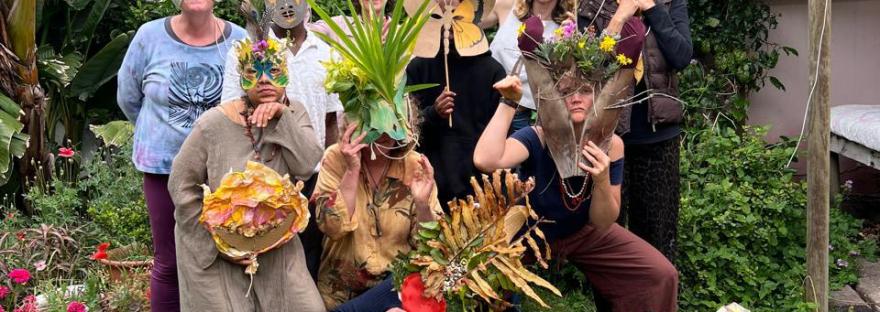
Last month, Angela MacPherson opened her studios and invited a diverse group of activists from the Cape Town area, many of whom were offered sponsorship, to participate in a Council of all Beings. This was an idea that had originated from a conversation between Angela and Erin Cowie, and I had the honour to be able to co-facilitate with them. After many enlightening conversations, the juicy emergent type that happen when working in collaboration, we designed a format that meandered on a local walk through three different venues.

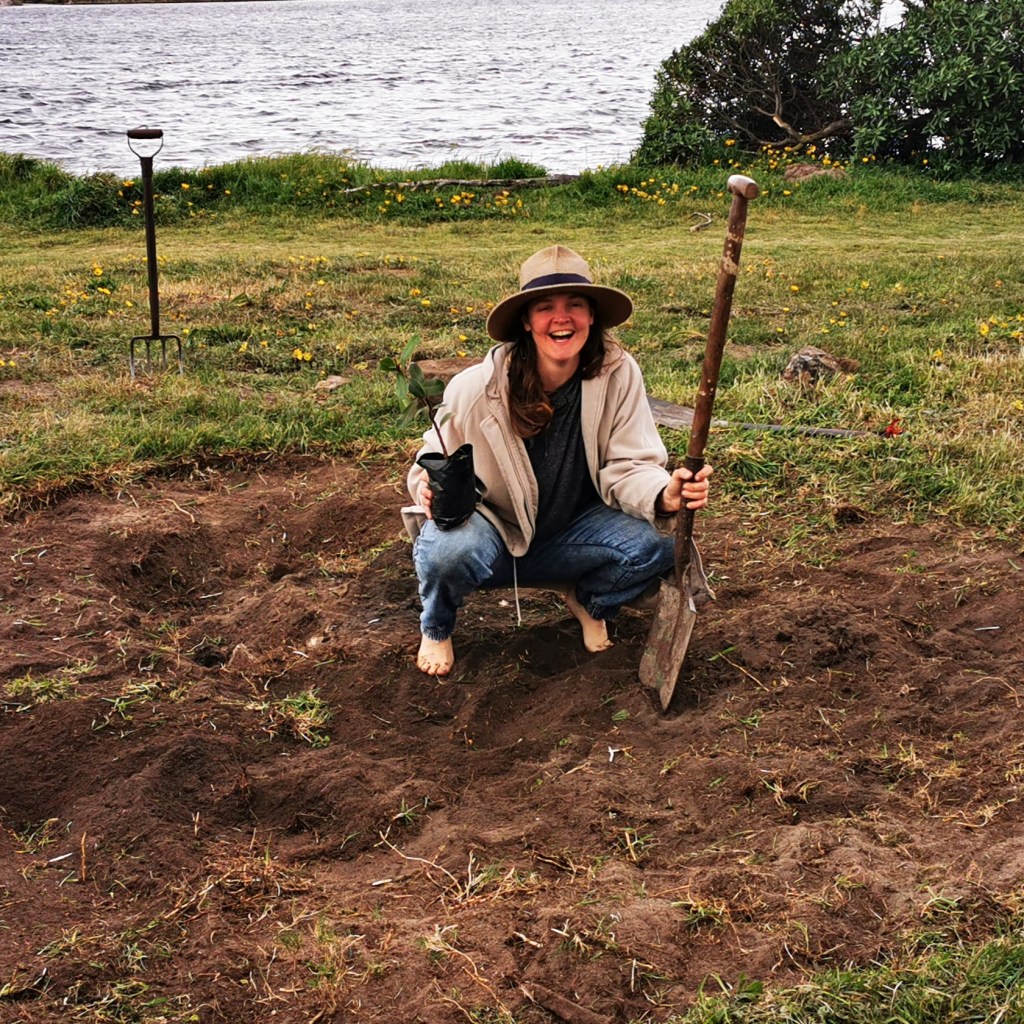
First, the Muizenberg Park, which volunteers planted and tended around us, we practiced some connection with each other and with the land, supported by Brown’s words and song. This is where we were chosen by another life form, in the still (unusually so!) springtime weather that invites so much birdsong and insect life, following the process developed by Joanna Macy and John Seed.
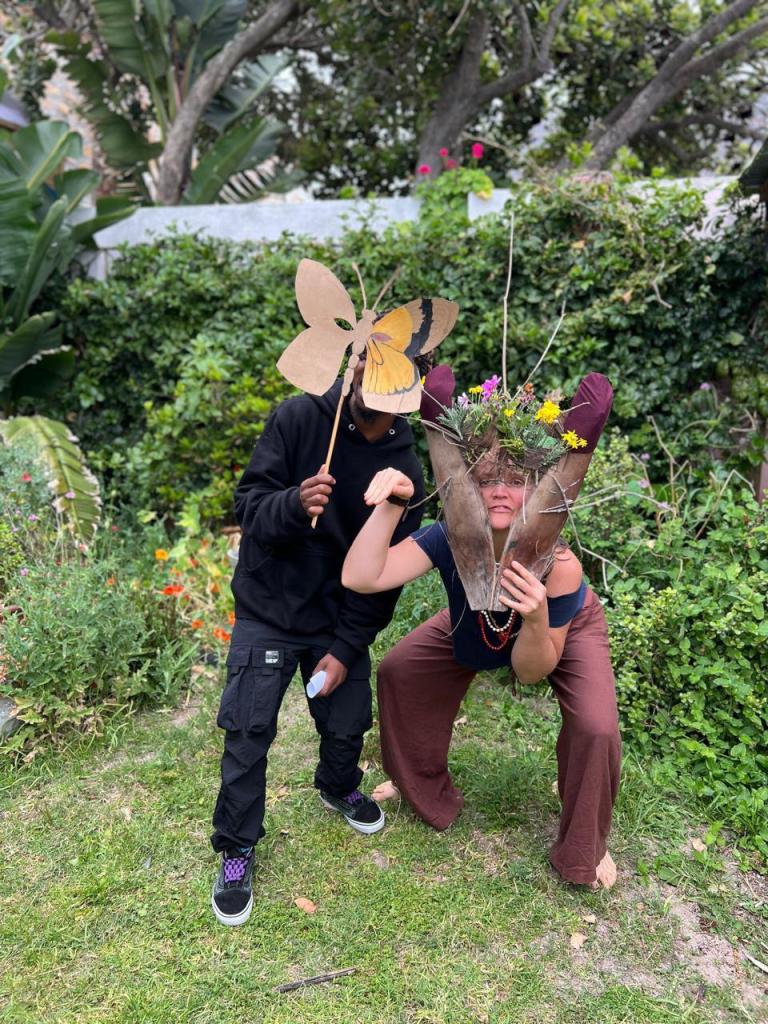
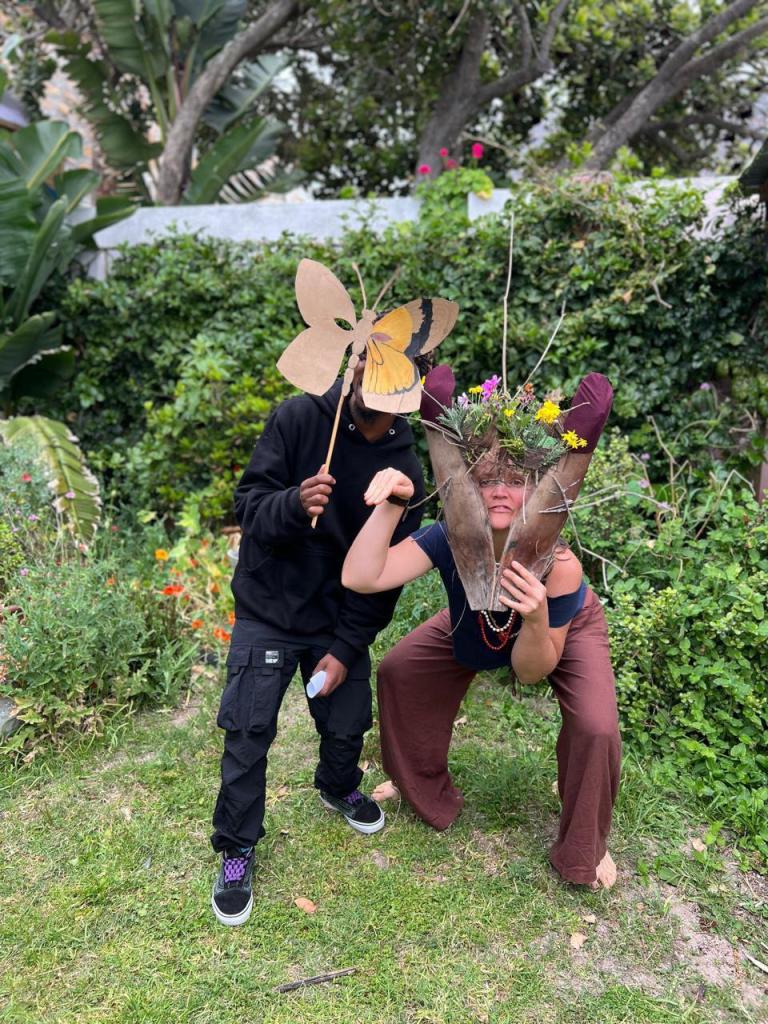
Then we visited the MacFabulous studio where Angela offered her space to create and play with many materials, producing a mask that we then carried to the third venue, the beautiful Samhitakasha cob house, where Erin led the Council itself, the more than humans spoke, and the beings listened.

A powerful day together indeed. Much healing to the land and the beings that we were chosen by. In gratitude.

Should you wish to hold a Council of All Brings on your land or with your community, please contact Joanna Tomkins

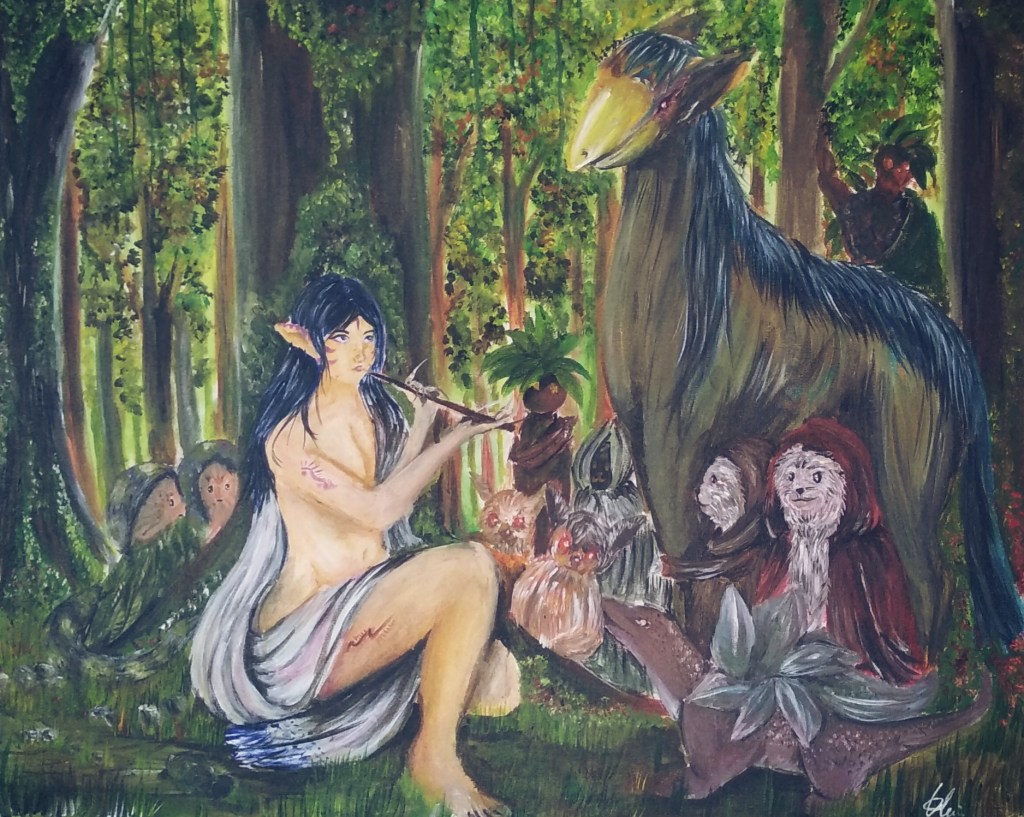
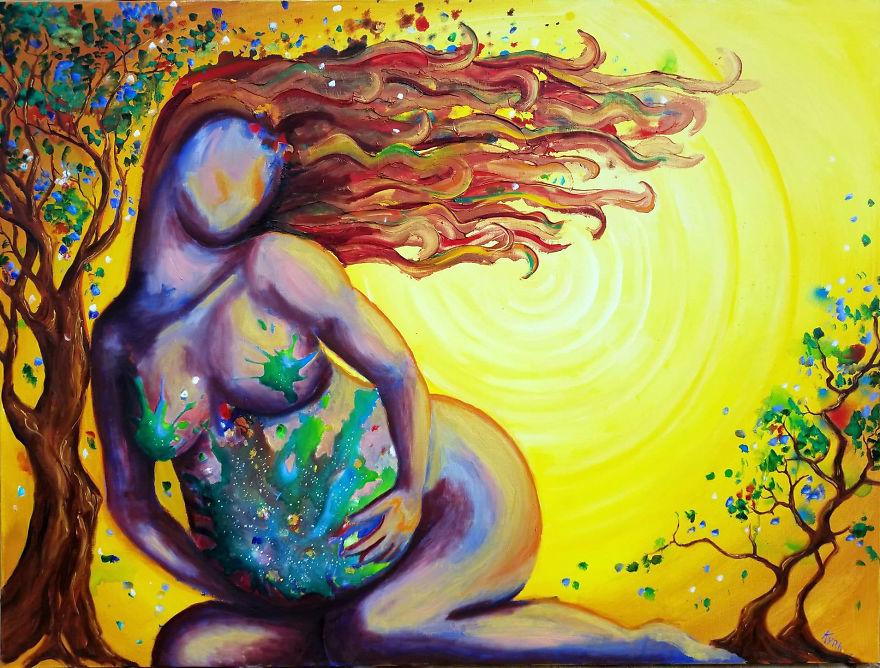
Artwork on this flyer by Angela McPherson

Uncategorized

Mentoring Work that Reconnects facilitators in South(ern) Africa

I extend my excited congratulations to the 3 members of the first “cohort’ that I have been mentoring over a period of 12 months. These facilitators work in different areas of the Great Turning, experienced in their own particular fields of work and they had in common that they had all experienced their a-ha! moment with the WTR.

I acted as an accountability partner and guided their self training. I also invited them to co-facilitate workshops with Gaia Speaking so that they could get the hands on experience that is required to register as a facilitator. The Work that Reconnects self training is “open source”: based on free and accessible resources and materials.

Erin Cowie, the Green Queen

What attracted you to the WTR when you first encountered it?

I first heard about The Work That Reconnects on a podcast where Joanna Macy was being interviewed. I was blown away by her grounded and calm words, her deep compassion and her wisdom. She said “everything is alive” and shared how our culture is extractive because we see the beings of the natural world mostly as dead or inert resources to plunder. She said that when you begin to see the world around you as alive, as a living, breathing web of interconnectedness, everything changes. This was a huge aha! moment for me. I had long been interested in finding ways to live in the world that are less extractive and more compassionate. For years I had been exploring permaculture, regenerative agriculture, yoga, slow living, thrifting, recycling, natural building and many other “alternative” modalities and perspectives. Hearing Joanna’s words felt like a homecoming. The Work gave me a language and a framework that validated and helped me to voice some really big feelings that I had been feeling about the world for a long time.

How will you use the WTR in the work that you do?

I have been bringing WTR rituals into my own unique offering, called Wild Immersion, which I run regularly in my local area. I would love to facilitate more Truth Mandalas as I have found these to be incredibly welcome and meaningful for my local community. It seems that the humans around me are thirsty for this kind of nourishment and I look forward to offering it as a way to bring healing and re-rooting my community of humans back into the Earth. I would love to bring some of the concepts and practices of WTR into my work with FynbosLIFE as a locally indigenous landscaper, to enliven my clients’ perspectives as we create wild gardens that support biodiversity. I am interested in learning more about anti-oppression in order to support the unfolding of a unique South African flavour of WTR. I am inspired to bring WTR into the corporate world and also to explore WTR through the body, using movement, dance & sensuality.

https://daughterofdirt.substack.com/ ; www.fynboslife.com


Diony Lalieu, a pledge for our Oceans

What attracted you to the Work that Reconnects when you first encountered it?

My first impression of the WTR with its deep spiral is how perfectly aligned it is with the work that I do in conservation. In the formative years of my NGO, I walked around with my eyes on the ground, constantly scanning the environment for plastic, until I finally reached a place of eco-despair. What I love about the Work that Reconnects is understanding that from the grief comes the potential to shift and that seeing the world with new eyes can lead to a more empowering vision in which we can create hope through our actions. I now walk with my chin up in the knowledge and peace that if I do my bit to rebuild a life sustaining society, it is enough.  

How will you use the WTR in the work that you do?

Ocean Pledge is about growing a network of youth ambassadors to be the spokespeople for the oceans. To nurture that powerful voice, it is crucial that we speak from the heart. Until recently, my students speak as if it is a school oral rather than coming from a place of passion. So, introducing the WTR enables us to really tap into the fear, uncertainties and emotions that the youth are holding, It creates a deeply honest space that builds trust and enables our youth to tap into their centres of power more effectively. There are so many opportunities to adapt this powerful work to our South African context and it has been stimulating and thought provoking to gauge how to do this best.

www.oceanpledge.org

Ocean Pledge logo

Simric Yarrow, bridging with playshops

What attracted you to the Work that Reconnects when you first encountered it?

I first encountered the principles of the Work That Reconnects on a workshop that included lots of embodied movement, and so from the first I was aware that it was a set of ideas that could be deeply applied, experienced and practised. Subsequently I attended many of Joanna and Rachel’s song circles which likewise bring the principles to life through artistic and ceremonial experience. I felt from the beginning that it was one of the most “real” processes I had been part of: facing our reality with honesty, but not stopping there. That’s the beauty of the spiral: it makes sure we don’t avoid the difficult feelings about the mess our world is in, while at the same time the continual movement through it builds heart-based resilience. This then support us in aligning with the Great Turning.

How will you use the WTR in the work that you do?

In the processes I run, I do intend to use the principles as a powerful guiding framework, while also encouraging participants to express themselves in ceremonies that include artistic modes – such as music, movement, poetry and theatre. I look forward to working with many kinds of group, including teenagers who are my main work focus at the moment. 

Uncategorized

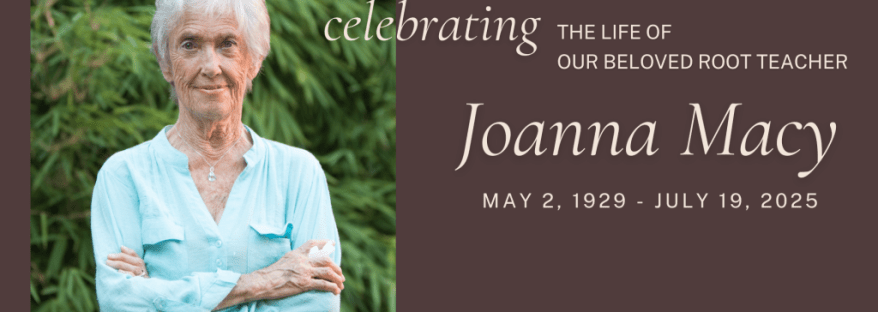
Joanna Macy – in Memoriam

As published on the international network http://www.workthatreconnects.org:

Joanna Rogers Macy leaves a legacy that will long continue to inform and energize both the work of healing the world from the frenzy of industrialized capitalism, and the complementary movements to come home to the true nature of our being. For, as she would say, we are embedded in the web of life.

From the late 1970’s, in her early mid-life on, Joanna devoted much of her energy to the development and dissemination of the body of work that became known as the Work That Reconnects. Working with colleagues throughout the world, and with the steady support of her husband Fran Macy, this work was enriched by her many related passions: the Sarvodaya movement for peace in Sri Lanka, whose efforts she and Fran ardently supported; the cultivation and connection with her teachers in the Tibetan Buddhist tradition, from which root concepts of the Work That Reconnects arose; and her work with nuclear guardianship, for she felt in her bones the call of the future beings to muster all of our wits for the protection of the web of life.

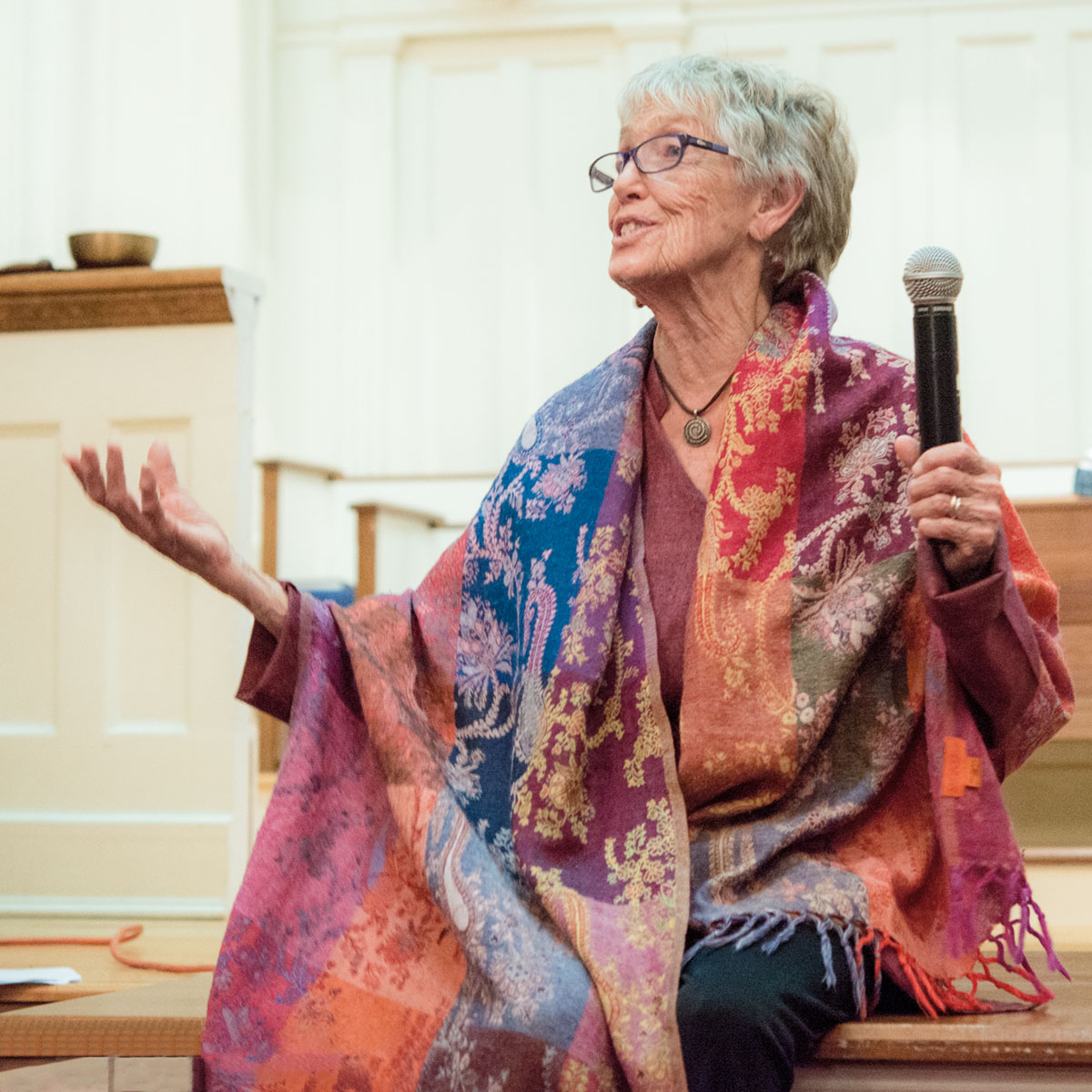
Joanna Macy teaching at Marlboro

Joanna Macy teaching at Marlboro, Image: Joan Beard

At the height of the “cold war” in the 1970s, after her own awakening to the dangers of nuclear power in particular, Joanna made a discovery: when a group of concerned people spoke to each other their fears, their terror, and even their despair, a spirit of connection arose in the group, and a clarity of focus and release of energy fueled strategic planning and action. Others were making this same discovery (psychologist Chellis Glendinning in particular was an early collaborator). The resulting “despair work,” with its “despair and empowerment workshops,” countervailed the numbing of terror and overwhelm, and the forces of the military/industrial growth culture which would have us live out our lives entirely within its story of fear and domination.

Joanna was a great storyteller. She had us in the palm of her hand, and we knew ourselves as our larger selves when she told of the Shambhala Warriors (surely we were meant to be warriors too; indeed, surely we had been secret warriors all along, preparing for our turns in the halls of power).

She was also a great collaborator – the Elm Dance, the Truth Mandala, the Council of All Beings all grew out of deeply collaborative relationships.

Joanna had a special connection with young people, whose passion, creativity and freedom of expression fueled her own inspiration and stamina.

Joanna loved to have a good time. Playfulness and its twin, imagination, infuse the Work That Reconnects. She poured her passion into the work, and as a result her many collaborator-friends formed among themselves a vibrant network of love.

She leaves us a toolkit – the Spiral of the Work That Reconnects and the fundamental framing and practices and stories that make the body of work what it is. The practices and stories keep evolving and changing, responding to one moment and helping to create the next in this work of the Great Turning.

For the many thousands of us who carry on and continue to develop the Work That Reconnects – this gift of the shared journey from despair to connection, empowerment, and action – Joanna Macy leaves us her particular inspiration of a robust fearlessness, and perseverance fueled by love.

Uncategorized

The Earth Charter

Get to know this essential publication, in times where we seem to be sliding further away from some of these basic principles, instead of finding the solutions of alignment within ourselves and our communities. – Gaia Speaking

Preamble by Earthcharter.org

We stand at a critical moment in Earth’s history, a time when humanity must choose its future. As the world becomes increasingly interdependent and fragile, the future at once holds great peril and great promise. To move forward we must recognize that in the midst of a magnificent diversity of cultures and life forms we are one human family and one Earth community with a common destiny. We must join together to bring forth a sustainable global society founded on respect for nature, universal human rights, economic justice, and a culture of peace. Towards this end, it is imperative that we, the peoples of Earth, declare our responsibility to one another, to the greater community of life, and to future generations.

Earth, Our Home

Humanity is part of a vast evolving universe. Earth, our home, is alive with a unique community of life. The forces of nature make existence a demanding and uncertain adventure, but Earth has provided the conditions essential to life’s evolution. The resilience of the community of life and the well-being of humanity depend upon preserving a healthy biosphere with all its ecological systems, a rich variety of plants and animals, fertile soils, pure waters, and clean air. The global environment with its finite resources is a common concern of all peoples. The protection of Earth’s vitality, diversity, and beauty is a sacred trust.

The Global Situation

The dominant patterns of production and consumption are causing environmental devastation, the depletion of resources, and a massive extinction of species. Communities are being undermined. The benefits of development are not shared equitably and the gap between rich and poor is widening. Injustice, poverty, ignorance, and violent conflict are widespread and the cause of great suffering. An unprecedented rise in human population has overburdened ecological and social systems. The foundations of global security are threatened. These trends are perilous—but not inevitable.

The Challenges Ahead

The choice is ours: form a global partnership to care for Earth and one another or risk the destruction of ourselves and the diversity of life. Fundamental changes are needed in our values, institutions, and ways of living. We must realize that when basic needs have been met, human development is primarily about being more, not having more. We have the knowledge and technology to provide for all and to reduce our impacts on the environment. The emergence of a global civil society is creating new opportunities to build a democratic and humane world. Our environmental, economic, political, social, and spiritual challenges are interconnected, and together we can forge inclusive solutions.

Universal Responsibility

To realize these aspirations, we must decide to live with a sense of universal responsibility, identifying ourselves with the whole Earth community as well as our local communities. We are at once citizens of different nations and of one world in which the local and global are linked. Everyone shares responsibility for the present and future well-being of the human family and the larger living world. The spirit of human solidarity and kinship with all life is strengthened when we live with reverence for the mystery of being, gratitude for the gift of life, and humility regarding the human place in nature.

We urgently need a shared vision of basic values to provide an ethical foundation for the emerging world community. Therefore, together in hope we affirm the following interdependent principles for a sustainable way of life as a common standard by which the conduct of all individuals, organizations, businesses, governments, and transnational institutions is to be guided and assessed.

Click below to continue reading the Earth Charter Four Pillars, each with 4 chapters, equalling 16 principles in total.

1: Respect and Care for the Community of Life.

2: Ecological Integrity

3: Social and Economic Justice

4: Democracy, Non Violence and Peace

These links will take you to the website Earthcharter.org, where you will also find more readings.

With thanks

Uncategorized

Cape Town: “Place Names of Pre-colonial Origin and their Use Today”

By Bradley van Sitters, originally posted on the Universty of Cape Town Humanities Archive website, on August 2, 2012


Changing the names of places is nothing new. But what has become interesting is how some place names still reveal aboriginal origins in spite of colonial onslaughts. Examples include, México, named after the Mexica, and Quebec from Mã­kmaq (képk) meaning “strait, narrows”. Many places in Australian have officially been named after Aboriginal people or language groups, such as Aranda or Tullamarine.

It is possible to revert to old names in places where oral history has been kept of the knowledge of the pre-colonial names. Oral history is not myths, chitchat, idle talk, or fairy tales, but rather the orderly collection of living people’s testimony about their own experiences. Khoi-San names of places are amongst the oldest in the country and even the world. Archaeological findings indicate that modern humans have inhabited Southern Africa for at least 170,000 years; with the Khoi-San’s history spanning as far back as the Later Stone Age, from about 40,000 years ago. They are thought to be the earliest-diverging human group showing the largest genetic diversity in matrilineally transmitted mtDNA of all human populations, and represent a group that has preserved the original human lifestyle along with genetics.

Mounting evidence suggests that early human communities lived in sight of Table Mountain. The study of names these communities gave to places thus constitutes an important contribution to the cultural and linguistic history of the entire population of the country. Giving names to places is an activity exclusive to humans and as such name-giving is part of the history of the human race spanning over millennia. Having command of language allowed humans to give names; and place names are, therefore, obviously in terms of time and space also related to the particular people from whose language they derive.

By means of word of mouth, oral history was the first kind of recording the past. Names of places are an important aspect of oral history as they become carriers of the past, allowing us a glimpse into occurrences in the past that history books often may have failed to mention. Over time the tip of Africa was well visited with devastating effects on the Khoi-San who were often displaced, conquered, absorbed and assimilated at the hands of migrating Africans on foot from the north around 300 AD and, later, Europeans arriving by sea.

Places have layer upon layer of history which often are capsulated in the names given to them over time. The case of Cape Town makes for an interesting study, as the memory of the Khoikhoi name //Hui !Gaeb had been forgotten in the place itself.

The many names of Cape Town warrant mentioning. On account of tremendous storms encountered on the high seas, Bartolomeu Dias, in 1487, called it, Cabo Tormentosa (Cape of Storms). In the hope of finding a sea route to India, King John II of Portugal in 1488, named it, Cabo de Boa Esperanza (Cape of Good Hope), a name that remained until 1686 when it was called Cabo de Goede Hoop by the Dutch. Antonio de Saldanha in 1503 was the first European to climb Huri àoaxa (Hoerikwagga) and for this feat he named it Taboa do Cabo (Table Mountain) and even had the bay called Aguada de Antonio de Saldanha (Watering place of Antonio de Saldanha). Dutch Captain Joris van Spilbergen in 1601 changed the name of Saldanha Bay to Table Bay. The first colonists were also known as Cabo or De Caab, an identity that seemingly started to develop around the new found colony. As the settlement took shape it developed into the establishment of a town around its harbour and by 1700 was named Kaap Stad. The earliest known English name in the country is ‘Chapman’s Chance’ later known as Chapman’s Peak and with the English take-overs in 1795 and again in 1806, Cape Town got its name, which still stands today.

Having evolved over thousands of years, indigenous names of places derived from aboriginal languages, and the cultures which they transmit. As arbitrary verbal symbols, by which a group converses, interrelates and self-articulates, languages preserve the mysteries, customs, and traditions of the people. It’s more than just preserving things of yesteryear; it involves maintaining bodies of knowledge, and beliefs.

Place names are never just meaningless sounds. Rather, they embody stories about the places to which they are attached. They give us valuable insights into history and provide clues about South Africa’s cultural and social development. In a manner of speaking, place names are the table of contents of the country’s history of customs and traditions often long forgotten. Accounts of Khoi-San place names that have been replaced by other names are numerous. Some of these names were only known to the early travellers while others existed alongside new names until they eventually became forgotten.

Today, the historical view of the Khoikhoi and Bushman as the Cape aboriginal inhabitants has always been through ‘European’ eyes. Oral tradition is lacking especially in the Western Cape. No qualified linguist was able to study the languages of the people at the Cape before these languages disappeared. But some early travellers and settlers did collect word lists. The Cape Khoikhoi spoke a dialect of Khoekhoegowab (Khoikhoi-language) akin to Nama, Griqua and !Korana, the dialects spoken on the west coast and along the Orange River, a language also spoken today by Khoe-speaking Bushman of South Africa, Botswana and Namibia.

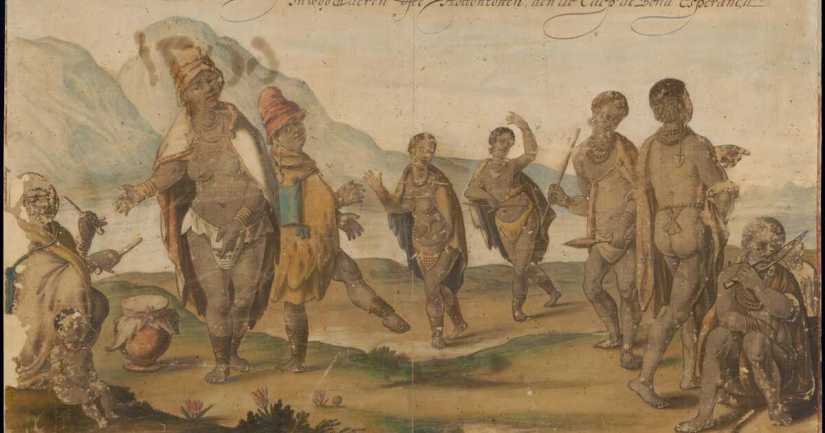
With a few exceptions, it took Europeans almost 400 hundred years, from Bartolomeu Dias up until 1870-1880, to show special interest in Khoi-San languages, with the /Xam and !Khun interviews and narratives by Lucy Lloyd and Wilhelm Bleek. Vasco da Gama penned this disinterest in 1497 by commenting, “small in stature, ugly of face, and when they speak it seems as if they hiccup.” Cornelis de Houtman in 1595 further illustrated this linguistic disinterest by writing, “I could learn no more from them but that they speak very clumsily” Edward Terry in 1616 implied animal (bird)-like sounds, saying, “… their speech it seemed to us inarticulate noise, rather than language, like the clucking of hens, or the gabbling of turkeys…”

The Khoi-San gave names to places throughout the country to identify the land they knew and with which they had a strong spiritual connection. Many of these names still survive today; to mention a few, !Huni //hāb for Johannesburg, //Khara hais for Upington, Gádaos for Goodhouse, Kai mãs for Keimoes… The place names themselves, at times, have been taken over in more or less adapted form into the languages of the other people of the country as current linguistic items. Although the use of Khoi-San place names were substantially eroded by contact with Europeans, some traditional beliefs have been preserved through oral histories, and even some religious practices are still observed in remote areas of Botswana and Namibia.

It is with this particular interest that I followed the spoor of the earliest Khoikhoi migration routes away from the European occupation, leading me to the trek across the !Gariep (Orange river) to Khaxutsus (Gibeon), in Great Namaqualand, during 2008 at the 103rd Heroes Day Festival, also the 30th year of reign of the 8th /Khowese Nama King, Gaob //Gawamãma /ÃnÍb, Dr. Rev. Captain Hendrik Witbooi. Oral history, shared by Senior Chief P.S.M. Kooper of the Kai //Khaun of the Great Red Nation from !Hoaxa !nÃs, indicated that historic information passed down. The information suggested they left what we know today as Cape Town 17 generations ago when it was still called by its pre-colonial name, //Hui !Gaeb or //Hui !Gais in search for their own autonomous rule away from the Cape Colony. I later discovered a number of writings referring to this name as the pre-colonial name of the Cape.

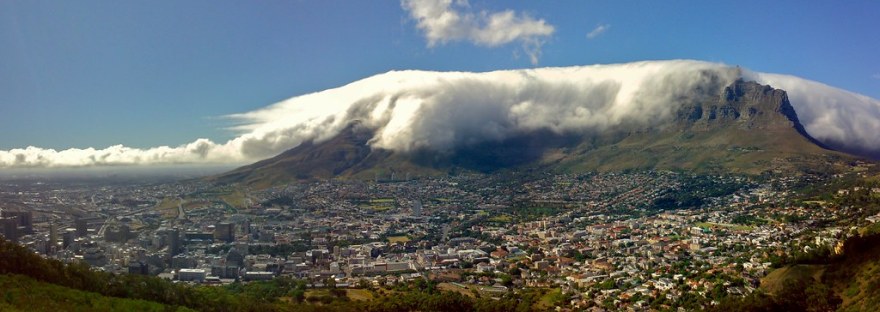
Hottentot (Khoekhoen) Place Names by G.S. Nienaber and P.E. Raper, specify that the first person to record it as the name of Cape Town was the apostle of the Namas, Father J.H. Schmelen (1831), who married a Nama women. Later Dr. Theophilus Hahn stated in Tsuni //Goam (1881), “wherever the Khoikhoi tongue is spoken, //Hu !Gais is the name by which Cape Town is known” (p.34). This name consists of two words, //hãs which is an old word used for cloud and !gai meaning to bind, to surround, to tie, to envelop; consequently denoting “veiled in clouds”. P.J. Nienaber in Dictionary of South African Place Names, highlights the use of //Hui !Geis, which didn’t entirely disappear out of existence, but was still in use by the Nama speakers in Namaqualand, as the Khoikhoi name for Cape Town.

Although Dutch settlers gave their own names to places, they also took note of the indigenous names of prominent geographical features such as mountains and rivers, which are the oldest names in South Africa. Such names include Bikamma (Melk River), Gantouw (Elandspad/ Sir Lowry’s Pass), Breé River (Synna), NyaraKeiskamma, and Tsitsikamma.

Preserving and even reviving Southern African indigenous names of places is of importance to all Southern African people, whether they are themselves of indigenous origin or not, and to mankind as a whole. For times immemorial, these names, that described the natural features of the land or commemorated significant historical events, were passed from one generation to the next. Aboriginal place names contribute to South Africa’s rich tapestry of cultural landscaping. These names reflect the diverse history and heritage of the nation and many of our earliest place names draw on Khoi-San origins. Only over the last few hundred years did pre-colonial place names go out of use as conquered places became re-named to mark occupation. Retrieving oral memories is thus a task more pressing than ever, especially in this country still wounded by a legacy of discrimination because of race.

Biblioteca Medicea Laurenziana, historic library in Florence

Bradley is a world renowned indigenous southern African languages activist and community languages researcher. He is chair of the A/Xarra Languages Commission. Find out more here https://ibali.uct.ac.za/s/dialogical-archive/item/29356


Uncategorized

Story as Medicine

by Nicola Lazenby, 25th March 2024

Everything about human life relies on story.

Our memories are stories about our past. Our dreams are stories we tell about our future. Our personalities are stories we tell about ourselves. There is no culture, nation, or religion without story. It’s one possible reason we have become the so-called dominant species on earth because it gave us the ability to cooperate in such large numbers.

It’s also true that children who read fiction show higher levels of empathy, bringing to life the quote from George R. R. Martin, “A reader lives a thousand lives before he dies… The man who never reads lives only one.”

One of the meanings of the word “story” is “storehouse”, a place where all our wisdom and knowing is stored, says mythologist and storyteller, Michael Meade. He explains that story is the place we always came when we had nowhere else to go.

Stories are at the heart of how we understand ourselves, our universe, and our place in it. As an English teacher in a previous life, I taught my students that learning how to wield story could change the course of their own narratives, protect them from the disempowering stories of others, and even change the world. Story shapes the possible options for how we might respond to our lives.

Is my life coming apart, or am I on a necessary journey down into the dark cave where I must face a shadowy thing with a more authentic treasure for me? Is the world ending, or has a thread from the great rug of the universe been pulled by a mischievous dog, leaving us with a tangle of yarn and a chance to re-weave the most beautiful tapestry yet?

Stories offer us a roadmap back to ourselves, especially in dark or confusing times. As narrative creatures, we yearn to find a meaningful story to which we can connect.

Meade puts it in his book, “Our job is not to comprehend or control everything, but to learn which story we are in and which of the many things calling out in the world is calling to us. Our job is to be fully alive in the life we have, to pick up the invisible thread of our own story and follow where it leads. Our job is to find the thread of our own dream and live it all the way to the end.”

Artwork by Yoshiyuki Hitoshi

So much of my work sitting across from the people in my counselling room is helping them tell their story. Sometimes, they have never had anyone to listen to it, and it is a secret they have carried like a bleeding key around their necks. Sometimes, they have been told the wrong stories about themselves all their life, and are trying to find their way to that small cottage in the deep forest of their past, where a burning skull is about to light their way back home. Sometimes they are learning to let one story end, to wail and grieve, so that a silence can descend, into which a new story may someday speak.

In this way, a story is more than entertainment or distraction. It is the means of very real transformation.

This is why ancient myths were always attached to sacred rites and rituals, says Karen Armstrong, a former Catholic nun turned academic and author. The rituals would have separated us from mundane life, opened up a numinous space where the myth, facilitated by skilled priests and sacred players, could act upon us. Act as a means of communicating directly with the meaning of the universe, to what is timeless in human existence, and for that moment, “deeply touch us and lift us momentarily beyond ourselves… even in the face of death and despair”, and fundamentally alter us. She says that trying to read a myth or folktale without the accompanying ritual is like trying to learn how to drive a car by reading the driving manual.

Along with many others, I think, I still experience this when I go into a cinema or theatre, and watch a beautiful production. The remnants of ritual are still there in the dark cavernous room, in the collective witnessing, in the separation from the day-to-day. I feel changed when I emerge into the strange light of “real life” again, even if just for a moment. I feel it in the throngs of a crowd at a concert swept up in wordless musical narrative, or when I have sat like a secluded monk for days or weeks with a book and it does its work on me in ways I can only sense when I close it.

Perhaps our worship of actors and writers and musicians is an echo of the power of the story they wield on our behalf.

Perhaps that explains some of our modern addiction to the streaming and social media platforms where we can binge watch the story that is so integral to our species, where we can incessantly post our own stories as we yearn for connection to some kind of larger mythic meaning.

The pervasive modern human story lacks interest and meaning. It encourages materialism, excess, cruelty, consumerism, isolation, colonialism, anthropocentrism, and is destroying our home. It is so understandable that we should be so addicted, so unwell, so lonely and anxious and full of conflict if we do not have a meaningful story that we can feel personally connected to.

We need a new story.

And like many of the mythopoetic thinkers, I believe that the old stories might offer us clues as to the way forward (or is it back?) not just in our own individual lives, but as a collective. Story is one of our oldest medicines.

What is the story you are in? Have you heard the call to personal adventure, that rattles in your car on your way to work, or causes the burnout that lays you low with chronic pain, or ends the relationship you never thought you would lose? Have you already crossed the threshold into the in-between, where you are being tested by your demons while you try to start a new way? Who are the unexpected helpers that solve the riddle, or know the secret door, and who is the one who comes to you as a wise mentor? Are you in the underworld of suicide, inconceivable loss, false selves or secrets, fighting for the life you cannot yet name, that is yet to be born? What is the treasure hidden deep within you, that the dragon slumbers on, that you will return with as a gift for your community and the world when this is all over?

May you see in the wild the wild in you.


Nicola Lazenby is a registered counsellor and eco-therapist. See Nicola Lazenby’s website to read more about her gifts to the Great Turning, including wilderness immersions, writing workshops, ritual and ceremony…

https://www.wildheartscounselling.org/

Uncategorized

SA could become the renewable energy powerhouse of Africa

By Judy Scott-Goldman, originally published on 21 April 2025 for Daily Maverick

Dr Judy Scott-Goldman is a spokesperson for Extinction Rebellion Cape Town.

How feasible is it to meet a country’s energy needs from renewable energy? Uruguay recently ran on 100% renewable power for 10 straight months and has become a net exporter of electricity.

My husband tells the tale of his great-grandfather, who lost an extraordinary opportunity because he couldn’t see what was coming down the road. He was a wagon maker in Johannesburg. The story goes that one day he was approached by Ford and offered the Ford Agency in South Africa. He refused. Why? Because he didn’t see a future in the motor car.

This inability to catch the zeitgeist and seize the opportunity seems to be plaguing South Africa. Some of our politicians are enthusiastic about 20th-century fuels such as coal, oil and gas, but show no excitement about the power and potential of fast-developing solar, wind and storage technologies.

Why are some in our government rubbing their hands with glee at the prospect of digging up oil and gas wherever they can find it, while having a yawn-yawn reaction to the miracle that is renewable energy?

Tuesday, 22 April, is Earth Day 2025. This year’s theme, “Our power, our planet”, encourages everyone around the globe to unite behind renewable energy, with a call to triple global electricity generation from renewable energy by 2030. There are many forms of renewable energy, but South Africa’s strengths are in solar and wind power, both of which have extraordinary positives.

First up, solar and wind energy are cheap and getting cheaper all the time. The CSIR showed back in 2014 that in South Africa, the cost of new solar PV and wind is 40% cheaper than new baseload coal.

The Presidential Climate Commission (PCC) has also stated, based on extensive modelling, that renewable energy, supported by storage solutions, is the cheapest form of electricity generation in South Africa.

Renewable energy is getting cheaper because experience and innovation is happening all the time all over the world and “the more one does it, the cheaper it gets” to quote Tobias Bischof-Niemz, of the CSIR .

It is cheaper because of something so obvious but so game-changing that we struggle to get our minds round it. The fact is that once you have forked out the money to get your solar or wind plant up and running, you don’t have to buy any fuel to feed it.

Think about it. If you build a power plant that produces electricity from coal, which is our major fuel for producing electricity in South Africa, every single day someone has to feed coal to the plant. This means that someone somewhere has to dig up the coal, which is a hard, dangerous, lung-damaging job, and the mining process leaves ugly coal ash dumps and water-polluting acid mine drainage.

The coal then has to be cleaned, stored and transported to the power plant, often in heavy, road-damaging trucks. Then it is crushed before it is burned to fuel huge turbines.

But no one has to dig up, clean, refine, crush or transport the wind or the sun to keep a wind or solar farm running – it just arrives by itself. It costs nothing. You can’t be side-swiped by a sudden increase in the price of your feedstock fuel, you can’t run out of stock, no one can steal it and no one can manipulate the price of it either.

Another extraordinary fact that we have not really taken on board is that renewable energy is a flow, not a stock, so it does not deplete.

If you dig a well to source oil or gas, the stock of oil or gas will be limited and gets harder to access over time. Sun and wind are not a depleting stock. A small town that grows up around a solar farm does not have to fear the day in the future when its energy source will be depleted.

No combustion is taking place at a solar or wind farm either, so no one is breathing in pollutants that cause respiratory diseases, shorten lives and create health costs.

And small renewable energy projects are great for providing energy solutions to rural areas where no one wants to pay to extend traditional grid infrastructure as the number of users is too small to cover the cost.

But the downside is that the sun doesn’t always shine and the wind doesn’t always blow. This is the intermittency problem which people have worried about for so long.

The good news is that huge strides are being taken to overcome this challenge. For instance, batteries store excess energy during peak production and release it during low generation periods, and batteries are getting cheaper and better.

Alongside the well-known lithium-ion batteries, mechanical forms of storage are being developed – gravity storage, for example. When there is excess renewable energy, it is used to drive a winch which lifts a weight. When the energy supply is too low to meet demand, the weight is released, releasing its stored energy. Research is happening in repurposing mine shafts for gravity batteries because the shafts can have drops of more than a kilometre.

Another answer to the intermittency problem is to site a solar farm and a wind farm close together so that the production of each can complement the other and they can share the same grid connection infrastructure. This is called co-location.

Also, countries, or distant areas within a country, are starting to connect cables to each other so that they can send energy back and forth to each other to balance supply and demand in their respective locations. There really is lots of exciting innovation and problem-solving going on.

So how feasible is it to meet a country’s energy needs from renewable energy? Uruguay recently ran on 100% renewable power for 10 straight months. Power production costs have declined, new jobs have been created and Uruguay has become a net exporter of electricity.

At least 10 countries are on track to get more than two-thirds of their electricity from wind and solar by 2030, and 19 could have more than half their electricity produced from the two technologies by 2030. Chile is aiming for 80–90% renewable electricity by 2030 and will have phased out coal by 2030.

South Africa could easily follow suit because it has tremendous untapped solar and wind potential spread over many provinces. It could become a renewable energy powerhouse of Africa.  

Why is it essential that we seize this renewable energy potential, phase out coal and don’t go down the oil and gas route? Some politicians would argue for a diversity of energy sources.

It is hard to see why we would choose more expensive options but the really urgent and pressing argument is this: we have to generate huge amounts of energy to power our modern world but it has become essential that we do so with a lighter footprint on the Earth.

The human and non-human world lives or dies by our ability to function within the physical, chemical and biological systems of planet Earth. Scientists (and Earth itself) are shouting loudly at us that we are overshooting Earth’s planetary boundaries and all our metrics show that Earth and its creatures are steadily declining in health and resilience.

Using coal, oil and gas for energy is far more polluting and environmentally destructive than using renewable energy. A rapid transition from fossil fuels to renewable energy is vital to arresting this decline in planetary health.

My husband’s ancestor thought that the future was business as usual. Stuck in old ways, he failed to seize the opportunity. Let’s not make the same mistake. 

Dear Judy, thank you for sharing this article with us! We appreciate the work that you do.

Uncategorized

Welcome

Delivered during a Transition Town workshop and adapted by WTR facilitator Silvia di Blasio

We are so honored to welcome you and all you bring to this healing circle. 

We welcome your excitement and your trepidation. We welcome your open hearts and skepticism. You are welcome here. 

Your culture is welcome. Your ethnic origin is welcome. Your race, your skin hue, accent, food preferences, and all of the complexities that make up your cultural identity are welcome here. 

The histories, herstories, and experiences of your ancestors are honored and welcomed. 

We welcome you with all of the connections you bring with you to the children in your lives, your partners, siblings, parents, the animals in your lives, your ancestors and spiritual allies and other loved ones. All your connections are welcome here. 

We welcome your spiritual practice, your religious affiliation, your spiritual walk. However you hold that aspect of your life is welcomed. 

Your love is welcome here. How you love, who you love, and your understanding of what love is, are all welcome. We welcome you in all of the ways your sexuality and gender are unfolding. 

We welcome you in your ignorance. We welcome you in your privilege. We welcome you in your grief. We welcome you in your guilt and shame.  You are welcome if you have been harmed by racism and white privilege or have caused harm to others because of your social conditioning. 

Your quirks and ambiguities are welcome. We welcome your humor and we welcome your silent contemplation. We welcome the parts of yourself that you’re still figuring out. We welcome you in your roles as activists, healers, feelers, intuitives, parents, caretakers, students, artists, witches, diviners, change agents, magicians, educators, and warriors. 

We welcome you at whatever level of mental and physical wellness you are currently functioning. We welcome your introversion and your extroversion. We welcome all of the experiences that led you to this moment. We welcome your wounds and scars. Your emotions, ALL of them, are welcome as well. 

Thank you for bringing your ancestors with you; we welcome them also. Ancestors, please be with us, collaborating with us to anchor the healing and what is most needed in these times. We welcome your sacred connections to the lands on which you were conceived, the lands that hosted your births, and the lands of your ancestors. The lands that you are currently standing upon and all the life that came before you – the animals, the indigenous peoples of the land you stand upon. we now collectively prepare the soil on each of our own lands through our intentions and sow the seeds of our visions for all beings. 

Let your roots sink into this nutrient dense soil, intertwining with the roots of everyone else here, and connecting to the root systems of all of the other living things around here as we collectively build our power to create a healing circle across continents. 

Settle in. 

Welcome.

Uncategorized

Directing our Creative Story

Art connects us to the Sacred. Sacred like a deep conscious in-breath. Like the lull between words or pauses to dig our hands in the soil. It slows us down—down to the core of the heartbeat, sparing time to see the sensuous colours of autumn leaves, to take in the patience of trees… And it also depicts the nuances of our story better than most classic dialectic born of the human brain!

Yet, whilst I invent ceramic sculptures in my studio, I often wonder about the relevance of plastic arts in the midst of this helpless, dramatic anthropocene of ours. Why use more materials and energy to produce and sell more objects? Am I not just adding weight to our fierce and fast capitalistic economy and depleting more resources?

I also ponder on the harmful twists given over time to the gift of human creativity. After all it’s got us here now, and can’t seem to get us out, can it?

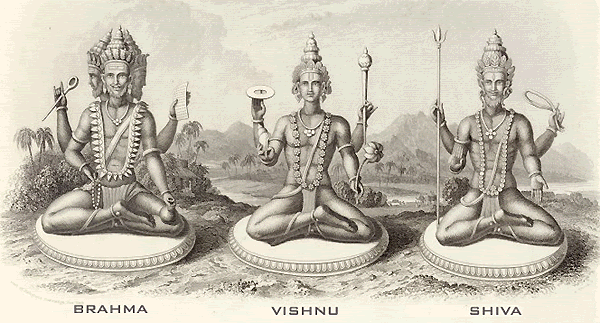
Named “Trimurti”, the Hindu holy trinity of Brahma, Vishnu and Shiva represents creation, preservation and destruction and is said to govern the world inexorably, consequently and simultaneously. In human embodied form though, our souls have misused the power of consciousness-fuelled creativity? Unlike other-than-humans who abidingly follow the rules of Mother Nature, we have transgressed the tacit contract of our role of guardians of the Sacred. We invented narcissistic and rebellious materialistic gods that separated us from Her and gradually entitled us to trade in our creativity for pernicious personal profit and to aggrandise a handful of two-legged, five-fingered beings. Free-willed creativity is what makes our species unique, and it also endows us with the responsibility to respond to the needs of wider Earth communities. Creativity helped us to design all the machines that our Business as Usual relies on now, drilling holes in the body of the Earth and sucking Her blood, and lately also enclosing us in isolated internet-driven, cement-walled physical and psychological traps or time capsules. Gaia’s Life is pending on a thread! And so what? I’m on to the next creation of mine…

The wisest pagan songs sing ” Hoof and Horn, All that dies shall be reborn. Corn and Grain, All that falls shall rise again…” Yet we cannot claim to slot in to the natural cycles of creation harmoniously or purposefully if we do not create mindfully. We cannot be excused by natural cycles of death and rebirth, if we do not take seriously the production in our lives.

And to make the control of our weaponised creativity even more complex now “As machines become more proficient at generating art, music, literature and solutions, we must reflect on the unique role of human intuition and experience in the creative process and explore the delicate balance between the advancements of AI and the irreplaceable nature of human creativity.” (Joseph Fowler, Head, Arts and Culture, World Economic). Well, there goes another strained train of though; we might want to park that one for now.

Back to the questioning of plastic art, and also applicable to poetry, fictional prose, performance, and even “creative solutions”, one answer may be that you cannot produce beauty with a more-is-better mentality. It just doesn’t hit the mystic spot. A tree cannot plan the majestic beauty of its outcome. It happens through it, connected to all the other beings that make up the forest and the knowledge that time does not belong to it. And when you buy a piece of art because it speaks to you – and not as a financial investment – you don’t follow the parameters of reason, you just fall in love and decide to surround yourself with something that has meaning for you. This something reminds you of a connection that is bigger than you. It may be a spiritual reminder, a piece of intimately familiar story-telling, a mirroring of your vision of nature, or a bonding to simple lines or angles, connecting to the strings that pull your own heart.

Creating something for the sake of beauty is a kind of meditation. In movement, in feminine flow with a masculine holding in the form. It’s the kind of meditation where you lose track of time and suddenly remember who you are. Where you feel the eternal essence of the materials under your fingertips, your grandmother humming in the background as you shape a line, or a bowl, or a prayer. There is no need to control your thoughts, She controls your thoughts in her becoming.

And then, sometimes, something extra happens. There’s this magic moment when the liminal sparks. A doorway opens, and suddenly you’re not just a person making something—you’re in deep conversation with Life itself. The boundaries blur. You feel yourself woven into a much wider web of interbeing. You are not separate. You are a thread in the great tapestry—co-creating, remembering, belonging. You’re not just on time; you’re in deep time. Held by all that came before, and all still to come.

Art is how we listen to what’s older than human language to praise our Mother. When our eros is aroused by the desire to birth beauty we have tools to give back to Gaia what we she gave us when she made us creative souls. In this reciprocal artistic exchange we take note and are inspired by the extraordinary images she displays in front of our retinas, and the miraculous, erotic, infinite experiences of Life unfolding that she gifts us.

“In a relationship, the narcissist asks, “How can I mine this relationship for my own benefit?” The lover asks, “How can I use my gifts to contribute to us.” Exploitative technology asks, “How can we extract as much as possible from the land, for our own ends?” Ecosexual technology asks, “How can we create greater wealth and harmony for people and land both?” Or, since the land wants to give, we might ask, “What is the dream of the land?” and on a planetary level, “What is the dream of Earth?”[…]” (Charles Eisenstein)

Art can be a ritual of remembering the Earth’s dream. A renewal of vows for a loving partnership, saying: This matters. You matter. I won’t look away.

So, perceiving and creating art can help us remember and move towards a more beautiful story for humanity—not by fixing it but by telling it differently, by engaging with Gaia in a different way. By reviving our erotic wild selves. By reconnecting us with what is timeless.
One verse, one pinch of clay, one slow, creative chapter at a time.

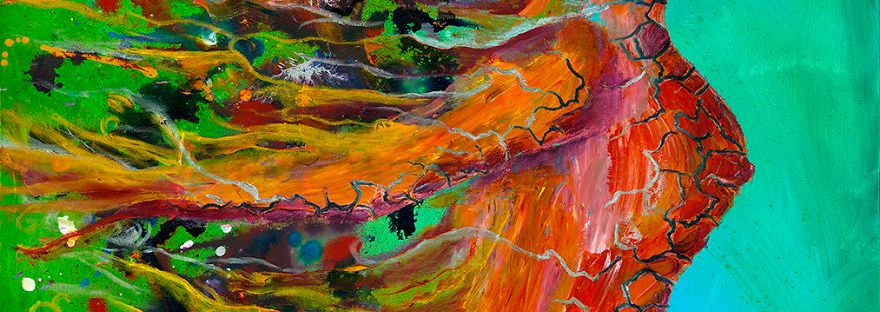
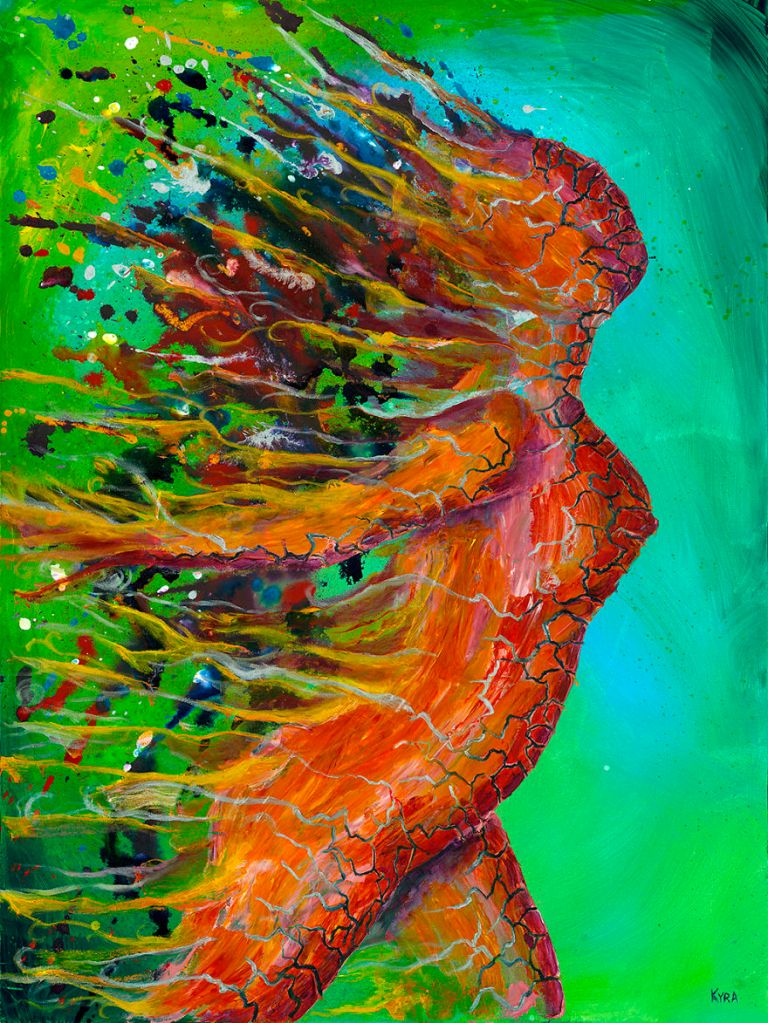
The two artworks on this page are by artist Kyra Coates: Breakthrough and The Most Common Miracle

WTR facilitator Joanna Tomkins creates a collection of handbuilt ceramic sculptures and ritual objects called Artwork that Reconnects, from her shared studio in Kommetjie, South Peninsula, Cape Town

Uncategorized

From Polarising to Weaving

by Joanna Tomkins

COMING FROM GRATITUDE

Breathing in, I know I am breathing in.

Breathing out, I know I am breathing out.

Breathing in, I notice my in breath has become deeper.

Breathing out, I notice that my out-breath has become slower….

Thich Nhat Hanh

HONOURING OUR PAIN FOR THE WORLD

In recent years, societies worldwide have faced unprecedented challenges—economic upheavals, political crises, and environmental disasters, and the heightened awareness of these through fast-speed internet. These crises have deepened a growing division between ideologies and communities. The roots of this divide are complex and its impact on resilience—the ability of societies to withstand and recover from sudden change—is profound. When people become entrenched in ideological or social oppositions, their ability to collaborate and find common ground weakens, making it harder to respond effectively to crises. With the acceleration of the Great Unravelling, which we perceive everyday in our lives, as division within ourselves, and separation from our collective Web of Life, we know that it is time now to find unity, if we want to have any chance of moving through this Great Turning in a good way.

This fragmentation is not a new phenomenon. Some trace its epicentre back to the bloody era of pre-industrial Western colonial and religious territorial invasions, cultural annihilation and societal plunder in the XVth and XVIth Century. Soon after, the scientific introduction of the predominant concept of Cartesian Split, generated originally by René Descartes, reinforced a worldview that separates mind from body, reason from emotion, human from nature, individual from collective, soul from reality, right from left, etc, etc. Most will agree that that era was most terrorific and machiavellic in terms of unravelling of moral values. Thereafter ensue four centuries that lead us to now this disastrous and compelling threshold for humanity; and this is infinitesimal in the wider view of Deep Time – which sees humans arriving on Earth less than a minute ago. And yes, indeed, many saints and great leaders proceeded these times and others have blossomed like lotus from mud throughout human history. We follow in the footsteps of these wise men, relearning the wisdom of pre-colonial Bodhisattvas.

Modern formal education reinforces these mental divisions through rigid structures that prioritise competition over collaboration. Standardised testing, hierarchical grading systems, and strict disciplinary measures condition students to equate self-worth with performance and single mindedness. Instead of being encouraged to explore different perspectives and develop emotional intelligence, children are often taught to seek external validation and fear failure. The system rewards obedience rather than curiosity, fear rather than love, creating individuals who hesitate to question authority, challenge assumptions, or engage in nuanced discussions. A student who learns that disagreement leads to punishment rather than understanding will later struggle to accept perspectives different from their own.

The consequences of societal fracturing are vast in our established institutions too. Political division makes cooperation on critical issues—such as overpopulation, mass production overshoot, lack of integral healthcare, disregard of human rights and the rights of our planet —nearly impossible, as factions focus more on defeating each other than solving problems. Cultural and social globalisation together with fragmentation erodes the fabric of local communities too, making collective action more difficult. Community resilience—our ability to support one another through crises—relies on strong social bonds. However, when divisions grows, following this detrimental programming, the willingness to collaborate diminishes when it is most needed, leaving societies vulnerable in times of uncertainty.

SEEING WITH NEW AND ANCIENT EYES

To rebuild resilience, we can actively cultivate the qualities that transcend social division. These values are not abstract ideals but essential human traits that, when nurtured, have the power to transform individuals and communities. Empathy allows us to connect with others beyond ideological differences. It enables us to see the world through another’s eyes, fostering understanding and reducing hostility. To cultivate empathy, we can engage in active listening, expose ourselves to diverse perspectives, and create spaces for open, nonjudgmental dialogue, role-playing, myth and story-telling and writing, art and poetry, community gatherings and rituals, nature immersion, etc, which will all challenge us to see the world from another’s perspective.

Compassion moves us to act, fostering a sense of shared responsibility that encourages people to support one another rather than compete. To reinforce compassion in society, we must create environments where acts of gratitude, kindness and service are valued as much as personal achievement. Recognising and rewarding cooperative efforts in schools, workplaces, and communities can shift the focus from individual success to collective well-being.

Adaptability is vital in an era of uncertainty. Rigid thinking leaves individuals and societies at continuous risk of collapse, whereas adaptability ensures resilience. Encouraging lifelong learning, curiosity, and openness to new experiences can help people embrace change rather than fear it. In education, fostering interdisciplinary learning—where students are exposed to different fields of knowledge and ways of thinking, beyond the rigidity of the classic classroom—can promote intellectual flexibility and innovation. I visualise a sense of excitement as we see the old unravelling and catch its threads in time to reweave them into something different, unknown, yet promising.

A society divided by ideological entrenchment struggles to work together in times of crisis. Strengthening collaboration means prioritising shared goals over individual or ideological victories. This requires a shift in how communities function, promoting cooperative projects, dialogue-based decision-making, and inclusive leadership. Encouraging collective problem-solving in schools, workplaces, and governance fosters a culture where people learn to work together despite differences.

How can we encourage education to shift away from rigid curricula and move toward fostering open-mindedness, emotional intelligence, and dialogue? Many educational initiatives, in particular small community based schools or extracurricular programmes so encourage critical thinking, teaching students not just to absorb information but to analyse and question it. Life skills such as emotional intelligence, a basic requirement for psychological and integrative health and thriving, could be integrated in formal education too, helping young people develop self-awareness, empathy, and conflict-resolution skills. By shifting from a system based on individualism, isolation and fear of failure to one that encourages exploration, trust and cooperation, we can raise generations better equipped to navigate the differences that we inevitably face in these times of radical shift rather than watch them fall victim to ideological entrenchment again, repeating the destructive cycles of our past.

GOING FORTH

I’m sure you perceived its tingling as you read these paragraphs that call us to Go Forth, for you will indeed notice that perhaps the most powerful force in sustaining resilience is hope. In times of crisis, hope gives us the strength to carry on, to envision a better future, and to find meaning in struggle. Hope is not passive optimism but an active commitment to creating positive change. To cultivate Active Hope, societies can nurture creativity, celebrate progress (however small), and build narratives that emphasise possibility and a sense of individual and collective purpose. By showcasing stories of resilience, reconciliation, and innovation, instead of doom and negativity, we reinforce the belief that healing is possible. We all know the limitless power of our beliefs when we put them into action and the exponential power that comes from doing that as a group. acting on behalf of our world.

The “Great Unraveling” threatens to divide humanity when we fight for survival, yet our resilience depends on choosing unity over separation. By strengthening our ability to listen, understand, and collaborate we can prepare for the challenges ahead. Going Forth in the “Great Turning” requires transcending the ignorant divisions of the past and the patriarcal competition enabled by our current Industrial Growth Society and embracing our collective responsibility to foster understanding, connection, and shared humanity. In doing so, we do not merely survive the future—we shape it.