Articles, Events & Reviews, Festival, Practices, Resources & Networks, Work that Reconnects (WTR)

We joined the Eco…Lution!

Last week, I was in Sedgefield, Western Cape, as facilitator and participant of the festival Ecolution. A small intimate festival celebrating our connection to the local environment. The festival focuses in particular on the wildlife corridors though the Well Being Sanctuary Land, in connection to wider Garden Route areas. Therefore, amidst other activities of dance, live music, drumming, talks and swims… we planted about 1000 trees, introducing more indigenous species and allowing the emergence and regeneration of ecosystems, in turn rewilding safe and natural passage for more-than-human beings.

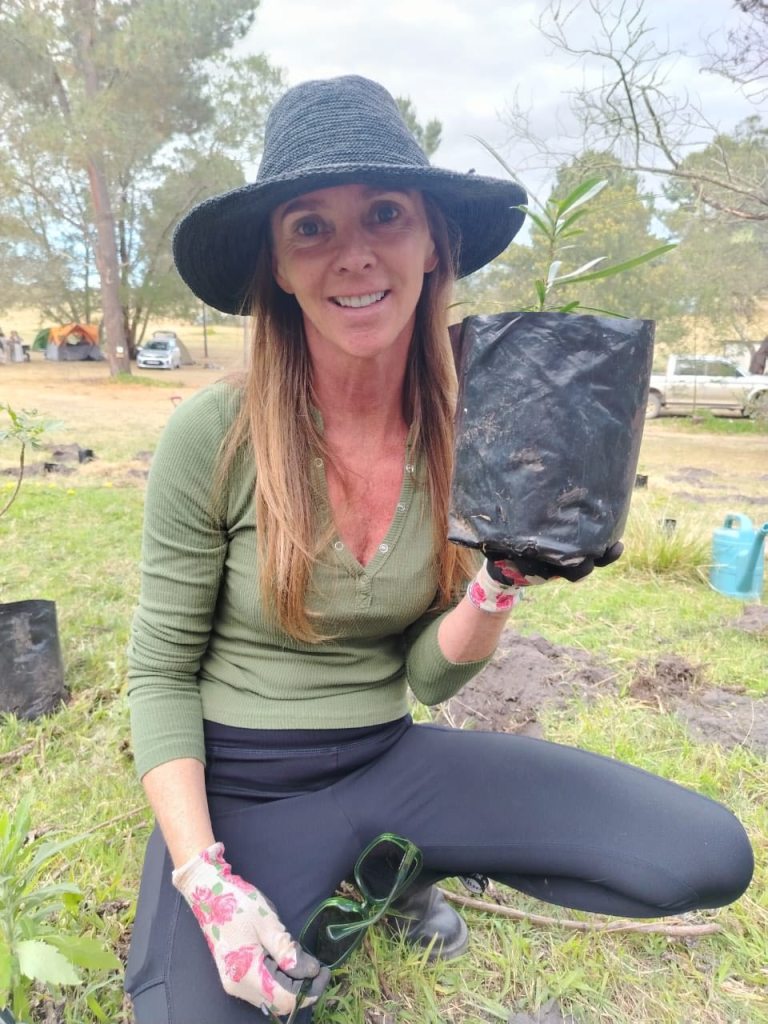
Hereunder I reproduce a post by Mariette Carstens, the custodian of the land… And is a photo of her with her fellow being of the collective yellowwood.

I feel very emotional about this post!

It has taken me a few days just to land with and integrate the magic that folded here at Ecolution Festival 2025

🌱✨ This weekend, something extraordinary happened in my life and Well-Being Sanctuary.

Together—with children, elders, dreamers, and doers—we planted 1,000 trees across our sacred sand dune. The first day, 700 trees found their home in pre-dug beds of possibility. The second day, we dug and planted 300 more, each one a prayer for the earth, a promise to the future.

We did this as part of the Ecolution Project, expanding the wildlife corridor that runs through our land—linking Sedgefield and moving towards Keurbooms River, all the way to Addo Elephant Park. Imagine that… a living bridge for birds and all wild beings to roam freely once more.

This was not just reforestation. It was restoration. Celebration. Collaboration.

With deep gratitude, I want to thank:

🌿 Butterfly Foundation – you are doing incredible work accross the world. We will continue next week as the South Africa Nomads join us with Travelbase to plant even more trees. This is conscious traveling.

🌿Precious Tree Project NPO—for your rooted wisdom and partnership.

🌿Antony Stone, The Rondevlei Learning Centre and Kula Malika, and the Swartvlei community—for standing with us in this vision.

And to the children of ALL AGES—who laughed, dug, danced, and planted with muddy hands and shining eyes—you are the heartbeat of this movement.

Here’s to joy, to soil, to sacred action.

💚 “To plant a tree is to believe in tomorrow. It is to place hope in the hands of time and trust that love will grow roots.”
My 💚 is full

My partner and co-faciltator Simric Yarrow and I inaugurated a Spiral ‘playshop’ including different drama games to embody the Four Stages of the Spiral – Gratittude, Honouring our Pain for the World, Seeing with New and Ancient Eyes and Going Forth-. Again, as with previous new formats we experiences that ritual, coupled with embodied practices AND what has been called ‘Eco-poetic’ languages can intensify reconnection and understanding on more-than-intellect levels… body intelligence at work, fun and pleasure too.

Looking forward to next year’s Festival and look forward to seeing you there too.

Films, Resources & Networks, Work that Reconnects (WTR)

Joanna Macy & The Great Turning

integrally reproduced from the page: https://www.christopherlandry.com/greatturningfilm

“Arguably the greatest interview of our time with one of the wisest women of our time. Heartbreakingly inspiring, practical and transcendental, transformative words that Joanna Macy has conjoined so beautifully in her life and work.” 

— Paul Hawken, author of Natural Capitalism

Joanna Macy and the Great Turning is a short film in which Joanna shares her understanding of these times we live in, when everything we treasure seems to be at risk. The film has screened at film festivals around the world and was featured in the PBS series Natural Heroes.

This is not a film about despair but one about the opportunity we have to come alive to our truest power, to “look straight into the face of our time, which is the biggest gift we can give,” and to participate in the Great Turning.

What is the Great Turning? It is, as Joanna describes it, the shift from the industrial growth society to a life-sustaining civilization. It is, she believes, the third major revolution of human existence, after the agricultural and industrial revolutions. This one, though, has to unfold much more quickly. The good news is that it is, all around the world.

“The most remarkable feature of this historical moment on Earth,” says Joanna, “Is not that we are on the way to destroying the world — we’ve actually been on the way for quite a while. It is that we are beginning to wake up, as from a millennia-long sleep, to a whole new relationship to our world, to ourselves and each other.”

This is a thoughtful, and ultimately hopeful, film for anyone concerned about the future of life on the planet. 

“We imagine they’ll look back at us,” Joanna says, referring to future generations, “Living in these early years of the third millennium, and say, ‘Oh, those ancestors. They were taking part in the Great Turning.’”

Tara Brach, author of Radical Acceptance, says, “This beautiful, wise and evocative film captures the crisis and possibility of our times. The Great Turning is a global awakening to the dis-ease of our planet, our love of life and the revolution that can heal our world. Please watch this, share with all you know, and allow the inspiration and hope to fill your heart. “ 

ABOUT JOANNA MACY 

Eco-philosopher Joanna Macy, PhD is a scholar of Buddhism, general systems theory, and deep ecology. A respected voice in the movements for peace, justice, and ecology, she interweaves her scholarship with five decades of activism. As the root teacher of the Work That Reconnects, she has created a ground-breaking theoretical framework for personal and social change, as well as a powerful workshop methodology for its application.

Many thousands of people around the world have participated in Joanna’s workshops and trainings. Her group methods have been adopted and adapted widely in classrooms, congregations, and grassroots organizing. Her work helps people transform despair and apathy, in the face of overwhelming social and ecological crises, into constructive, collaborative action. It brings a new way of seeing the world, as our larger living body, freeing us from the assumptions and attitudes that now threaten the continuity of life on Earth.

Joanna Macy has inspired thousands of people around the world who teach others about the Great Turning. You can find a lot of great resources at Joanna’s website, including all her books, and connect with others on The Work That Reconnects Facebook page.

HOW TO WATCH

Individuals and small groups can watch the film for free below. Institutions can purchase the film through the The Video Project. Questions about film festivals, streaming, and other uses can be sent to Chris Landry.

Events & Reviews, Organisations, Resources & Networks

At Boulders Beach with the Disa Primary eco-warriors

by Joanna Tomkins, 3rd March 2025

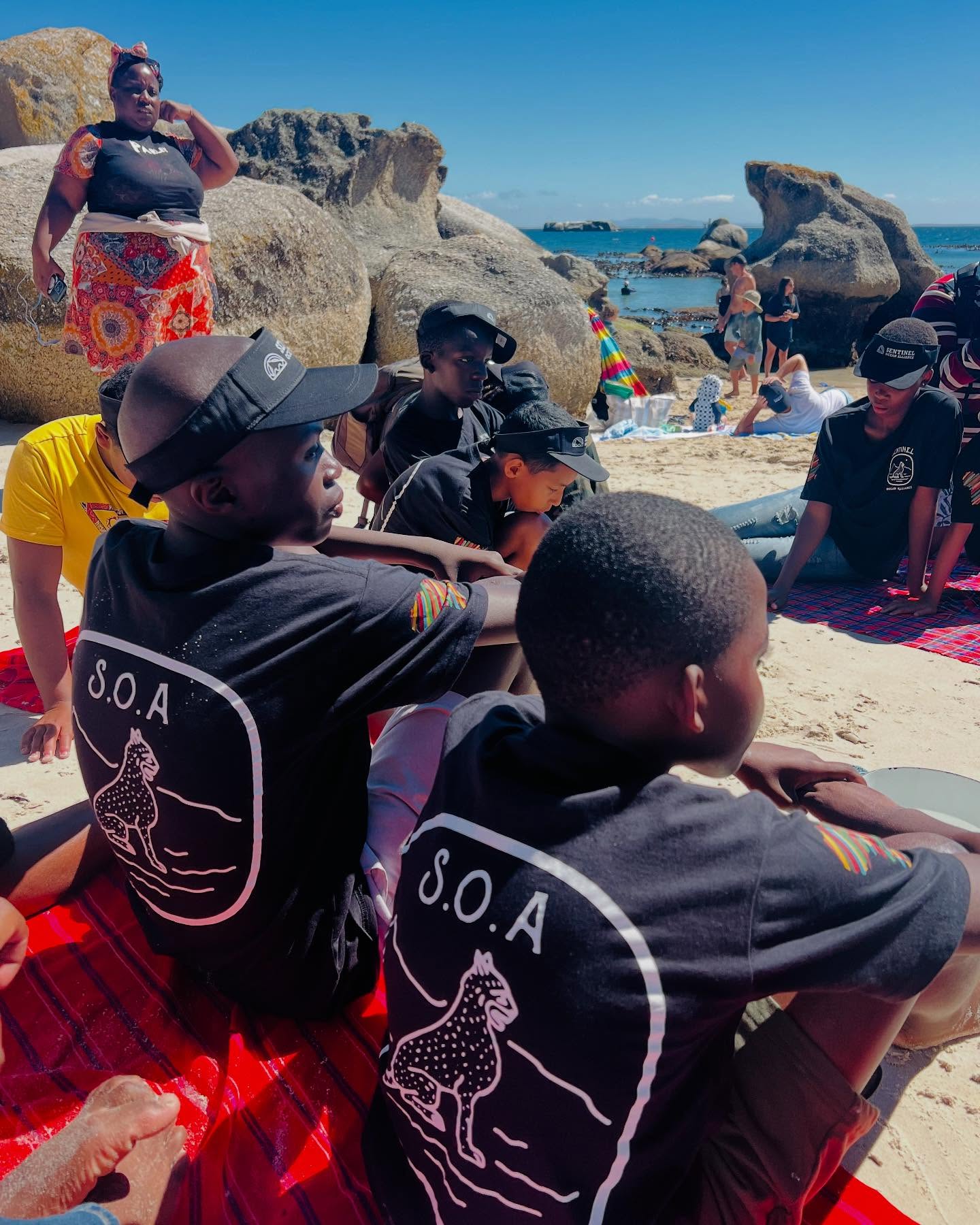
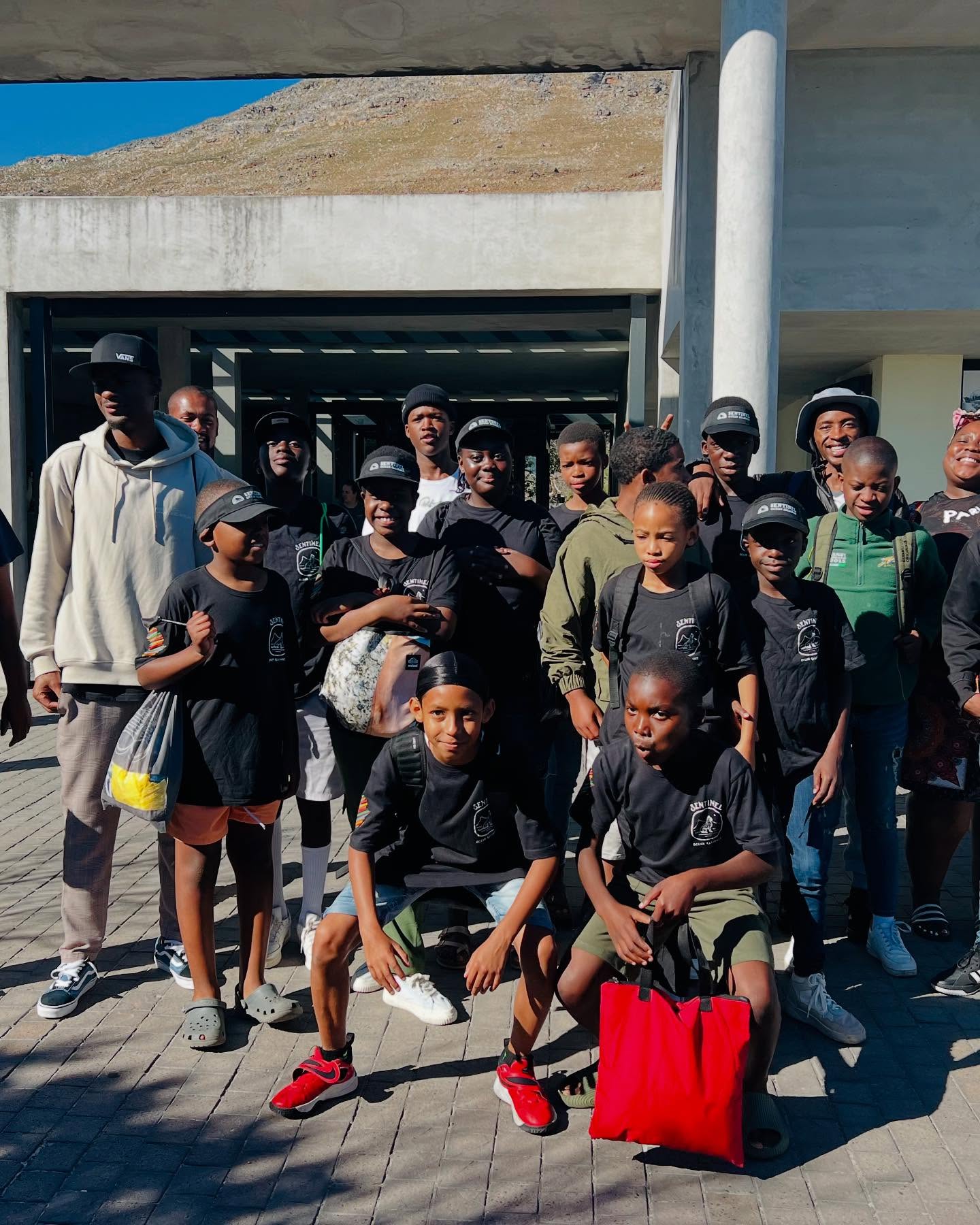
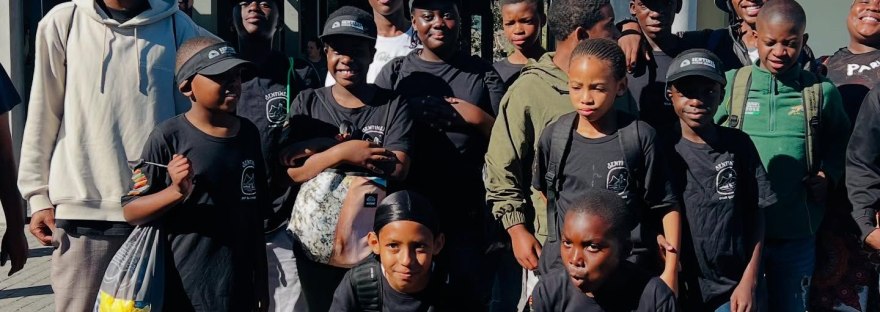
The Ocean Pledge NPO, led by Diony Lalieu, gathered a group of eco warriors from Hout Bay’s Disa Primary last month at the iconic Boulders Beach San Parks nature reserve in Cape Town.

It was an honour to facilitate a workshop for these young pioneers from Disa Primary. Although they come from historically disadvantaged families, and facing or witnessing many social challenges in their communities, they have chosen to be with us today, with their monitors from Sentinel Ocean Alliance, who offer educational programmes for the children to learn about ocean conservation, and to nurture their connection to their natural environment.

Diony and I had created a programme that would satisfy their playfulness and at the same time allow them to ask some deep questions about their own relationship to their feelings about the extinction of species or overfishing, plastic pollution, etc…

To kick it off we went on an educational outing to visit the penguins in the Boulders colony in Simonstown and to be guided by a knowledgeable and passionate expert of SANCCOB, who told us how we could help the penguins avoid extinction. SANCCOB recently calculated that African Penguins, endemic to our coast in South Africa and Namibia, are threatened to go extinct by . The students got a chance to meet an inspiring conservation volunteer, as he answered all our questions about all the penguins’ behavioural facts and monitoring tools.

At the end of our tour Ocean Pledge then decided to ‘adopt’ a penguin on behalf of the kids, whereby they will provide enough funds for one individual rescue penguin to be monitored and cared for. Read more about this on SANCCOB’s page.

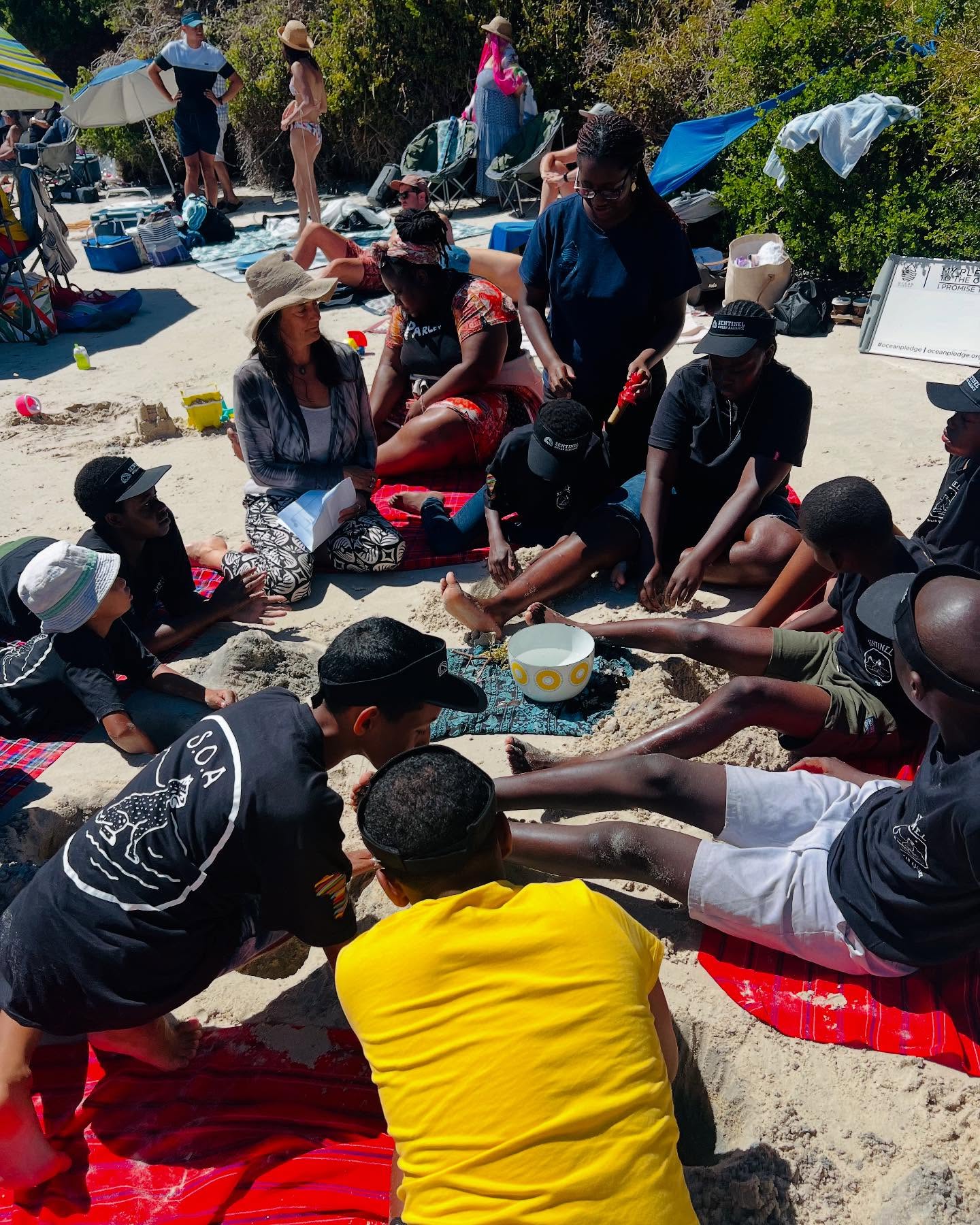
After that we went to the Boulders Beach nearby for a 60 minute workshop that we jointly facilitated, going around the spiral of the Work that Reconnects. I was impressed at the youth’s interest and capacity to focus and to open up about their feelings about our natural world. This was a highlight for me, as a facilitator of the WTR and I feel deeply grateful for this opportunity.

“In these times in which we live, our feelings of pain and inner suffering are so often undermined and even pathologised. We are told things like: ‘boys don’t cry’, to ‘pick up and carry on’, or to ‘eat a teaspoon of cement’- there is little space for tears. Daily we are overcome with messages around murders, wars, famine, injustice, devastating fires or storms, and, to deal with the barrage of destruction, some of us just switch off – feeling empty is better than feeling overwhelmed, right? Yet, the experience of this pain and suffering stems from a deep compassion and a shared connectivity with all beings. It is precisely in feeling this pain that we can release our fears so that we can make way for the desire to spark new life-sustaining realities.” This is an extract from the Chapter for Children and Teens of the book “Coming Back to Life” by Joanna Macy and Molly Young Brown.

“This deep reconnection to ourselves, our feelings and mother nature was the focus of our work today. After all, the most powerful speakers are the ones that speak from the heart ♥️“, said Diony Lalieu, director of the NPO Ocean Pledge, after our workshop on 1st February on Boulder Beach in Simonstown, Cape Town.

And she continues: “Based on work of deep ecologist, Joanna Macy, the students were guided through a 4-staged spiral starting with Gratitude; Honouring our Pain; Seeing the World with New Eyes and culminating in ‘Going Forth’, with an inspired vision of how we can all play our part in building back better.

“Thank you to Gaia Speaking and to our sponsors and partners for making this long-time dream come true.”They are the Sentinel Ocean Alliance and Mission Blue, in partnership with Plum Foundation, Naure Connects, the Table Mountain Fund and the Ocean Family Foundation. “

Community of Practice (CoP), Poems, Resources & Networks

Poem that Reconnects: “Please Call me by my True Names”

Don’t say that I will depart tomorrow —
even today I am still arriving.

Look deeply: every second I am arriving
to be a bud on a Spring branch,
to be a tiny bird, with still-fragile wings,
learning to sing in my new nest,
to be a caterpillar in the heart of a flower,
to be a jewel hiding itself in a stone.

I still arrive, in order to laugh and to cry,
to fear and to hope.

The rhythm of my heart is the birth and death
of all that is alive.

I am the mayfly metamorphosing
on the surface of the river.
And I am the bird
that swoops down to swallow the mayfly.

I am the frog swimming happily
in the clear water of a pond.
And I am the grass-snake
that silently feeds itself on the frog.

I am the child in Uganda, all skin and bones,
my legs as thin as bamboo sticks.
And I am the arms merchant,
selling deadly weapons to Uganda.

I am the twelve-year-old girl,
refugee on a small boat,
who throws herself into the ocean
after being raped by a sea pirate.
And I am the pirate,
my heart not yet capable
of seeing and loving.

I am a member of the politburo,
with plenty of power in my hands.
And I am the man who has to pay
his “debt of blood” to my people
dying slowly in a forced-labor camp.

My joy is like Spring, so warm
it makes flowers bloom all over the Earth.
My pain is like a river of tears,
so vast it fills the four oceans.

Please call me by my true names,
so I can hear all my cries and my laughter at once,
so I can see that my joy and pain are one.

Please call me by my true names,
so I can wake up,
and so the door of my heart
can be left open,
the door of compassion.

Thich Nhat Hanh tells the story of the poem:

After the Vietnam War, many people wrote to us in Plum Village. We received hundreds of letters each week from the refugee camps in Singapore, Malaysia, Indonesia, Thailand, and the Philippines, hundreds each week. It was very painful to read them, but we had to be in contact. We tried our best to help, but the suffering was enormous, and sometimes we were discouraged. It is said that half the boat people fleeing Vietnam died in the ocean; only half arrived at the shores of Southeast Asia.

There are many young girls, boat people, who were raped by sea pirates. Even though the United Nations and many countries tried to help the government of Thailand prevent that kind of piracy, sea pirates continued to inflict much suffering on the refugees. One day, we received a letter telling us about a young girl on a small boat who was raped by a Thai pirate.

She was only twelve, and she jumped into the ocean and drowned herself.
When you first learn of something like that, you get angry at the pirate. You naturally take the side of the girl. As you look more deeply you will see it differently. If you take the side of the little girl, then it is easy. You only have to take a gun and shoot the pirate. But we can’t do that. In my meditation, I saw that if I had been born in the village of the pirate and raised in the same conditions as he was, I would now be the pirate. There is a great likelihood that I would become a pirate. I can’t condemn myself so easily. In my meditation, I saw that many babies are born along the Gulf of Siam, hundreds every day, and if we educators, social workers, politicians, and others do not do something about the situation, in twenty-five years a number of them will become sea pirates. That is certain. If you or I were born today in those fishing villages, we might become sea pirates in twenty-five years. If you take a gun and shoot the pirate, you shoot all of us, because all of us are to some extent responsible for this state of affairs.

After a long meditation, I wrote this poem. In it, there are three people: the twelve-year-old girl, the pirate, and me. Can we look at each other and recognize ourselves in each other? The title of the poem is “Please Call Me by My True Names,” because I have so many names. When I hear one of the of these names, I have to say, “Yes.”

Note by Joanna Tomkins:

After Thay’s death, in 2022, I listened to the podcast hereunder, a conversation between Joanna Macy, founder of the Work that Reconnects and presenters of the podcast “The Way Out is In: the Zen Art of Living” Brother Phap Huu and Jo Confino. Here is the link if you want to listen too:

Articles, Resources & Networks, Work that Reconnects (WTR)

I am part of the rainforest protecting myself

By John Seed,

I am part of the rainforest protecting itself– John Seed

It may seem altruistic to protect nature. For me, it’s self-preservation.

ASSUMPTION OF A DIVIDE

If I see a strong divide between me and nature, then nature can easily be seen primarily as a source of resources, a place to put waste, and a place to occasionally enjoy. If I do something to protect nature, it’s altruistic and often a bit peripheral. It’s a nice thing to do but not terribly important.

INTERCONNECTEDNESS OF ALL LIFE

If I realize the interconnectedness of all life, then I recognize – in a more visceral way – that my own well-being and my own life is utterly and intrinsically dependent on the health and existence of the larger ecosystems and this living planet I am part of. Here, protecting nature becomes self-preservation. I am dependent on the health and vibrancy of nature locally, regionally, and globally.

I AM NATURE PROTECTING ITSELF

I can also go one step further and recognize that I am nature protecting itself. I am a part of this living evolving system protecting itself. I am a separate self, and more fundamentally I am a temporary and local expression of this larger living and evolving system. I am a temporary and local expression of the living and evolving Earth. I am a temporary and local expression of the evolving universe and all of existence.

GETTING IT MORE VISCERALLY

Getting this more viscerally is a big and important shift. It brings us more in alignment with reality. It gives grounding. It’s nourishing. It makes us less dependent on the more temporary surface experiences and situations.

SYSTEM CHANGE

And, of course, it doesn’t mean I am or need to be “perfect” in terms of my own life. I am also a child of my culture. I am also embedded in our social and cultural systems.

As all of us, I live in an economic and social system that rests on the assumption that humans are somehow separate from nature, that the resources of nature are limitless, and that the ability of nature to absorb waste is equally limitless. We live in a human-created social system where what’s easy and attractive to do is also, in most cases, destructive to nature.

And we have another option. We can create an economic and social system that take our ecological realities into account, and where what’s easy and attractive to do – for individuals and businesses – supports life and our ecosystems. It’s possible. We can do it. We even know quite a bit about how to do it.

And yet, it does require a profound transformation of our whole civilization – our worldview, philosophy, economics, energy sources, production, transportation, education, and everything else. And that requires a deep collective motivation. Will we find it? Perhaps. But likely not until we are much further into our current ecological crisis. (Which is a socal crisis since all of our human systems are embedded within our ecological systems.)

John Seed is an Australian environmentalist and director of the Rainforest Information Centre, which campaigned to save the sub-tropical rainforests of New South Wales. He is also a prominent figure in the deep ecology movement and co-creator of the Council of All Beings, and other re-earthing processes.

Community of Practice (CoP), Practices, Resources & Networks, Work that Reconnects (WTR)

Who Are You?

(60 minutes)

Practice extracted from the book Coming Back to Life

This process in pairs serves to move us beyond constricted notions of who we are and what can happen through us. Of a metaphysical bent, it was originally inspired by followers of the Hindu sage Sri Ramana Maharshi. In their enlightenment intensives, persistent inquiry helps participants to free themselves from socially constructed self-definitions and attain a realization of the inherently unlimited nature of consciousness. In our workshop the process is condensed and less ambitious. We use it to remind ourselves that we are not our social roles or skin-encapsulated egos so much as participants in a larger encompassing awareness — or the awakening consciousness of Earth.


METHOD

Each pair sits close enough together and far enough from the others to avoid distraction. The partners take turns querying each other for 30 minutes each way, without comment.
This is a strenuous mental exercise. It can produce extraordinary insights, sometimes with bursts of laughter, but it can feel relentless. It must be undertaken gently and with respect.
Here are the instructions to Partner A, which are repeated to B later:”

“Partner A, you begin by asking B, “Who are you?” You listen. You ask again, “Who are you?” Again you listen, then repeat the question, “Who are you?” Rest assured that the answers will be different. You can vary the question, if you wish, with “What are you?” but you say nothing else. This continues for about ten minutes, until I ring the bell.
Remember, you are not badgering your partner. You’re not suggesting that his responses are wrong; you’re helping him go deeper. You are in service to your partner. The tempo and tonality of your questions will vary; you’ll know intuitively when to ask again quickly and when to pause in silence. Now before you begin, bow to your partner — and to the essential mystery at the core of this being.
After the first ten-minute bell, give the next instruction:

Now shift to a second question, “What do you do?” For the next ten minutes, you listen to those answers and keep repeating the query, “What do you do?” You can also phrase it, “What happens through you?”
After ringing the bell, give the third instruction:”

“Please revert now to the first question, “Who (or what) are you?”
Partner A bows to B once more when the cycle of questions is over. As the partners change roles, let them stand and stretch, without talking. Then repeat the process with B querying A.
At the end of the entire practice, which takes an hour, allow plenty of time for people to digest what has happened for them. They may want to journal or talk quietly with their partners. Then, if there is time, bring them back together in the large group so that they reflect on the process.”

Community of Practice (CoP), Extracts from Active Hope, Practices, Resources & Networks, Uncategorized

Seeing with New and Ancient Eyes Home Practice: Listening to our World

Adapting the words of Active Hope facilitator Madeleine Young

Choose – or create – a space that you can repeatedly go to – a place where you can be quiet and receptive and listen to the world. Ideally this will be a spot in Nature, but it is more important that it is a place that is easily visitable by you, and it is entirely possible to create your ‘Nature spot’ inside your home. Make it somewhere that you feel safe and can relax.


There are many ways to refer to this place – it could be your listening spot, your Nature spot, your Gaia spot, your sit-spot, or whatever feels right for you. This is your place to acknowledge the greater whole that you are a part of.
Set aside an amount of time that you are going to spend at your spot. We suggest starting small, to make it achievable that you spend time there each day.
Each time you arrive at your spot, relax, breathe, feel yourself in your body, and practice
engaging your senses – look, listen, feel, smell (possibly even taste, if you have chosen a spot where edible things are growing!) – be receptive to all the details.
If you feel fidgety or unsettled at first, or your mind is full of thoughts, just observe this, without judgement, and keep gently bringing yourself back into your senses. This practice is about building up receptivity and relationship over time and not about seeking to come too readily to clarity.
Whilst at your spot, you could try slowing your movements right down, as this is a great way to signify to yourself that this is a space outside of your everyday. Allow yourself to be playful – let your imagination be wide open, like a satellite dish, and let your critical rational mind take a back seat while you are here. As much as you can, let go of expectations, as communication from the greater whole may come in unexpected ways.


Let your relationship with your spot develop over time – returning as regularly as you can. Just as with any relationship, you will need to get to know each other first and may start off ‘making small talk’ – with invested time together, your intimacy will begin to deepen. This practice is all about making ourselves available, being quiet, and listening.
If it feels useful, you could try out sentence starters, like these, while listening at your spot:
If our world could speak to me, what it might say is…
If the collective intelligence of our world were to guide me, what it might invite me to consider is…


Personal Reflection
There is the doing of this practice – actually turning up, repeatedly, at your spot – but, also, there’s a potential for reflection on the practice, enabling any guidance to ripple out by exploring it further in different ways.
Journaling, drawing or doodling, can be a great tool here – either whilst at your spot, or after. Let your hand take over and create whatever feels to come without overthinking it- colours, or mandalas can be particularly powerful to play with.


Background
The “Listening to Our World” practice is situated within the third stage (or station) of the spiral of “the Work that Reconnects”. In the first stage, we developed strong roots through experiencing and expressing our gratitude and appreciation for life. One aspect of experiencing such appreciation is a deeper knowing of our interconnectedness. This knowing is deepened further still in stage 2 of the Spiral of the WTR, when we honour our pain for the world – welcoming it as a sign of our ability to feel with this world – a world that we are an integral part of.
This third stage: ‘Seeing with New and Ancient Eyes’, is all about inviting in a fresh perspective. In a way, by experiencing this integrated nature of our human experience, we have already been ‘seeing with new (and ancient) eyes’. Living with an awareness of our interconnectedness is a radical shift in perspective from the separate view of ourselves that is encouraged within ‘business as usual’. As we step into stage 3 of the spiral, we are deepening this shift in perspective.
In this practice, we are encouraged to begin to dedicate some time and space, within our daily lives, to receive guidance. This is based on an understanding that we are part of a complex living system and that there will be aspects of this system that may wish to emerge through us. By ‘listening to our world’ we begin relating to Nature, like a good family member – acknowledging our belonging, and cultivating an understanding of it by just being quiet and letting insights
surface.

Books, Extracts from Active Hope, Resources & Networks, Uncategorized

Seeing Success with New Eyes

by Chris Johnstone and Joanna Macy, an extract from the book Active Hope

Images from the buddhist platform Tricycle, with thanks

While having our heart in what we do is an essential part of what makes life satisfying, it isn’t enough. Repeated failure, frustration, and lack of progress can leave us wondering whether we’re wasting our time. It is difficult to stick to a path if we don’t see it going anywhere. So the way we understand and experience success affects our willingness to keep going.
The models of success we’re likely to have been given generally take us in the wrong direction. In the story of Business as Usual, success is measured in terms of wealth, fame, or position. A company making massive profits is regarded as successful, even when its ways of doing this harm its employees and our world. People are judged as successful simply because they have managed to acquire a vastly larger share of the world’s resources than they could ever need — at a time when hundreds of millions starve. It is the very hunger for this type of success that leads us, collectively, to plunder our planet.
With the consciousness shift of the Great Turning, we recognize ourselves as intimately connected with all life, like a cell within a “larger body. To call an individual cell “successful” while the larger body sickens or dies is complete nonsense. If we are to survive as a civilization, we need the intelligence to define success as that which contributes to the well-being of our larger body, the web of life. Commercial success is easy to count, but how do we count the success of contributing to planetary well-being? Do we experience this success often? And if not, what is getting in the way?

TRY THIS: REFLECTING ON SUCCESS

Taking your definition of success as that which contributes to the well-being of our world, how often do you feel you are succeeding?


We experience success when we reach a goal that is significant to us. But what if our goal is the elimination of poverty or the transition to a low-carbon economy? If the change we want doesn’t happen in our lifetime, does that mean we will never experience success? For the encouraging boost we get when we know we’re moving forward, we need to find markers of progress we can spot more easily and often. What helps here is making the distinction between eventual goals and intermediate ones.


The progressive brainstorming process (described in chapter 9 of the Active Hope book) began with longer-range, eventual goals. These are the things we would really like to see happen, even if we can’t immediately see how they will come about. We take one of these eventual goals and list some of the conditions needed to bring it about. So if our goal is the elimination of poverty, we would need to have in place widespread political will, new taxation policies, redistribution of resources, and the like. Then, taking one of these, we ask, “What would be needed for this?” Each stage moves us closer to our present situation. Before long, we’re identifying steps that are within our reach, such as eating lower in the food chain or setting up a study-action group on world hunger.
For any goal we choose to pursue, we track back in time to identify intermediate steps. Each time we take a step like this, we are succeeding. Instead of rushing on immediately to the next task, we can take a moment to savor these mini-victories. The following open sentence is a useful prompt for this process.

TRY THIS: SAVORING SUCCESS EVERY DAY with the following open sentence.

A recent step I’ve taken that I feel good about is…


There are steps we take that often don’t get counted, like the choice of where to place our attention. Just noticing that things are seriously amiss is a step on the journey. If we care enough to want to do something, that is also a significant mini-victory. Just to show up with bodhichitta is a success.


In a society that views success in competitive terms, it is usually only those recognized as “winners” who are applauded. We need to learn the skill of encouraging and applauding ourselves. We can reinforce our appreciation of the steps we take by imagining the support of the ancestors, the future beings, and the more-than-human world. When we develop our receptivity, we will sense them cheering us on. If we form a study-action group or build support in other ways, we can take time to do this for each other, noticing and appreciating what we’re doing well.
When we reflect on past successes, we can ask, “What strengths in me helped me do that?” Naming our strengths makes them more available to us. However, the challenges we face demand of us more commitment, endurance, and courage than we could ever dredge up out of our individual supply. That is why we need to make the essential shift of seeing with new eyes — it takes the process of strength recognition to a new level, that of the larger web of life. Just as we can identify with the suffering of other beings in in this web, so too can we identify with their successes and draw on their strengths. There is an ancient Buddhist meditation that helps us do this. It is called “the Great Ball of Merit” and it is excellent training for the moral imagination:

TRY THIS: THE GREAT BALL OF MERIT

Relax and close your eyes, relax into your breathing…Open your awareness to the fellow beings who share with you this planet-time…in this room…this neighborhood…this town. Open to all those in this country and in other lands…Let your awareness encompass all beings living now in our world.
Opening now to all time, let your awareness encompass all beings who have ever lived…of all races and creeds and walks of life, rich and poor, kings and beggars, saints and sinners…Like successive mountain ranges, the vast vistas of these fellow beings present themselves to your mind’s eye.
Now open to the knowledge that in each of these innumerable lives some act of merit was performed. No matter how stunted or deprived the life, there was at the very least one gesture of kindness, one gift of love, or one act of valor or self-sacrifice…on the battlefield or in the workplace, hospital or home…From each of these beings in their endless multitudes arose actions of courage, kindness, of teaching and healing…Let yourself see these manifold, immeasurable acts of merit. “Now imagine that you can sweep together these acts of merit. Sweep them into a pile in front of you. Use your hands…pile them up…pile them into a heap, viewing it with gladness and gratitude. Now pat them into a ball. It is the Great Ball of Merit. Hold it now and weigh it in your hands…Rejoice in it, knowing that no act of goodness is ever lost. It remains ever and always a present resource…a means for the transformation of life…So now, with jubilation and thanksgiving, you turn that great ball, turn it over…over…into the healing of our world.


The more we practice this meditation, the more familiar we become with the process of drawing strengths from outside our narrow self. Knowing about the Great Ball of Merit can also change the way we think about our own actions. Each time we do something, no matter how small, that is guided by bodhichitta and contributes to our world, we know we are adding to this abundance.

Articles, Local News and Articles, Organisations, Resources & Networks, Uncategorized

Pesticides: Shooting the Messenger (and other Innocent Bystanders)

by Ninette Tarlton, first published on Patreon on 28 August 2024

“Three billion kilograms of pesticides are used worldwide every year [6], while only 1% of total pesticides are effectively used to control insect pests on target plants [1]. The large amounts of remaining pesticides penetrate or reach non-target plants and environmental media. As a consequence, pesticide contamination has polluted the environment and caused negative impacts on human health [1,7].”  Source: https://www.ncbi.nlm.nih.gov/pmc/articles/PMC7908628/

For many decades, the world has been following the advice of the pesticides industry on how to deal with “pests”.  Consumer choices in this area have largely been dictated by fear and/or ignorance and/or trust in suppliers of pesticides.  The result? TONS of synthetic chemical formulations specifically designed to poison are released into the environment, year after year, by all sectors of society, from individuals to farmers, businesses, public institutions, governments and even schools to “deal” with every “pest” under the sun. 

Insanely this broad spread anthropogenic chemical pollution is deemed the “norm”, so much so that it is even accepted to spray these poisons on or near the food we eat, in or near our freshwater resources, in and around our homes and even on or near where our children play. It should come as no surprise that traces of these chemicals are now being found everywhere and that soil life, aquatic life, ecological and even our own biological biodiversity is being destroyed.

All along, we have been looking at things wrong. The “pests” have simply been trying to tell us something.  It is their advice we should follow.  They were never the “problem”, just like climate change is not the problem. Big industry LOVES discussing these “problems” (they are actually symptoms) at conferences because they know that these narratives: 1. Breed fear; 2. disassociate people from the true problem so that they are unable to respond correctly and effectively.  

The truth that the problem is how we humans have been doing things will set us free! This is the Best and Worst news EVER, all rolled into one. Worst: because it means we all have to finally take responsibility for our individual actions and Best: because it means we, the people of Earth, can start changing the world virtually overnight SIMPLY THROUGH THE CHOICES WE MAKE, without any help from government or industry!

Woah! An overwhelming realisation! Don’t let it be. The pests have a POWERFUL and encouraging message for you: It’s not about how little the one does, it is about how much all get done together!

Things are changing, whether you are on board or not.  It’s just that we might be able to make it a little easier on ourselves if we raise our white flags in this war on nature.  Nature is not the enemy, unless we continue to make her one. Being on the wrong side of nature, we will certainly lose because waging war on nature is waging war on ourselves.

I feel an extreme sense of urgency to do this work.  Some would call me a pest, but I truly believe nature is running out of patience.  “Pests” are there to bother us so that we will be forced to pay attention.  They have important messages for us and will set us on the right path, if only we listen. 

My name is Ninette and I currently run a campaign in Cape Town South Africa called “Poison-free Peninsula”.  Our current primary focus is on advocating for the City of Cape Town to immediately stop its shocking practice of blanket spraying toxic synthetic herbicides on the streets and sidewalks of our communities in the iconic biodiversity hotspot, the Cape Peninsula. Concurrently we are working to inspire and support individuals, farmers, businesses, public institutions and schools in Cape Town to discontinue their reliance on toxic pesticides.  Although this campaign is region specific, we encourage all individuals to join us in the hope that others receive some inspiration/guidance to do similar work elsewhere.

To join us, send an email to: poisonfreepeninsula@proton.me. You can watch our video about blanket spraying of herbicides in the Cape Peninsula here: https://youtu.be/iA2RC3bsjAE

Spring is in the Air, lets keep pesticides out of it! (19 September 2024)

Please follow the link here above to a short video suitable for sharing on whatsapp community groups and Facebook groups. Help raise awareness! This little action is dedicated to all the worker bees out there!

To read more from Ninette, please visit https://www.patreon.com/NinetteTarlton

Films, Organisations, Resources & Networks, Uncategorized

Films that Reconnect: “Mother Nature in the Boardroom”

Sea Change Project’s latest short film Mother Nature in the Boardroom, narrated by Craig Foster and featuring Dr Jane Goodall, has an urgent message for decision makers: provide a seat at your boardroom table for Mother Nature. Include her voice in every choice you make. Listen to her warnings and wisdom and join the drive to give her the best chance possible by prioritising biodiversity – the thing upon which all life depends.

“Storytelling for Nature Protection”, an introduction to Sea Change Project by its founders.

Sea Change Project is a nonprofit environmental storytelling organisation, founded by Craig Foster and Ross Frylinck in 2012.  We are a team of media and science professionals who are dedicated to the wild and specifically the Great African Seaforest. Our work includes films, books, exhibitions, education, and marine biology research.

Inspired by nature, informed by science and guided by indigenous wisdom. We aim to build a deeper connection between humans and the natural world by telling stories, through the use of world-class media, that generate a deep desire in people across the world to engage with, conserve and protect nature.

Our Oscar and Bafta winning film My Octopus Teacher has championed a global movement of emotional ecology.

Our work is based on our connection to the Great African Seaforest. We set out to make the kelp forests of Southern Africa a global icon by giving them a collective identity: the Great African Seaforest. We carefully embedded this brand in all our media work and in 2021 it was named a New World Wonder. This newfound iconic status will help ensure its long-term protection.

 The Great African Seaforest is a deep source of inspiration for our minds, hearts and souls. By sharing these experiences with the world, we hope to inspire a global movement of nature connection and more stories about the intrinsic relationship between humans and the living planet.

You can read more about Sea Change Project here.

And hereunder is another beautiful piece of videography by Craig Foster from 2023. Thank you for all your contributions towards a future Life Sustaining Society.