Articles, Events & Reviews, Festival, Practices, Resources & Networks, Work that Reconnects (WTR)

We joined the Eco…Lution!

Last week, I was in Sedgefield, Western Cape, as facilitator and participant of the festival Ecolution. A small intimate festival celebrating our connection to the local environment. The festival focuses in particular on the wildlife corridors though the Well Being Sanctuary Land, in connection to wider Garden Route areas. Therefore, amidst other activities of dance, live music, drumming, talks and swims… we planted about 1000 trees, introducing more indigenous species and allowing the emergence and regeneration of ecosystems, in turn rewilding safe and natural passage for more-than-human beings.

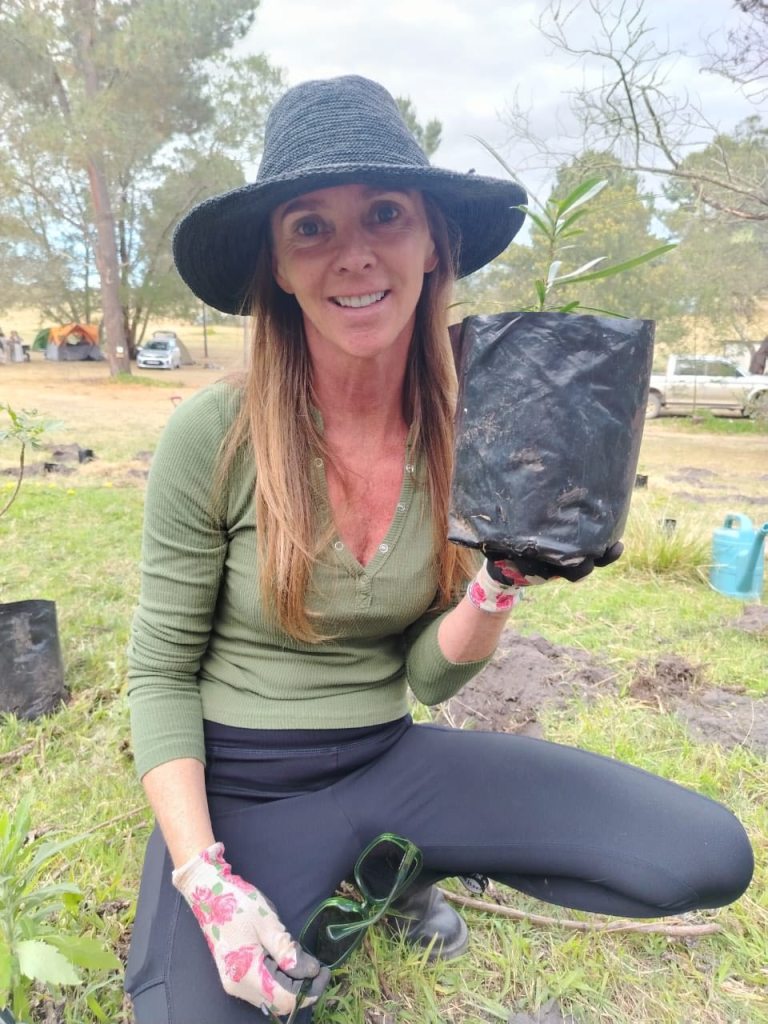
Hereunder I reproduce a post by Mariette Carstens, the custodian of the land… And is a photo of her with her fellow being of the collective yellowwood.

I feel very emotional about this post!

It has taken me a few days just to land with and integrate the magic that folded here at Ecolution Festival 2025

🌱✨ This weekend, something extraordinary happened in my life and Well-Being Sanctuary.

Together—with children, elders, dreamers, and doers—we planted 1,000 trees across our sacred sand dune. The first day, 700 trees found their home in pre-dug beds of possibility. The second day, we dug and planted 300 more, each one a prayer for the earth, a promise to the future.

We did this as part of the Ecolution Project, expanding the wildlife corridor that runs through our land—linking Sedgefield and moving towards Keurbooms River, all the way to Addo Elephant Park. Imagine that… a living bridge for birds and all wild beings to roam freely once more.

This was not just reforestation. It was restoration. Celebration. Collaboration.

With deep gratitude, I want to thank:

🌿 Butterfly Foundation – you are doing incredible work accross the world. We will continue next week as the South Africa Nomads join us with Travelbase to plant even more trees. This is conscious traveling.

🌿Precious Tree Project NPO—for your rooted wisdom and partnership.

🌿Antony Stone, The Rondevlei Learning Centre and Kula Malika, and the Swartvlei community—for standing with us in this vision.

And to the children of ALL AGES—who laughed, dug, danced, and planted with muddy hands and shining eyes—you are the heartbeat of this movement.

Here’s to joy, to soil, to sacred action.

💚 “To plant a tree is to believe in tomorrow. It is to place hope in the hands of time and trust that love will grow roots.”

My 💚 is full

My partner and co-faciltator Simric Yarrow and I inaugurated a Spiral ‘playshop’ including different drama games to embody the Four Stages of the Spiral – Gratittude, Honouring our Pain for the World, Seeing with New and Ancient Eyes and Going Forth-. Again, as with previous new formats we experiences that ritual, coupled with embodied practices AND what has been called ‘Eco-poetic’ languages can intensify reconnection and understanding on more-than-intellect levels… body intelligence at work, fun and pleasure too.

Looking forward to next year’s Festival and look forward to seeing you there too.

Community of Practice (CoP), Practices, Resources & Networks, Work that Reconnects (WTR)

Who Are You?

(60 minutes)

Practice extracted from the book Coming Back to Life

This process in pairs serves to move us beyond constricted notions of who we are and what can happen through us. Of a metaphysical bent, it was originally inspired by followers of the Hindu sage Sri Ramana Maharshi. In their enlightenment intensives, persistent inquiry helps participants to free themselves from socially constructed self-definitions and attain a realization of the inherently unlimited nature of consciousness. In our workshop the process is condensed and less ambitious. We use it to remind ourselves that we are not our social roles or skin-encapsulated egos so much as participants in a larger encompassing awareness — or the awakening consciousness of Earth.


METHOD

Each pair sits close enough together and far enough from the others to avoid distraction. The partners take turns querying each other for 30 minutes each way, without comment.
This is a strenuous mental exercise. It can produce extraordinary insights, sometimes with bursts of laughter, but it can feel relentless. It must be undertaken gently and with respect.
Here are the instructions to Partner A, which are repeated to B later:”

“Partner A, you begin by asking B, “Who are you?” You listen. You ask again, “Who are you?” Again you listen, then repeat the question, “Who are you?” Rest assured that the answers will be different. You can vary the question, if you wish, with “What are you?” but you say nothing else. This continues for about ten minutes, until I ring the bell.
Remember, you are not badgering your partner. You’re not suggesting that his responses are wrong; you’re helping him go deeper. You are in service to your partner. The tempo and tonality of your questions will vary; you’ll know intuitively when to ask again quickly and when to pause in silence. Now before you begin, bow to your partner — and to the essential mystery at the core of this being.
After the first ten-minute bell, give the next instruction:

Now shift to a second question, “What do you do?” For the next ten minutes, you listen to those answers and keep repeating the query, “What do you do?” You can also phrase it, “What happens through you?”
After ringing the bell, give the third instruction:”

“Please revert now to the first question, “Who (or what) are you?”
Partner A bows to B once more when the cycle of questions is over. As the partners change roles, let them stand and stretch, without talking. Then repeat the process with B querying A.
At the end of the entire practice, which takes an hour, allow plenty of time for people to digest what has happened for them. They may want to journal or talk quietly with their partners. Then, if there is time, bring them back together in the large group so that they reflect on the process.”

Community of Practice (CoP), Extracts from Active Hope, Practices, Resources & Networks, Uncategorized

Seeing with New and Ancient Eyes Home Practice: Listening to our World

Adapting the words of Active Hope facilitator Madeleine Young

Choose – or create – a space that you can repeatedly go to – a place where you can be quiet and receptive and listen to the world. Ideally this will be a spot in Nature, but it is more important that it is a place that is easily visitable by you, and it is entirely possible to create your ‘Nature spot’ inside your home. Make it somewhere that you feel safe and can relax.


There are many ways to refer to this place – it could be your listening spot, your Nature spot, your Gaia spot, your sit-spot, or whatever feels right for you. This is your place to acknowledge the greater whole that you are a part of.
Set aside an amount of time that you are going to spend at your spot. We suggest starting small, to make it achievable that you spend time there each day.
Each time you arrive at your spot, relax, breathe, feel yourself in your body, and practice
engaging your senses – look, listen, feel, smell (possibly even taste, if you have chosen a spot where edible things are growing!) – be receptive to all the details.
If you feel fidgety or unsettled at first, or your mind is full of thoughts, just observe this, without judgement, and keep gently bringing yourself back into your senses. This practice is about building up receptivity and relationship over time and not about seeking to come too readily to clarity.
Whilst at your spot, you could try slowing your movements right down, as this is a great way to signify to yourself that this is a space outside of your everyday. Allow yourself to be playful – let your imagination be wide open, like a satellite dish, and let your critical rational mind take a back seat while you are here. As much as you can, let go of expectations, as communication from the greater whole may come in unexpected ways.


Let your relationship with your spot develop over time – returning as regularly as you can. Just as with any relationship, you will need to get to know each other first and may start off ‘making small talk’ – with invested time together, your intimacy will begin to deepen. This practice is all about making ourselves available, being quiet, and listening.
If it feels useful, you could try out sentence starters, like these, while listening at your spot:
If our world could speak to me, what it might say is…
If the collective intelligence of our world were to guide me, what it might invite me to consider is…


Personal Reflection
There is the doing of this practice – actually turning up, repeatedly, at your spot – but, also, there’s a potential for reflection on the practice, enabling any guidance to ripple out by exploring it further in different ways.
Journaling, drawing or doodling, can be a great tool here – either whilst at your spot, or after. Let your hand take over and create whatever feels to come without overthinking it- colours, or mandalas can be particularly powerful to play with.


Background
The “Listening to Our World” practice is situated within the third stage (or station) of the spiral of “the Work that Reconnects”. In the first stage, we developed strong roots through experiencing and expressing our gratitude and appreciation for life. One aspect of experiencing such appreciation is a deeper knowing of our interconnectedness. This knowing is deepened further still in stage 2 of the Spiral of the WTR, when we honour our pain for the world – welcoming it as a sign of our ability to feel with this world – a world that we are an integral part of.
This third stage: ‘Seeing with New and Ancient Eyes’, is all about inviting in a fresh perspective. In a way, by experiencing this integrated nature of our human experience, we have already been ‘seeing with new (and ancient) eyes’. Living with an awareness of our interconnectedness is a radical shift in perspective from the separate view of ourselves that is encouraged within ‘business as usual’. As we step into stage 3 of the spiral, we are deepening this shift in perspective.
In this practice, we are encouraged to begin to dedicate some time and space, within our daily lives, to receive guidance. This is based on an understanding that we are part of a complex living system and that there will be aspects of this system that may wish to emerge through us. By ‘listening to our world’ we begin relating to Nature, like a good family member – acknowledging our belonging, and cultivating an understanding of it by just being quiet and letting insights
surface.