
Community of Practice (CoP), Extracts from Active Hope, Practices, Resources & Networks, Uncategorized

Seeing with New and Ancient Eyes Home Practice: Listening to our World

Adapting the words of Active Hope facilitator Madeleine Young

Choose – or create – a space that you can repeatedly go to – a place where you can be quiet and receptive and listen to the world. Ideally this will be a spot in Nature, but it is more important that it is a place that is easily visitable by you, and it is entirely possible to create your ‘Nature spot’ inside your home. Make it somewhere that you feel safe and can relax.


There are many ways to refer to this place – it could be your listening spot, your Nature spot, your Gaia spot, your sit-spot, or whatever feels right for you. This is your place to acknowledge the greater whole that you are a part of.
Set aside an amount of time that you are going to spend at your spot. We suggest starting small, to make it achievable that you spend time there each day.
Each time you arrive at your spot, relax, breathe, feel yourself in your body, and practice
engaging your senses – look, listen, feel, smell (possibly even taste, if you have chosen a spot where edible things are growing!) – be receptive to all the details.
If you feel fidgety or unsettled at first, or your mind is full of thoughts, just observe this, without judgement, and keep gently bringing yourself back into your senses. This practice is about building up receptivity and relationship over time and not about seeking to come too readily to clarity.
Whilst at your spot, you could try slowing your movements right down, as this is a great way to signify to yourself that this is a space outside of your everyday. Allow yourself to be playful – let your imagination be wide open, like a satellite dish, and let your critical rational mind take a back seat while you are here. As much as you can, let go of expectations, as communication from the greater whole may come in unexpected ways.


Let your relationship with your spot develop over time – returning as regularly as you can. Just as with any relationship, you will need to get to know each other first and may start off ‘making small talk’ – with invested time together, your intimacy will begin to deepen. This practice is all about making ourselves available, being quiet, and listening.
If it feels useful, you could try out sentence starters, like these, while listening at your spot:
If our world could speak to me, what it might say is…
If the collective intelligence of our world were to guide me, what it might invite me to consider is…


Personal Reflection
There is the doing of this practice – actually turning up, repeatedly, at your spot – but, also, there’s a potential for reflection on the practice, enabling any guidance to ripple out by exploring it further in different ways.
Journaling, drawing or doodling, can be a great tool here – either whilst at your spot, or after. Let your hand take over and create whatever feels to come without overthinking it- colours, or mandalas can be particularly powerful to play with.


Background
The “Listening to Our World” practice is situated within the third stage (or station) of the spiral of “the Work that Reconnects”. In the first stage, we developed strong roots through experiencing and expressing our gratitude and appreciation for life. One aspect of experiencing such appreciation is a deeper knowing of our interconnectedness. This knowing is deepened further still in stage 2 of the Spiral of the WTR, when we honour our pain for the world – welcoming it as a sign of our ability to feel with this world – a world that we are an integral part of.
This third stage: ‘Seeing with New and Ancient Eyes’, is all about inviting in a fresh perspective. In a way, by experiencing this integrated nature of our human experience, we have already been ‘seeing with new (and ancient) eyes’. Living with an awareness of our interconnectedness is a radical shift in perspective from the separate view of ourselves that is encouraged within ‘business as usual’. As we step into stage 3 of the spiral, we are deepening this shift in perspective.
In this practice, we are encouraged to begin to dedicate some time and space, within our daily lives, to receive guidance. This is based on an understanding that we are part of a complex living system and that there will be aspects of this system that may wish to emerge through us. By ‘listening to our world’ we begin relating to Nature, like a good family member – acknowledging our belonging, and cultivating an understanding of it by just being quiet and letting insights
surface.

Books, Extracts from Active Hope, Resources & Networks, Uncategorized

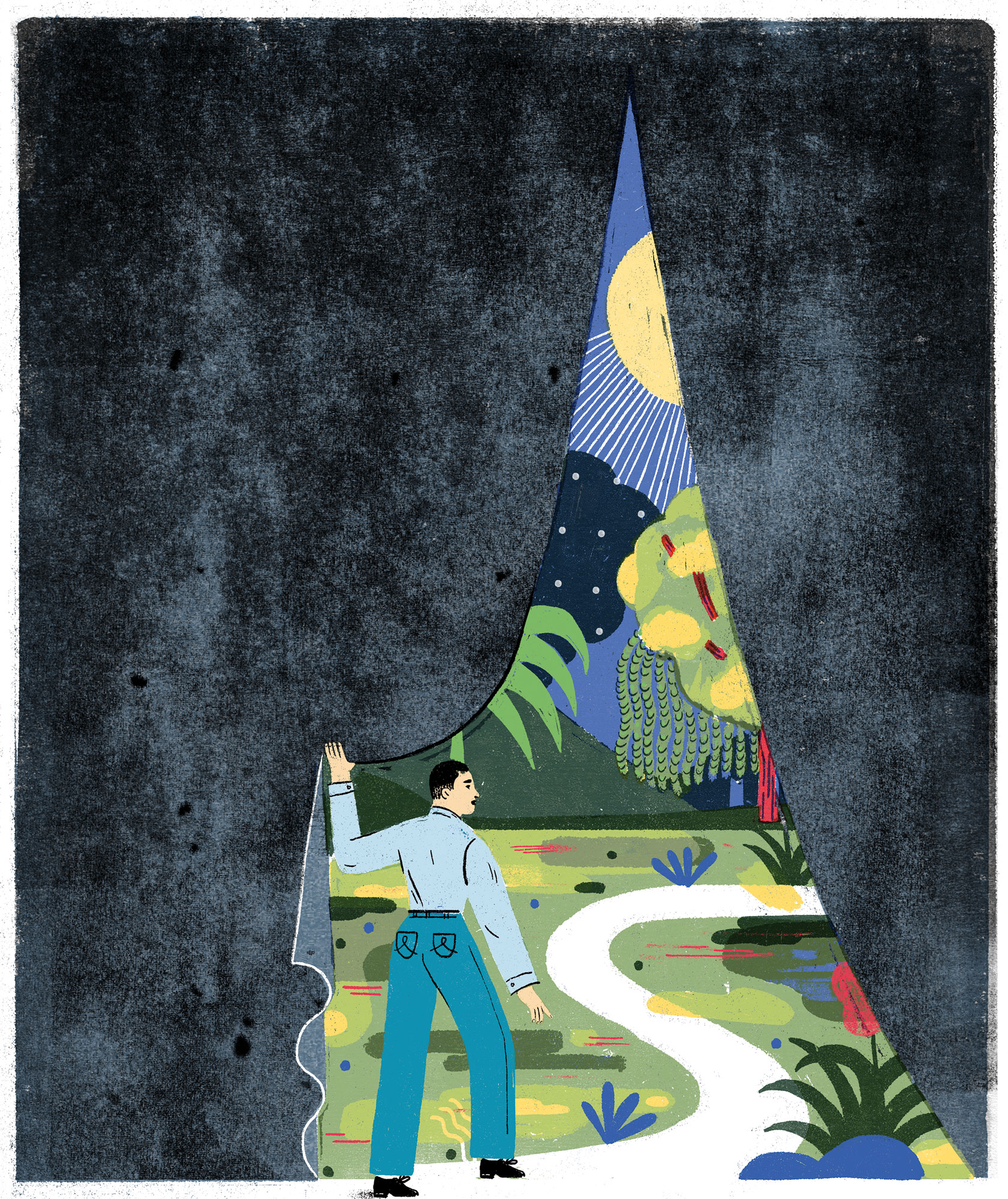
Seeing Success with New Eyes

by Chris Johnstone and Joanna Macy, an extract from the book Active Hope

Images from the buddhist platform Tricycle, with thanks

While having our heart in what we do is an essential part of what makes life satisfying, it isn’t enough. Repeated failure, frustration, and lack of progress can leave us wondering whether we’re wasting our time. It is difficult to stick to a path if we don’t see it going anywhere. So the way we understand and experience success affects our willingness to keep going.
The models of success we’re likely to have been given generally take us in the wrong direction. In the story of Business as Usual, success is measured in terms of wealth, fame, or position. A company making massive profits is regarded as successful, even when its ways of doing this harm its employees and our world. People are judged as successful simply because they have managed to acquire a vastly larger share of the world’s resources than they could ever need — at a time when hundreds of millions starve. It is the very hunger for this type of success that leads us, collectively, to plunder our planet.
With the consciousness shift of the Great Turning, we recognize ourselves as intimately connected with all life, like a cell within a “larger body. To call an individual cell “successful” while the larger body sickens or dies is complete nonsense. If we are to survive as a civilization, we need the intelligence to define success as that which contributes to the well-being of our larger body, the web of life. Commercial success is easy to count, but how do we count the success of contributing to planetary well-being? Do we experience this success often? And if not, what is getting in the way?

TRY THIS: REFLECTING ON SUCCESS

Taking your definition of success as that which contributes to the well-being of our world, how often do you feel you are succeeding?


We experience success when we reach a goal that is significant to us. But what if our goal is the elimination of poverty or the transition to a low-carbon economy? If the change we want doesn’t happen in our lifetime, does that mean we will never experience success? For the encouraging boost we get when we know we’re moving forward, we need to find markers of progress we can spot more easily and often. What helps here is making the distinction between eventual goals and intermediate ones.


The progressive brainstorming process (described in chapter 9 of the Active Hope book) began with longer-range, eventual goals. These are the things we would really like to see happen, even if we can’t immediately see how they will come about. We take one of these eventual goals and list some of the conditions needed to bring it about. So if our goal is the elimination of poverty, we would need to have in place widespread political will, new taxation policies, redistribution of resources, and the like. Then, taking one of these, we ask, “What would be needed for this?” Each stage moves us closer to our present situation. Before long, we’re identifying steps that are within our reach, such as eating lower in the food chain or setting up a study-action group on world hunger.
For any goal we choose to pursue, we track back in time to identify intermediate steps. Each time we take a step like this, we are succeeding. Instead of rushing on immediately to the next task, we can take a moment to savor these mini-victories. The following open sentence is a useful prompt for this process.

TRY THIS: SAVORING SUCCESS EVERY DAY with the following open sentence.

A recent step I’ve taken that I feel good about is…


There are steps we take that often don’t get counted, like the choice of where to place our attention. Just noticing that things are seriously amiss is a step on the journey. If we care enough to want to do something, that is also a significant mini-victory. Just to show up with bodhichitta is a success.


In a society that views success in competitive terms, it is usually only those recognized as “winners” who are applauded. We need to learn the skill of encouraging and applauding ourselves. We can reinforce our appreciation of the steps we take by imagining the support of the ancestors, the future beings, and the more-than-human world. When we develop our receptivity, we will sense them cheering us on. If we form a study-action group or build support in other ways, we can take time to do this for each other, noticing and appreciating what we’re doing well.
When we reflect on past successes, we can ask, “What strengths in me helped me do that?” Naming our strengths makes them more available to us. However, the challenges we face demand of us more commitment, endurance, and courage than we could ever dredge up out of our individual supply. That is why we need to make the essential shift of seeing with new eyes — it takes the process of strength recognition to a new level, that of the larger web of life. Just as we can identify with the suffering of other beings in in this web, so too can we identify with their successes and draw on their strengths. There is an ancient Buddhist meditation that helps us do this. It is called “the Great Ball of Merit” and it is excellent training for the moral imagination:

TRY THIS: THE GREAT BALL OF MERIT

Relax and close your eyes, relax into your breathing…Open your awareness to the fellow beings who share with you this planet-time…in this room…this neighborhood…this town. Open to all those in this country and in other lands…Let your awareness encompass all beings living now in our world.
Opening now to all time, let your awareness encompass all beings who have ever lived…of all races and creeds and walks of life, rich and poor, kings and beggars, saints and sinners…Like successive mountain ranges, the vast vistas of these fellow beings present themselves to your mind’s eye.
Now open to the knowledge that in each of these innumerable lives some act of merit was performed. No matter how stunted or deprived the life, there was at the very least one gesture of kindness, one gift of love, or one act of valor or self-sacrifice…on the battlefield or in the workplace, hospital or home…From each of these beings in their endless multitudes arose actions of courage, kindness, of teaching and healing…Let yourself see these manifold, immeasurable acts of merit. “Now imagine that you can sweep together these acts of merit. Sweep them into a pile in front of you. Use your hands…pile them up…pile them into a heap, viewing it with gladness and gratitude. Now pat them into a ball. It is the Great Ball of Merit. Hold it now and weigh it in your hands…Rejoice in it, knowing that no act of goodness is ever lost. It remains ever and always a present resource…a means for the transformation of life…So now, with jubilation and thanksgiving, you turn that great ball, turn it over…over…into the healing of our world.


The more we practice this meditation, the more familiar we become with the process of drawing strengths from outside our narrow self. Knowing about the Great Ball of Merit can also change the way we think about our own actions. Each time we do something, no matter how small, that is guided by bodhichitta and contributes to our world, we know we are adding to this abundance.