Articles, Events & Reviews, Uncategorized

Celebrating Mabon, the Autumn Equinox

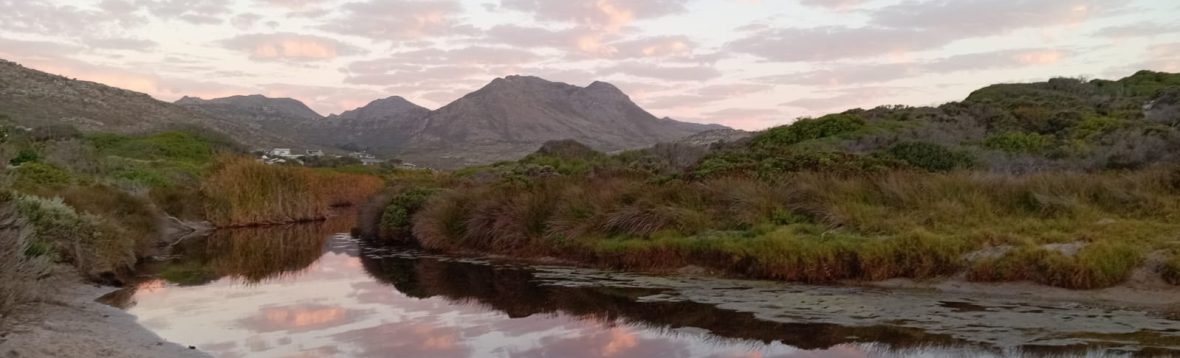
On 20 March here in the Southern Hemisphere we celebrated Mabon, or the Autumn Equinox.  Hosted by the Center, a beautiful venue in Noordhoek, we gathered to celebrate and offer our prayers.

Altar created by Luciana do Cabo, with gratitude

Like all sacred times, the Equinox is a perfect time to reflect on our inner spiritual work. Because we are a reflection of the universe surrounding us, what takes place outside must also occur within us. 

This time of year, as we move from summer to autumn, is the time of Harvest. The Earth, by this time of year, has given us everything. Fruits, grains, and vegetables. Now, tired and withered, she lies down to rest. At this time, we can give thanks for the abundance of the Earth, and all that she provides. Equally it is an opportunity to reflect on the abundance in each of our lives, and all the things we can be grateful for. It is an opportunity to turn within and to reflect on what gifts, strengths, experiences and skills we can harvest and take forwards with us into the darker months.  

What are you grateful for?  What life lessons have helped you learn and grow? What can you harvest internally that may be supportive in the coming months?  

The Equinox, both Autumn and Spring, is the only time when both the northern and southern hemispheres experience roughly equal amounts of daytime and night-time. These are the days when the sun is exactly above the equator making day and night equal in length.  Equinox is a Latin word that means ‘equal night; – It is the time of equal day and night.

Energetically, the Autumn Equinox is a time of balance and pause, a transitional moment between the bright half of the year and the dark half of the year.  This time brings the light and darkness to the front together, neither one preceding nor following the other. Spiritual guidance can be taken from this rhythm of nature. The Autumn Equinox is a perfect time to consider and invite balance into your life – shadow and light, inner and outer, masculine and feminine, the dance between ego and Soul.

Take a moment to slow down and listen inwardly. Is there something your body is asking you for? In which areas of life do you need to re-find balance?

To think of the Equinoxes and Solstices in terms of a life, the year is “born” on the winter solstice, matures at the spring equinox, and reaches the prime of life at the summer solstice. The autumnal equinox marks the descent into old age, and, finally, the moment of the winter solstice marks simultaneous death and rebirth, starting the cycle anew.                       

And so, from a spiritual growth perspective, Autumn is about endings, as reflected in our natural environment, with the trees losing their leaves and plants dying off. It’s all a very natural process. And so the Autumn is also a time to descend into one’s own darkness. Darkness, when ignored and exiled, grows and takes over. But when given the opportunity to be worked with and exposed, provides an opportunity for growth once the light returns. 

Autumn is a time to feel into the areas of your life that need to be let go of, consider what no longer serves you, gets in your way, and needs to wither.  Remember—we all have leaves, of a sort. For a time, they gather energy unto us, but at a certain point, they no longer serve us. They lose their chlorophyll, turn brown, wither, and must be released. As you watch those earthly leaves fall to the ground to nourish the next generation of nature, consider your own leaves.

What do you need to let go? Are you allowing for this release or are you hanging on to the dead?

I’m so grateful for the opportunity to celebrate these ceremonies of the ‘Wheel of the Year’, an annual cycle of seasonal festivals that were celebrated by our foremothers and fathers.  As we find ourselves in the midst of ecological chaos, one of the most potent ways for us to find ways to come back into balance with the earth is to reconnect to her seasons and cycles, honouring these, as we learn to tune in, celebrate and adapt to her natural cycles. Happy Equinox everyone.

Articles, Uncategorized

Narcissists and psychopaths: how some societies ensure these dangerous people never wield power

Originally written by Steve Taylor, Senior Lecturer in Psychology, Leeds Beckett University, and published in theconversation.com.

Throughout history, people who have gained positions of power tend to be precisely the kind of people who should not be entrusted with it. A desire for power often correlates with negative personality traits: selfishness, greed and a lack of empathy. And the people who have the strongest desire for power tend to be the most ruthless and lacking in compassion.

Often those who attain power show traits of psychopathy and narcissism. In recent times, psychopathic leaders have been mostly found in less economically developed countries with poor infrastructures and insecure political and social institutions. People such as Saddam Hussein in Iraq, Muammar Gaddafi in Libya and Charles Taylor in Liberia.

But modern psychopaths generally don’t become leaders in affluent countries (where they are perhaps more likely to join multinational corporations). In these countries, as can be seen in the US and Russia, there has been a movement away from psychopathic to narcissistic leaders.

After all, what profession could be more suited to a narcissistic personality than politics, where the spotlight of attention is constant? Narcissists feel entitled to gain power because of their sense of superiority and self-importance.

Those with narcissistic personalities tend to crave attention and admiration and feel it is right that other people should be subservient to them. Their lack of empathy means they have no qualms about exploiting other people to attain or maintain their power.

Meanwhile, the kind of people who we might think are ideally suited to take on positions of power – people who are empathetic, fair minded, responsible and wise – are naturally disinclined to seek it. Empathetic people like to remain grounded and interact with others, rather than elevating themselves. They don’t desire control or authority, but connection, leaving those leadership roles vacant for those with more narcissistic and psychopathic character traits.

Different types of leader


Yet it would be misleading to say it is only psychopaths and narcissists who gain power. Instead, I would suggest that there are generally three types of leaders.

The first are accidental leaders who gain power without a large degree of conscious intention on their part, but due to privilege or merit (or a combination). Second are the idealistic and altruistic leaders, probably the rarest type. They feel impelled to gain power to improve the lives of other people – or to promote justice and equality, and try to become instruments of change. But the third are the narcissistic and psychopathic leaders, whose motivation for gaining power is purely self-serving.

This doesn’t just apply to politics, of course. It’s an issue in every organisation with a hierarchical structure. In any institution or company, there is a good chance that those who gain power are highly ambitious and ruthless, and lacking in empathy.

Narcissistic leaders may seem appealing because they are often charismatic (they cultivate charisma in order to attract attention and admiration). As leaders they can be confident and decisive and their lack of empathy can promote a single-mindedness which can, in some cases, lead to achievement. Ultimately though, any positive aspects are far outweighed by the chaos and suffering they create.

An anti-Trump demonstration in Washington DC. Shutterstock/bakdc
What is needed are checks to power – not just to limit the exercise of power, but to limit its attainment. Put simply, the kind of people who desire power the most should not be allowed to attain positions of authority.

Every potential leader should be assessed for their levels of empathy, narcissism or psychopathy to determine their suitability for power. At the same time, empathetic people – who generally lack the lust to gain power – should be encouraged to take positions of authority. Even if they don’t want to, they should feel a responsibility to do so – if only to get in the way of tyrants.

Models of society

There are many tribal hunter-gatherer societies where great care is taken to ensure that unsuitable individuals don’t attain power.

Instead, anyone with a strong desire for power and wealth is barred from consideration as a leader. According to anthropologist Christopher Boehm, present-day foraging groups “apply techniques of social control in suppressing both dominant leadership and undue competitiveness”.

If a dominant male tries to take control of the group, they practise what Boehm calls “egalitarian sanctioning”. They team up against the domineering person, and ostracise or desert him. In this way, Boehm says, “the rank and file avoid being subordinated by vigilantly keeping alpha-type group members under their collective thumbs”.

Just as importantly, in many simple hunter-gatherer groups power is assigned to people, rather than being sought by them. People don’t put themselves forward to become leaders – other members of the group recommend them, because they are considered to be experienced and wise, or because their abilities suit particular situations.

San hunter gatherers in Southern Africa

In some societies, the role of leader is not fixed, but rotates according to different circumstances. As another anthropologist, Margaret Power, noted: “The leadership role is spontaneously assigned by the group, conferred on some members in some particular situation … One leader replaces another as needed.”

In this way, simple hunter-gatherer groups preserve stability and equality, and minimise the risk of conflict and violence.

It’s true that large modern societies are much more complex and more populous than hunter-gatherer groups. But it may be possible for us to adopt similar principles. At the very least, we should assess potential leaders for their levels of empathy, in order to stop ruthless and narcissistic people gaining power.

We could also try to identify narcissists and psychopaths who already hold positions of power and take measures to curtail their influence. Perhaps we could also ask communities to nominate wise and altruistic people who would take an advisory role in important political decisions.

No doubt all this would entail massive changes of personnel for most of the world’s governments, institutions and companies. But it might ensure that power is in the hands of people who are worthy of it, and so make the world a much less dangerous place.

With much gratitude for this insightful article. Gaia Speaking

Articles, Resources & Networks, Uncategorized

Meet the Doughnut and the concepts at the heart of Doughnut Economics

Who would have thought that doughnuts could change the world?

by Joanna Tomkins

They certainly get our attention, don’t they? In the same way we may ourselves once have been addicted to eating doughnuts, our policies are still addicted to promoting growth, even if it harms us each and and every time.

But… now we have got your attention, as you will see hereunder in the graphics, the doughnut in this model is in fact the shape that represents a “safe and just space for humanity”

The text hereunder, originally published on the DEAL website, offers a comprehensive and convincing introduction to the Doughnut or Donut model. This umbrella is very exciting because its design has enough strength and simplicity to allow policy makers to regroup under it. I personally studied international business at university in France and Spain and I was so put off by some of the contents of the studies, particularly the economical theories, seminars with bankers and practicals in marketing, that I swore to never work for a large corporation. Much later, after I rerouted my career towards arts and also started to work in Africa as a wilderness guide, I went back to university in Barcelona to study Post-developmental African Studies. This was before I moved to Cape Town, wanting to learn about some of the original philosophies on the Continent and the forces at work behind the neocolonialism that still stifle them today. I rallied around the ideas of Serge Latouche (Farewell to Growth, 2007) and his peers. Since the 1980s, voices such as his have been loudly coining terms such as “economical footprint”, “eco-feminism, “overshoot”, etc, and claiming urgency. Yet, those voices have been drowned by the constantly renewed pressure from the Industrial Growth Society.

Finally, in the last few years, at the same time as a larger part of humanity starts to call for socio-economical justice – the one with the privilege to do so and be heard- , some strong, credible and conscious voices have created new alternative economical models that can be understood by many. They are now becoming mainstream and can offer politicians solid solutions to build resilience in the communities whose welfare they are responsible for. Gratitude.

If you are interested in learning more, please read some of the Stories on DEAL. This one for example about how the model has been adopted by 5 major cities around the world:

If you know how this model could be introduced to the University of Cape Town, or the City of Cape Town, please get in touch with me, I’d love to get involved.

Introduction

The Doughnut offers a vision of what it means for humanity to thrive in the 21st century – and Doughnut Economics explores the mindset and ways of thinking needed to get us there.

First published in 2012 in an Oxfam report by Kate Raworth, the concept of the Doughnut rapidly gained traction internationally, from the Pope and the UN General Assembly to Extinction Rebellion.

Kate’s 2017 book, Doughnut Economics: seven ways to think like a 21st century economist,  further explored the economic thinking needed to bring humanity into the Doughnut, drawing together insights from diverse economic perspectives in a way that everyone can understand. The book has now been published in over 20 languages.

This 2018 TED talk gives a summary of the book’s core messages, and you can read Chapter One here..

The Doughnut’s holistic scope and visual simplicity, coupled with its scientific grounding, has turned it into a convening space for big conversations about reimagining and remaking the future. It is now being discussed, debated and put into practice in education and in communities, in business and in government, in towns, cities and nations worldwide.

Kate Raworth

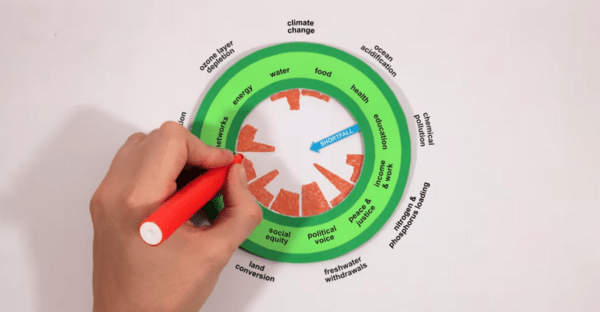
The Doughnut of social and planetary boundaries.

What is the Doughnut?

Think of it as a compass for human prosperity in the 21st century, with the aim of meeting the needs of all people within the means of the living planet.

The Doughnut consists of two concentric rings: a social foundation, to ensure that no one is left falling short on life’s essentials, and an ecological ceiling, to ensure that humanity does not collectively overshoot the planetary boundaries that protect Earth’s life-supporting systems. Between these two sets of boundaries lies a doughnut-shaped space that is both ecologically safe and socially just: a space in which humanity can thrive.

What is Doughnut Economics?

If the 21st century goal is to meet the needs of all people within the means of the living planet – in other words, get into the Doughnut – then how can humanity get there? Not with last century’s economic thinking.

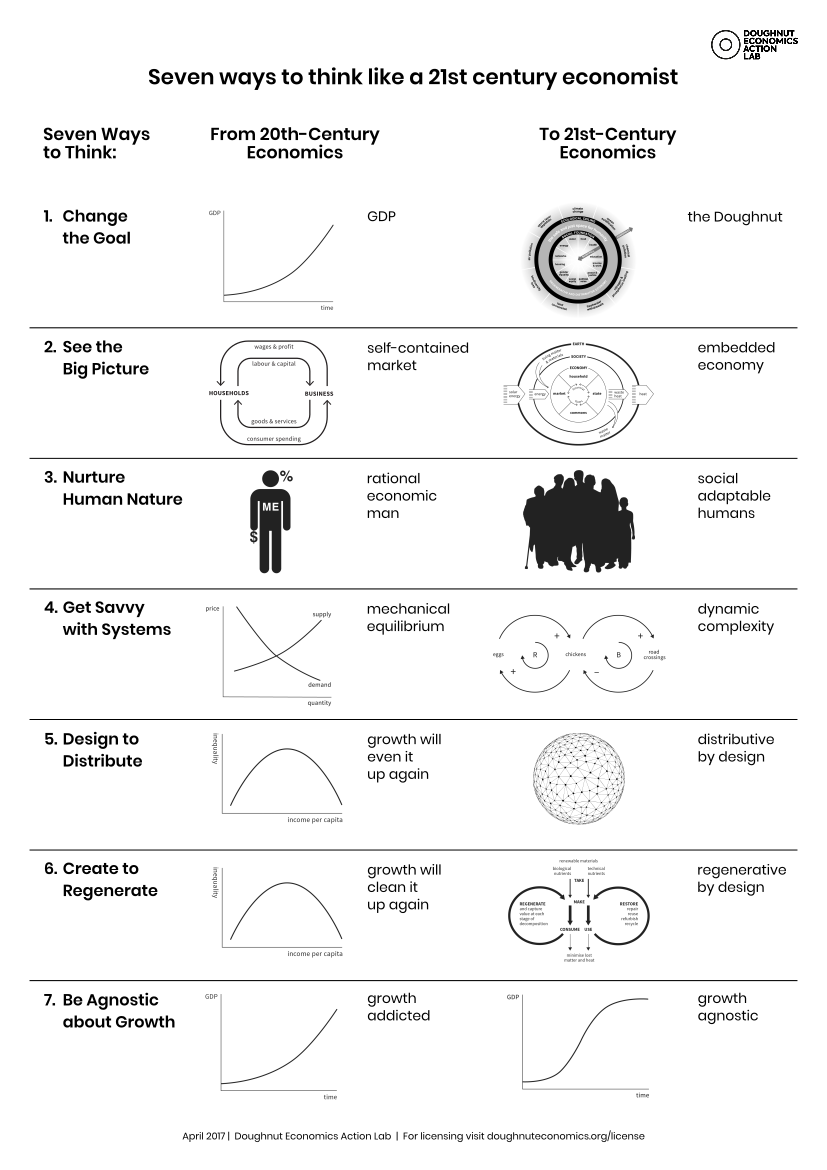
Doughnut Economics proposes an economic mindset that’s fit for our times. It’s not a set of policies and institutions, but rather a way of thinking to bring about the regenerative and distributive dynamics that this century calls for. Drawing on insights from diverse schools of economic thought – including ecological, feminist, institutional, behavioural and complexity economics – it sets out seven ways to think like a 21st century economist in order to transform economies, local to global.

The starting point of Doughnut Economics is to change the goal from endless GDP growth to thriving in the Doughnut. At the same time, see the big picture by recognising that the economy is embedded within, and dependent upon, society and the living world. Doughnut Economics recognises that human behaviour can be nurtured to be cooperative and caring, just as it can be competitive and individualistic.

It also recognises that economies, societies, and the rest of the living world, are complex, interdependent systems that are best understood through the lens of systems thinking. And it calls for turning today’s degenerative economies into regenerative ones, and divisive economies into far more distributive ones. Lastly, Doughnut Economics recognises that growth may be a healthy phase of life, but nothing grows forever: things that succeed do so by growing until it is time to grow up and thrive instead.

Dive deeper into the seven ways to think like a 21st century economist with our series of 90-second animations

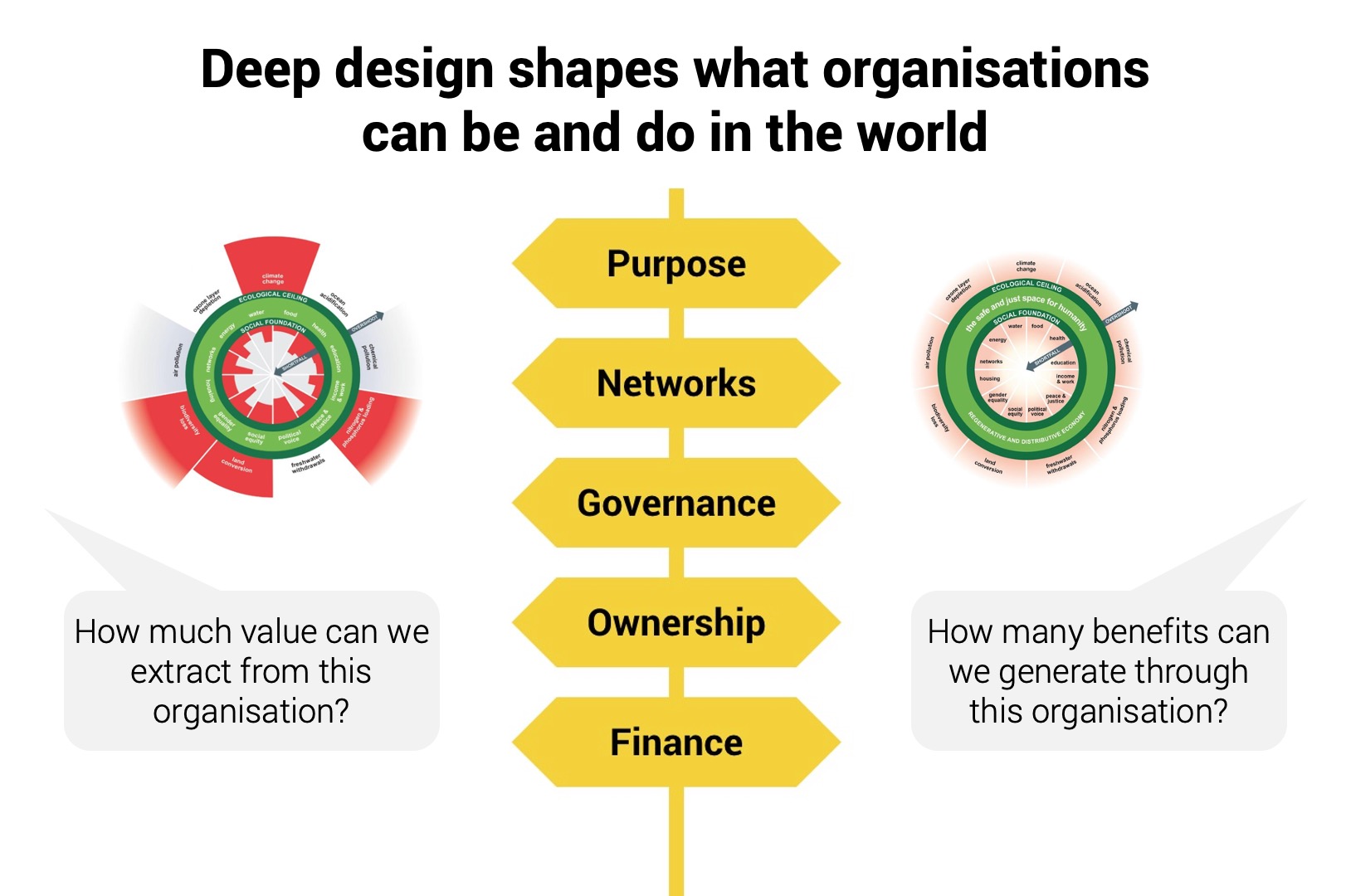
The five layers of organisational design.

Why design matters

What would make it possible for an organisation to become regenerative and distributive so that it helps bring humanity into the Doughnut? DEAL has run workshops with enterprises, city departments, foundations, and other kinds of organisations that want to explore this question, and the implications are transformational.

At the heart of these workshops is a focus on design: not the design of their products and services, or even of their office buildings, but the design of the organisation itself. As described by Marjorie Kelly, a leading theorist in next-generation enterprise design, there are five key layers of design that powerfully shape what an organisation can do and be in the world:

Purpose. Networks. Governance. Ownership. Finance.

Together these five aspects of organisational design profoundly shape any organisation’s ability to become regenerative and distributive by design, and so help bring humanity into the Doughnut. 

Doughnut Principles of Practice

To ensure the integrity of the ideas of Doughnut Economics, we ask that the following principles are followed by any initiative that is working to put the ideas of Doughnut Economics into practice.
Embrace the 21st Century Goal

Aim to meet the needs of all people within the means of the planet. Seek to align your organisation’s purpose, networks, governance, owner-ship and finance with this goal.

See the big picture

Recognise the potential roles of the household, the commons, the market and the state – and their many synergies – in transforming economies. Ensure that finance serves the work rather than drives it.

Nurture human nature

Promote diversity, participation, collaboration and reciprocity. Strengthen community networks and work with a spirit of high trust. Care for the wellbeing of the team.

Think in systems

Experiment, learn, adapt, evolve and aim for continuous improvement. Be alert to dynamic effects, feedback loops and tipping points.

Be distributive

Work in the spirit of open design and share the value created with all who co-created it. Be aware of power and seek to redistribute it to improve equity amongst stakeholders.

Be regenerative

Aim to work with and within the cycles of the living world. Be a sharer, repairer, regenerator, steward. Reduce travel, minimize flights, be climate and energy smart.

Aim to thrive rather than to grow

Don’t let growth become a goal in itself. Know when to let the work spread out via others rather than scale up in size.

Be strategic in practice

Go where the energy is – but always ask whose voice is left out. Balance openness with integrity, so that the work spreads without capture. Share back learning and innovation to unleash the power of peer-to-peer inspiration.

Articles, Uncategorized

The great African regreening: millions of ‘magical’ new trees bring renewal

By Ruth Maclean for the Upside, the Guardian

First published on Thursday 16 Aug 2018

Farmers in Niger are nurturing gao trees to drive Africa’s biggest environmental change

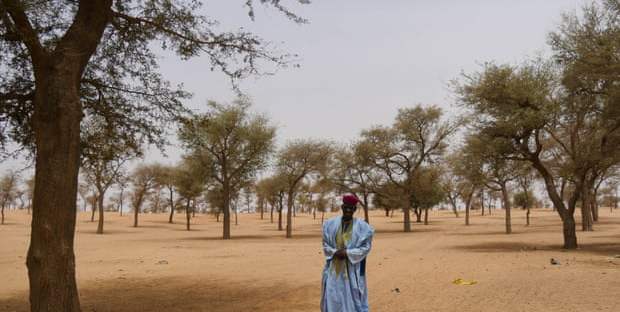
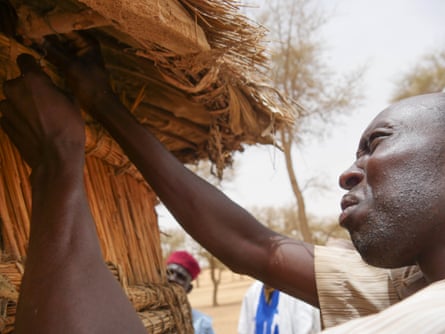
Rain had come to nearby villages, but not yet to Droum in south-east Niger. The sand under its stately trees looked completely barren, but Souley Cheibou, a farmer in his 60s, was not worried. He crooked a finger, fished in the sand, and brought out a millet seed. In a week or two, this seed would germinate and sprout, and soon the whole field would be green.

Cheibou’s peace of mind stemmed from the trees encircling him, which had been standing long before he was born. Despite appearances, these were not any old acacias. They were gao trees – known as winterthorns in English – with unique, seemingly magical powers.

From the peanut basin of Senegal to the Seno plains of Mali, to Yatenga, formerly the most degraded region of Burkina Faso, and as far south as Malawi: gaos are thriving in Africa. And over the past three decades, the landscape of southern Niger has been transformed by more than 200m new trees, many of them gaos. They have not been planted but have grown naturally on over 5m hectares of farmland, nurtured by thousands of farmers.

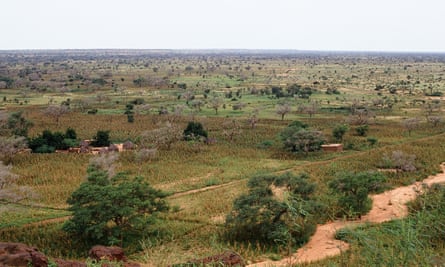
Near Dogondoutchi, about 200 km east of Niamey. The setting is in a “Dallol” which is a broad, sandy valley completely devoted to rainfed cropland.
A valley near the town of Dogondoutchi in the east of Niger. The valley is completely devoted to rainfed cropland. Photograph: Gray Tappan

According to scientists, what has happened in Niger – one of the world’s poorest countries – is the largest-scale positive transformation of the environment in the whole of Africa. This is not a grand UN-funded project aiming to offset climate change. Small-scale farmers have achieved it because of what the trees can do for crop yields and other aspects of farming life.

“It’s a magic tree, a very wonderful tree,” said Abasse Tougiani of Niger’s National Institute of Agricultural Research, who has travelled all over Niger studying Faidherbia albida – the gao’s Latin name.

Shielded from the sun, crops planted under the canopy of a tree usually do not do well in the short term, although there can be longer-term benefits. That’s one reason why many west African rainforests have been decimated. But with gaos, it’s the other way round. The root system of the gao is nearly as big as its branches, and unusually it draws nitrogen from the air, fertilising the soil. And unlike other trees in the area, gao tree leaves fall in the rainy season, allowing more sunlight through to the crops at a key moment.

Used along with mineral fertilisers, crop yields double under gaos, and the gao-nourished soil holds water better, ensuring a better crop in drought years.

A seed-pod of the gao tree.
A seed-pod of the gao tree. Photograph: Ruth Maclean/Ruth Maclean for the Guardian

Counterintuitively, the great gao regreening is only happening in areas of Niger with high-density populations. With less space to expand into as more people are born, hard-up farmers are increasingly realising that the trees can regenerate degraded land.

“It’s literally a story of more people, more trees,” said Chris Reij, a sustainable land management specialist. “The whole point is that the trees are not protected and managed by farmers for their environmental beauty, but because they are part of the agricultural production system.”

Inadvertently, the farmers are also doing their bit to offset climate change. Trees are crucial for storing carbon, absorbing it out of the atmosphere. “In mature, fairly dense areas, you get 30 tons of wood per hectare. Half of that is carbon,” said Gray Tappan, a geographer.

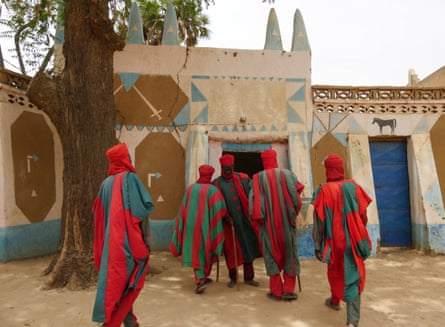
The guards of Droum gather outside the district chief’s palace.
The guards of Droum gather outside the district chief’s palace. Photograph: Ruth Maclean/Ruth Maclean for the Guardian

Efforts to restore 100m hectares of degraded African land by 2030 are underway. The ambitious Great Green Wall project to surround the Sahara desert with trees and other plants has changed beyond recognition after debate over whether desertification – the process by which soil loses its fertitlity – is realProgress is slow. In Niger, where temperatures often reach the 40s, the trees create a cooler microclimate, and rabbits and jackals are coming back.

But none of these grand political projects explains why gaos have caught on. The trees’ pods make very nutritious animal fodder, and fallen branches make good firewood, meaning Droum’s women and children – whose job it is to collect fuel for cooking fires – rarely have to venture further than a few kilometres to find it.

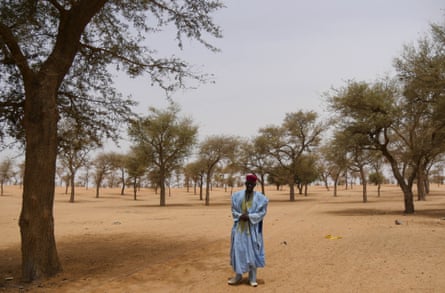
A Droum resident with the village’s mature gao trees.
A Droum resident with the village’s mature gao trees. Photograph: Ruth Maclean/Ruth Maclean for the Guardian

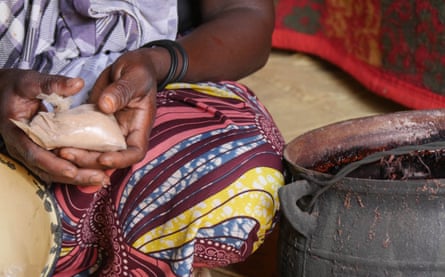
Women in Droum have also made medicine from their gaos for generations. “People come all the way from Zinder [Niger’s second largest city] to buy it,” said Husseina Ibrahim, a busy mother, next to a pot of boiling gao bark. “I’m the only one who makes this here. It’s great for me, it earns me a bit of money which I pay into the women’s cooperative.”

Tales about how the gao came to be so revered abound. Legend has it that crimes against gaos have been taken very seriously since the mid-19th century. “If you touched a branch, you would go to jail,” Tougiani said. In splendid brocade robes and curly-toed velvet slippers, surrounded by self-portraits and stick-wielding guards dressed in red and green, today’s district chief in Droum takes a slightly softer approach.

Gao bark powder and infusion, which locals say cures haemmerhoids.
Gao bark powder and infusion, which locals say cures haemmerhoids. Photograph: Ruth Maclean/Ruth Maclean for the Guardian

“It’s shameful to have to come before the chief and explain yourself. Often that’s punishment enough,” Maman Ali Kaoura said. Droum’s reoffenders face fines of between 5,000 to 10,000 West African CFA francs (€8 to 15), a huge amount for hard-up farmers.

A sense of ownership has been key in the regreening of Niger. Until the mid-1980s, every tree was considered to belong to the state. When this changed, regreening began, as people were happier to look after trees that belonged to them. In areas with the best cover, they organised patrols to protect their trees from passing farmers and neighbouring villagers seeking firewood.

Once people discovered that “one gao was equal to 10 cows” for fertilising, as Tougiani put it, the tree’s popularity took off. Several schemes, including one where farmers with more than 50 gaos were paid 50 CFA for each one, helped it along.

A Droum farmer opens his millet store.
A Droum farmer opens his millet store. Photograph: Ruth Maclean/Ruth Maclean for the Guardian

But their loyalty to their gaos could make areas around Zinder the most vulnerable to a disease that Reij and Tougiani have recently spotted killing trees near Niamey, the capital. If it spreads, the losses could be enormous, particularly in places where there is a near-monoculture of gaos.

“I’m worried, because it’s green oil for farmers – it’s their wealth,” said Tougiani. “If they lose Faidherbia albida, they’ll lose their way of life. They’ll have to leave the village.”

For Cheibou, losing his trees is unthinkable – they were his birthright. “I have nearly 100 gao trees in my fields, which I inherited from my father,” he said. On his way back to the village, he paused by a particularly large one, and cracked open its round seedpod. “This one was here when I was a boy. Just like it is now.”

A note from the Guardian:

Ever wondered why you feel so gloomy about the world – even at a time when humanity has never been this healthy and prosperous? Could it be because news is almost always grim, focusing on confrontation, disaster, antagonism and blame?

This series is an antidote, an attempt to show that there is plenty of hope, as our journalists scour the planet looking for pioneers, trailblazers, best practice, unsung heroes, ideas that work, ideas that might and innovations whose time might have come.

Readers can recommend other projects, people and progress that we should report on by contacting us at theupside@theguardian.com

A note from Gaia Speaking to the Guardian:

We thank you for your independent journalism, which is such an important aspect of the Great Turning, your holding actions create awareness around the negative and the positive actions of thousands of individuals and corporations worldwide. Your writing in turn sparks initiatives in people’s hearts, by informing them about issues that would otherwise go unnoticed, but also by giving them hope through a sense of possibility and togetherness with stories like this one. Gratitude.

Subscribe to the Upside here:

https://www.theguardian.com/world/2018/feb/12/the-upside-sign-up-for-our-weekly-email

And support the Guardian’s fearless, leader-read, independent journalism here:

https://support.theguardian.com/

Articles, Resources & Networks

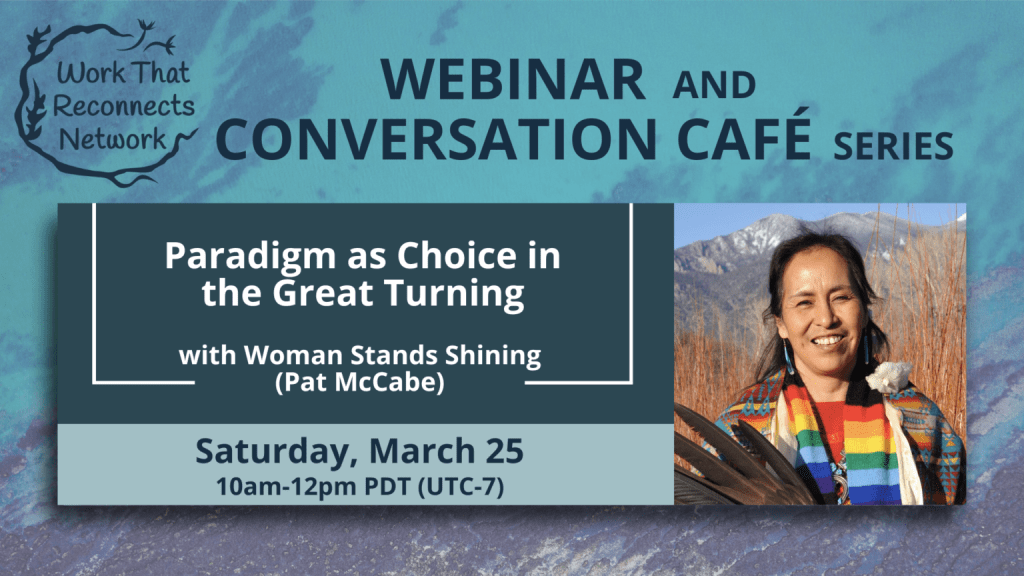
Paradigm as Choice in the Great Turning

with Woman Stands Shining (Pat McCabe)

One of the most invigorating experiences for me in the last two years, since I became a WTR facilitator – and recently also as volunteer for the International WTR Network, is to listen to the conversations that take place on the WTR webinars. I feel such relief when I hear my thoughts reflected in the words of others in such a away.

I highly recommend to browse through the recording that are on the page below and listen to some of them. Even in the aftermath, the buzz of the Community that gather around these thoughts is tangible, and I’m sure you will gain a lot of insight and inspiration.

A lot of links are shared, so you will find the experience grows your branches out towards other authors and thinkers too.

WEBINAR AND CONVERSATION CAFÉ SERIES – click here

And if you prefer to be present in live, please don’t miss the one coming this month, on Saturday, 25th March at 9 am PST or 20 pm SAST (in South Africa). Here’s the link to join and a bit more info. I’ll be there.

Join the international network mailing list on their website if you want to received future notifications.

Hereunder is the information published on the WTR international site.

Much love and gratitude, Joanna


Register for this webinar here

The suggested requested donation for this webinar is between $25-$35USD. However, no one will be turned away for lack of funds. Please donate generously within your means but feel free to join us even if you can’t contribute financially. 

The Great Turning requires profound shifts in consciousness and in our perceptions of reality. In a society that’s so heavily influenced by the Power Over Paradigm that defines reality in static, concrete terms, we often don’t realize that it’s within our ability to choose to see and experience reality through different paradigmatic lenses.

As a holy earth surface walker of the Dine’ people, Woman Stands Shining (Pat McCabe) understands that the Power Over Paradigm is not the only way to understand and move through reality. She knows that the Earth operates within the Thriving Life Paradigm and that it is well within our ability to choose alignment with that paradigm.

Join us in a rich conversation as we explore our capacity, as humans, to participate with Earth in service to Thriving Life and muse on questions like:

  • What structures (hidden, overt, internal, external) exist to keep the Power Over Paradigm firmly in place?
  • How can we, here and now, wherever we are, cultivate a Thriving Life Paradigm within our own consciousness and in the world around us?
  • What are some radical, joyful, meaningful ways to step into that lifegiving empowerment?

We highly recommend listening to this episode of the Science and Nonduality (SAND) podcast with Woman Stands Shining (Pat McCabe) before our live webinar, if you’re able. It’s not required at all, but is a perfect lead-in for the conversation we’ll be having on March 25th. 

Woman Stands Shining (Pat McCabe), is of the Diné Nation (often known incorrectly as “Navajo”), and was also adopted into the Lakota Spiritual way of Life. She is a mother, grandmother, activist, artist, and international speaker. She identifies as a “radical bridger” of worlds and paradigms, with a focus on sharing from her own deep inquiry into Thriving Life Paradigm: “How do I become that being, that human, whose presence and way of being supports and causes all other life to Thrive?” She calls upon her lived experience from her indigenous cultures to make hypotheses and proposals to “Modern World Paradigm” as all of humanity is faced with its current crisis of relationship, with ourselves, with each other, and with the Earth.

Articles, Resources & Networks

The Work that Reconnects International Network, Going Forth

The Weavers and Volunteers working for The Work that Reconnects International Network are currently preparing a new website and an important online conference, both due later this year, in a huge collective effort to share wider and louder the valuable support resources that the network offers.

The Gaian Gathering has been in the collective dreams of the network for several years and 2023 is the year it comes into fruition! This global summit will combine online events and guided gatherings of local communities around the world. Watch out for further updates!

In the past years, the organisation has both strengthened and widened its web, by inviting in much novelty in all areas of thinking, being and doing. This represents a vast attempt to move away from the old paradigm, opening up to the astounding potential of transformation that is awakening in us at these times of the Great Turning. Some of the themes for reflection that have been highlighted over the last few years have been included on the website under the umbrella “Evolving Edge”.

This new breadth encourages more resilience within the network by shifting our patterns of thought, encouraging discussions and resources around topics such as white privilege, trauma informed practices, undoing oppression, collective and ancestral trauma, etc…

Secondly, the ongoing evolution of the network also intelligently considers the emergence of more multidisciplinary formats and specific applications for the original Work that Reconnects methodology. Indeed, whilst all the workshops and events by registered facilitators are always inspired by the Foundations of the Work that Reconnects and its Spiral, they now often are themed in areas like the Arts, Permaculture, Nature Quests, Parenting, etc. This allows the Work to expand as a tool in wider, younger and more active circles. And of course since 2020, many new formats have emerged online, following broad acceptance on distance workshopping by audiences worldwide.

And thirdly, I would add that some of the the other aspects that make the Work that Reconnects so stable in these wobbly times are its inherent diversity and inclusivity. Indeed, Joanna Macy already included different fields of knowledge in the philosophy at the roots of the Work, from indigenous wisdom to buddhist principles, or from deep ecology to systems thinking. She thereby made sure to utilise the principles at the base of the most resilient strains of knowledge available on Earth and inspired by Earth. Additionally, the co-founders guaranteed that the training remained open source, so as to make it available to a wide variety of facilitators worldwide, independently of their area of activism, location or income.

Increasingly, the resources and practices of the Work that Reconnects are incorporating contributions by activists from a variety of influential organisations worldwide, helped by the ease of online conversations and events. These activists often in turn have been inspired by the Work that Reconnects or Joanna Macy over the years and this reciprocity is at the base of the strength of this web.

Most of the recordings of the webinars organised over the last few years are available here:

Above is the last one I watched. As always, I found it revitalising and brimming with active hope and insight.

We invite you to join the Community as a Friend of the network if you have not already on https://workthatreconnects.org/register/

You will also receive the Deep Times Newsletter termly. Watch out for the next edition which talks about the vocabulary of these shifting times. The more we consolidate the “Gaianist” vocabulary, the more emergence and resilience can be birthed… Think “Great Turning”, “Business as Usual”, “Post-colonialism”, “Whiteness”, “Ecological Civilisation”, etc… We need a solid ground of expression to move forward as one humanity.

Articles

Envisioning the Transition to an Ecological Economy…

Professor Brannon Andersen explores some of the key challenges, potentials, and mechanisms to transition to a sustainable economy. Not easy, but as he notes, possible—if we all start rolling up our sleeves and building a new system in the cracks of the current one. Originally published in Gaianism.org

Mind the cliff at the end!

The current global, neoliberal capitalist economic system, reliant on perpetual growth, is incompatible with an ecological civilization. David Korten calls it a “suicide economy” because the extraction of resources and production of waste is undermining the very foundation of civilization by destroying the ecosystems on which it depends. The many consequences are unsustainable both socially and environmentally, and are accelerating.

So what would an alternative look like?

An ecological civilization would recognize the proper position of the economy within Gaia. The economy is a subsystem of society, and society is a subsystem of the planetary environment. Thus, the economic system must be redesigned to serve society and function within the biophysical limits of Earth. From a systems perspective, the system goal must change from exponential growth in profits at any cost to the wellbeing of the planet and people. An ecological civilization would require a radical, and rapid, change in cultural values and worldviews, as pointed out in at least three of the YES! articles.

The scale of the economy must be far smaller, local, and decentralized (Trainer 2020). The purpose of profit would shift from private accumulation to investment in public wealth. This would be a radical departure from our current materialist, consumer-based society.

The End of Growth

[…] A system goal of ever increasing growth in profit results in a system structure that leads to social inequality and environmental degradation as features of the system. Feedback loops in the system reinforce political capture by the wealthy elite and wage suppression of workers, increase consumption, and siphon wealth from the real economy into the elite financial economy, all to increase profits. The system overproduces material goods, then creates demand via advertising, media exposure, and perceived and planned obsolescence, all geared to increase consumption. Increased production drives extraction, consumption of resources, and production of waste which drives environmental degradation. Thus, we need an economic system that is not based on growth in profits. In fact, we need to degrow the material and energy throughput of the global economy to achieve sustainability.

The scale of degrowth required is staggering. Currently, the exponentially growing global material footprint is over 95 Gt/year. The estimated sustainable material footprint is around 6-8 tonnes per person annually, or around 50 Gt/year globally. Consumption is vastly unequal—the material footprint of an American is about 30 tonnes/person/year, whereas an Ethiopian is 0.47 tonnes/person/year. Thus, we must shrink and share consumption to achieve global sustainability. Wealthy countries must reduce their material footprints by anywhere from 60-90% and their carbon footprints by as much as 95%. The magnitude of this shift to a frugal, materially sufficient, localized, low-technology lifestyle is difficult to imagine. And […] the globally interconnected economy makes downscaling very difficult. Reformist strategies such as taxing consumption leaves capitalism in place and is not a path to sustainability.

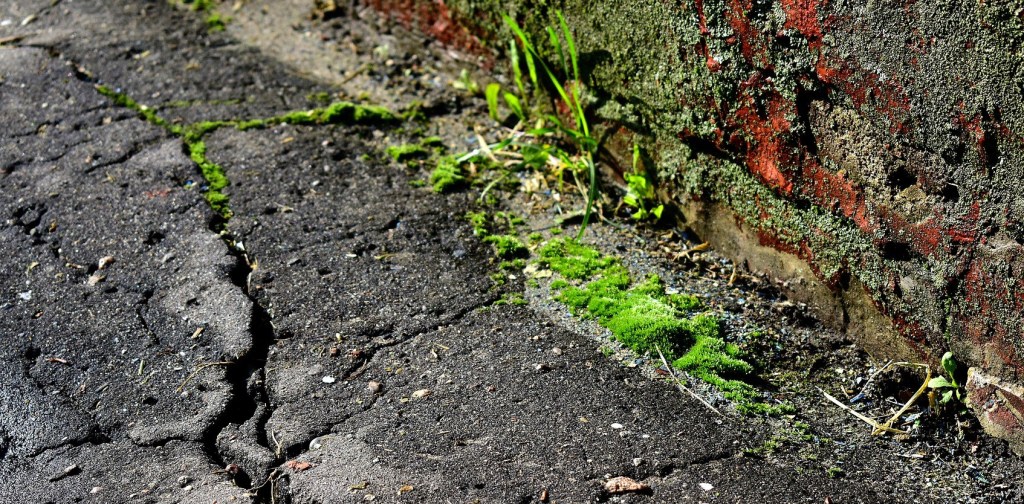
We can build the new system within the cracks of capitalism…

Pr. Brannon Andersen

Building the Next System

We need a major change in societal goals (the system goal) and the cultural values and worldviews that stem from a new societal goal. Trainer suggests a “world view which is basically collectivist, cooperative and concerned to nurture other individuals and the community” in which material sufficiency and public wealth would be valued over private accumulation. Healthcare, education, energy, housing, water, and so on, would be considered public goods available to all rather than private commodities designed to maximize profit. This transition won’t be easy, of course, and the tension between the need for a “next system” and the power of the current capitalist system are captured well in the “Three Cities Switching to Life-Affirming Economies.” But, we can build the new system within the cracks of capitalism.

The Gaian Way, while one small effort, represents a needed paradigm shift for a new cultural worldview, bringing focus to humans as part of, and dependent on, the interdependent web of being. One aspect of the Gaian Way that attracts me is the focus on contentment and joy derived from interacting with nature and fellow human beings. Frances Lappé calls this “shifting the lens from the quantity of things to the quality of relationships.” This corresponds with the call for a “new hedonism” and greater emphasis on conviviality, a world in which our role is citizens with a reverence for Gaia, not consumers. We need this new worldview, perhaps founded on the Gaian Way, as a compelling alternative opposing neoliberal capitalist ideology.

Envisioning the Transition

The above thinkers have focused on the vision of the next system. Others have quantified what a sustainable, equitable standard of living entails. (See for example the 1.5 Degree Lifestyles report.) The scenarios suggest a sustainable global energy consumption equivalent to 1960s levels. Globally, all people could have all the necessities for a sufficient and comfortable life with electricity, hot water, air conditioning, lighting, and so on, but with much smaller and energy efficient homes (15 to 30 m2 per person—think small apartments or multifamily houses), the scale of which limits consumption. Rather than cars, we’d walk, bike, or take public transport to work and school. Intercity travel would be by bus or rail. Production of food and household essentials would for the most part be locally produced by small private firms or cooperatives that invest their profits in the community. Other industries, such as steel and pharmaceuticals, would be regional, and publically-owned. Our diet, by necessity, would be very low in animal products. Vacation travel would be limited. Appliances would be durable and repairable. A less materialistic world, rich with basic services, and more economically equal, would likely be happier and healthier. And, there is no environmental sustainability or social sustainability without racial justice […]. This is a world of radical abundance.

Alternatives to capitalism exist and are growing. The question is how to begin developing the next system as quickly as possible to avoid socioecological collapse. As Trainer (2012) points out, “the changes can only come from the bottom via slow development of the ideas, understandings, and values within ordinary people, leading them to begin building and taking control of their local economies.” This is the hard work of building a new system in the cracks of the old (Trainer 2020). It requires a global social configuration of partnership, rather than one of domination. Although individual actions are important (e.g., eating less meat, driving less, joining a credit union), bottom up community-level change is critical. This is the ongoing “great transition” in which we all can participate.

How many people would this take? Research on social tipping points shows that only about 25% of the population needs to be actively involved to drive system change, and maybe less. This may not be has hard as it seems. Many groups are working towards building a more sustainable, ecological civilization—Sierra Club, Union of Concerned Scientists, Sunrise Movement, Black Lives Matter, Fridays for the Future, the National Urban League, Amnesty International, and many, many others. What if all of these organizations recognized their concerns were all connected and caused largely by neoliberal capitalism? What if they had a unified vision of a sustainable world? At that point, rapid non-linear social change would be possible—as might be the shift to an ecological civilization. Perhaps, just perhaps, an eco-spiritual community like the Gaian Way can help draw disparate groups together, and glue them through a love and spiritual connection to our shared and living Earth. That might be too much to ask for any community, but it is a dream worth dreaming.

Brannon Andersen is the Rose J. Forgione Professor of Earth, Environmental, and Sustainability Sciences at Furman University, Greenville, SC. He is currently living without a car in Rijeka, Croatia with his wife and younger daughter where he is a Visiting Professor in the Faculty of Humanities and Social Sciences in the University of Rijeka.