Uncategorized

The Song of Understanding…

We’re being called to come to terms with the truth of ourselves, the purity of ourselves, the innocence of our love, that we haven’t had access to for a long time. And eventually come to be that one that sends out the song of understanding of the beauty of how we are, where we are and how it is to be human…”  Pat McCabe, Woman Standing Shining

When I heard these words on a podcast I was listening to, in preparation for being with Pat McCabe, who is a guest teacher on a programme I mentor on, I could just feel my whole nervous system relax. A deep inner knowing of this sacred truth, shared by this incredible Navajo mother, grandmother, activist, artist, writer, ceremonial leader, and international speaker.

Since a very young age, I’ve know that something has gone very wrong with our systems and constructs that have come to be seen as ‘normal’ in our Western cultures.  And ultimately the prevailing worldview or myth that shapes and directs the way we interact – this story of separation, as Charles Eisenstein names it. It’s truly heartbreaking to witness the increasing polarisation, demonstrated through the ongoing wars and continued violence. And indeed the continued violence towards the ecosystems that sustain us and all of life. I’m brought to tears when I realise that only 4% of the mammal kingdom (both land and sea) are wild animals, for example. The rest are either humans or animals we have domesticated for our use.

Throughout all of my young and adult life, leading almost to the time where I began to make the transition towards cronehood, I can see now that I have lived within the archetype of Atlas- the Greek Titan condemned to hold up the heavens or sky for eternity- but instead of holding up the sky, and the stars, I have been carrying the weight of the world on my shoulders.

I need to save the world was my mantra…

Of course, not only has this placed an impossible burden on me over the years, which has felt extremely heavy and has filled me with anxiety, but it also feeds directly into the story of separation- me separate from all others – and also separate from the companionship and support of all our relations, both human and non-human.

I’m sharing this story with the curiosity as to whether some of you who are reading it may resonate? A lot of us carry anxiety about what’s happening in the world right now, or guilt that we are not doing enough. And this, in itself, can ironically (and yet inevitably) lead to inaction, or freeze.

The answer isn’t to close our eyes to what is happening around us, to ‘keep calm and carry on’.  Rather, a complete shift in how we experience ourselves, and all of life, is the piece that will truly transform our relationship with ourselves, with each other and with our natural environment.

It’s time to tune back into the earth-based wisdom that resides within us all, the seeds of which are carried by the wisdom keepers, indigenous people such as Pat McCabe, from around the world. Including, of course, bushmen elders right here in South Africa.

So, first to come back into ‘right relation’. To remember our place of belonging in this ecological web of life – as nature – not separate from it.  This is a shift from an anthropocentric view of life, where humans are at the centre, and the rest of nature exists for our use or enjoyment, to a way of seeing life on Earth with humans in their rightful place, as co-contributors of the Earth community, not with dominion over.

Pat McCabe poses some serious questions: Can we do all that we dream up to do… and have life on this planet?  Are we ready to give up some of what we dream we can do, in order to give space to the other beings?

And how can we live in a way that does not undermine the right of other beings to survive and thrive? Or the ecosystem to re-find equilibrium? What does consent really mean in this context?

On a practical note, this might mean really taking responsibility for the waste we create through our consumption. Or looking at our inputs, for example within the food we eat -can we truthfully say we have not contributed towards the degradation of soil, and all that means, through the choices we have made?

The second piece of this puzzle-  tuning back into what is truthful, and reverberating that song out into the world  – is something which, as a Purpose Guide, is just as dear to my heart.  Each one of us, when we tune in at a deep level, has something entirely unique to offer to this world, in service of more beauty, more truth, more goodness. It’s waiting there for us, when we allow ourselves to be still and to remove all the layers that might be getting in the way.
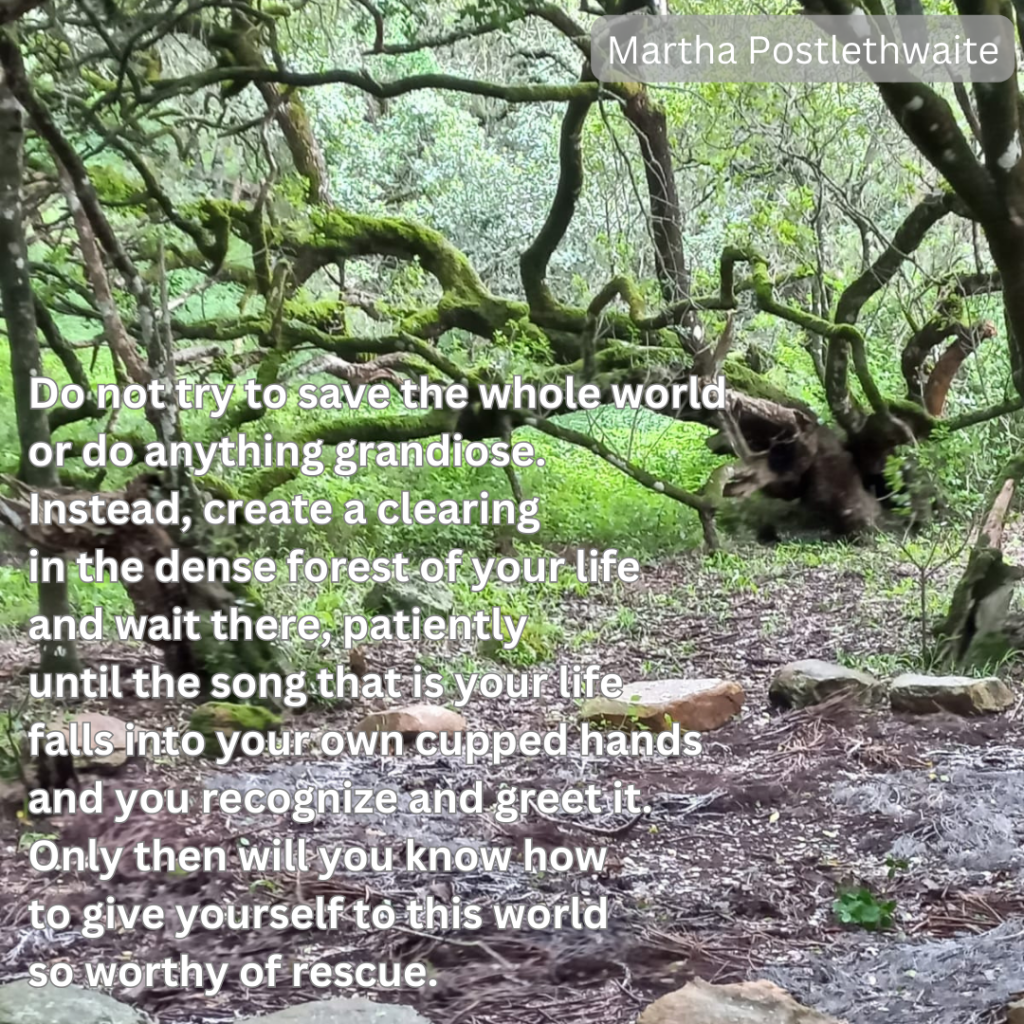
Martha Postlethwaite’s most beautiful poem feels so relevant here.  It doesn’t happen when we take on the archetype of Atlas, or when we approach it from a place of fear or anxiety. But from the  knowing that each of us has hidden within us a unique gift to offer this world. And it is exactly the medicine that is needed right now.

Pat McCabe’s way of expressing it is like this: ‘My biology gives me a way of contributing to the sacred hoop in a way that only I can’. The sacred hoop is a powerful Native American symbol that represents the interconnectedness of all life, and within that the importance of balance and respect for nature.

An enquiry might be  – ‘In what ways can I tune into what is rightfully mine to bring in service of humanity and the greater Earth community?’

Or ‘how is the dream of the forth calling me forth, at this moment in time?’

We are all related. What is mine to bring interweaves with what is yours. And so it goes on, as we weave the tapestry of this miracle we call life.

Uncategorized

Good Grief: Truth Rituals for Our Times

We are living in challenging times. The systems and culture we have created in our world are showing themselves for the destructive force they are for our planet. Increasing consumption, coupled with population increases means that our human species’ use of resources exceeds the Earth’s capacity by an increasing margin year on year. Today we need around 1.75 planets to provide the resources to meet our demand for consumption and to absorb our waste. According to WWF, by 2050, or even sooner, this will have increased to the need for 2 planets, ‘borrowing nature’ from future generations.

Many of us feel the burden of the irreversible loss of eco-systems, degradation of soils, loss of wild places, pollution of fresh water, and other ecological losses, and experience feelings of deep grief, coupled often with regret for our own lifestyle practices that have contributed towards this.

For others there is continued and growing anxiety about the trajectory the human species is currently following, and further losses that are feeling inevitable- including runaway climate change and species extinctions, even the fear of our own extinction.   For many there is a growing feeling of urgency, coupled with the pain of feeling somehow paralysed or powerless.

As we see war unfold again in the Middle East this week, and violence and suffering continuing in many countries across the world, including South Sudan and Ethiopia, the sense of despair and helplessness can feel extremely acute.

Here in South Africa, these feelings of grief and anxiety, present themselves on top of extreme societal ‘complex trauma’, a traumatic history that for many remains unprocessed and unresolved. The adverse living conditions of many South Africans, extreme poverty (currently 45% of South Africa’s population) and extreme inequality (the richest 10% hold 71% of the wealth), compounds this trauma. 

All of this can feel extremely distressing and overwhelming.

It’s no surprise it feels this way. The planet Earth is our home, our place of shelter, our provider of all that we need. When we see her change and come under stress, it’s only natural to grieve and to feel concerned. Our fellow people are our brothers and sisters and we all have the capacity to show and receive compassion, deeply rooted in our mammalian instinct of caring.

And yet, there’s also something much deeper here. All of the losses, the trauma, the destruction, the pain we cause, results from a narrative that still governs our thinking and actions, in a deeply subconscious way – the story of separation. A deep-rooted separation, that stretches back over centuries, from our very selves and our true nature, from each other and from the Earth. This worldview that we exist as individuals, separate from all other individuals and from all other beings in nature, has ripped apart the fabric of what it means to be fully human, and to feel our full belonging first and foremost as members of the Earth community, and to live in the truest sense of ‘Ubuntu’. For many of us, this separation is where our deep grief originates, and it is through holding this grief in community that we will be able to find our way back home.  

Grief is not typically invited in our society. The typical response  is rather to numb our feelings, finding ways to distract ourselves so we don’t feel the pain. Yet deep grief is a way for us to be present for the world, and to come into our full authentic power to make and support change, with no pretense that we can carry on the way that we are.

We invite you to join us for a series of Truth Rituals, based on the Work That Reconnects by Buddhist Scholar and Earth Elder, Joanna Macy, and adapted to suit our South African context. These Truth Rituals will be held outdoors in sacred spaces and are open to all. Through coming together and expressing our rage, fear, despair and emptiness, we will find our way back to our hearts and to a way of living in right relation with ourselves, all other beings, and our home planet Earth.

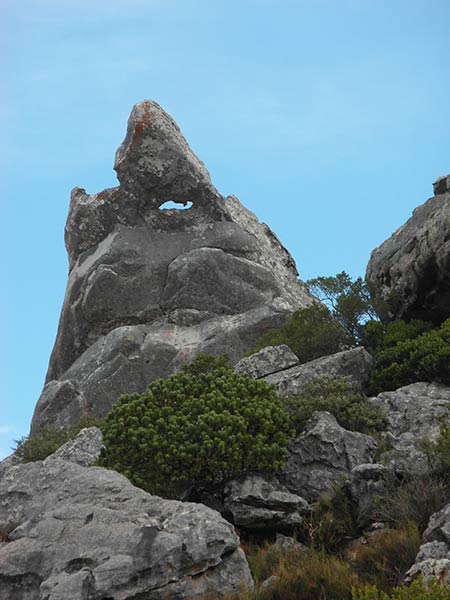
Join us on Sunday 22nd October: 9am – 11.30am for our first ritual of this series, at a very special sacred site –  All Seeing Pyramid Rock, Blackhill.  Meeting point is at the car park near the top (Sunvalley side) of the Glencairn Expressway and we will all move towards the site together. For more information and bookings please contact us on 061 864 6799 or  gaiaspeaking@gmail.com.  Recommended donation: R200 – R300

Articles, Events & Reviews, Uncategorized

Celebrating Mabon, the Autumn Equinox

On 20 March here in the Southern Hemisphere we celebrated Mabon, or the Autumn Equinox.  Hosted by the Center, a beautiful venue in Noordhoek, we gathered to celebrate and offer our prayers.

Altar created by Luciana do Cabo, with gratitude

Like all sacred times, the Equinox is a perfect time to reflect on our inner spiritual work. Because we are a reflection of the universe surrounding us, what takes place outside must also occur within us. 

This time of year, as we move from summer to autumn, is the time of Harvest. The Earth, by this time of year, has given us everything. Fruits, grains, and vegetables. Now, tired and withered, she lies down to rest. At this time, we can give thanks for the abundance of the Earth, and all that she provides. Equally it is an opportunity to reflect on the abundance in each of our lives, and all the things we can be grateful for. It is an opportunity to turn within and to reflect on what gifts, strengths, experiences and skills we can harvest and take forwards with us into the darker months.  

What are you grateful for?  What life lessons have helped you learn and grow? What can you harvest internally that may be supportive in the coming months?  

The Equinox, both Autumn and Spring, is the only time when both the northern and southern hemispheres experience roughly equal amounts of daytime and night-time. These are the days when the sun is exactly above the equator making day and night equal in length.  Equinox is a Latin word that means ‘equal night; – It is the time of equal day and night.

Energetically, the Autumn Equinox is a time of balance and pause, a transitional moment between the bright half of the year and the dark half of the year.  This time brings the light and darkness to the front together, neither one preceding nor following the other. Spiritual guidance can be taken from this rhythm of nature. The Autumn Equinox is a perfect time to consider and invite balance into your life – shadow and light, inner and outer, masculine and feminine, the dance between ego and Soul.

Take a moment to slow down and listen inwardly. Is there something your body is asking you for? In which areas of life do you need to re-find balance?

To think of the Equinoxes and Solstices in terms of a life, the year is “born” on the winter solstice, matures at the spring equinox, and reaches the prime of life at the summer solstice. The autumnal equinox marks the descent into old age, and, finally, the moment of the winter solstice marks simultaneous death and rebirth, starting the cycle anew.                       

And so, from a spiritual growth perspective, Autumn is about endings, as reflected in our natural environment, with the trees losing their leaves and plants dying off. It’s all a very natural process. And so the Autumn is also a time to descend into one’s own darkness. Darkness, when ignored and exiled, grows and takes over. But when given the opportunity to be worked with and exposed, provides an opportunity for growth once the light returns. 

Autumn is a time to feel into the areas of your life that need to be let go of, consider what no longer serves you, gets in your way, and needs to wither.  Remember—we all have leaves, of a sort. For a time, they gather energy unto us, but at a certain point, they no longer serve us. They lose their chlorophyll, turn brown, wither, and must be released. As you watch those earthly leaves fall to the ground to nourish the next generation of nature, consider your own leaves.

What do you need to let go? Are you allowing for this release or are you hanging on to the dead?

I’m so grateful for the opportunity to celebrate these ceremonies of the ‘Wheel of the Year’, an annual cycle of seasonal festivals that were celebrated by our foremothers and fathers.  As we find ourselves in the midst of ecological chaos, one of the most potent ways for us to find ways to come back into balance with the earth is to reconnect to her seasons and cycles, honouring these, as we learn to tune in, celebrate and adapt to her natural cycles. Happy Equinox everyone.

Uncategorized

Moving Beyond Business as Usual…

I’m originally from the UK and this year have taken the opportunity to travel back there to visit family. I haven’t spent much time in the UK recently, what with Covid travel restrictions and the dissonance I feel in terms of my own carbon footprint when I travel by air. As a result the changes that have taken place in the UK to move towards a more ‘eco-friendly’ way of living were very noticeable to me: A huge interest in electric vehicles; plant-based alternatives to meat diets available everywhere; more sustainable packaging options; significant growth in renewable energy (nearly 50% of the UK’s power is now generated from renewable sources, up from just 20% in 2010).  While the changes I’ve seen here are truly necessary, at the same time I find myself still asking the question of whether these changes truly have the potential to go to the depths we need in order to ensure a life-affirming future for all, one that regenerates our natural and cultural systems, or are we simply trying to find ways to perpetuate ‘business as usual’, albeit with a green tinge?  Things are never simple, and the devil is always in the detail.  It feels like we are moving towards ‘less bad’, within the context of the consumer-conformist society we live in, rather than a truly regenerative culture.

Regenerative Urban Culture…

It feels that we urgently need to reframe our actions and responses within a new context: One that moves beyond the story of separation that we have been operating within, towards one of interconnection and regeneration. 

Our economic systems have been built on a paradigm of separation, essentially extractive both in terms of ecology and wealth distribution.   This sense of separateness from nature began over 500 years ago with the advent of civilisation and the increasing rationalistic portrayal of nature as a resource to be used for human betterment.

While we hear businesses telling customers and investors what they are doing in terms of social and environmental responsibility for most (with a few notable exceptions – check out the incredibly inspiring Patagonia story), this is mainly about minimizing risk in order to maximize profits (business as usual).  The fundamental question remains of whether it is possible to shift business models sufficiently in order to meet the culture and nature crisis we find ourselves in, or do we actually need to entirely rethink our economic models? It seems to me that as long as we continue to see the environment as a subset of the economy, and nature as ‘natural resources’ to be used for economic gain, nothing substantial will ever change.

Otto Scharmer’s work is helpful here. Scharmer states that in order to meet the challenges of this century we need to update our economic logic and operating system from an obsolete “ego-system” focused entirely on the well-being of oneself to an eco-system awareness that emphasizes the well-being of the whole. This sounds very much like the African cultural concept of ‘Ubuntu’, an African Nguni word that means ‘humanity to others’ and has a correlated meaning of ‘I am who I am because of others’.

If applied in the operations of business, Ubuntu has the potential to create strong collaboration and business that has a focus on community development.  The social enterprise movement provides some hope of genuine alternatives. The gift economy is another way of conceptualising an emergent economic system whose focus is not on profit and growth. However, while gaining significant momentum, both of these are still emergent especially in the South African context.  And yet for all of us no matter where we are, we have the opportunity to actively use our economic power to support these alternatives, organisations who are proactively operating in support of a better world.

A shift from the ‘business as usual’ paradigm requires a shift in consciousness. This shift can neatly be articulated as a shift from separateness to interconnectedness. This is about seeing the core truth of who we really are, spiritual beings having a human experience, connected to all other beings – human and non-human – on this home planet Earth.  From this place, our decisions look very different from those that are taken within a ‘business as usual’ story.  

As Einstein so famously said ‘ If we want to change the world we have to change our thinking…no problem can be solved from the same consciousness that created it’ We are not going to solve the problems created by the industrial growth culture using the rules, methods and mindsets of that same culture.

Reversing climate damage has to do with the creation of a new human story.  The role for each and every one of us revolves squarely around the courage to step into this – a story of reconnection and interbeing, a story of regeneration, a story that recognises we are nature and it is us.

If we want things to really change, it will happen because we give ourselves the opportunity to connect with our beautiful home planet, and we acknowledge that the true solutions to the climate crisis are also the solutions that create a profoundly different and better world for everyone.

Ideas and examples of what you can do as part of this emerging consciousness to follow in part 2 of this blog.