Work That Reconnects facilitator, wilderness guide, documentary maker, ceramicist, singer, soul quester, lover and mother.
Interested in community, rewilding, holistic and systemic thinking.
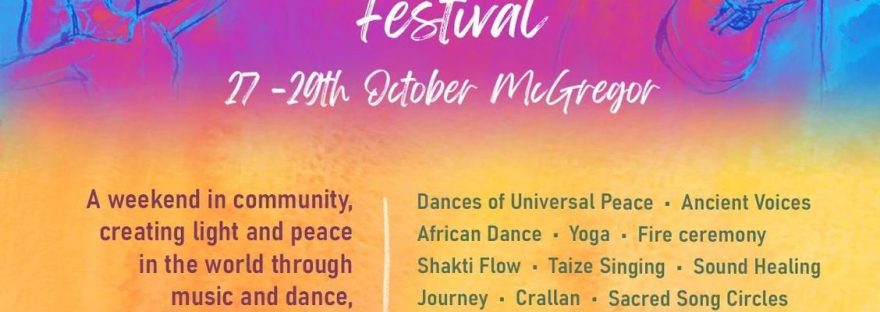
Here are a few images of the Sacred Music and Dance Festival that Gaia Speaking took part in last week. Participants and facilitators danced and sang, shared movement, poems and prayers, and all came together in a multicoloured multifaceted work of art and soul. It was truly a pleasure to be a part of this co-creation.
The festival, which was born out of a deep love for music, spirituality, humanity, and a reverence for all of life, is non profit and is held in McGregor, a village nestled in the Klein Karoo, 2 to 3 hours from Cape Town. It is a great setting for this festival, where the events are held in two exceptional venues: Temenos – a retreat centre and absolute treasure embraced by the Gardens of the Beloved – and the Wisdom School, at slow walking distance, housed in historical buildings, which have been carefully and tastefully restored.
It was nice to amble around the village and enjoy its scattered and quaint coffee shops and restaurants and then a little bit strange to watch rugby on Saturday night, for the World Cup final that South Africa won.
Rachael and I participated in the opening ritual around the fire, which ended at dusk with a performance from the Zolani choir from Ashton.
Wisdom School Courtyard above and Hall below
Both our Songs that Reconnect circles felt very resonant with the vision of the festival. They were were both held at Temenos, First in the Caritas Library, surrounded by the wealth of knowledge contained in thousands of spiritual books, and then at the very special venue called “The Well”. We are grateful for our participation in SAMAD for many reasons and in particular because we felt a lot of connection with the embodied forms of the Work that Reconnects that Rachael and I practice.
We celebrated and strengthened with powerful songs Coming From Gratitude into the Spiral, the soft sound of sacred water reminding us of the essence of impermanence and flow. At the Well itself, in the centre of the temple, we facilitated the ritual of the Bowl of Tears as we sang the soft chant “Rivers of Tears” to Honour our Pain for the World. Seeing with New Eyes and Going Forth around the Spiral, we sang and danced a little and we shared some words of reconnection too. It is always an honour to provide these offerings inspired by the Work that Reconnects, in our own particular style, and this festival and these venues were very auspicious places to do so. All our events and all those that I had the privilege to participate in were so unique and filled my heart with a sense of appreciation of community. I felt an upsurge of energy and gratitude for all the gifts that we carry and how this fosters in me hope for a more beautiful world for all. Thank you.
As we come together to sing and dance in this way, through sound, movement, meditation and consciousness, we touch something deeply within our beings. In such moments it is the soul which is dancing. In those rare moments of recognising that it is that great Love which is present behind all that exists, one experiences a kind of ecstasy. So it is with the experience of sacred music and dance that brings us back to the unity of community, the unity of being.
This festival is a celebration of all spiritual paths. The time we find ourselves inat present reveals that there is a greater need than ever before to find commonground, to unite and bring peace to the world. By coming together we can learnabout, open to, and sing and dance the unity of creation, while respecting andhonouring each unique spiritual path toward the One. This is a journey of creativity and joy.
Harold Epstein
If you want to join next year’s festival, you can stay connected with the organisers, Harold and Anja, on the following website or facebook:
We were reminded of these vows yesterday during the Gaian Gathering. These are words that we can voice aloud while witnessed in a workshop or to ourselves, as we are always witnessed by the Earth and each other in a myriad of ways. They are such profound anchors for our collective in this time of Great Turning…
I vow to myself and to each of you to commit myself daily to the healing of our world and the welfare of all beings.
I vow to myself and to each of you to live on Earth more lightly and less violently in the food, products and energy I consume.
I vow to myself and to each of you to draw strength and guidance from the living Earth, the ancestors, the future beings and our kin of all species.
I vow to myself and to each of you to seek liberation from patriarchy, colonialism, and racism in all dimensions of my life.
I vow to myself and to each of you to support you in your work for the world, and to ask for help when I need it.
I vow to myself and to each of you to pursue a daily spiritual practice that clarifies my mind, strengthens my heart and supports me in observing these vows.
I am excited about this news from the United Nations, an excerpt of which is hereunder. Of course we know that within traditional institutions like this, with slow heavy politically-engineered routes to actions, big steps like this on paper are only baby steps on the ground, and we have no time to spare. Yet it gives me courage to read this vision from this global bureaucratic body. And hopefully this will encourage states to adopt new laws in that respect.
This immediately gives credit to the work of countless NPOs working with children on the one hand and with environment on the other, and can possibly also fuel more synergy between both those areas of focus. I think this can also create a much needed bridge between the field of education and environmental and ecospiritual awareness. With conventions like this isn’t it time to reform the curriculum so that we are not teaching our children how to destroy their future?
The Rights of the Planet also need urgent recognition on a global scale. These rights are essential to support the work of other activists working on the front line today, defending what is left of wilderness and regenerative life. Together with the rights of our children and the future generations, rights for the Earth herself leave no space for more plundering. – Joanna Tomkins
See hereunder an extract from the UN press release:
GENEVA (28 August 2023) – The UN Child Rights Committee today published authoritative guidance on children’s rights and the environment with a special focus on climate change. The guidance specifies the legislative and administrative measures States should urgently implement to address the adverse effects of environmental degradation and climate change on the enjoyment of children’s rights, and to ensure a clean, healthy, and sustainable world now and to preserve it for future generations. The Committee has adopted its guidance, formally known as General Comment No. 26, after two rounds of consultation with States, national human rights institutions, international organizations, civil society, thematic experts and children. The Committee received 16,331 contributions from children in 121 countries; children shared and reported on the negative effects of environmental degradation and climate change on their lives and communities and asserted their right to live in a clean, healthy and sustainable environment. “Children are architects, leaders, thinkers and changemakers of today’s world. Our voices matter, and they deserve to be listened to,” said 17-year-old Kartik, a climate and child rights activist from India and one of the Committee’s child advisers. “General Comment No. 26 is the instrument that will help us understand and exercise our rights in the face of environmental and climate crises,” he added.
“This general comment is of great and far-reaching legal significance,” said Ann Skelton, Chair of the Committee, emphasising, “as it details States’ obligations under the Child Rights Convention to address environmental harms and guarantee that children are able to exercise their rights. This encompasses their rights to information, participation, and access to justice to ensure that they will be protected from and receive remedies for the harms caused by environmental degradation and climate change.” The general comment clarifies how children’s rights apply to environmental protection and underscores that children have the right to a clean, healthy and sustainable environment.
This right is implicit in the Convention and directly linked to, in particular, the rights to life, survival and development, the highest attainable standard of health, an adequate living standard, and education. This right is also necessary for the full enjoyment of children’s rights. The general comment further asserts that States shall protect children against environmental damage from commercial activities. It specifies that States are obliged to provide legislative, regulative and enforcement frameworks to ensure that businesses respect children’s rights, and should require businesses to undertake due diligence regarding children’s rights and the environment.Immediate steps should be taken when children are identified as victims to prevent further harm to their health and development and to repair the damage done.
It seems that around the world the veil is thinning. As the expected climatic changes put more pressure on voters and consumers, the expected reactions of outrage are rising too. Unfortunately the reaction from the Industrial Growth Society’s most arduous defenders is at its strongest now too, as they feel the ridicule of their modus operandi. Criminalisation of activists is sadly surging. It is indeed hard to admit for the most guilty – although, indeed, we are all conniving unwillingly on a large scale – that one’s life goals are geared to destroy. So, it’s easier to try to eliminate those who are pointing a finger at the crime.
When the same mob mentality that makes corporates believe they are acting as good citizens of the “normal” world tips in a more compassionate direction, the majority will assuredly turn around and stand up for the defence of Life too. Now, more than ever, as more people start to engage in Holding Actions, to detain the harm, other must continue to create awareness and build resilience for the years to come. The Great Turning is here and it will come at a cost but there is only one way: forward and together.
Hereunder I would like to reproduce an editorial from ‘Down to Earth’, the environmentalist section of the Guardian. It seems there is an increase of action from people from all walks of life fighting ruthless agents of corporativism and negligent politicians who fail to represent the rights of the planet and the future generations that will inhabit it after they have gone. Once again we applaud and jump on board to commend and recommend the work of journalists that free our opinion and inspire us to talk about what is really concerning our heartminds. There are links in the text to interesting articles. Thanks for reading! – Joanna Tomkins
By Nina Lakhani, climate justice reporter, 30/08/2023
“Arresting climate and environmental activists is so widespread that it’s almost become routine – applauded, even, as governments and corporations label those who block roads, disrupt shareholder meetings and throw confetti at tennis matches as radical lawbreakers. But jailing ordinary people trying to stop the destruction of the planet – while the industries responsible keep profiteering and elected officials keep letting them – isn’t normal or accidental.
To understand what’s going on today, I recently travelled back to San Miguel Ixtahuacán, a rural community in the western highlands of Guatemala, where 15 years ago Indigenous-led opposition to a sprawling Canadian gold and silver mine became one of the earliest documented cases of a transnational corporation – and its state allies – weaponising the legal system against environmental defenders.
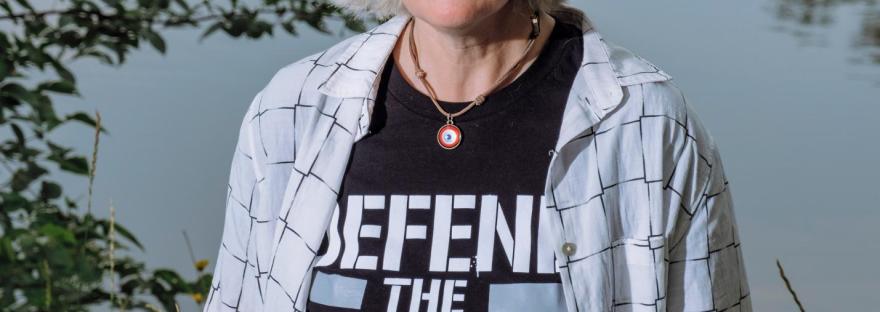
Patrocinia Mejía, a 63-year-old grandmother, was among scores of community members slapped with arbitrary criminal charges, which divided and crippled the social movement. “We were so scared of being captured that we didn’t hold our meetings any more, and I was too afraid to show my face at protests,” Mejía (pictured above) told me. Even today, six years since the mine was closed, the divisions and collective trauma were gut-wrenching to see.
Experts told me that what happened in San Miguel Ixtahuacán proved to be so effective that criminalisation spread across Latin America and is now deployed globally as part of a playbook of tactics to divide communities, and detract attention away from legitimate debate and protests about environmental and climate harms. Guatemala was a textbook example of a draconian crackdown and became a laboratory of sorts, said Jorge Santos, the director of Udefegua, a Guatemala-based rights group tracking attacks on defenders.
It’s worth noting that criminalisation is among a gamut of repressive tools being used against climate and environmental activists, which also includes online attacks, financial sanctions and even kidnap and assassinations. Yet criminalisation stands out as it exposes the barefaced nexus between corporations and governments. Corporations can hire private security thugs to intimidate and attack grassroots leaders, but they cannot arrest and charge them without their political and law enforcement allies.
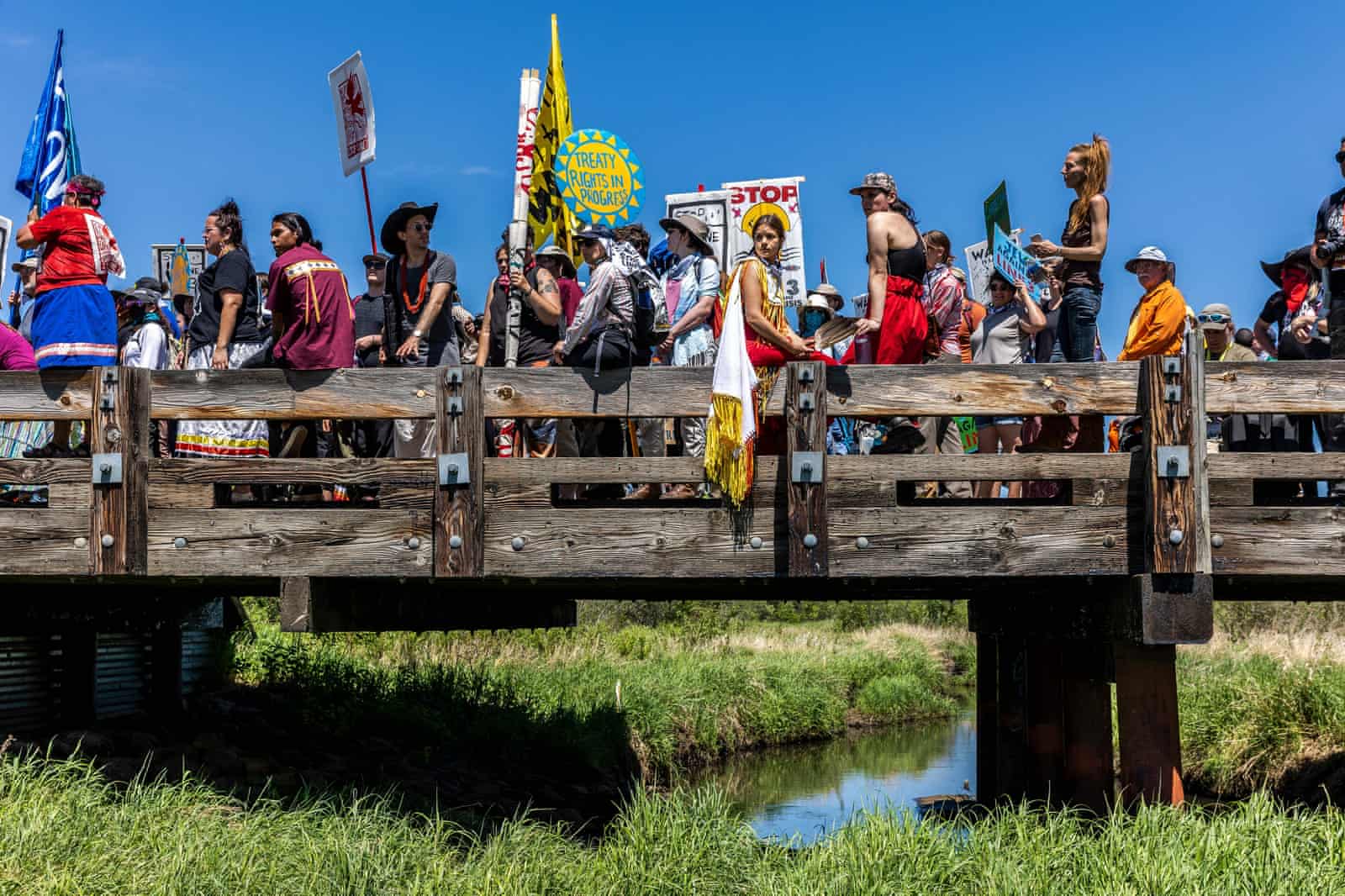
Take the case of Mylene Vialard, a French translator from Colorado, who faces up to five years in jail for her role in trying to stop the expansion of Line 3, a tar sands oil pipeline with a dire environmental record. Minnesota law enforcement – which along with other agencies reportedly received at least $8.6m in payments from the Canadian pipeline company Enbridge – made more than 1,000 arrests between December 2020 and September 2021. Overall, at least 967 criminal charges were filed including several people charged under the state’s new critical infrastructure protection legislation – approved as part of a wave of anti-protest laws inspired by the American Legislative Exchange Council (Alec), an ultra-right US group backed by fossil fuel companies. (Similar laws are spreading across the world). Yet the vast majority of charges were dismissed, suggesting the mass arrests were about silencing and distracting protesters – not public safety or national security as was claimed at the time, according to Claire Glenn, an attorney at the Climate Defense Project who has represented more than 100 Line 3 protesters.
Over the next few months, we’ll be reporting on the criminalisation of climate and environmental activists globally; connecting the dots between these seemingly disparate cases is key to exposing who and what is behind the crackdown.”
To stay in this loop, you can sign up for the Down to Earth weekly newsletter here(The Guardian free environmental email. “The planet’s most important stories.”)
I enjoyed reading this editorial that I received in my email… And watching this short film about the incredible Irish peat, by the winners of Waterbear’s prize this year.
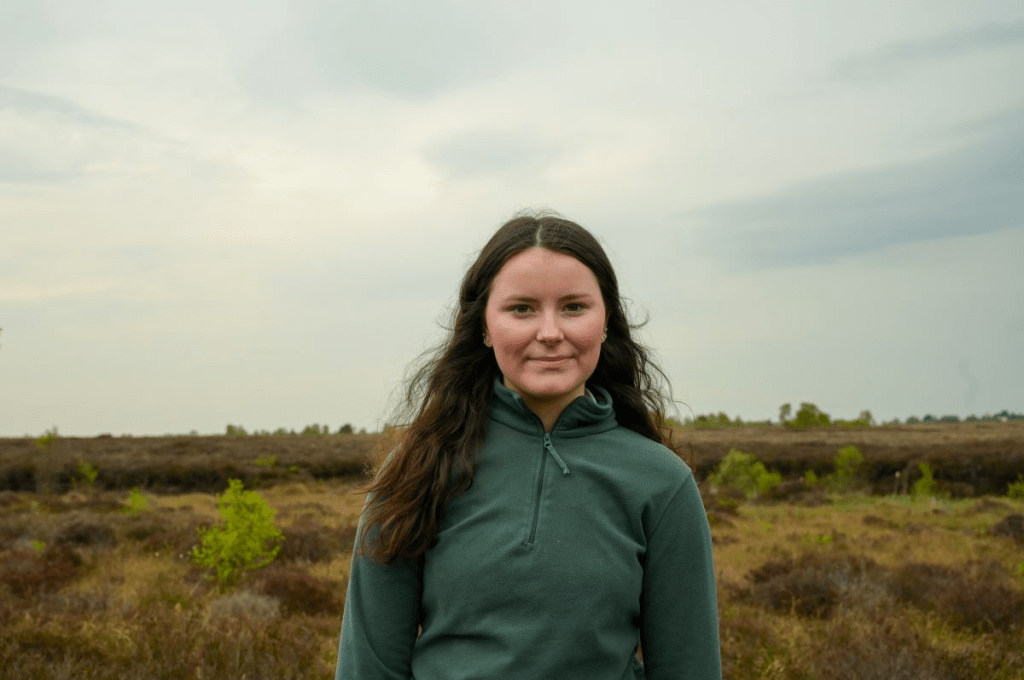
The young winner duo Swantje Furtak and Frankie Turk are committed educating people about the importance of wetlands through their activist work at RE-PEAT, a youth-led collective that pushes for a future where peatlands are protected. Kudos.
Hereunder is an introduction to the beautiful work by S.Furtak and F. Turk :
Peatlands are some of our oldest living ecosystems, forming and surviving for tens of thousands of years. Many have existed back when our human ancestors were only toying with early agriculture, when we first started forming towns and cities, and – more recently – when we started radically altering our global climate and ecology. Composed of semi-decomposed plant matter (peat) preserved in water, peatlands are like capsules of deep time.
“In Death Is Life” is a short documentary about a community in rural Ireland with a long history tied to their peatland ecosystems. For generations draining and cutting the peatland was part of their local culture. Traditionally, the peat (or “turf”) was cut in the early summer, dried outside and burned as fuel in the cold winter months. This cheap and accessible material also powered their struggle for Independence during Ireland’s colonial rule. However, starting in the 1700s, through a rapid industrialisation process turf cutting became mechanised and happened at a much larger scale.
In a healthy state, peatlands are the planet’s largest terrestrial carbon store (holding twice as much carbon as all the world’s forests), they are hotspots of biodiversity, and have the capability to slow us down.
These unique traits drove us, Swantje Furtak (24) and Frankie Turk (27) to tell the story of the peatlands in Ireland. Coming from different paths, we have both sunken deeply into the topic of peatlands. In a long call in 2021, we started dreaming of the idea to create a documentary series. We started to collect stories of peatland communities across the world – Ireland, the Congo, Latvia, Germany and Indonesia.
Nearly every country on the globe has peatlands, in different shapes, colours and histories. You probably have a peatland near you! And it is like Tommy said: If you allow the peatland to slow you down, it can change your time.
“With this offering, I aim to establish an oasis of sanity, a studio of sanity, and an incubator of sanity for coming times. We have seen in recent years a mounting madness that took on a new and virulent form during the Covid era. Though that particular expression of madness has abated, the social and psychic conditions that spawned it are still in place. Our politics, our culture, and our public discourse swing to new extremes of derangement.
Getting swept up in mass hysteria is just one type of insanity. Resisting it takes a psychic toll. Those who try often succumb instead to despair, depression, addiction, extremism, and conspiracy theories.
I speak here from experience – I too went a little crazy during the Covid years. The experience confirmed that I cannot stay sane alone. At key moments, friends and allies said the right thing to me at the right time and brought me back to sanity. With this program, I aim to pass that gift onward and to create conditions by which many of us can stay sane together.
What do I mean by staying sane?
To hold center, and return to it when you lose it
To hold a good and true story of self and world
To be able to abide in not-knowing for as long as it takes for authentic knowing to emerge
To hold peace amid information warfare
To distinguish and hold your truth in the midst of hysteria
To build sustaining connections with human and other-than-human beings, to have an ongoing experience of kinship.
To build resistance to manipulation and covert fundamentalism
To access a wholesome wellspring of sense, meaning, and identity
To fortify the integrity of body/mind/spirit
To mutually reinforce all of these with others, to form islands of sanity in a world that is still far from sane
To be a seed crystal that brings a higher level of sanity to all you touch”
Hereunder also is an animation that he directed and his interpretation under that…
“Hi everyone, I am so proud to share with you this short film, the first I’ve written and directed myself. It has deep relevance to the theme of this program. I won’t comment on it yet, because I think the story itself exercises more power than any interpretation of it can. So please take it in as you would any other film. Maybe watch it a few times.” – Charles Eisenstein –
“The choice that [this film] represents isn’t only a choice made before lifetimes. It is an ongoing choice, day to day, moment to moment, about how to engage the world.
One way to engage (or really, not engage) is to stay in whatever temporary comfort realm one can manage with distractions, entertainment, addiction. Yet none of these can be permanent, and even the most sublime experiences of immersion in nature or lovemaking cannot be prolonged beyond their right span. At some point, the awareness grows that we are on the brink of a pit, that right beneath us, just a shift of attention away, is a world that begs our service. To rest, to recharge, is important in order to render that service well, but when the batteries are full, restlessness will seize even the most indolent among us. So, the choice to attempt a permanent disengagement from the world to abide in its pleasurable precincts is futile.
A second way to engage is with a heavy spirit of duty, overcoming by force of will a reluctance to enter the fray, carrying a subtle distaste for the lower realms. It comes from a false sense of superiority, and leads as well to a partiality of engagement. One stays half in, half out, never fully committing to embodiment.
The film portrays a third choice. The luminous beings plunge into the pit — all the way in. And they do so in peace, in joy, in serenity. They do not feel sorry for themselves as they take the plunge. They meet their mission gladly.
I will confess — I didn’t actually make this film for you. I made it for me. I’m the one who has so often hung back from life, stayed timidly a little bit above the fray. I’m the one who often engages life joylessly, with too heavy a sense of duty. I’m the one who, sometimes, sees people with ungenerous eyes blind to the truth that they here on the same mission I am.
As I enter more deeply into the “fray” of a political campaign, I hope to do so as the people in the film do — fully, but not as a fighter, not to become a creature of the Pit. I will watch this film from time to time to help me stay serene in the knowledge of what I and all others are really here for. May this film help you, as it has helped me, to see with generous eyes and speak with generous words that summon what is seen into manifestation.”
Yesterday was the UN “World Environment Day”. under the theme BeatPlasticPollution. And on 8th June it will be the World Ocean Day. Two drops of awareness in a vast ocean of Great Unravelling, which made me wonder what is being done in the country I call home, South Africa. Whilst we do have admirable local initiatives to clean our beaches, ecobrick and recycle ‘sea plastic’ into art, it made me realise I have no idea if,in the meantime, there are any lobbies working towards the actual ban of single use plastics in our country. Is the government -immersed in other energetic and economic challenges and scandals – needing more pressure from citizens? Do we not, as an economically privileged country within the continent have a certain responsibility to pioneer political and technological innovation in that field? What can we do on an individual level to make the ban happen?
Last week a small group of activists created a social media group and urged participants to request the ban of the use of harmful Round Up pesticides in the highly sensitive Cape Peninsula biodiversity hotspot we live in. It only took the support of a few hundred concerned residents writing letters to their local ward councillors and the extra initiative of a few of them to take the matter right up to the Premier of the Western Cape Province, where it was taken very seriously. It was an inspiring course of events for many, illustrating that we should not consider any action to be powerless, and how fast shift can happen nowadays. We all care, we all care for our mother. Some emerging political programmes are deeply engaged with her cause. Even if we have been programmed to believe nature is a machine, and corporate greed is still a widespread habit, in all areas there is knowing that radical change is necessary and urgent.
A shift to a more ecological civilisation is underway. Hereunder is an article published by theconversation.com
“Single-use plastic bans: research shows three ways to make them effective”
Published: January 13, 2023 8.15am SAST Authors: Antaya March, Steve Fletcher and Tegan Evans, University of Portsmouth, UK
Governments around the world are introducing single-use plastic product bans to alleviate pollution.
Zimbabwe banned plastic packaging and bottles as early as 2010. Antigua and Barbuda banned single-use catering and takeaway items in 2016, and the Pacific island of Vanuatu did the same for disposable containers in 2018.
The EU prohibited cotton buds, balloon sticks, plastic catering items and takeaway containers, including those made from expanded polystyrene, in 2021.
The UK government has followed suit by announcing a ban on the supply of single-use plastic plates, cutlery, balloon sticks, and polystyrene cups and containers supplied to restaurants, cafes and takeaways in England. The measure will start in April 2023. The same products sold in supermarkets and shops will be exempt from the ban, but subject to new regulations expected in 2024.
While the forthcoming ban is a step in the right direction, the production, use and disposal of plastics typically spans several countries and continents. The success of any policy aimed at restricting the use of plastic products in one country should not be taken for granted.
Our research continues to highlight that policies which influence what consumers buy, such as bans, taxes or charges, lack the reach to confront the global scale of pollution. The effect of banning single-use plastic items is limited to the jurisdiction in which it is implemented, unless it inspires a wider shift in public or commercial behaviour across international boundaries.
Without supporting measures, or by failing to treat the ban as the beginning of a broader phase-down of plastic, banning some items does little to change the attitudes which reinforce a throwaway culture.
The Global Plastics Policy Centre of the University of Portsmouth reviewed 100 policies aimed at tackling plastic pollution worldwide in 2022 to understand what makes them successful. Here are three key lessons which can make [bans] more effective.
Make it easy to use alternatives Consumers and businesses are less likely to comply with a ban if they are expected to go entirely without plastic overnight. Ensuring businesses can source affordable alternatives is critical. Antigua and Barbuda did this by investing in the research of more sustainable materials and listing approved alternatives to plastic, such as bagasse, a byproduct of sugar-cane processing.
To maintain public support, it helps if there are measures which prevent cost hikes being passed directly on to consumers.
Alternative materials or products must have a lower environmental impact than the banned product, but this isn’t always guaranteed. Substituting plastic bags for paper, for example, may not be the best idea when the entire life cycle of a product is accounted for.
Phase in a ban A phased approach to a ban improves how well it works but requires consistent and clear messaging about what products are banned and when. In Antigua and Barbuda, phased plastic bag bans in 2016 and 2017 generated support for banning other plastic products between 2017 and 2018.
In both cases, importing these products was restricted first, followed by a ban on distributing them, which gave suppliers time to find alternatives and use up existing stock.
This approach was used to good effect in an English ban on plastic straws, cotton buds and stirrers in 2020, allowing retailers to use up their supplies during the six months following the ban’s introduction.
Involve the public Information campaigns which explain why a ban is needed, what it means for the public and businesses and what alternatives are available serve to support a ban. This was evident from Vanuatu, where the inclusion of diapers in a ban was postponed due to public concerns around the availability of sustainable alternatives.
Working closely with the public like this can also encourage innovation. For example, in Vanuatu in 2018, weavers and crafting communities filled the gap left by banned plastic bags and polystyrene takeaway containers with natural alternatives made locally, including bags and food containers woven from palm leaves.
Single-use plastic bans can inspire wider changes to social systems and the relationship each person has with plastic. But without planned access to alternatives, a phased introduction, efforts to nurture public support and broader consideration of the entire life cycle of plastic, product bans have a limited effect on plastic pollution, and can even give the false impression of progress.
Thanks to the writers of this article. Various ideas here are examples of what could soon also happen in South Africa if we have enough voices and consensus.
If you want to read more of their articles, every Wednesday, The Conversation’s environment editor writes Imagine, a short email that goes a little deeper into a “climate” issue. Check their website.
I first heard about the plastic-eating capacity of mycelium during a permaculture course I attended in 2016 when my friend and mycologist Justin White showed us a TED Talk by Paul Stamets about how mushrooms COULD save the world. (You may have seen the 2019 “Fantastic Fungi” documentary that Stamets features in – if you haven’t yet, please do!)
I have felt excited about mycelium ever since because at the time I thought, YES, but of course Mushrooms WILL save the world… It just seemed so clear and I was so grateful for news unusually filled with so much hope.
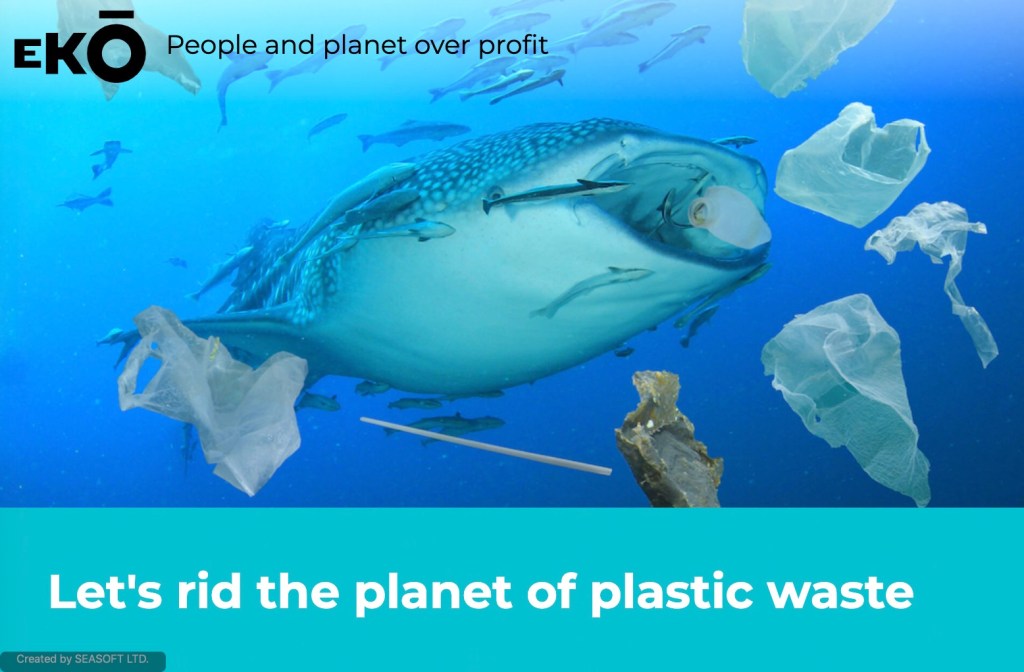
As I prepare this post today, 14 years after this TED Talk was published, and with an accute sense of urgency, I feel like the mycelium myself, as I navigate from one link to another, from one passionate researcher to another adamant activist, from one fungal function to another attribute of intelligence demonstrated by these incredible species. And I heard someone saying yesterday that mushrooms can absorb radioactive emissions too, and last week I read and shared a campaign from the platform EKO, pitching for funds to develop research for some plastic-devouring heroes. And another mushroom ceremony in the hood. And, and, and…
The healing powers of mushrooms are spreading all over the news just as exponentially as our communication networks themselves. Is there anything they cannot do?!
“How amazing is this — scientists have discovered mushrooms that can devour plastic waste in a matter of weeks…plastic that would otherwise remain in the ocean forever.
Right now 91% of the plastics we use can’t be recycled, and every minute another truckloads-worth is dumped into the ocean, suffocating sea life and spreading pollutants across shores.
But scientists say these magnificent mushrooms could eat up to half of the plastic waste being dumped in the ocean. They’re asking for our help to continue their groundbreaking research, and together we could give them the funds they need right away to expand their research in the US and New Zealand.”
The World Wide Web which carries the news became available to us only 30 years ago. On April 30, 1993, the European Organization for Nuclear Research (CERN) put the web that it had developed onto the public domain. In 1993 also, I wrote a research project for university about the “Prospects of Expansion of Electronic Commerce in Spain” . It was minuscule at the time, there were only two shops online in the country (!). I concluded that it seemed unstoppable but that its expansion would depend largely on hardware development and availability – desktop computers I believed at the time!.
Now, in 2023 there are more than 8 billion smart mobile devices in the world, and 65 percent (up from 54 per cent in 2019) of the world’s population are using the Internet.
The speed of technological hardware expansion is terrifying and goes hand in hand with the integration of social networks and software applications, which has gone out of bounds since our society crash landed online after the dramatic “Great Pause” of 2020. The communication system that we call “cloud” is not so ethereal as we wish to believe as we type, record and film on and on. It lives between its massive servers – which would occupy the surface area of entire countries if placed alongside each other– and all our desktop and handheld devices: a vertiginous global network of cell phones, powerbanks, cables, computers, televisions, sound systems, etc, and another even more vertiginous destitute heap of e-waste. This cloud we all float in uses an exponential amount of electricity to manufacture, cool and power. So, to satisfy it we are digging into the Earth, instead of feeding it.
The Earth’s Mushrooms are a form of evolved cointelligence which can support us as we find ways to support the transformation of our own Human society. We/They need a human critical mass to be better connected to the Earth in order to understand the principles of interbeing and cointelligence.
So, want I’m wanting to highlight here I think, is that there is a huge opportunity in the spread of the online ‘aerial’ mycelium that connects us all. Even if there is aggression and waste in its making, for we can indeed share precious news and tools for the shift in consciousness that needs to happen now. Yet, we need to change our worldview so that it can evolve through sustainable and ethical practices, so that the channels we choose and the contents we communicate, exchange and trade via these networks become more life-sustaining and life-enhancing as soon as possible.
Prototaxites hundreds of millions of years old
The story says that between 350 and 420 million years ago, there were already fungal organisms with trunks up to 7 metres high. For hundreds of millions of years, these families have been hard at work. This mycelium constantly transforming matter, sharing information and nutrients has always been working symbiotically with other species to thrive and sustain on behalfof life on Earth. Let’s mimic that better now, while we still have a chance to learn. Let’s aim wide, and wider still!
Extracts from the book Active Hope by Chris Johnstone and Joanna Macy
Hereunder are some of my favourite extracts from the book Active Hope, some which we used for our online Gaia Speaking course “Active Hope in the Great Turning” this month during the Seeing with New Eyes session. I am drawing inspiration again from this section of the book as I prepare the section Going Forth, as it indeeds fills me with Active Hope.
It illustrates so well how we can Go Forth with the joy of being an synergetic part of humanity, one through who inevitably emergence with happen. And if we align with the concept and practice of “power-with”, this emergence will most certainly be produced in the direction that we personally wish humanity to follow. I hope these words provide as much relief as they do to me in these challenging times where we feel called to make a difference. – Joanna Tomkins
While the conversations between Mandela and de Klerk played a pivotal role in bringing apartheid to an end, this historic change wouldn’t have happened without a much larger context of support. Within South Africa, people risked their lives daily to engage in the struggle for change. Around the world, millions of people played supporting roles by joining boycotts and campaigns. If we focus only on each separate activity, it is easy to dismiss it by thinking, “That won’t do much.” To see the power of a step, we need to ask, “What is it part of?” An action that might seem inconsequential by itself adds to and interacts with other actions in ways that contribute to a much bigger picture of change. Remember our example of the newspaper photograph? When seen under a magnifying glass it appears as just a collection of tiny dots, but when, from a little distance, we see the photo as a whole, the larger pattern comes into view. In a similar fashion, a bigger picture of change emerges out of the many tiny dots of separate actions and choices. This link between small steps and big changes opens up our power in an entirely new way. Each individual step doesn’t have to make a big impact on its own — because we can understand that the benefit of an action may not be visible at the level at which that action is taken. Shared visions, values, and purposes flow through and between people. Nelson Mandela was deeply committed to a vision for his country that many were holding; the power of that vision moved through him and was transmitted to others. This type of power can’t be hoarded or held back by prison walls; it is like a kind of electricity that lights us up inside and inspires those around us. When a vision moves through us, it becomes expressed in what we do, how we are, and what we say. The alignment of these three creates a whole that is more than the sum of its parts. The words below, from Mandela’s defense at his trial in the 1960s, mean so much more because of the actions that followed them:
“During my lifetime I have dedicated myself to this struggle of the African people. I have fought against white domination and I have fought against black domination. I have cherished the ideal of a democratic and free society in which all persons live together in harmony and with equal opportunities. It is an ideal which I hope to live for and to achieve. But if needs be, it is an ideal for which I am prepared to die.”
THE POWER OF EMERGENCE
The concept of power-with contains hidden depths; so far we’ve described four aspects. First, there is the power of inner strengths drawn from us when we engage with challenges and rise to the occasion. Second, there is the power arising out of cooperation with others. Third, there is the subtle power of small steps whose impact only becomes evident when we step back and see the larger picture they contribute to. And last, there is the energizing power of an inspiring vision that moves through and strengthens us when we act for a purpose bigger than ourselves. All these are products of synergy and emergence; they come about when different elements interact to become a whole that is more than the sum of its parts. At every level, from atoms and molecules to cells, organs, and organisms, complex wholes arise bringing new capacities into existence.
At each level, the whole acts through its parts to achieve more than we could ever imagine from examining the parts alone. So what new capacities emerge when groups of people act together to form larger complex social systems? Our technologically advanced society has achieved wonders our ancestors could never have envisioned. We’ve put people on the moon, decoded DNA, and cured diseases. The problem is this collective level of power is also destroying our world. Countless seemingly innocent activities and choices are acting together to bring about the sixth mass extinction in our planet’s history. Seeing with new eyes, we recognize that we’re not separate individuals in our own little bubbles but connected parts in a much larger story. A question that helps us develop this wider view is “What is happening through me?” Is the sixth mass extinction happening through us as a result of our habits, choices, and actions? By recognizing the ways we contribute to the unraveling of our world, we identify choice points at which we can turn toward its healing. The question “How could the Great Turning happen through me?” invites a different story to flow through us. This type of power happens through what we say and do and are.
NOT NEEDING TO KNOW THE OUTCOME
The concept of emergence is liberating because it frees us from the need to see the results of our actions. Many of our planet’s problems, such as climate change, mass starvation, and habitat loss, are so much bigger than we are that it is easy to believe we are wasting our time trying to solve them. If we depend on seeing the positive results of our individual steps, we’ll avoid challenges that seem beyond what we can visibly influence. Yet our actions take effect through such multiplicities of synergy that we can’t trace their causal chain. Everything we do has ripples of influence extending far beyond what we can see. When we face a problem, a single brain cell doesn’t come up with a solution, though it can participate in one. The process of thinking happens at a level higher than just individual brain cells — it happens through them. Similarly, there’s no way that we personally can fix the mess our world is in, but the process of healing and recovery at a planetary level can happen through us and through what we do. ”
For this to happen, we need to play our part. That’s where power-with comes in.
THE HELPING HAND OF GRACE
All the individuals on a team may each be brilliant by themselves, but if they don’t shift their story from personal success to team success, their net effectiveness will be greatly reduced. When people experience themselves as part of a group with a shared purpose, team spirit flows through them, and their central organizing principle changes. The guiding question moves from “What can I gain?” to “What can I give?” We can develop a similar team spirit with life. When we are guided by our willingness to find and play our part, we can feel as if we are acting not just alone but as part of a larger team of life that acts with us and through us. Since this team involves many other players, unsuspected allies can emerge at crucial moments; unseen helpers can remove obstacles we didn’t even know were there. When we’re guided by questions such as “What can I offer?” and “What can I give?” we might sometimes play the role of stepping out in front and at other times that of being the ally giving support. Either way, we think of the additional support behind our actions as a form of grace. Based on an interview with Joanna, this poem, edited into verse by Tom Atlee, founder of the Co-Intelligence Institute, expresses well the grace that comes from belonging to life:
When you act on behalf of something greater than yourself, you begin to feel it acting through you with a power that is greater than your own.
This is grace.
Today, as we take risks for the sake of something greater than our separate, individual lives, we are feeling graced by other beings and by Earth itself.
Those with whom and on whose behalf we act give us strength and eloquence and staying power we didn’t know we had. We just need to practice knowing that and remembering that we are sustained by each other in the web of life.
Our true power comes as a gift, like grace, because in truth it is sustained by others. If we practice drawing on the wisdom and beauty and strengths of our fellow human beings and our fellow species we can go into any situation and trust that the courage and intelligence required will be supplied.
POWER-WITH IN ACTION
Here are three ways we can open to the kind of power we’ve been describing. We can: • hear our call to action and choose to answer it. • understand that power-with arises from what we do, not what we have. • draw on the strengths of others.
There will be times when we become alerted to an issue and experience an inner call to respond. Choosing to respond to that call empowers us. Once we take that first step, we start on a journey presenting us with situations that increase our capacity to respond. Strengths such as courage, determination, and creativity are drawn forth from us most when we rise to the challenges that evoke them. When we share our cause with others, allies appear; synergy occurs. And when we act for causes larger than ourselves, the larger community for whom we do this will be acting through us. We can experience our call to action in many different ways. Sometimes the uncomfortable discrepancy of realizing that our behavior is out of step with our values motivates us. Our conscience calls, and when we step into integrity, more of who we are heads in the same direction. At other times our call is more of a powerful summoning. We just know, even if we’re not sure how, that we need to be somewhere, do something, or contact a particular person. If we think of ourselves only as separate individuals, then we understand these intuitive calls purely in personal terms. Recognizing ourselves as part of the larger web of life leads to a different view. Just as we experience the Earth crying within us as pain for the world, we can experience the Earth thinking within us as a guiding impulse pulling us in a particular direction. We can view this as “cointelligence,” an ability to think and feel with our world.
Developing a sense of partnership with Earth involves listening for guiding signals and taking them seriously when we hear them.
Extract from an article in theconversation.com by Katie Field, Professor in Plant-Soil Processes, University of Sheffield
Nearly all of Earth’s organisms communicate with each other in one way or another, from the nods and dances and squeaks and bellows of animals, through to the invisible chemical signals emitted by plant leaves and roots. But what about fungi? Are mushrooms as inanimate as they seem – or is something more exciting going on beneath the surface?
New research by computer scientist Andrew Adamatzky at the Unconventional Computing Laboratory of the University of the West of England, suggests this ancient kingdom has an electrical “language” all of its own – far more complicated than anyone previously thought. According to the study, fungi might even use “words” to form “sentences” to communicate with neighbours.
Almost all communication within and between multi-cellular animals involves highly specialised cells called nerves (or neurones). These transmit messages from one part of an organism to another via a connected network called a nervous system. The “language” of the nervous system comprises distinctive patterns of spikes of electrical potential (otherwise known as impulses), which help creatures detect and respond rapidly to what’s going on in their environment.
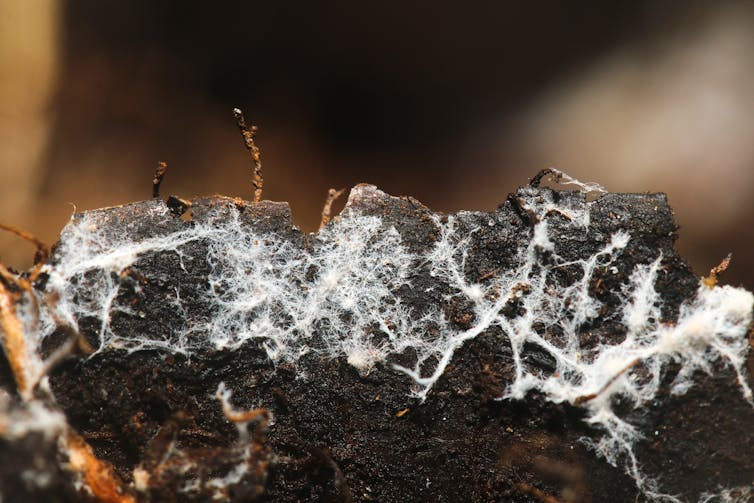
Despite lacking a nervous system, fungi seem to transmit information using electrical impulses across thread-like filaments called hyphae. The filaments form a thin web called a mycelium that links fungal colonies within the soil. These networks are remarkably similar to animal nervous systems. By measuring the frequency and intensity of the impulses, it may be possible to unpick and understand the languages used to communicate within and between organisms across the kingdoms of life.
Using tiny electrodes, Adamatzky recorded the rhythmic electrical impulses transmitted across the mycelium of four different species of fungi.
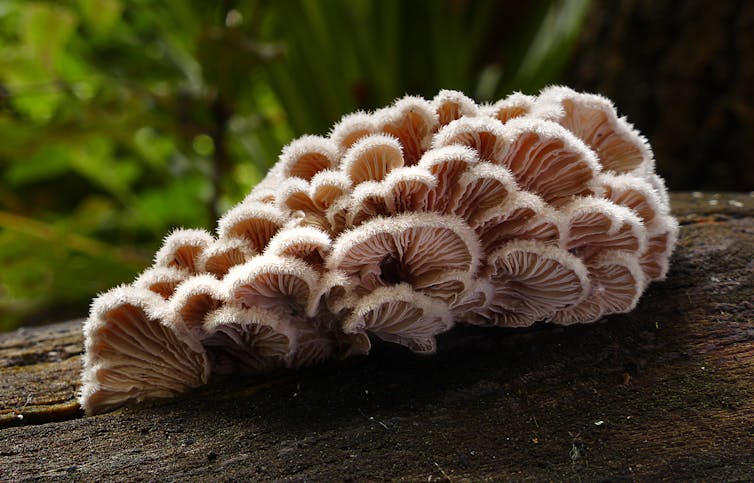
He found that the impulses varied by amplitude, frequency and duration. By drawing mathematical comparisons between the patterns of these impulses with those more typically associated with human speech, Adamatzky suggests they form the basis of a fungal language comprising up to 50 words organised into sentences. The complexity of the languages used by the different species of fungi appeared to differ, with the split gill fungus (Schizophyllum commune) using the most complicated lexicon of those tested.
The split gill fungus is common in rotting wood and is reported to have more than 28,000 sexes. Bernard Spragg/Wikipedia
This raises the possibility that fungi have their own electrical language to share specific information about food and other resources nearby, or potential sources of danger and damage, between themselves or even with more distantly connected partners.
Underground communication networks
This isn’t the first evidence of fungal mycelia transmitting information.
Mycorrhizal fungi – near-invisible thread-like fungi that form intimate partnerships with plant roots – have extensive networks in the soil that connect neighbouring plants. Through these associations, plants usually gain access to nutrients and moisture supplied by the fungi from the tiniest of pores within the soil. This vastly expands the area that plants can draw sustenance from and boosts their tolerance of drought. In return, the plant transfers sugars and fatty acids to the fungi, meaning both benefit from the relationship.
The mycelium of mycorrhizal fungi enable symbiotic relationships with plants. KYTan/Shutterstock
Experiments using plants connected only by mycorrhizal fungi have shown that when one plant within the network is attacked by insects, the defence responses of neighbouring plants activate too. It seems that warning signals are transmitted via the fungal network.
Other research has shown that plants can transmit more than just information across these fungal threads. In some studies, it appears that plants, including trees, can transfer carbon-based compounds such as sugars to neighbours. These transfers of carbon from one plant to another via fungal mycelia could be particularly helpful in supporting seedlings as they establish. This is especially the case when those seedlings are shaded by other plants and so limited in their abilities to photosynthesise and fix carbon for themselves.
Exactly how these underground signals are transmitted remains a matter of some debate though. It is possible the fungal connections carry chemical signals from one plant to another within the hyphae themselves, in a similar way to how the electrical signals featured in the new research are transmitted. But it is also possible that signals become dissolved in a film of water held in place and moved across the network by surface tension. Alternatively, other microorganisms could be involved. Bacteria in and around fungal hyphae might change the composition of their communities or function in response to changing root or fungal chemistry and induce a response in neighbouring fungi and plants.
The new research showing transmission of language-like electrical impulses directly along fungal hyphae provides new clues about how messages are conveyed by fungal mycelium.

















 Gaia Speaking
_(33389628036).jpg)