Work That Reconnects facilitator, wilderness guide, documentary maker, ceramicist, singer, soul quester, lover and mother.
Interested in community, rewilding, holistic and systemic thinking.
My loves, we are living through fast-moving, heart-shattering times.
The looming threats of World War III and AI dystopia. Powerful pedophilic political puppeteers. ICE terrorism against our communities. Seemingly endless ongoing assaults upon human and more-than-human life…
So many of us feel defeated, fragmented, frozen. How about you?
How the hell are we supposed to hold it all? If Joanna taught me anything, it’s that we cannot do it alone.
We have been fed endless myths that teach us that individualism equals strength — the lone wolf, the fierce independent woman, the self-made hero who needs no one, and arrives at the perfect moment to save the day. These stories are dangerous because the truth of course, is that strong community, not individual strength, is what gets people through dark times such as these.
There is no script and no playbook for living through times of unraveling but the one thing I know is that if we want to lead with love we need to break our contract with insidious individualism and practice embedding and entwining ourselves in loving connection with one another.
Individualism undermines the belonging that most of us are so desperately hungry for, but breaking our contract with it is harder work than it might seem. We have been well trained by our culture.
Check in with yourself. When in the last week did you:
Swallow your heartbreak or outrage at the state of the world instead of sharing it with a loved one?
Say “I’m fine” to someone who genuinely wanted to know how you were?
Feel moved to reach out to someone and then talk yourself out of it? — It’s too much. I’m too needy. They’re probably busy.
Default to doom-scrolling over reaching out for connection — to a friend, colleague, or the natural world.
If any moments came to mind here — welcome to the club! There is nothing wrong with you. This is what it looks like to be raised in a culture of separation.Subscribe
The Great Turning is an invitation into a culture of belonging — but we have to be the ones to build that culture. No one is coming to do that part for us.
This is not easy work for people who have been wired to believe that separate = safe, but what wildly worthy work it is nonetheless.
Together, we can practice feeling the full, achy reality of what’s happening on our planet without being swallowed by it. We can remember that none of us carry this alone, so that we can start acting together. We can learn how to love ourselves and each other through the fear and vulnerability and into a lived experience of interdependence. We can redesign our lives in the pursuit of deep community, solidarity, and belonging, no matter how daunting it may feel.
In this New Year 2026, I wrote the following editorial for my Great Turning Newsletter. I was inspired by some definitions I read while researching a bit more about the term Quantum that we hear about regularly in fields of healing as well as physics. It is a good example of how science meets spirituality. It inspires and is inspired by Systems thinking, one of the main modern philosophies at the base of the Work that Reconnects.
So under this text extracted from the Quantum Physics website https://quantumconsortium.org/ I will paste the editorial.
Consider this a musing on how these fields of Quantum and Work That Reconnects inspire me and give me Active hope for the year ahead. Enjoy the read.
An Introduction for Everyone
Quantum physics is a fascinating branch of science that explores the behavior of matter and energy at the smallest scales of our universe. Imagine a world where objects can exist in multiple places at once, where “entangled” particles separated across vast distances have intertwined fates, and where the very act of observing something can change its nature. This is the strange and captivating realm of quantum physics.
Quantum physics is the foundation of much of the technology we use today, and its principles shape our understanding of the universe at the smallest scales. This article will break down quantum physics in a way that is simple, approachable, and hopefully, a little fun.
The Basics of Quantum Physics
Quantum physics is the science of how the universe behaves at the smallest scales—think atoms, electrons, and photons (particles of light) and the coldest temperatures (around what is referred to as “absolute zero”, beyond which there is nothing colder). It’s a branch of science that allows us to understand and predict the behavior of particles that are so tiny, we can’t see them with the naked eye or most microscopes. Unlike the world we see around us, which is referred to as “Classical Physics” these particles don’t behave in ways we’d expect. Instead, they follow their own set of rules, which often seem bizarre to us humans living at human temperatures and sizes. For example:
A particle can exist in multiple places at once (this is called superposition).
Two particles can be mysteriously linked so that what happens to one affects the other—even if they’re miles apart (this is called entanglement).
Uncertainty is fundamental; there are some things that the universe just won’t let us know. For example, you can’t measure certain combinations of properties to absolute precision, like a particle’s position and speed, at the same time (this is called Heisenberg’s Uncertainty Principle).
Matter exhibits properties of both particles and waves, a phenomenon known as wave-particle duality.
The energies of matter exist at only “quantized” or discrete values. This would be like saying the temperature of your coffee may be 120 degrees or 125 degrees but not in between.
To us “Classical” beings, these ideas are strange, but they’ve been confirmed by countless experiments and are at the heart of technologies we use every day (we’ll explore these in more detail in the next blog).
The History of Quantum Physics
Quantum physics emerged in the early 20th century as scientists struggled to explain behaviors they observed that could not be explained by classical physics. Some key moments include:
1900: Max Planck proposed that energy is not continuous but comes in tiny packets called “quanta.” This was the first step toward quantum theory.
1905: Albert Einstein explained the photoelectric effect, showing that light behaves both as a wave and a particle.
1925–1927: Erwin Schrödinger and Werner Heisenberg developed mathematical frameworks to describe quantum systems, such as wave mechanics and matrix mechanics.
1935: Einstein, along with Boris Podolsky and Nathan Rosen, described the concept of entanglement, calling it “spooky action at a distance.”
Our understanding and our “ability to exploit” the quantum world continue to evolve, enabling technologies and informing philosophies.
Greetings Planetarians!
I welcome you to a new calendar year and wonder what this year has in store for you, your family and community and which vision we are making possible together as a community.
January in South Africa, particularly for those of us making a living from independent business or taking children through the institutionalised school system, offered a lot of trepidation and doubt. As we redefine if what we are being is the best version of ourselves for ourselves, for our children, our community and for these mind-boggling times, invariably we question why we do what we do.
Messages of inadequacy probably come through very strong when we look at the status quo of ‘Business as Usual’ around us and put that into our personal equation too, taking into account the economical, social and psychological toll that our society is taking on our world.
How to feel fulfilled at a deeper level, when we know that our world is on the edge of such an abyss and that we are continuing, year after year, on a spiral-down trajectory?
Maybe we ask ourselves…..so, how does what I do impact this at this tipping point? What has my small life contributed to Earth’s balance in 2025 and now, how am I to support our faltering world this year?
I can’t turn this around, can I…. but, oh yes, we can! Even in the minutest of ways, how we set our intentions of course matters. What you and I do or even how we think and trust matters. And what you and I think TOGETHER matters so much more. Chris Johnstone, author of the book Active Hope, reminds us that
1 + 1 = 2 and a bit
This is the basic concept behind ‘synergy’ and ‘emergence’.
This is very important to have in mind when we look at our we look at our individual purpose in society and how we value ourselves. This is not measurable. The result of emergence is always uncertain. Yet as everything is always in motion and that we are never alone, we are always acting as a collective, know it or not, emergence itself is certain. This brings about a solid sense of Active Hope for as we go forth this year, seeding this collective Great Turning.
On January 17th I got married, in my 50th year (!). My husband Simric Yarrow and I organised a co-creative gathering in nature full of ritual and shared moments. Co-creation like art, dance, music or performance are visible forms of emergence. And intangible joy – outwardly visible in the smiles – emerged from sharing a partnered dance for example, each step creating a new level of knowing each other.
The sharing of skills, from the serving of food to the design of rituals and the creation of spaces to hold them, were all tokens of genius and possibility. Not to mention all the spontaneous additions that happen to such a programme, where 1 + 1 actually equals 3 or 4 almost instantaneously!… We were all immensely blessed and so grateful to weave magical natural spaces with threads of human heart consciousness. Coming together in ritual is truly a most precious way to bring back meaning to a material and profit-driven world.
Indeed, five fingered beings thrive on myth, on art, on emergence. They thrive on creative group ritual practices. A ritual can simply be a coincidental or engineered coming together with spaciousness, with intention and with love, to innovate together. Although we may have misplaced or discarded our ancestors original formats, we do have a lot of new tools available to us.
In the countries where we enjoy freedom of expression, we have the right (and the duty?) to act creatively now, to find new solutions. We are embracing the ripple effect of worldwide creative networking, and welcoming new models of organisation, those that have small yet profound effects on local ecosystems and communities. We are rooting change as would our fellow communities of grassroots and mycelia.
The most savvy investment for 2026 is in collective creativity. It has the potential to paralyse the Great Unravelling and grow its wings of change.
So, let’s forget the maths of a linear industrial system for a moment and dream in to a ritualistic future birthing radical shifts.
In Gratitude, Truth, Love and Active Hope, Joanna Yarrow (Tomkins)
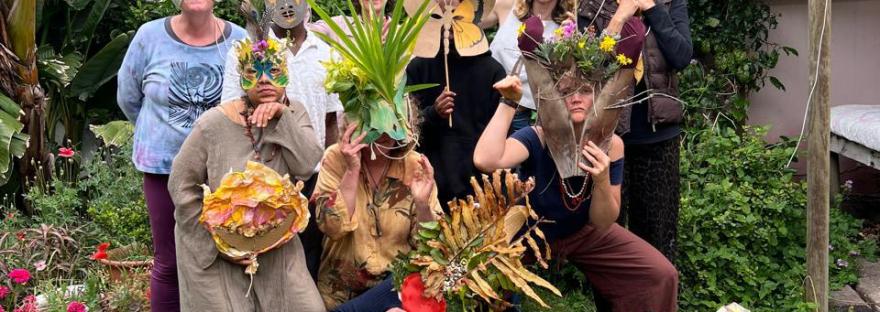
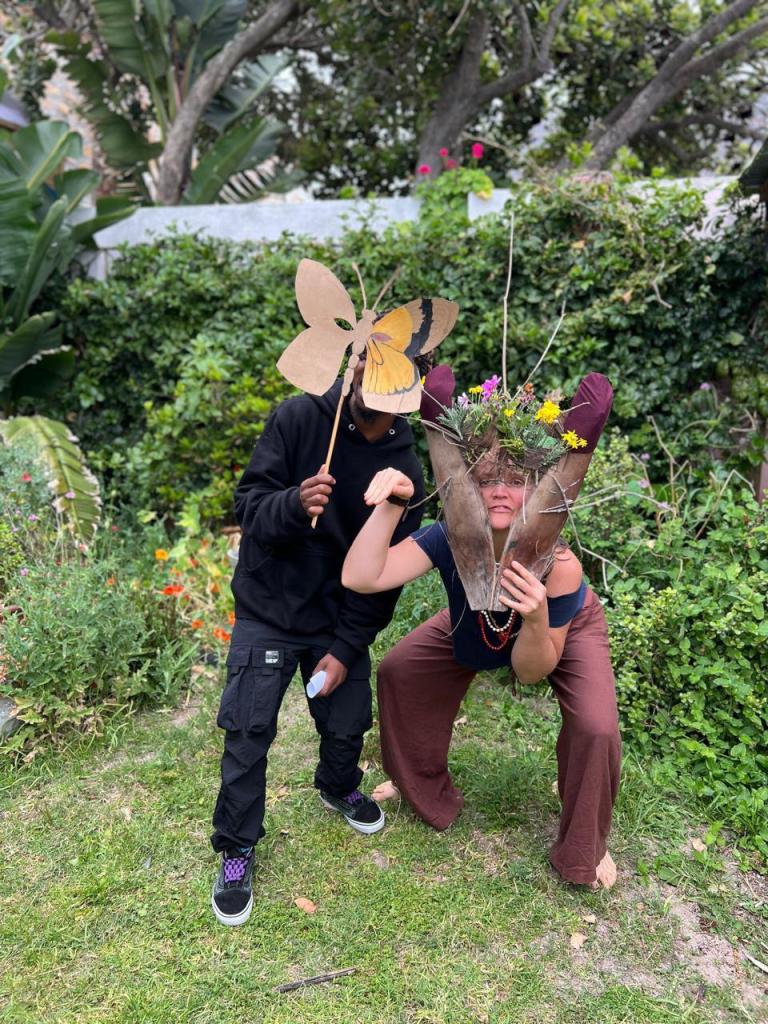
Last month, Angela MacPherson opened her studios and invited a diverse group of activists from the Cape Town area, many of whom were offered sponsorship, to participate in a Council of all Beings. This was an idea that had originated from a conversation between Angela and Erin Cowie, and I had the honour to be able to co-facilitate with them. After many enlightening conversations, the juicy emergent type that happen when working in collaboration, we designed a format that meandered on a local walk through three different venues.
First, the Muizenberg Park, which volunteers planted and tended around us, we practiced some connection with each other and with the land, supported by Brown’s words and song. This is where we were chosen by another life form, in the still (unusually so!) springtime weather that invites so much birdsong and insect life, following the process developed by Joanna Macy and John Seed. Then we visited the MacFabulous studio where Angela offered her space to create and play with many materials, producing a mask that we then carried to the third venue, the beautiful Samhitakasha cob house, where Erin led the Council itself, the more than humans spoke, and the beings listened.
A powerful day together indeed. Much healing to the land and the beings that we were chosen by. In gratitude.
Should you wish to hold a Council of All Brings on your land or with your community, please contact Joanna Tomkins
I extend my excited congratulations to the 3 members of the first “cohort’ that I have been mentoring over a period of 12 months. These facilitators work in different areas of the Great Turning, experienced in their own particular fields of work and they had in common that they had all experienced their a-ha! moment with the WTR.
I acted as an accountability partner and guided their self training. I also invited them to co-facilitate workshops with Gaia Speaking so that they could get the hands on experience that is required to register as a facilitator. The Work that Reconnects self training is “open source”: based on free and accessible resources and materials.
Please get in touch if you work in Southern Africa and are interested in receiving more information about the 2026 cohort plans.
Erin Cowie, the Green Queen
What attracted you to the WTR when you first encountered it?
I first heard about The Work That Reconnects on a podcast where Joanna Macy was being interviewed. I was blown away by her grounded and calm words, her deep compassion and her wisdom. She said “everything is alive” and shared how our culture is extractive because we see the beings of the natural world mostly as dead or inert resources to plunder. She said that when you begin to see the world around you as alive, as a living, breathing web of interconnectedness, everything changes. This was a huge aha! moment for me. I had long been interested in finding ways to live in the world that are less extractive and more compassionate. For years I had been exploring permaculture, regenerative agriculture, yoga, slow living, thrifting, recycling, natural building and many other “alternative” modalities and perspectives. Hearing Joanna’s words felt like a homecoming. The Work gave me a language and a framework that validated and helped me to voice some really big feelings that I had been feeling about the world for a long time.
How will you use the WTR in the work that you do?
I have been bringing WTR rituals into my own unique offering, called Wild Immersion, which I run regularly in my local area. I would love to facilitate more Truth Mandalas as I have found these to be incredibly welcome and meaningful for my local community. It seems that the humans around me are thirsty for this kind of nourishment and I look forward to offering it as a way to bring healing and re-rooting my community of humans back into the Earth. I would love to bring some of the concepts and practices of WTR into my work with FynbosLIFE as a locally indigenous landscaper, to enliven my clients’ perspectives as we create wild gardens that support biodiversity. I am interested in learning more about anti-oppression in order to support the unfolding of a unique South African flavour of WTR. I am inspired to bring WTR into the corporate world and also to explore WTR through the body, using movement, dance & sensuality.
What attracted you to the Work that Reconnects when you first encountered it?
My first impression of the WTR with its deep spiral is how perfectly aligned it is with the work that I do in conservation. In the formative years of my NGO, I walked around with my eyes on the ground, constantly scanning the environment for plastic, until I finally reached a place of eco-despair. What I love about the Work that Reconnects is understanding that from the grief comes the potential to shift and that seeing the world with new eyes can lead to a more empowering vision in which we can create hope through our actions. I now walk with my chin up in the knowledge and peace that if I do my bit to rebuild a life sustaining society, it is enough.
How will you use the WTR in the work that you do?
Ocean Pledge is about growing a network of youth ambassadors to be the spokespeople for the oceans. To nurture that powerful voice, it is crucial that we speak from the heart. Until recently, my students speak as if it is a school oral rather than coming from a place of passion. So, introducing the WTR enables us to really tap into the fear, uncertainties and emotions that the youth are holding, It creates a deeply honest space that builds trust and enables our youth to tap into their centres of power more effectively. There are so many opportunities to adapt this powerful work to our South African context and it has been stimulating and thought provoking to gauge how to do this best.
What attracted you to the Work that Reconnects when you first encountered it?
I first encountered the principles of the Work That Reconnects on a workshop that included lots of embodied movement, and so from the first I was aware that it was a set of ideas that could be deeply applied, experienced and practised. Subsequently I attended many of Joanna and Rachel’s song circles which likewise bring the principles to life through artistic and ceremonial experience. I felt from the beginning that it was one of the most “real” processes I had been part of: facing our reality with honesty, but not stopping there. That’s the beauty of the spiral: it makes sure we don’t avoid the difficult feelings about the mess our world is in, while at the same time the continual movement through it builds heart-based resilience. This then support us in aligning with the Great Turning.
How will you use the WTR in the work that you do?
In the processes I run, I do intend to use the principles as a powerful guiding framework, while also encouraging participants to express themselves in ceremonies that include artistic modes – such as music, movement, poetry and theatre. I look forward to working with many kinds of group, including teenagers who are my main work focus at the moment.
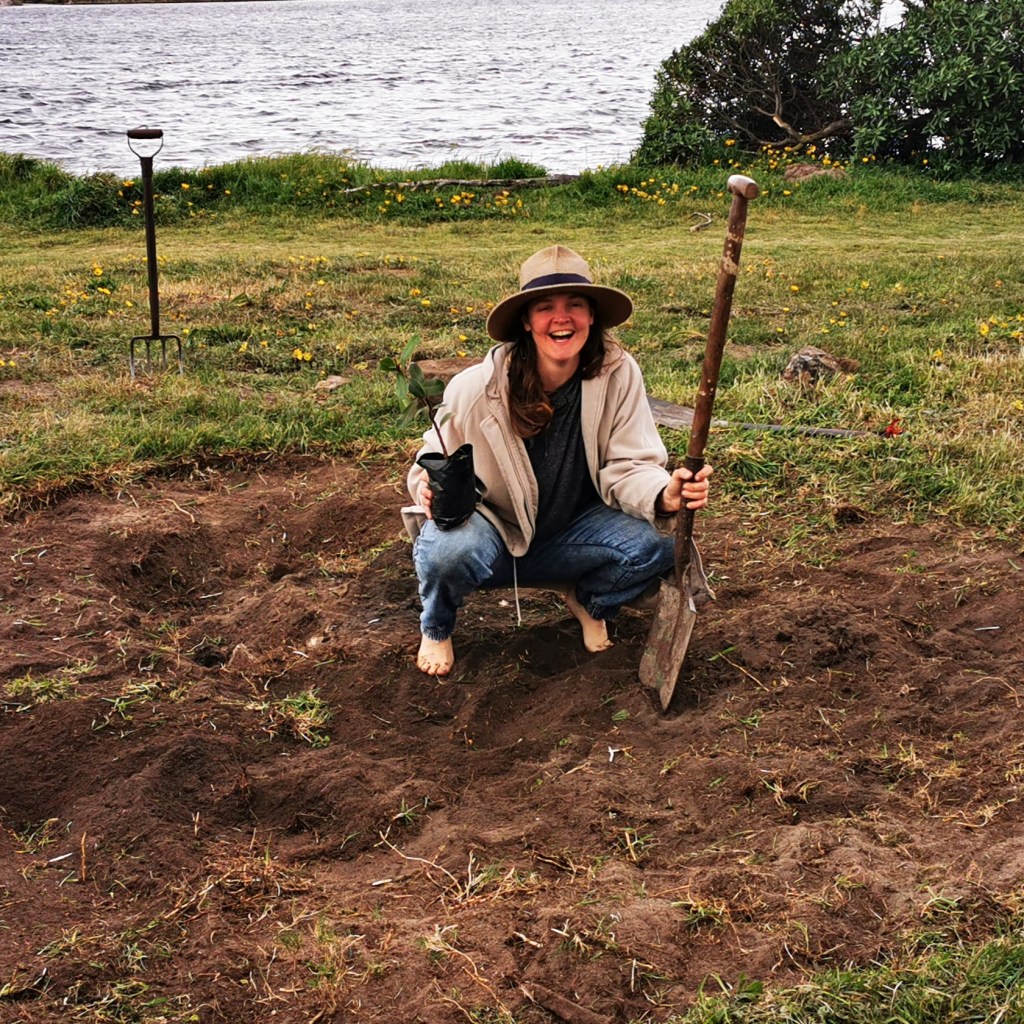
Last week, I was in Sedgefield, Western Cape, as facilitator and participant of the festival Ecolution. A small intimate festival celebrating our connection to the local environment. The festival focuses in particular on the wildlife corridors though the Well Being Sanctuary Land, in connection to wider Garden Route areas. Therefore, amidst other activities of dance, live music, drumming, talks and swims… we planted about 1000 trees, introducing more indigenous species and allowing the emergence and regeneration of ecosystems, in turn rewilding safe and natural passage for more-than-human beings.
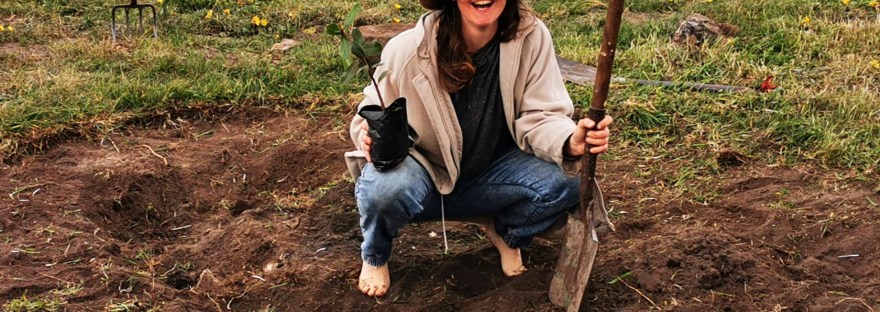
Hereunder I reproduce a post by Mariette Carstens, the custodian of the land… And is a photo of her with her fellow being of the collective yellowwood.
I feel very emotional about this post!
It has taken me a few days just to land with and integrate the magic that folded here at Ecolution Festival 2025
This weekend, something extraordinary happened in my life and Well-Being Sanctuary.
Together—with children, elders, dreamers, and doers—we planted 1,000 trees across our sacred sand dune. The first day, 700 trees found their home in pre-dug beds of possibility. The second day, we dug and planted 300 more, each one a prayer for the earth, a promise to the future.
We did this as part of the Ecolution Project, expanding the wildlife corridor that runs through our land—linking Sedgefield and moving towards Keurbooms River, all the way to Addo Elephant Park. Imagine that… a living bridge for birds and all wild beings to roam freely once more.
This was not just reforestation. It was restoration. Celebration. Collaboration.
With deep gratitude, I want to thank:
Butterfly Foundation – you are doing incredible work accross the world. We will continue next week as the South Africa Nomads join us with Travelbase to plant even more trees. This is conscious traveling.
Antony Stone, The Rondevlei Learning Centre and Kula Malika, and the Swartvlei community—for standing with us in this vision.
And to the children of ALL AGES—who laughed, dug, danced, and planted with muddy hands and shining eyes—you are the heartbeat of this movement.
Here’s to joy, to soil, to sacred action.
“To plant a tree is to believe in tomorrow. It is to place hope in the hands of time and trust that love will grow roots.”
My is full
My partner and co-faciltator Simric Yarrow and I inaugurated a Spiral ‘playshop’ including different drama games to embody the Four Stages of the Spiral – Gratittude, Honouring our Pain for the World, Seeing with New and Ancient Eyes and Going Forth-. Again, as with previous new formats we experiences that ritual, coupled with embodied practices AND what has been called ‘Eco-poetic’ languages can intensify reconnection and understanding on more-than-intellect levels… body intelligence at work, fun and pleasure too.
Looking forward to next year’s Festival and look forward to seeing you there too.
“Arguably the greatest interview of our time with one of the wisest women of our time. Heartbreakingly inspiring, practical and transcendental, transformative words that Joanna Macy has conjoined so beautifully in her life and work.”
— Paul Hawken, author of Natural Capitalism
Joanna Macy and the Great Turning is a short film in which Joanna shares her understanding of these times we live in, when everything we treasure seems to be at risk. The film has screened at film festivals around the world and was featured in the PBS series Natural Heroes.
This is not a film about despair but one about the opportunity we have to come alive to our truest power, to “look straight into the face of our time, which is the biggest gift we can give,” and to participate in the Great Turning.
What is the Great Turning? It is, as Joanna describes it, the shift from the industrial growth society to a life-sustaining civilization. It is, she believes, the third major revolution of human existence, after the agricultural and industrial revolutions. This one, though, has to unfold much more quickly. The good news is that it is, all around the world.
“The most remarkable feature of this historical moment on Earth,” says Joanna, “Is not that we are on the way to destroying the world — we’ve actually been on the way for quite a while. It is that we are beginning to wake up, as from a millennia-long sleep, to a whole new relationship to our world, to ourselves and each other.”
This is a thoughtful, and ultimately hopeful, film for anyone concerned about the future of life on the planet.
“We imagine they’ll look back at us,” Joanna says, referring to future generations, “Living in these early years of the third millennium, and say, ‘Oh, those ancestors. They were taking part in the Great Turning.’”
Tara Brach, author of Radical Acceptance, says, “This beautiful, wise and evocative film captures the crisis and possibility of our times. The Great Turning is a global awakening to the dis-ease of our planet, our love of life and the revolution that can heal our world. Please watch this, share with all you know, and allow the inspiration and hope to fill your heart. “
ABOUT JOANNA MACY
Eco-philosopher Joanna Macy, PhD is a scholar of Buddhism, general systems theory, and deep ecology. A respected voice in the movements for peace, justice, and ecology, she interweaves her scholarship with five decades of activism. As the root teacher of the Work That Reconnects, she has created a ground-breaking theoretical framework for personal and social change, as well as a powerful workshop methodology for its application.
Many thousands of people around the world have participated in Joanna’s workshops and trainings. Her group methods have been adopted and adapted widely in classrooms, congregations, and grassroots organizing. Her work helps people transform despair and apathy, in the face of overwhelming social and ecological crises, into constructive, collaborative action. It brings a new way of seeing the world, as our larger living body, freeing us from the assumptions and attitudes that now threaten the continuity of life on Earth.
Joanna Macy has inspired thousands of people around the world who teach others about the Great Turning. You can find a lot of great resources at Joanna’s website, including all her books, and connect with others on The Work That Reconnects Facebook page.
HOW TO WATCH
Individuals and small groups can watch the film for free below. Institutions can purchase the film through the The Video Project. Questions about film festivals, streaming, and other uses can be sent to Chris Landry.
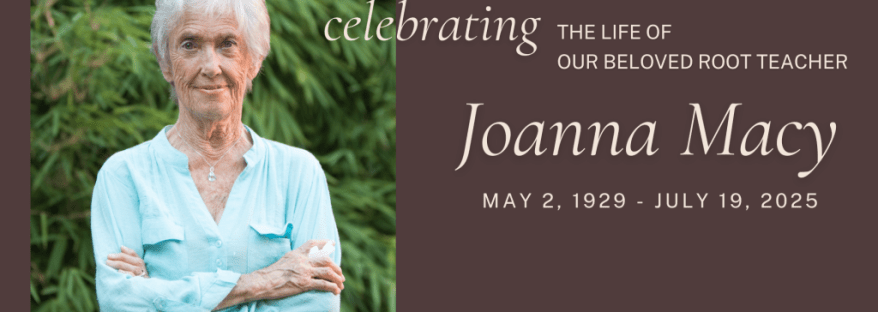
Last month, on 23rd August I had the pleasure to hear more heartfelt stories – and the song below – from some of Joanna Macy’s closest friends and family, in a public remembrance hosted by the Purpose Guide Institute online.
I invite you to have a new look at the In Memoriam page of the Work that Reconnects to read more testimonies and discover or learn more about the founder of the WTR. https://workthatreconnects.org/joanna-macy-in-memoriam/
It felt intimate and generous to learn more about her from those who knew her most and it also held testimony of the impact of her teachings on everyone.
Far from being as grand as the Dalai Lama, or as austere as her friend Thich Naht Hahn was, she was down to Earth and honest with all her feelings, extremely passionate and not shy of her crazy (we all have it though some of us hide it, right?:-)). Those of us who spiral the Work that Reconnects and who knew her direct or indirectly have laughed and cried at her intense capacity to intensely love every being on the Earth, not always in a ‘nice’ way, but always generously.
I am becoming suspicious of guru figures, especially as I am worried lately about the danger oI am quite suspicious of guru figures, especially as I am worried lately about the danger of ‘spiritual bypassing’ taking the focus away from the pressing calls of ecocide. We are most adept nowadays to follow the Western dominant culture and therefore to busily create new solutions that may often themselves become part of the problem, following the same old ‘business as usual’ growth patterns. We need to continually remember to question why we do what we do, and honestly think what we can do differently, each step of the way in this Great Turning we share.
Joanna Macy, though famous, felt like a simple channel of honest, fierce love. She expressed Life through her own powerful heart-mind and her wise words, yet at the same time she had lost attachment to her body and to her own beliefs, swimming skilfully in what she called “the collective moral imagination”.
I have only met Joanna Macy once in person in a break out room and in those few minutes I felt that she could ‘read’ through me. I think she could read love in all its colours, in all its textures and all its manifestations. She could decipher love when present in humans or ‘more than humans’, either in a leaf, or in a song. She could also detect love in the pain that it causes and not only its joys. From the darkest night of the soul, Joanna Macy would be able to bring back the gold. And that is why she said she was sad to leave us – although sometimes she felt like humanity was the captain of a “sinking ship”- for she would have loved (wholeheartedly, with both grief and awe) to be a part of the next chapter of humanity’s adventure, as uncertain as the outcome may be.
We hosted a Song that Reconnects Circle in remembrance of Joanna last month on 12th August in Glencairn. It was as always very connecting to open our hearts and voices simulteneously. And this time was specially moving, as we scattered quotes extracted from some of Joanna’s books: World as Lover, World as Self, Widening Circles, Coming Back to Life, Active Hope. I am sharing them hereunder, for your reflection.
These gatherings online and in person, and all the readings I have done lately as I delve into fresh archival memories, have reminded me yet again – as does the writing of this WTR newsletter loyally each month – how affirmed I feel by the depth and the reach of this moving body of work and the people who work it. As diverse as are the constituents of the beloved moving body of Earth. Always looking for ways to reconnect life, to reconnect to life.
by Joanna Tomkins
QUOTES BY JOANNA MACY: (read during Songs that Reconnect, 12th August 2025, Glencairn, Cape Town)
“Gratitude for the gift of life is the primary wellspring of all religions, the hallmark of the mystic, the source of all true art…. It is a privilege to be alive in this time when we can choose to take part in the self-healing of our world.”:
“In the face of impermanence and death, it takes courage to love the things of this world and to believe that praising them is our noblest calling.”
“Gratitude is liberating. It is subversive. It helps us to realize that we are sufficient, and that realization frees us.”
“Your pain is the breaking of the shell that encloses your understanding… could you keep your heart in wonder at the daily miracles… your pain would not seem less wondrous than your joy.”
“it is ok for our hearts to be broken over the world. What else are hearts for? There’s great intelligence in that’.
“Truth-telling is like oxygen. It enlivens us. Without it we grow confused and numb. It is also a homecoming, bringing us back to powerful connections’
‘The heart that breaks open can contain whole universe..’
“To see all life as holy rescues us from loneliness and the sense of futility that comes with isolation. The sacred becomes part of every encounter when you open to it and let it receive your full attention.” – in World as Lover, World as Self
“O you who will walk this Earth when we are gone, stir us awake. Behold through our eyes the beauty of this world. Let us feel your breath in our lungs, your cry in our throat. Let us see you in the poor, the homeless, the sick.
Haunt us with your hunger, hound us with your claims, that we may honor the life that links us.
You have as yet no faces we can see, no names we can say. But we need only hold you in our mind, and you teach us patience. You attune us to measures of time where healing can happen, where soil and souls can mend.
You reveal courage within us we had not suspected, love we had not owned.
O you who come after, help us remember: we are your ancestors. Fill us with gladness for the work that must be done.”
— inWidening Circles
“The future is not in front of us, it’s within us.”
“By inviting in these experiences of interconnectedness we can enhance our sense of belonging to our world. This mode of being widens and deepens our sense of who we are.”
“You don’t need to do everything. Do what calls your heart; effective action comes from love. It is unstoppable, and it is enough.”
“If the world is to be healed through human efforts, I am convinced it will be by ordinary people, people whose love for this life is even greater than their fear.”
Joanna Rogers Macy leaves a legacy that will long continue to inform and energize both the work of healing the world from the frenzy of industrialized capitalism, and the complementary movements to come home to the true nature of our being. For, as she would say, we are embedded in the web of life.
From the late 1970’s, in her early mid-life on, Joanna devoted much of her energy to the development and dissemination of the body of work that became known as the Work That Reconnects. Working with colleagues throughout the world, and with the steady support of her husband Fran Macy, this work was enriched by her many related passions: the Sarvodaya movement for peace in Sri Lanka, whose efforts she and Fran ardently supported; the cultivation and connection with her teachers in the Tibetan Buddhist tradition, from which root concepts of the Work That Reconnects arose; and her work with nuclear guardianship, for she felt in her bones the call of the future beings to muster all of our wits for the protection of the web of life.
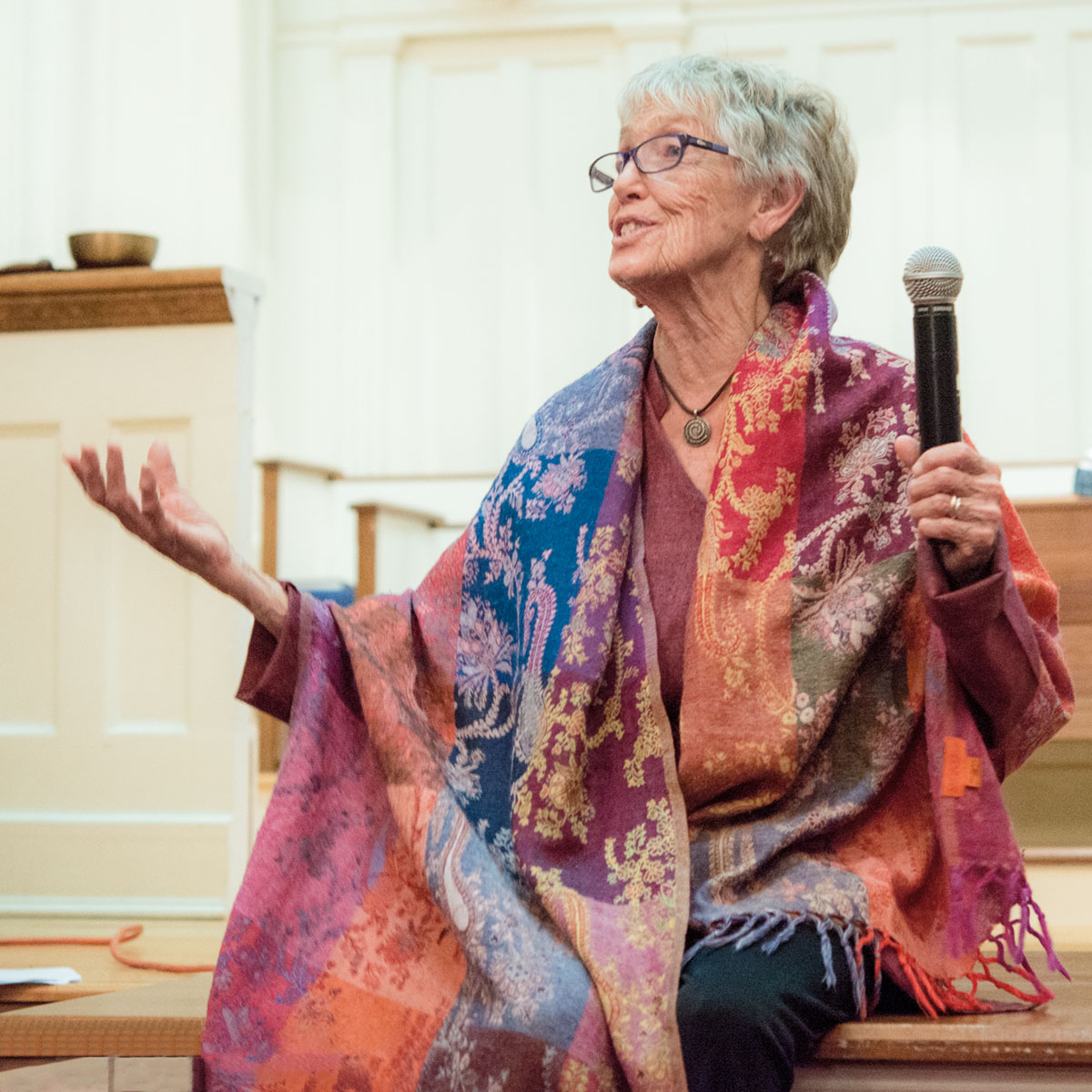
Joanna Macy teaching at Marlboro, Image: Joan Beard
At the height of the “cold war” in the 1970s, after her own awakening to the dangers of nuclear power in particular, Joanna made a discovery: when a group of concerned people spoke to each other their fears, their terror, and even their despair, a spirit of connection arose in the group, and a clarity of focus and release of energy fueled strategic planning and action. Others were making this same discovery (psychologist Chellis Glendinning in particular was an early collaborator). The resulting “despair work,” with its “despair and empowerment workshops,” countervailed the numbing of terror and overwhelm, and the forces of the military/industrial growth culture which would have us live out our lives entirely within its story of fear and domination.
Joanna was a great storyteller. She had us in the palm of her hand, and we knew ourselves as our larger selves when she told of the Shambhala Warriors (surely we were meant to be warriors too; indeed, surely we had been secret warriors all along, preparing for our turns in the halls of power).
Joanna had a special connection with young people, whose passion, creativity and freedom of expression fueled her own inspiration and stamina.
Joanna loved to have a good time. Playfulness and its twin, imagination, infuse the Work That Reconnects. She poured her passion into the work, and as a result her many collaborator-friends formed among themselves a vibrant network of love.
She leaves us a toolkit – the Spiral of the Work That Reconnects and the fundamental framing and practices and stories that make the body of work what it is. The practices and stories keep evolving and changing, responding to one moment and helping to create the next in this work of the Great Turning.
For the many thousands of us who carry on and continue to develop the Work That Reconnects – this gift of the shared journey from despair to connection, empowerment, and action – Joanna Macy leaves us her particular inspiration of a robust fearlessness, and perseverance fueled by love.
Get to know this essential publication, in times where we seem to be sliding further away from some of these basic principles, instead of finding the solutions of alignment within ourselves and our communities. – Gaia Speaking
Preamble by Earthcharter.org
We stand at a critical moment in Earth’s history, a time when humanity must choose its future. As the world becomes increasingly interdependent and fragile, the future at once holds great peril and great promise. To move forward we must recognize that in the midst of a magnificent diversity of cultures and life forms we are one human family and one Earth community with a common destiny. We must join together to bring forth a sustainable global society founded on respect for nature, universal human rights, economic justice, and a culture of peace. Towards this end, it is imperative that we, the peoples of Earth, declare our responsibility to one another, to the greater community of life, and to future generations.
Earth, Our Home
Humanity is part of a vast evolving universe. Earth, our home, is alive with a unique community of life. The forces of nature make existence a demanding and uncertain adventure, but Earth has provided the conditions essential to life’s evolution. The resilience of the community of life and the well-being of humanity depend upon preserving a healthy biosphere with all its ecological systems, a rich variety of plants and animals, fertile soils, pure waters, and clean air. The global environment with its finite resources is a common concern of all peoples. The protection of Earth’s vitality, diversity, and beauty is a sacred trust.
The Global Situation
The dominant patterns of production and consumption are causing environmental devastation, the depletion of resources, and a massive extinction of species. Communities are being undermined. The benefits of development are not shared equitably and the gap between rich and poor is widening. Injustice, poverty, ignorance, and violent conflict are widespread and the cause of great suffering. An unprecedented rise in human population has overburdened ecological and social systems. The foundations of global security are threatened. These trends are perilous—but not inevitable.
The Challenges Ahead
The choice is ours: form a global partnership to care for Earth and one another or risk the destruction of ourselves and the diversity of life. Fundamental changes are needed in our values, institutions, and ways of living. We must realize that when basic needs have been met, human development is primarily about being more, not having more. We have the knowledge and technology to provide for all and to reduce our impacts on the environment. The emergence of a global civil society is creating new opportunities to build a democratic and humane world. Our environmental, economic, political, social, and spiritual challenges are interconnected, and together we can forge inclusive solutions.
Universal Responsibility
To realize these aspirations, we must decide to live with a sense of universal responsibility, identifying ourselves with the whole Earth community as well as our local communities. We are at once citizens of different nations and of one world in which the local and global are linked. Everyone shares responsibility for the present and future well-being of the human family and the larger living world. The spirit of human solidarity and kinship with all life is strengthened when we live with reverence for the mystery of being, gratitude for the gift of life, and humility regarding the human place in nature.
We urgently need a shared vision of basic values to provide an ethical foundation for the emerging world community. Therefore, together in hope we affirm the following interdependent principles for a sustainable way of life as a common standard by which the conduct of all individuals, organizations, businesses, governments, and transnational institutions is to be guided and assessed.
Click below to continue reading the Earth CharterFour Pillars, each with 4 chapters, equalling 16 principles in total.
ByBradley van Sitters, originally posted on the Universty of Cape Town Humanities Archive website, on August 2, 2012
Changing the names of places is nothing new. But what has become interesting is how some place names still reveal aboriginal origins in spite of colonial onslaughts. Examples include, México, named after the Mexica, and Quebec from Mãkmaq (képk) meaning “strait, narrows”. Many places in Australian have officially been named after Aboriginal people or language groups, such as Aranda or Tullamarine.
It is possible to revert to old names in places where oral history has been kept of the knowledge of the pre-colonial names. Oral history is not myths, chitchat, idle talk, or fairy tales, but rather the orderly collection of living people’s testimony about their own experiences. Khoi-San names of places are amongst the oldest in the country and even the world. Archaeological findings indicate that modern humans have inhabited Southern Africa for at least 170,000 years; with the Khoi-San’s history spanning as far back as the Later Stone Age, from about 40,000 years ago. They are thought to be the earliest-diverging human group showing the largest genetic diversity in matrilineally transmitted mtDNA of all human populations, and represent a group that has preserved the original human lifestyle along with genetics.
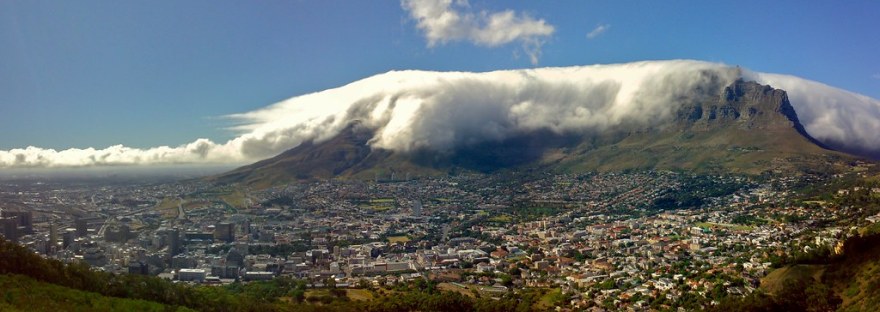
Mounting evidence suggests that early human communities lived in sight of Table Mountain. The study of names these communities gave to places thus constitutes an important contribution to the cultural and linguistic history of the entire population of the country. Giving names to places is an activity exclusive to humans and as such name-giving is part of the history of the human race spanning over millennia. Having command of language allowed humans to give names; and place names are, therefore, obviously in terms of time and space also related to the particular people from whose language they derive.
By means of word of mouth, oral history was the first kind of recording the past. Names of places are an important aspect of oral history as they become carriers of the past, allowing us a glimpse into occurrences in the past that history books often may have failed to mention. Over time the tip of Africa was well visited with devastating effects on the Khoi-San who were often displaced, conquered, absorbed and assimilated at the hands of migrating Africans on foot from the north around 300 AD and, later, Europeans arriving by sea.
Places have layer upon layer of history which often are capsulated in the names given to them over time. The case of Cape Town makes for an interesting study, as the memory of the Khoikhoi name //Hui !Gaeb had been forgotten in the place itself.
The many names of Cape Town warrant mentioning. On account of tremendous storms encountered on the high seas, Bartolomeu Dias, in 1487, called it, Cabo Tormentosa (Cape of Storms). In the hope of finding a sea route to India, King John II of Portugal in 1488, named it, Cabo de Boa Esperanza (Cape of Good Hope), a name that remained until 1686 when it was called Cabo de Goede Hoop by the Dutch. Antonio de Saldanha in 1503 was the first European to climb Huri àoaxa (Hoerikwagga) and for this feat he named it Taboa do Cabo (Table Mountain) and even had the bay called Aguada de Antonio de Saldanha (Watering place of Antonio de Saldanha). Dutch Captain Joris van Spilbergen in 1601 changed the name of Saldanha Bay to Table Bay. The first colonists were also known as Cabo or De Caab, an identity that seemingly started to develop around the new found colony. As the settlement took shape it developed into the establishment of a town around its harbour and by 1700 was named Kaap Stad. The earliest known English name in the country is ‘Chapman’s Chance’ later known as Chapman’s Peak and with the English take-overs in 1795 and again in 1806, Cape Town got its name, which still stands today.
Having evolved over thousands of years, indigenous names of places derived from aboriginal languages, and the cultures which they transmit. As arbitrary verbal symbols, by which a group converses, interrelates and self-articulates, languages preserve the mysteries, customs, and traditions of the people. It’s more than just preserving things of yesteryear; it involves maintaining bodies of knowledge, and beliefs.
Place names are never just meaningless sounds. Rather, they embody stories about the places to which they are attached. They give us valuable insights into history and provide clues about South Africa’s cultural and social development. In a manner of speaking, place names are the table of contents of the country’s history of customs and traditions often long forgotten. Accounts of Khoi-San place names that have been replaced by other names are numerous. Some of these names were only known to the early travellers while others existed alongside new names until they eventually became forgotten.
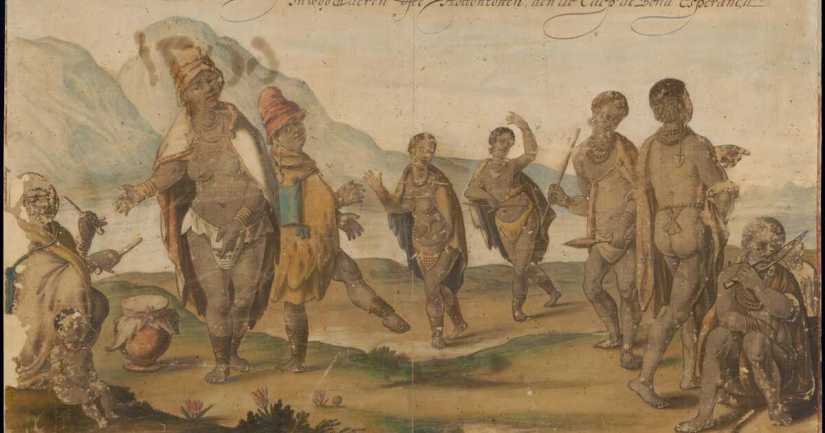
Today, the historical view of the Khoikhoi and Bushman as the Cape aboriginal inhabitants has always been through ‘European’ eyes. Oral tradition is lacking especially in the Western Cape. No qualified linguist was able to study the languages of the people at the Cape before these languages disappeared. But some early travellers and settlers did collect word lists. The Cape Khoikhoi spoke a dialect of Khoekhoegowab (Khoikhoi-language) akin to Nama, Griqua and !Korana, the dialects spoken on the west coast and along the Orange River, a language also spoken today by Khoe-speaking Bushman of South Africa, Botswana and Namibia.
With a few exceptions, it took Europeans almost 400 hundred years, from Bartolomeu Dias up until 1870-1880, to show special interest in Khoi-San languages, with the /Xam and !Khun interviews and narratives by Lucy Lloyd and Wilhelm Bleek. Vasco da Gama penned this disinterest in 1497 by commenting, “small in stature, ugly of face, and when they speak it seems as if they hiccup.” Cornelis de Houtman in 1595 further illustrated this linguistic disinterest by writing, “I could learn no more from them but that they speak very clumsily” Edward Terry in 1616 implied animal (bird)-like sounds, saying, “… their speech it seemed to us inarticulate noise, rather than language, like the clucking of hens, or the gabbling of turkeys…”
The Khoi-San gave names to places throughout the country to identify the land they knew and with which they had a strong spiritual connection. Many of these names still survive today; to mention a few, !Huni //hÄb for Johannesburg, //Khara hais for Upington, Gádaos for Goodhouse, Kai mãs for Keimoes… The place names themselves, at times, have been taken over in more or less adapted form into the languages of the other people of the country as current linguistic items. Although the use of Khoi-San place names were substantially eroded by contact with Europeans, some traditional beliefs have been preserved through oral histories, and even some religious practices are still observed in remote areas of Botswana and Namibia.
It is with this particular interest that I followed the spoor of the earliest Khoikhoi migration routes away from the European occupation, leading me to the trek across the !Gariep (Orange river) to Khaxutsus (Gibeon), in Great Namaqualand, during 2008 at the 103rd Heroes Day Festival, also the 30th year of reign of the 8th /Khowese Nama King, Gaob //Gawamãma /ÃnÃb, Dr. Rev. Captain Hendrik Witbooi. Oral history, shared by Senior Chief P.S.M. Kooper of the Kai //Khaun of the Great Red Nation from !Hoaxa !nÃs, indicated that historic information passed down. The information suggested they left what we know today as Cape Town 17 generations ago when it was still called by its pre-colonial name, //Hui !Gaeb or //Hui !Gais in search for their own autonomous rule away from the Cape Colony. I later discovered a number of writings referring to this name as the pre-colonial name of the Cape.
Hottentot (Khoekhoen) Place Names by G.S. Nienaber and P.E. Raper, specify that the first person to record it as the name of Cape Town was the apostle of the Namas, Father J.H. Schmelen (1831), who married a Nama women. Later Dr. Theophilus Hahn stated in Tsuni //Goam (1881), “wherever the Khoikhoi tongue is spoken, //Hu !Gais is the name by which Cape Town is known” (p.34). This name consists of two words, //hãs which is an old word used for cloud and !gai meaning to bind, to surround, to tie, to envelop; consequently denoting “veiled in cloudsâ€. P.J. Nienaber in Dictionary of South African Place Names, highlights the use of //Hui !Geis, which didn’t entirely disappear out of existence, but was still in use by the Nama speakers in Namaqualand, as the Khoikhoi name for Cape Town.
Although Dutch settlers gave their own names to places, they also took note of the indigenous names of prominent geographical features such as mountains and rivers, which are the oldest names in South Africa. Such names include Bikamma (Melk River), Gantouw (Elandspad/ Sir Lowry’s Pass), Breé River (Synna), Nyara, Keiskamma, and Tsitsikamma.
Preserving and even reviving Southern African indigenous names of places is of importance to all Southern African people, whether they are themselves of indigenous origin or not, and to mankind as a whole. For times immemorial, these names, that described the natural features of the land or commemorated significant historical events, were passed from one generation to the next. Aboriginal place names contribute to South Africa’s rich tapestry of cultural landscaping. These names reflect the diverse history and heritage of the nation and many of our earliest place names draw on Khoi-San origins. Only over the last few hundred years did pre-colonial place names go out of use as conquered places became re-named to mark occupation. Retrieving oral memories is thus a task more pressing than ever, especially in this country still wounded by a legacy of discrimination because of race.
Biblioteca Medicea Laurenziana, historic library in Florence
Bradley is a world renowned indigenous southern African languages activist and community languages researcher. He is chair of the A/Xarra Languages Commission. Find out more here https://ibali.uct.ac.za/s/dialogical-archive/item/29356








 This weekend, something extraordinary happened in my life and
  Butterfly Foundation – you are doing incredible work accross the world. We will continue next week as the South Africa Nomads join us with Travelbase to plant even more trees. This is conscious traveling.
 “To plant a tree is to believe in tomorrow. It is to place hope in the hands of time and trust that love will grow roots.”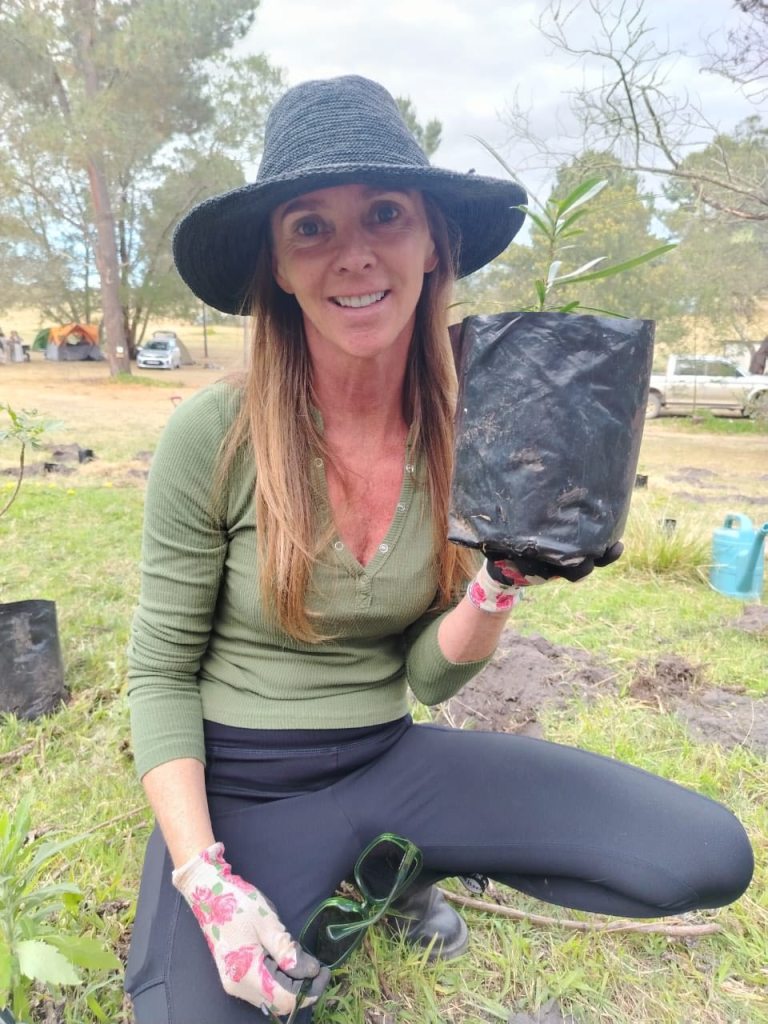







 Gaia Speaking