

by Nicola Lazenby, 25th March 2024
Everything about human life relies on story.
Our memories are stories about our past. Our dreams are stories we tell about our future. Our personalities are stories we tell about ourselves. There is no culture, nation, or religion without story. It’s one possible reason we have become the so-called dominant species on earth because it gave us the ability to cooperate in such large numbers.
It’s also true that children who read fiction show higher levels of empathy, bringing to life the quote from George R. R. Martin, “A reader lives a thousand lives before he dies… The man who never reads lives only one.”
One of the meanings of the word “story” is “storehouse”, a place where all our wisdom and knowing is stored, says mythologist and storyteller, Michael Meade. He explains that story is the place we always came when we had nowhere else to go.
Stories are at the heart of how we understand ourselves, our universe, and our place in it. As an English teacher in a previous life, I taught my students that learning how to wield story could change the course of their own narratives, protect them from the disempowering stories of others, and even change the world. Story shapes the possible options for how we might respond to our lives.
Is my life coming apart, or am I on a necessary journey down into the dark cave where I must face a shadowy thing with a more authentic treasure for me? Is the world ending, or has a thread from the great rug of the universe been pulled by a mischievous dog, leaving us with a tangle of yarn and a chance to re-weave the most beautiful tapestry yet?
Stories offer us a roadmap back to ourselves, especially in dark or confusing times. As narrative creatures, we yearn to find a meaningful story to which we can connect.
Meade puts it in his book, “Our job is not to comprehend or control everything, but to learn which story we are in and which of the many things calling out in the world is calling to us. Our job is to be fully alive in the life we have, to pick up the invisible thread of our own story and follow where it leads. Our job is to find the thread of our own dream and live it all the way to the end.”
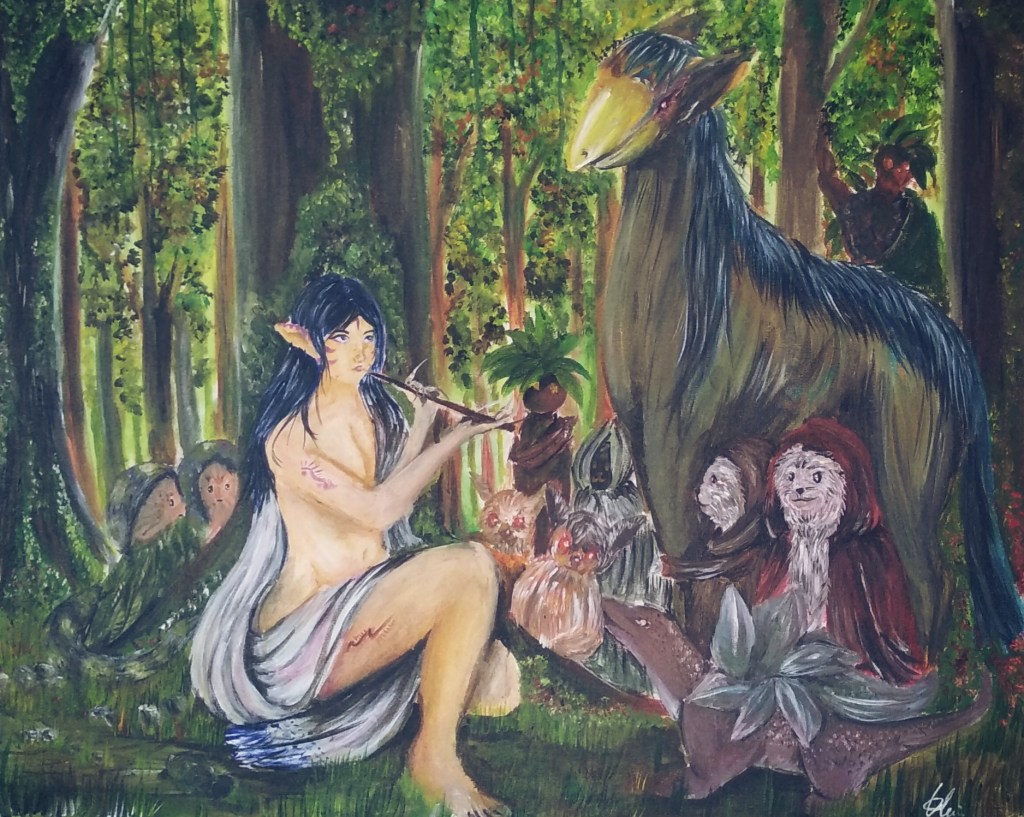
Artwork by Yoshiyuki Hitoshi
So much of my work sitting across from the people in my counselling room is helping them tell their story. Sometimes, they have never had anyone to listen to it, and it is a secret they have carried like a bleeding key around their necks. Sometimes, they have been told the wrong stories about themselves all their life, and are trying to find their way to that small cottage in the deep forest of their past, where a burning skull is about to light their way back home. Sometimes they are learning to let one story end, to wail and grieve, so that a silence can descend, into which a new story may someday speak.
In this way, a story is more than entertainment or distraction. It is the means of very real transformation.
This is why ancient myths were always attached to sacred rites and rituals, says Karen Armstrong, a former Catholic nun turned academic and author. The rituals would have separated us from mundane life, opened up a numinous space where the myth, facilitated by skilled priests and sacred players, could act upon us. Act as a means of communicating directly with the meaning of the universe, to what is timeless in human existence, and for that moment, “deeply touch us and lift us momentarily beyond ourselves… even in the face of death and despair”, and fundamentally alter us. She says that trying to read a myth or folktale without the accompanying ritual is like trying to learn how to drive a car by reading the driving manual.
Along with many others, I think, I still experience this when I go into a cinema or theatre, and watch a beautiful production. The remnants of ritual are still there in the dark cavernous room, in the collective witnessing, in the separation from the day-to-day. I feel changed when I emerge into the strange light of “real life” again, even if just for a moment. I feel it in the throngs of a crowd at a concert swept up in wordless musical narrative, or when I have sat like a secluded monk for days or weeks with a book and it does its work on me in ways I can only sense when I close it.
Perhaps our worship of actors and writers and musicians is an echo of the power of the story they wield on our behalf.
Perhaps that explains some of our modern addiction to the streaming and social media platforms where we can binge watch the story that is so integral to our species, where we can incessantly post our own stories as we yearn for connection to some kind of larger mythic meaning.
The pervasive modern human story lacks interest and meaning. It encourages materialism, excess, cruelty, consumerism, isolation, colonialism, anthropocentrism, and is destroying our home. It is so understandable that we should be so addicted, so unwell, so lonely and anxious and full of conflict if we do not have a meaningful story that we can feel personally connected to.
We need a new story.
And like many of the mythopoetic thinkers, I believe that the old stories might offer us clues as to the way forward (or is it back?) not just in our own individual lives, but as a collective. Story is one of our oldest medicines.
What is the story you are in? Have you heard the call to personal adventure, that rattles in your car on your way to work, or causes the burnout that lays you low with chronic pain, or ends the relationship you never thought you would lose? Have you already crossed the threshold into the in-between, where you are being tested by your demons while you try to start a new way? Who are the unexpected helpers that solve the riddle, or know the secret door, and who is the one who comes to you as a wise mentor? Are you in the underworld of suicide, inconceivable loss, false selves or secrets, fighting for the life you cannot yet name, that is yet to be born? What is the treasure hidden deep within you, that the dragon slumbers on, that you will return with as a gift for your community and the world when this is all over?
May you see in the wild the wild in you.
Nicola Lazenby is a registered counsellor and eco-therapist. See Nicola Lazenby’s website to read more about her gifts to the Great Turning, including wilderness immersions, writing workshops, ritual and ceremony…

 Gaia Speaking