
Art connects us to the Sacred. Sacred like a deep conscious in-breath. Like the lull between words or pauses to dig our hands in the soil. It slows us down—down to the core of the heartbeat, sparing time to see the sensuous colours of autumn leaves, to take in the patience of trees… And it also depicts the nuances of our story better than most classic dialectic born of the human brain!
Yet, whilst I invent ceramic sculptures in my studio, I often wonder about the relevance of plastic arts in the midst of this helpless, dramatic anthropocene of ours. Why use more materials and energy to produce and sell more objects? Am I not just adding weight to our fierce and fast capitalistic economy and depleting more resources?

I also ponder on the harmful twists given over time to the gift of human creativity. After all it’s got us here now, and can’t seem to get us out, can it?
Named “Trimurti”, the Hindu holy trinity of Brahma, Vishnu and Shiva represents creation, preservation and destruction and is said to govern the world inexorably, consequently and simultaneously. In human embodied form though, our souls have misused the power of consciousness-fuelled creativity? Unlike other-than-humans who abidingly follow the rules of Mother Nature, we have transgressed the tacit contract of our role of guardians of the Sacred. We invented narcissistic and rebellious materialistic gods that separated us from Her and gradually entitled us to trade in our creativity for pernicious personal profit and to aggrandise a handful of two-legged, five-fingered beings. Free-willed creativity is what makes our species unique, and it also endows us with the responsibility to respond to the needs of wider Earth communities. Creativity helped us to design all the machines that our Business as Usual relies on now, drilling holes in the body of the Earth and sucking Her blood, and lately also enclosing us in isolated internet-driven, cement-walled physical and psychological traps or time capsules. Gaia’s Life is pending on a thread! And so what? I’m on to the next creation of mine…
The wisest pagan songs sing ” Hoof and Horn, All that dies shall be reborn. Corn and Grain, All that falls shall rise again…” Yet we cannot claim to slot in to the natural cycles of creation harmoniously or purposefully if we do not create mindfully. We cannot be excused by natural cycles of death and rebirth, if we do not take seriously the production in our lives.
And to make the control of our weaponised creativity even more complex now “As machines become more proficient at generating art, music, literature and solutions, we must reflect on the unique role of human intuition and experience in the creative process and explore the delicate balance between the advancements of AI and the irreplaceable nature of human creativity.” (Joseph Fowler, Head, Arts and Culture, World Economic). Well, there goes another strained train of though; we might want to park that one for now.
Back to the questioning of plastic art, and also applicable to poetry, fictional prose, performance, and even “creative solutions”, one answer may be that you cannot produce beauty with a more-is-better mentality. It just doesn’t hit the mystic spot. A tree cannot plan the majestic beauty of its outcome. It happens through it, connected to all the other beings that make up the forest and the knowledge that time does not belong to it. And when you buy a piece of art because it speaks to you – and not as a financial investment – you don’t follow the parameters of reason, you just fall in love and decide to surround yourself with something that has meaning for you. This something reminds you of a connection that is bigger than you. It may be a spiritual reminder, a piece of intimately familiar story-telling, a mirroring of your vision of nature, or a bonding to simple lines or angles, connecting to the strings that pull your own heart.
Creating something for the sake of beauty is a kind of meditation. In movement, in feminine flow with a masculine holding in the form. It’s the kind of meditation where you lose track of time and suddenly remember who you are. Where you feel the eternal essence of the materials under your fingertips, your grandmother humming in the background as you shape a line, or a bowl, or a prayer. There is no need to control your thoughts, She controls your thoughts in her becoming.
And then, sometimes, something extra happens. There’s this magic moment when the liminal sparks. A doorway opens, and suddenly you’re not just a person making something—you’re in deep conversation with Life itself. The boundaries blur. You feel yourself woven into a much wider web of interbeing. You are not separate. You are a thread in the great tapestry—co-creating, remembering, belonging. You’re not just on time; you’re in deep time. Held by all that came before, and all still to come.
Art is how we listen to what’s older than human language to praise our Mother. When our eros is aroused by the desire to birth beauty we have tools to give back to Gaia what we she gave us when she made us creative souls. In this reciprocal artistic exchange we take note and are inspired by the extraordinary images she displays in front of our retinas, and the miraculous, erotic, infinite experiences of Life unfolding that she gifts us.
“In a relationship, the narcissist asks, “How can I mine this relationship for my own benefit?” The lover asks, “How can I use my gifts to contribute to us.” Exploitative technology asks, “How can we extract as much as possible from the land, for our own ends?” Ecosexual technology asks, “How can we create greater wealth and harmony for people and land both?” Or, since the land wants to give, we might ask, “What is the dream of the land?” and on a planetary level, “What is the dream of Earth?”[…]” (Charles Eisenstein)
Art can be a ritual of remembering the Earth’s dream. A renewal of vows for a loving partnership, saying: This matters. You matter. I won’t look away.
So, perceiving and creating art can help us remember and move towards a more beautiful story for humanity—not by fixing it but by telling it differently, by engaging with Gaia in a different way. By reviving our erotic wild selves. By reconnecting us with what is timeless.
One verse, one pinch of clay, one slow, creative chapter at a time.
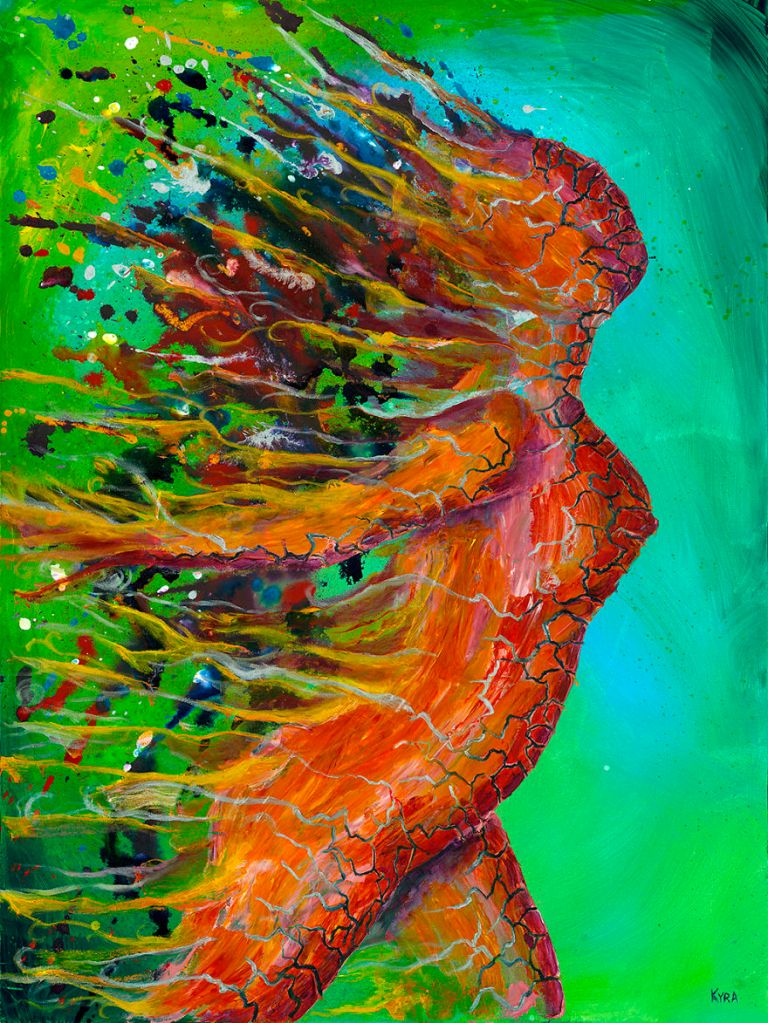
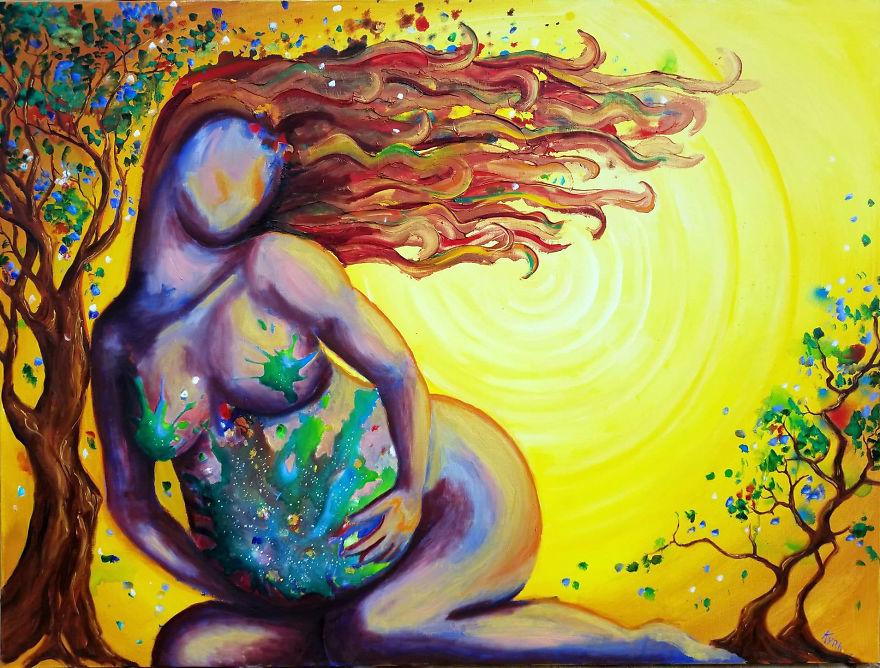
The two artworks on this page are by artist Kyra Coates: Breakthrough and The Most Common Miracle
WTR facilitator Joanna Tomkins creates a collection of handbuilt ceramic sculptures and ritual objects called Artwork that Reconnects, from her shared studio in Kommetjie, South Peninsula, Cape Town

 Gaia Speaking